#galaxyFormation

2025-11-15

Weekly Update from the Open Journal of Astrophysics – 15/11/2025

It’s Saturday again, so it’s time for the usual update of the week’s new papers at the Open Journal of Astrophysics. It has been quite a busy week. Since the last update we have published another seven papers, which brings the number in Volume 8 (2025) up to 175, and the total so far published by OJAp up to 410.

First on the menu for this week is “Dynamical friction and measurements of the splashback radius in galaxy clusters” by Talia M. O’Shea (U. Wisconsin-Madison, USA), Josh Borrow & Stephanie O’Neil (U. Pennsylvania, USA) and Mark Vogelsberger (MIT, USA). Published on Tuesday 11th November in the folder Cosmology and NonGalactic Astrophysics, this one presents a study suggesting that dynamical friction does not play a major role in reducing the radius of the splashback feature in real data compared to numerical simulations.

The overlay is here:

You can find the officially accepted version on arXiv here.

The Fediverse announcement is here:

Open Journal of Astrophysics

@OJ_Astro@fediscience.org

New Publication at the Open Journal of Astrophysics: "Dynamical friction and measurements of the splashback radius in galaxy clusters" by Talia M. O'Shea (U. Wisconsin-Madison, USA), Josh Borrow & Stephanie O'Neil (U. Pennsylvania, USA) and Mark Vogelsberger (MIT, USA)

doi.org/10.33232/001c.147125

November 11, 2025, 8:36 am 3 boosts 1 favorites


The second paper of the week is “Microlensing of lensed supernovae Zwicky & iPTF16geu: constraints on the lens galaxy mass slope and dark compact object fraction” by Nikki Arendse (Stockholm University, Sweden) and and international cast of 11 others based in Sweden, UK and France. This one was published on 11th November 2025 in the folder Astrophysics of Galaxies. It is about combining observations of two supernovae, iPTF16geu and SN Zwicky, with microlensing magnification maps to probe the properties of the lens galaxy.

The overlay is here:


You can find the official version of this one on arXiv here. The federated announcement on Mastodon is here:

Open Journal of Astrophysics

@OJ_Astro@fediscience.org

New Publication at the Open Journal of Astrophysics: "Microlensing of lensed supernovae Zwicky & iPTF16geu: constraints on the lens galaxy mass slope and dark compact object fraction" by Nikki Arendse (Stockholm University, Sweden) and 11 others based in Sweden, UK and France

doi.org/10.33232/001c.147126

November 11, 2025, 8:53 am 1 boosts 1 favorites


Next one up is “Neutrino Constraints on Black Hole Formation in M31” by Yudai Sawa (U. Tokyo, Japan) and 11 others all based in Japan. This was published on Tuesday 11th November in the folder High-Energy Astrophysical Phenomena. It presents a calculation of the neutrino emission expected from the collapse of massive stars and its use in constraining black hole formation using neutrino detectors.


The overlay is here:

You can find the official accepted version on arXiv here. The fediverse announcement is here:

Open Journal of Astrophysics

@OJ_Astro@fediscience.org

New Publication at the Open Journal of Astrophysics: "Neutrino Constraints on Black Hole Formation in M31" by Yudai Sawa (U. Tokyo, Japan) and 11 others all based in Japan

doi.org/10.33232/001c.147127

November 11, 2025, 9:04 am 0 boosts 1 favorites

The fourth paper this week is “Redshift Drift in Relativistic N-Body Simulations” by Alexander Oestreicher (U. Southern Denmark, DK), Chris Clarkson (QMUL, UK), Julian Adamek (U. Zürich, CH) and Sofie Marie Koksbang (U. Southern Denmark, DK). This one was published on Wednesday 12th November in the folder marked Cosmology and NonGalactic Astrophysics. It presents numerical calculations of the cosmological redshift drift effect for comparison with future surveys.

The overlay is here:


You can find the official published version on arXiv here. The Fediverse announcement follows:

Open Journal of Astrophysics

@OJ_Astro@fediscience.org

New Publication at the Open Journal of Astrophysics: "Redshift Drift in Relativistic N-Body Simulations" by Alexander Oestreicher (U. Southern Denmark, DK), Chris Clarkson (QMUL, UK), Julian Adamek (U. Zürich, CH) and Sofie Marie Koksbang (U. Southern Denmark, DK)

doi.org/10.33232/001c.147178

November 12, 2025, 8:35 am 1 boosts 0 favorites


The fifth paper for this week is “Attributing the point symmetric structure of core-collapse supernova remnant N132D to the jittering jets explosion mechanism” by Noam Soker (Technion, Haifa, Israel). This one, published on Wednesday November 12th in the folder High-Energy Astrophysical Phenomena, presents a discussion of the morphology of a supernova remnant and possible explanation for it in terms of the explosion mechanism.

The overlay is here:


The officially accepted version can be found on arXiv here. The Fediverse announcement is here:

Open Journal of Astrophysics

@OJ_Astro@fediscience.org

New Publication at the Open Journal of Astrophysics: "Attributing the point symmetric structure of core-collapse supernova remnant N132D to the jittering jets explosion mechanism" by Noam Soker (Technion, Haifa, Israel)

doi.org/10.33232/001c.147183

November 12, 2025, 8:46 am 1 boosts 0 favorites

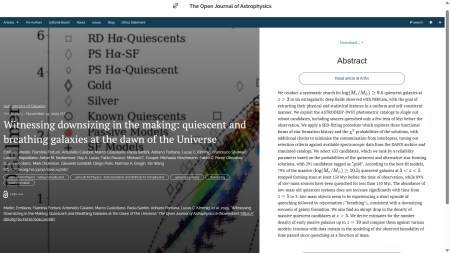
The sixth paper to report this week is “Witnessing downsizing in the making: quiescent and breathing galaxies at the dawn of the Universe” by Emiliano Merlin (Osservatorio Astronomico di Roma, Italy) and an international cast of 20 others based in Italy, Germany, UK, USA, Switzerland, Spain and China. This one was published on Friday November 14th in the folder Astrophysics of Galaxies.

You can find the officially-accepted version on arXiv here. The fediverse announcement is here:

Open Journal of Astrophysics

@OJ_Astro@fediscience.org

New Publication at the Open Journal of Astrophysics: "Witnessing downsizing in the making: quiescent and breathing galaxies at the dawn of the Universe" by Emiliano Merlin (Osservatorio Astronomico di Roma, Italy) and 20 others based in Italy, Germany, UK, USA, Switzerland, Spain and China

doi.org/10.33232/001c.147267

November 14, 2025, 8:38 am 1 boosts 1 favorites

And finally (for this week) we have “Beyond No No Tension: JWST z > 10 Galaxies Push Simulations to the Limit” by Joe McCaffrey (NUI Maynooth, Ireland), Samantha Hardin & John Wise (Georgia Institute of Technology, USA) and John Regan (Maynooth). This one was also published on Friday 14th November, in the folder marked Astrophysics of Galaxies. It asks the question whether newly-discovered high redshift galaxies are consistent with simulations of galaxy formation. The overlay is here:

You can find the officially acceopted version on arXiv here. The fediverse announcement is here:

Open Journal of Astrophysics

@OJ_Astro@fediscience.org

New Publication at the Open Journal of Astrophysics: "Beyond No No Tension: JWST z > 10 Galaxies Push Simulations to the Limit" by Joe McCaffrey (NUI Maynooth, Ireland), Samantha Hardin & John Wise (Georgia Institute of Technology, USA) and John Regan (Maynooth)

doi.org/10.33232/001c.147278

November 14, 2025, 9:02 am 2 boosts 0 favorites

And that concludes the update for this week. There will be another next Saturday.

#250419510v2 #arXiv240518468v2 #arXiv250101578v2 #arXiv250419510v2 #arXiv250504731v2 #arXiv250700757v2 #arXiv250907695v2 #arXiv250909764v3 #AstrophysicsOfGalaxies #blackHoles #Cosmology #CosmologyAndNonGalacticAstrophysics #DiamondOpenAccess #DiamondOpenAccessPublishing #downsizing #dynamicalFriction #Explosion #galaxyFormation #gravitationalMicrolensing #HighEnergyAstrophysicalPhenomena #jitteringJets #JWST #M31 #neutrinos #OpenAccess #OpenJournalOfAstrophysics #redshiftDrift #splashbackRadius #supernovae #TheOpenJournalOfAstrophysics
2025-11-08

Weekly Update from the Open Journal of Astrophysics – 08/11/2025

It’s Saturday again, so it’s time for the usual update of the week’s new papers at the Open Journal of Astrophysics. Since the last update we have published another five papers, which brings the number in Volume 8 (2025) up to 168, and the total so far published by OJAp up to 403.

The first paper this week is “Maximizing Ariel’s Survey Leverage for Population-Level Studies of Exoplanets” by Nicolas B. Cowan and Ben Coull-Neveu (McGill University, Canada). This article was published in the folder Earth and Planetary Astrophysics on Tuesday 4th November 2025; it discusses various different schemes to select the mission reference sample for a notional three year transit spectroscopy survey with the European Space Agency’s Ariel mission

The overlay is here:


You can find the officially accepted version on arXiv here.

The Fediverse announcement is here:

Open Journal of Astrophysics

@OJ_Astro@fediscience.org

New Publication at the Open Journal of Astrophysics: "Maximizing Ariel’s Survey Leverage for Population-Level Studies of Exoplanets" by Nicolas B. Cowan and Ben Coull-Neveu (McGill University, Canada)

doi.org/10.33232/001c.146656

November 4, 2025, 5:08 pm 1 boosts 3 favorites


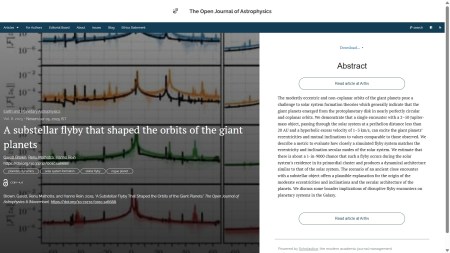
The second paper of the week is “A substellar flyby that shaped the orbits of the giant planets” by Garett Brown (U. Toronto at Scarborough, Canada), Renu Malhotra (U. Arizona, USA) and Hanno Rein (U. Toronto at Scarborough, Canada). This article was published on Wednesday 5th November 2025, also in the folder Earth and Planetary Astrophysics. It argues that an ancient close encounter with a substellar object offers a plausible explanation for the origin of the moderate eccentricities and inclinations of the giant planets.

The overlay is here:

You can find the official version of this one on arXiv here. The federated announcement on Mastodon is here:

Open Journal of Astrophysics

@OJ_Astro@fediscience.org

New Publication at the Open Journal of Astrophysics: "A substellar flyby that shaped the orbits of the giant planets" by Garett Brown (U. Toronto at Scarborough, Canada), Renu Malhotra (U. Arizona, USA) and Hanno Rein (U. Toronto at Scarborough, Canada)

doi.org/10.33232/001c.146688

November 5, 2025, 8:34 am 3 boosts 3 favorites

Next one up is “The Potential Impact of Primordial Black Holes on Exoplanet Systems” by Garett Brown (U. Toronto at Scarborough), Linda He (Harvard U., USA),  and James Unwin (U. Illinois Chicago, USA). This one was also published on Wednesday 5th November 2025, but in the folder Astrophysics of Galaxies. This one is an exploration of the possibility that primordial black holes (PBHs) in our Galaxy, might impact the orbits of exoplanets. The overlay is here:

You can find the official accepted version on arXiv here. The fediverse announcement is here:

Open Journal of Astrophysics

@OJ_Astro@fediscience.org

New Publication at the Open Journal of Astrophysics: "The Potential Impact of Primordial Black Holes on Exoplanet Systems" by Garett Brown (U. Toronto at Scarborough), Linda He (Harvard U., USA), James Unwin (U. Illinois Chicago, USA)

doi.org/10.33232/001c.146689

November 5, 2025, 8:49 am 3 boosts 1 favorites

The fourth paper to report is “The Unhurried Universe: A Continued Search for Long Term Variability in ASAS-SN” by Sydney Petz, C. S. Kochanek & K. Z. Stanek (Ohio State U., USA), Benjamin J. Shappee (U. Hawaii, USA), Subo Dong (Peking University, China), J. L. Prieto (Universidad Diego Portales, Chile) and Todd A. Thompson (Ohio State U., USA). This one was also published on Wednesday November 5th 2025, but in the folder Solar and Stellar Astrophysics.  It describes the discovery and investigation of slowly-varying sources in the All Sky Automated Survey for SuperNovae (ASAS-AN) leading to the identification of 200 new variable stars. The overlay is here:


You can find the official published version on arXiv here. The Fediverse announcement follows:

Open Journal of Astrophysics

@OJ_Astro@fediscience.org

New Publication at the Open Journal of Astrophysics: "The Unhurried Universe: A Continued Search for Long Term Variability in ASAS-SN" by Sydney Petz, C. S. Kochanek & K. Z. Stanek (Ohio State U., USA), Benjamin J. Shappee (U. Hawaii, USA), Subo Dong (Peking University, China), J. L. Prieto (Universidad Diego Portales, Chile) and Todd A. Thompson (Ohio State U., USA)

doi.org/10.33232/001c.146690

November 5, 2025, 9:08 am 1 boosts 0 favorites

The fifth and final paper for this week is “Measuring the splashback feature: Dependence on halo properties and history” by Qiaorong S. Yu (Oxford U., UK) and 9 others based in the UK and USA. This was published on Friday 7th November 2025 in the folder Cosmology and Nongalactic Astrophysics. It discusses how the properties of “splashback” features in halo profiles relate to the halo’s assembly history (e.g. mass accretion rate and most recent merger time). The overlay is here:

The officially accepted version can be found on arXiv here. The Fediverse announcement is here:

Open Journal of Astrophysics

@OJ_Astro@fediscience.org

New Publication at the Open Journal of Astrophysics: "Measuring the splashback feature: Dependence on halo properties and history" by Qiaorong S. Yu (Oxford U., UK) and 9 others based in the UK and USA.

doi.org/10.33232/001c.146824

November 7, 2025, 9:12 am 0 boosts 0 favorites

That’s all the papers for this week. I’ll do another report next Saturday.

#Ariel #arXiv241204583v2 #arXiv250606429v2 #arXiv250705389v3 #arXiv250707174v2 #arXiv250722102v2 #CosmologyAndNonGalacticAstrophysics #DarkMatterHaloes #DiamondOpenAccess #DiamondOpenAccessPublishing #EarthAndPlanetaryAstrophysics #eccentricity #EuropeanSpaceAgency #exoplanets #ExtrrasolarPlanets #galaxyFormation #galaxyHaloes #GiantPlanets #OpenAccess #OpenJournalOfAstrophysics #primordialBlackHoles #Splashback #TheOpenJournalOfAstrophysics

2025-10-11

Weekly Update from the Open Journal of Astrophysics – 11/10/2025

It’s time once again for the usual Saturday update of the week’s new papers at the Open Journal of Astrophysics. Since the last update we have published six  more papers, which brings the number in Volume 8 (2025) up to 152, and the total so far published by OJAp up to 387. Not only have we passed the 150 mark for the year, but this week saw another record for the Journal, in that it was the first week in which we published at least one paper on every day.

Anyway, here are this week’s papers:

The first paper is “Mapping the Nearest Ancient Sloshing Cold Front in the Sky with XMM-Newton” by Sheng-Chieh Lin (University of Kentucky) and 10 others based in the USA, Spain and Germany. This article, published on Monday 6th October 2025, in the section High-Energy Astrophysical Phenomena discusses cold fronts in the Virgo Cluster, their importance in shaping the thermal dynamics of the intracluster medium beyond the cluster core, and their implications for cluster cosmology.

The overlay is here:


The officially accepted version of this paper can be found on the arXiv here.

The second paper this week, also published on Monday 6th October, is “Testing gravitational physics by combining DESI DR1 and weak lensing datasets using the E_G estimator” by S.J. Rauhut (Swinburne University of Technology, Australia) and an international cast of 63 others. This one is in the folder Cosmology and NonGalactic Astrophysics, and it presents a comparison of  Baryon Acoustic Oscillation (BAO) measurements from BOSS, DESI with weak lensing from KiDS, DES and HSC showing that the results are altogether consistent with the standard cosmological model.

The overlay is here:

You can find the officially accepted version of this paper on arXiv here.

Next one up is “Analysis of Galaxies at the Extremes: Failed Galaxy Progenitors in the MAGNETICUM Simulations” by Jonah S. Gannon (Swinburne University, Australia), Lucas C. Kimmig (Ludwig-Maximilians-Universität, Germany; LMU), Duncan A. Forbes (Swinburne), Jean P. Brodie (Swinburne), Lucas M. Valenzuela (LMU), Rhea-Silvia Remus (LMU), Joel L. Pfeffer (Swinburne) and Klaus Dolag (LMU). This paper, published on Tuesday 7th October 2025, in the folder Astrophysics of Galaxies, discusses the business of identifying the possible high-redshift progenitors of low-redshift ultra-diffuse galaxies in cosmological simulations.

The corresponding overlay is here:

You can find the officially accepted version on arXiv here.

The fourth paper this week, published on Wednesday 8th October 2025 in the folder Astrophysics of Galaxies,  is
What Sets the Metallicity of Ultra-Faint Dwarfs?” by Vance Wheeler, Andrey Kravtsov, Anirudh Chiti & Harley Katz (U. Chicago) and Vadim A. Semenov (CfA Harvard), all based in the USA.

The overlay is here:

You can find the officially-accepted version on arXiv here.

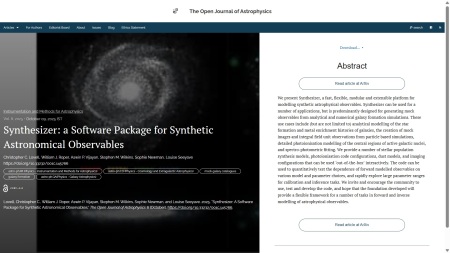
Next, and fifth, we have our 150th publication of 2025, “Synthesizer: a Software Package for Synthetic Astronomical Observables” by Christopher C. Lovell (Cambridge, UK), William J. Roper, Aswin P. Vijayan & Stephen M. Wilkins (Sussex, UK), Sophie Newman (Portsmouth, UK) and Louise Seeyave (Sussex). This paper presents a suite of software tools for creating synthetic astrophysical observables for use in mock galaxy catalogues. It was published on Thursday 9th October 2025 in the folder Instrumentation and Methods for Astrophysics.

The overlay is here:

You can find the officially accepted version on arXiv here.

And finally for this week we have “Introducing the THESAN-ZOOM project: radiation-hydrodynamic simulations of high-redshift galaxies with a multi-phase interstellar medium” by Rahul Kannan (York University, Canada) and 13 others based in the USA, Germany, Japan, Italy and the UK. This one was published on Friday 10th October (i.e. yesterday) in the folder Astrophysics of Galaxies. It describes a comprehensive suite of high-resolution zoom-in simulations of high-redshift galaxies, encompassing a diverse range of halo masses, selected from the THESAN simulation volume.

The corresponding overlay is here:

You can find the officially accepted version of this one on arXiv here.

That concludes the papers for this week. I will, however, add a short postscript. This week saw the announcement of this year’s list of MacArthur Fellows. among them Kareem El-Badry who has published quite a few papers with the Open Journal of Astrophysics. His biography on the MacArthur Foundation page includes this:

He has published articles in Monthly Notices of the Royal Astronomical SocietyThe Astrophysical Journal, and The Open Journal of Astrophysics, among other leading scientific journals.

I’m pleased to see us listed with the established names. I mention this just in case there are still people out there who think it might damage their career if they publish with a non-mainstream journal. I guess we are mainstream now…

#arXiv250220437v3 #arXiv250703182v2 #arXiv250716098v3 #arXiv250803888v3 #arXiv251003150v1 #arXiv251004416v2 #AstrophysicsOfGalaxies #coldFronts #cosmologicalSimulations #CosmologyAndNonGalacticAstrophysics #galaxyFormation #HighRedshiftGalaxies #HighEnergyAstrophysicalPhenomena #InstrumentationAndMethodsForAstrophysics #KareemElBadry #MAGNETICUM #mockGalaxyCatalogues #THESANSimulations #ultraFaintDwarfGalaxy #ultradiffuseGalaxies #VirgoCluster #XRayAstronomy

2025-10-04

Weekly Update from the Open Journal of Astrophysics – 04/10/2025

It’s Saturday again, so it’s time for a summary of the week’s new papers at the Open Journal of Astrophysics. Since the last update we have published five more papers, which brings the number in Volume 8 (2025) up to 146, and the total so far published by OJAp up to 381. At this rate Volume 8 will contain around 190 by the end of 2025.

Anyway, here are this week’s papers, starting with three published on Monday 29th September 2025.

The first paper is “Cosmic Multipoles in Galaxy Surveys II: Comparing Different Methods in Assessing the Cosmic Dipole” by Vasudev Mittal, Oliver T. Oayda and Geraint F. Lewis (U. Sydney, Australia). This is in the folder Cosmology and Nongalactic Astrophysics. It presents a comparison of methods for determining the number count dipole from cosmological surveys with a discussion of the implications for the known discordance with the CMB diple.

The overlay is here:

You can make this larger by clicking on it.  The officially accepted version of this paper can be found on the arXiv here.

The second paper this week, also published on Monday 29th September, is “SDSS-C4 3028: the Nearest Blue Galaxy Cluster Devoid of an Intracluster Medium” by Shweta Jain (University of Kentucky, USA) and 11 others based in the USA, Australia and Korea. This describes a galaxy cluster with an unusually high fraction (about 63%) of star-forming galaxies which may be a result of ram pressure stripping; the article is in the folder Astrophysics of Galaxies.

The corresponding overlay is here:


You can find the officially accepted version on arXiv here.

The third one this week, published on also published on Monday 29th September but in the folder Earth and Planetary Astrophysics, is “Comparing the Architectures of Multiplanet Systems from Kepler, K2, and TESS Data” by Robert L Royer and Jason H. Steffen (University of Nevada, USA).  This paper explores the trends seen in exoplanet survey data, including Kepler, TESS, and K2 including many planetary systems with multiple planets.

The overlay is here:


You can find the officially-accepted version on arXiv here.

The next one up is “Seeding Cores: A Pathway for Nuclear Star Clusters from Bound Star Clusters in the First Billion Years” by Fred Angelo Batan Garcia (Columbia University, USA), Massimo Ricotti (University of Maryland, USA) and Kazuyuki Sugimura (Hokkaido University, Japan). This paper was published on Thursday 2nd October in the folder Astrophysics of Galaxies. This is about modelling the formation of Nuclear Star Clusters using cosmological radiation-hydrodynamic simulations, with discussion of the implications for seeding supermassive black holes and the little red dots seen by JWST.

The corresponding overlay is here:

You can find the officially accepted version of this one on arXiv here.

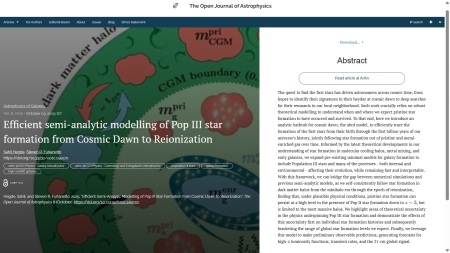
The fifth and last one for this week, published on Friday 3rd October 2025, is “Efficient semi-analytic modelling of Pop III star formation from Cosmic Dawn to Reionization” by Sahil Hegde and Steven R. Furlanetto (University of Californi Los Angeles, USA).  This is also in the folder marked Astrophysics of Galaxies. It uses a self-consistent analytic model to trace the formation of the first stars from their birth through the first billion years of the universe’s history. complementing semi-analytic and computational methods.


You can find the officially-accepted version of this paper on arxiv here.

That concludes the report for this week. I’ll post another update next Saturday.

#arXiv250308779v2 #arXiv250620654v3 #arXiv250719581v2 #arXiv250920651v1 #arXiv250922523v1 #AstrophysicsOfGalaxies #cosmicDipoles #CosmologyAndNonGalacticAstrophysics #DiamondOpenAccess #EarthAndPlanetaryAstrophysics #GalaxyCluster #galaxyFormation #galaxySurveys #JWST #Kepler #LittleRedDots #MultiplanetSystems #nuclearStarClusters #OpenAccessPublishing #OpenJournalOfAstrophysics #PopulationIIIStars #ramPressureStripping #SDSSC42028 #semiAnalyticGalaxyFormation #TheOpenJournalOfAstrophysics

2025-09-03

A Primordial Black Hole?

There’s a recent paper on arXiv with the title A direct black hole mass measurement in a Little Red Dot at the Epoch of Reionizationon by Juodžbalis et al. that is causing a lot of interest. The paper is here and the abstract is:

There is a discussion of this in the Grauniad here and in several other places on the interwebs. It comes hard on the heels of the theoretical paper announced here.

I only saw this paper yesterday and, now that I’ve read it, it isn’t really all that clear to me what this object is. No doubt there’ll be considerable follow-up. One possibility – and it is just a possibility – is that we are seeing evidence of a primordial black hole, called a PBH for short. These are black holes formed by direct collapse in the early Universe rather than by merging of stellar black holes. Note the use of the word “naked” is rather misleading. It does not mean a naked singularity, in the sense of a singularity without an event horizon around it. In this case it just means that it appears not to be surrounded by accreting material or even a host galaxy.

A PBH of mass M would form at a particular cosmic time t if a region of radiius ~ct (the cosmological horizon scale) collapses into a black hole. Obviously this would require a large fluctuation in density on that scale but if a PBH does form then its mass will be roughly the mass contained within the horizon, i.e. M ~ ρ(t) (ct)3 (ignoring dimensionless factors). The sort of mass required (~106 M☉) corresponds to a time when the Universe was radiation-dominated and before matter and radiation decoupled. What would be inside such a black hole is therefore predominantly trapped radiation, which is Quite Interesting, but as far as the outside universe is considered it’s just a massive black hole.

Graphic by European Space Agency showing how structure formation might be affected by PBH formation

Anyway, during radiation domination, the mass-energy density of the Universe ρ(t) ∝ t-2, so the horizon mass increases linearly with t. According to the standard cosmology, the epoch of radiation domination lasts for approximately 50,000 years after the Big Bang, i.e. of order 1012 seconds, and at the end of it the horizon mass is of order 1014 M☉. Assuming that the universe is completely radiation-dominated before that the time at which a PBH of mass 106 M☉ would form is about 104 seconds, i.e. getting on for 3 hours after the Big Bang. This is after the end of cosmological nucleosynthesis, but not by much. Primordial black holes of lower mass than this would form earlier, with a stellar mass PBH having to collapse around the time of the quark-hadron transition. Lighter PBHs would form even earlier.

The numbers I’ve quoted are very approximate, back-of-the-envelope, ballpark guesstimates. For one thing not all of the horizon mass will end up in a PBH: energy may well be released during the collapse. Moreover, some PBHs on one scale will subsequently be subsumed within objects of larger mass. Also I’ve ignored quite a lot of numerical factors. All this will have to be worked out properly, but there are potential constraints on any physical processes that might give rise to PBHs on the relevant scale if they involve a release of significant amount of energy as there may not be time for this excess to be thermalized by scattering or they may intefere with the element abundances predicted by nucleosynthesis.

That is all assuming it is a primordial black hole in the first place…

#arXiv250821748 #Cosmology #galaxyFormation #matterRadiationEquivalence #PBHs #primordialBlackHoles

2025-09-01

Galaxies and Black Holes in the First Billion Years

Trying to catch up on recent developments in galaxy formation? I can heartily recommend an excellent review article on the subject by Richard Ellis which you can find on the arXiv here. The abstract reads:

 I present written notes from three lectures given at the 54th Saas-Fee Advanced Course of the Swiss Society of Astrophysics and Astronomy in January 2025 entitled “Galaxies and Black Holes in the First Billion Years as seen by the JWST”. I focused my lectures on progress in studies of cosmic reionisation, the properties of galaxies in the reionisation era, topics related to the redshift frontier and the search for Population III stars. The lectures were given to graduate students in astrophysics and cover both pedagogical material as well as observational results from the first two and half years of JWST science operations. The pace of discovery with JWST is, of course, rapid and so my lectures discuss long-term goals, analysis methods and their assumptions and limitations in the hope that the underlying material will retain value in the near future. In this written version, the visual material is that presented at Saas-Fee in January 2025 but I have provided updates on progress from the literature up to August 2025. The material is aimed at early career researchers and should not be considered as a scholarly review of the entire JWST literature on high redshift galaxies.

It’s quite a long article (65 pages) but nicely written and well worth reading, as it is full of information about recent advances as well as historical insights. Talking of which, there’s a picture on page 41 taken at a meeting in Durham in 1988 called The Epoch of Galaxy Formation that I attended while I was still a graduate student:

Richard Ellis himself is in the front row, left of centre with light-coloured trousers, checked shirt and hands in pockets. I’m in the picture too, but I’ll leave it up to you to find me!

A poll was held among the delegates at that meeting about various questions to do with galaxy formation. The majority opinions revealed by these votes nearly all turned out to be utterly wrong! That’s progress, I guess…

#arXiv250816948 #blackHoles #Cosmology #galaxyFormation #JWST #RichardEllis

2025-08-03

Six galaxies "brise‑modèles" observées à seulement 500‑700 M ans après le Big Bang : des masses > 10¹⁰ M☉, révolution imminente en cosmologie.
neozone.org/aerospatiale/notre

2025-06-28

Weekly Update from the Open Journal of Astrophysics – 28/06/2025

It’s Saturday morning again so time for an update of papers published at the Open Journal of Astrophysics. Since the last update we have published eight new papers, which brings the number in Volume 8 (2025) up to 82, and the total so far published by OJAp  up to 317. With about half the year gone, we’re on target to published around 160 papers this year.

The papers published this week, with their overlays, are as follows.  You can click on the images of the overlays to make them larger should you wish to do so.

The first paper to report is “Spectroscopic and X-ray Modeling of the Strong Lensing Galaxy Cluster MACS J0138.0-2155” by Abigail Flowers (University of California at Santa Cruz; UCSZ), Jackson H. O’Donnell (UCSZ), Tesla E. Jeltema (UCSZ), Vernon Wetzell (U. Pennsylvania) & M. Grant Roberts (UCSZ). This artticle, which is in the folder marked Cosmology and NonGalactic Astrophysics, presents a study of the mass distribution and substructure of a galaxy cluster that acts as a gravitational lens for a source galaxy at z=1.95 that contains two supernovae. It was published on 23rd June 2025. The overlay is here:

The officially-accepted version can be found on arXiv here.

Illuminating the Physics of Dark Energy with the Discovery Simulations” by Gillian D. Beltz-Mohrmann (Argonne National Laboratory, USA) and 12 others based in the USA and Spain. This describes new high-resolution cosmological simulations providing a testbed for alternative cosmological probes that may offer additional constraining power beyond Baryon Accoustic Oscillations. It is filed in the folder marked Cosmology and NonGalactic Astrophysics.

The overlay is here:

You can read the final accepted version on arXiv here.

Next one up is in the folder marked Astrophysics of Galaxies. The title is “On the minimum number of radiation field parameters to specify gas cooling and heating functions” and it is by David Robinson & Camille Avestruz (U. Michigan) and Nickolay Y. Gnedin (U.Chicago) and was published on 23rd June 2025. It presents an analysis using machine learning of atomic gas cooling and heating functions computed by the spectral synthesis code Cloudy.

The overlay is here:


You can find the officially-accepted version of the paper on arXiv here.

The thirtd paper is “On the Use of WGANs for Super Resolution in Dark-Matter Simulations” by John Brennan (Maynooth), Sreedhar Balu (U. Melbourne), Yuxiang Qin (ANU), John Regan (Maynooth) and Chris Power (U. Western Australia). This one is also in the folder marked Astrophysics of Galaxies and was also published on Monday 23rd June. It is about using the Wasserstein Generative Adversarial Network (WGAN) model to increase the particle resolution of dark-matter-only simulations of galaxy formation. The overlay is here:

You can find the officially-accepted version of the paper on arXiv here.

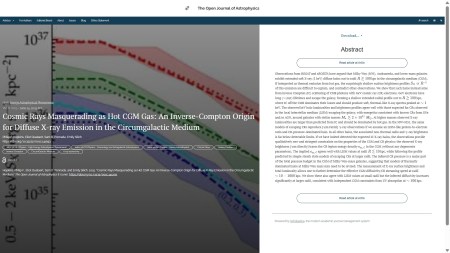
Next we have “Cosmic Rays Masquerading as Hot CGM Gas: An Inverse-Compton Origin for Diffuse X-ray Emission in the Circumgalactic Medium” by Philip F. Hopkins (Caltech), Eliot Quataert (Princeton), Sam B. Ponnada (Caltech) and Emily Silich (Caltech), all based in the USA.  This one was published on 24th June 2025 in the folder High-Energy Astrophysical Phenomena

You can find the officially-accepted version on arXiv here.

The fifth paper this week is “Compact Binary Formation in Open Star Clusters III: Probability of Binary Black Holes Hidden Inside of Gaia Black Hole Binary” by Ataru Tanikawa (Fukui Prefectural University, Japan), Long Wang (Sun Yat-sen University, China), Michiko S. Fujii (University of Tokyo, Japan), Alessandro A. Trani (Niels Bohr Institute, Denmark), Toshinori Hayashi (Kyoto University, Japan) and Yasushi Suto (Kochi University of Technology, Japan).  This one is in the folder marked Astrophysics of Galaxies and was published on Tuesday 24th June. It presents an investigation into whether some Gaia black hole binary systems may in fact involve three black holes, including a pair too compact to be resolved astrometrically. Here is the overlay:

You can find the officially-accepted paper on arXiv here.

Next we have “Rapid identification of lensed type Ia supernovae with color-magnitude selection” by Prajakta Mane (IISER) and Anupreeta More & Surhud More (IUCAA), all based in India. This paper presents an  extension of the use of color-magnitude diagrams, used previously as a means to identify lensed supernovae, with applications to LSST-like photometric data. It is in the folder marked Astrophysics of Galaxies and was published on Thursday 26th June.

The officially-accepted version of the article can be found on arXiv here.

The penultimate article this week is: “Cosmic Reionization On Computers: Biases and Uncertainties in the Measured Mean Free Path at the End Stage of Reionization” by Huanqing Chen (U. Alberta, Canada), and Jiawen Fan & Camille Avestruz (U. Michigan, USA). This one is in the folder Cosmology and Nongalactic Astrophysics and was published on 26th June 2025.  This paper studies possible systematic effects in computer simulations of cosmic reionization especially when it results from quasar radiation.

The overlay is here:

You can find the officially-accepted version on arXiv here.

Eighth and last paper this week is “Exploring the Core-galaxy Connection” by Isabele Lais de Souza Vitório (U. Michigan) and Michael Buehlmann, Eve Kovacs, Patricia Larsen, Nicholas Frontiere & Katrin Heitmann (Argonne National Laboratory, USA).  This one is in the folder Cosmology and Nongalactic Astrophysics and was published on Friday 27th June 2025 (i.e. yesterday).

The overlay is here:


You can find the officially-accepted version on arXiv here.

And that’s all the papers for this week. I do, however, have some more news to pass on. We are delighted to welcome two new recruits to our Editorial Board,  Dr Foteini Oikonomou of the Norwegian University of Science and Technology, who specializes in the application of particle physics theories to  high-energy astrophysical phenomena, and Dr Heloise Stevance of Oxford University (UK), who specializes in the interface between Machine Learning and Astrophysics.

#arXiv240619446v2 #arXiv240700268v4 #arXiv240703662v4 #arXiv241005372v3 #arXiv241109412v2 #arXiv241219955v2 #arXiv250113056v2 #arXiv250118696v2 #AstrophysicsOfGalaxies #BinaryBlackHoles #CircumgalacticMedium #cosmicRays #CosmicReionization #CosmologyAndNonGalacticAstrophysics #DiamondOpenAccessPublishing #DrHeloiseStevcance #GalacyHalos #galaxyClusters #galaxyFormation #HighEnergyAstrophysicalPhenomena #OJAp #OpenJournalOfAstrophysics #supernovae #TheOpenJournalOfAstrophysics #WAGN
2025-05-19

A galaxy at redshift z=14.44?

This morning’s arXiv mailing presented me with a distraction from examination marking in the form of a paper by Naidu et al. with this abstract:

This paper has been submitted to the Open Journal of Astrophysics. In the relatively recent past, papers like this about record-breaking galaxies would normally be submitted to Nature so perhaps we’re at last starting to see a change of culture?

I usually feel a bit conflicted in situations when a paper has been submitted for editorial review there. In this case I am posting it here for two reasons: one is that I am not the Editor responsible for this paper; the other is that the arXiv submission specifically says

Submitted to the Open Journal of Astrophysics. Comments greatly appreciated and warmly welcomed!

In order to generate flagging it here to encourage people to comment, either through the box below or by contacting the authors.

For reference, here is the key plot showing the spectrum from which the redshift is determined. It is rather noisy, but the Lyman break seems reasonably convincing and there are some emission lines that appear to offer corroborative evidence:

You might want to read this article (another OJAp paper) which contains this plot showing how galaxies at redshift z>10 challenge the standard model:

Please read the paper and comment if you wish!

#arXiv250511263 #Cosmology #galaxyFormation #highRedshiftGalaxy #LymanBreak #z1444

2025-05-10

Weekly Update from the Open Journal of Astrophysics – 10/05/2025

It’s time for another update Saturday morning update of activity at the Open Journal of Astrophysics. After the record-breaking stats described in the last update , this week has been on the slow side with just one paper published. This brings the number in Volume 8 (2025) up to 55 and the total so far published by OJAp up to 290.

The paper to report is “Late-time growth weakly affects the significance of high-redshift massive galaxies” by Qianran Xia & Dragan Huterer (U. Michigan, USA) and Nhat-Minh Nguyen (U. Tokyo, Japan). This paper, which was published on Wednesday 7th May 2025,  is published in the folder Cosmology and NonGalactic Astrophysics. It presents an argument that changes in the growth rate of perturbations at low redshift do not have much effect on predictions of the abundance of lassive galaxies at high redshift.

The overlay is here:


You can find the officially accepted version on arXiv here.

That’s all for now. I’ll do another update next week.

#arXiv250300155v2 #CosmologyAndNonGalacticAstrophysics #DiamondOpenAccess #galaxyFormation #growthRate #OpenJournalOfAstrophysics #TheOpenJournalOfAstrophysics

2025-04-09

R.I.P. Jerry Ostriker (1937-2025)

Once again I find myself using this blog to pass on sad news. This time it is of the death of renowned astrophysicist Jerry Ostriker (pictured left in 2012), who passed away on Monday 6th April 2025 just a week before his 88th birthday.

Jeremiah Paul Ostriker (to give his full name) was an extremely energetic, versatile and influential theorist who worked on a wide range of problems in diverse areas of astrophysics and produced a number of classic papers. Close to my own specialism I would quote two in particular: one written with Jim Peebles in 1973 about the stability of galactic disks; and the other with Martin Rees in 1977 about the role of gas cooling and fragmentation in determining the size of galaxies and clusters. He also did much to establish the use of hydrodynamic simulations in cosmology and was an early adopter of the current standard cosmological model, including a cosmological constant. He worked on many other things too, including pulsars and galactic nuclei.

I only met Jerry Ostriker a few times, mainly at conferences – where he was never shy to contribute to discussions after talks – but also once back in the 1990s when I was a visitor Princeton (where he was Professor). I didn’t have much time to talk to him then as he always seemed to be on the go, so I never really got to know him personally. After spending most of his career in Princeton, including a spell as Provost, in 2001 Ostriker moved to Cambridge for a short stint as Plumian Professor, before returning to Princeton.

There is a very nice obituary of Jerry Ostriker by Dennis Overbye in the New York Times.

Rest in peace, Jerry Ostriker

#Astrophysics #Cosmology #DennisOverbye #galaxyFormation #JeremiahPOstriker #JerryOstriker #Princeton

2025-04-05

Weekly Update from the Open Journal of Astrophysics – 05/04/2025

It’s time once more for the regular Saturday morning update of papers published at the Open Journal of Astrophysics. Since the last update we have published one new paper. The number of articles in Volume 8 (2025) is now up to 33 and the total so far published by OJAp up to 268.

The paper concerned, published on 2nd April 2025, is “The molecular gas content throughout the low-z merger sequence” by Mark T. Sargent (ISSI, Bern), S. L. Ellison (U. Victoria, Canada), J. T. Mendel (ANU), A. Saintonge (UCL), D. Cs. Molnár & T. Schwandt (U. Sussex), J. M. Scudder (Oberlin College, USA) and G. Violino (U. Hertfordshire). It is published in the folder Astrophysics of Galaxies and it discusses the observed properties of molecular gas in post-merger galaxies and interacting pairs and the physical origin of these properties.

Here is the overlay:

You can read the officially accepted version of this paper on arXiv here.

That’s all for this week. I’ll do another update next Saturday.

#arXiv240906572v2 #AstrophysicsOfGalaxies #DiamondOpenAccess #galaxyFormation #molecularGas #TheOpenJournalOfAstrophysics

2025-03-22

Weekly Update at the Open Journal of Astrophysics – 22/03/2025

It’s Satuday morning once again, and time for another update of papers published at the Open Journal of Astrophysics. Since the last update we have published two papers, which brings the number in Volume 8 (2025) up to 29 and the total so far published by OJAp up to 264.

The papers we have published this week are connected by the theme of black holes and their role in galaxy formation, which is a very hot topic nowadays!

The first paper to report is “Hawking Radiation from non-evaporating primordial black holes cannot enable the formation of direct collapse black holes” by Jonathan Regan, Marios Kalomenopoulos and Kelly Kosmo O’Neil of the University of Nevada, USA. This paper, which is based on an undergraduate thesis, is a study of the irradiating effects of primordial black holes and a discussion of whether these might influence the subsequent formation of supermassive black holes. It is in the section marked Astrophysics of Galaxies, and was published on Tuesday  18th March.

The overlay is here:

and you can find the final accepted version on arXiv here.

The second paper, which was published on Wednesday 19th March and is also in the folder Astrophysics of Galaxies, is “First Light and Reionization Epoch Simulations (FLARES) – XV: The physical properties of super-massive black holes and their impact on galaxies in the early universe” by Stephen Wilkins & Jussi K. Kuusisto (U. Sussex, UK), Dimitrios Irodotou (Institute of Cancer Research, UK), Shihong Liao (Beijing, China) Christopher C. Lovell (Portsmouth, UK), Sonja Soininen (Insitute of Cancer Research), Sabrina C. Berger (Melbourne, Australia), Sophie L. Newman (Portsmouth, UK), William J. Roper (Sussex), Louise T. C. Seeyave (Sussex), Peter A. Thomas (Sussex) and Aswin P. Vijayan Sussex). This paper uses cosmological hydrodynamical zoom simulations to study the formation of supermassive black holes and their impact on star formation in the early Universe.

Here is the overlay, which you can click on to make larger if you wish:


You can read the officially accepted version of this paper on arXiv here.

That’s all for this week. It’s been a bit frustrating for me as Managing Ediutor, because we have built up a backlog of several papers that were accepted for publication some time ago, but are still waiting for the authors to place the final version on arXiv. I hope these won’t take too long to appear, not least because I would like to clear my workflow on the Scholastica platform!

#arXiv240402815v3 #arXiv241109081v2 #AstrophysicsOfGalaxies #DiamondOpenAccess #FirstLight #FLARES #galaxyFormation #HawkingRadiation #OpenAccessPublishing #OpenJournalOfAstrophysics #primordialBlackHoles #reionization #supermassiveBlackHoles

Louis Marmet has movedredshiftdrift@astrodon.social
2025-01-14

#LCDM #GalaxyFormation #EarlyGalaxies #Illustris
"Old galaxies in the early universe"

<<it isn’t a resounding success if we have to scrape the bottom of the simulated barrel after cherry-picking which barrel.>>

#MOND #MassiveGalaxies

🔗tritonstation.com/2025/01/14/o

2024-12-28

New Publication at the Open Journal of Astrophysics

I wasn’t planning to do the usual weekly update of activity at the Open Journal of Astrophysics this morning as I thought we wouldn’t publish any more papers between last week’s update and the Christmas break. However, one final version did hit the arXiv on Christmas Eve so I decided to publish it straight away. This brings the total for Volume 7 (2024) to 120 – a neat average of ten a month – and the overall total to 235.

Here’s a table showing the sequence of papers published over the last six years and the series formed from the aforementioned sequence:

Year201920202021202220232024Papers1215171750120Total16314865115235

Anyway, the new paper is “Galaxy evolution in the post-merger regime. II – Post-merger quenching peaks within 500 Myr of coalescence” by Sara Ellison (U. Victoria, Canada), Leonardo Ferreira (U. Victoria), Vivienne Wild, (St Andrews, UK), Scott Wilkinson (U. Victoria), Kate Rowlands, (STScI, USA) & David R. Patton (Trent U., Canada). It was published on 24th December 2024 in the folder marked Astrophysics of Galaxies. It comprises an investigation of the possibility that quenching of star formation is a consequence of galaxy-galaxy interactions and mergers. The overlay is here:

You can find the officially accepted version on arXiv here.

Well, that definitely concludes the updates for 2024. I’ll be back on January 4th with the first update of 2025.

#arXiv241006357v2 #AstrophysicsOfGalaxies #DiamondOpenAccess #galaxyFormation #starFormation #TheOpenJournalOfAstrophysics

2024-12-22

Very readable blog about cosmology with some surprisingly easy to understand "back of the envelope" calculations about the boundary conditions under which galaxies may form.

tritonstation.com/2024/12/20/o

#tritonstation #cosmology #jwst #MOND #darkmatter #galaxyformation

2024-12-07

Four New Publications at the Open Journal of Astrophysics

It’s Satuday morning once again so here’s another quick update of activity at the Open Journal of Astrophysics. Since the last update a week ago we have published  four papers, which takes the count in Volume 7 (2024) up to 110 and the total published altogether by OJAp up to 225.

In chronological order of publication, the four papers published this week, with their overlays, are as follows. You can click on the images of the overlays to make them larger should you wish to do so.

First one up is “The impact of feedback on the evolution of gas density profiles from galaxies to clusters: a universal fitting formula from the Simba suite of simulations” by Daniele Sorini & Sownak Bose (Durham University, UK), Romeel Davé (University of Edinburgh, UK), and Daniel Anglés-Alcázar (University of Connecticut, USA). The paper, which is in the folder marked Astrophysics of Galaxies, presents a study of the effects of stellar and/or AGN feedback on the shape and evolution of gas density profiles in galaxy haloes using the SIMBA simulations. It was published on Tuesday 3rd December 2024.

Here is a screen grab of the overlay, which includes the abstract:


You can find the officially accepted version of the paper on the arXiv here.

The second paper to announce, also published on 3rd December 2024, and is also the folder “Astrophysics of Galaxies, is “Self-regulated growth of galaxy sizes along the star-forming main sequence” by Shweta Jain (U. Kentucky, USA), Sandro Tacchella (U. Cambridge, UK) and Moein Mosleh (Shiraz University, Iran).  This paper suggestes an identification of a possible self-regulating mechanism in galaxy size growth involving the interplay between feedback from star formation and newly accreted gas.

You can see the overlay here:


The accepted version of this paper can be found on the arXiv here.

The third paper, published on Thursday 6th December 2024 in the folder marked Cosmology and NonGalactic Astrophysics, is called  “BLAST: Beyond Limber Angular power Spectra Toolkit. A fast and efficient algorithm for 3×2 pt analysis” by Sofia Chiarenza, Marco Bonici & Will Percival (Waterloo, Canada) and Martin White (Berkeley, USA). It presents BLAST, an efficient algorithm for calculating angular power spectra without employing the Limber approximation or assuming a scale-dependent growth rate, based on the use of Chebyshev polynomials. The code is written in Julia.

Here is the overlay


The final version accepted on arXiv is here.

Last in this batch, published on 6th December 2024, and in the folder Astrophysics of Galaxies, is “On the universality of star formation efficiency in galaxies” by Ava Polzin & Andrey V. Kravtsov (U. Chicago) and Vadim A. Semenov & Nickolay Y. Gnedin (CfA Harvard), all based in the USA. The paper presents an argument that the universality of observational estimates of star formation efficiency per free-fall time can be plausibly explained by the turbulence-driven and feedback-regulated properties of star-forming regions.

You can find the official accepted version on the arXiv here.

We seem to have recovered from a small Thanksgiving lull and, looking at the OJAp workflow, I think we’ll have a similar number of publications next week. I’ll do another update next weekend!

#3x2ptAnalysis #AngularPowerSpectrum #arXiv240711125v2 #arXiv240905815v3 #arXiv241003632v2 #arXiv241200599v1 #AstrophysicsOfGalaxies #BLAST #CosmologyAndNonGalacticAstrophysics #galaxyFormation #LimberApproximation #starFormation

2024-11-16

Two New Publications at the Open Journal of Astrophysics

Once again it’s time for a Saturday morning update on activity at the  Open Journal of Astrophysics.  Since the last update we have published two more papers, taking  the count in Volume 7 (2024) up to 104 and the total published by OJAp up to 219.

The first paper of the most recent pair, published on November 13 2024,  in the folder Cosmology and NonGalactic Astrophysics, is “Stochastic Super-resolution of Cosmological Simulations with Denoising Diffusion Models” by Andreas Schanz, Florian List and Oliver Hahn (all based in the University of Vienna, Austria). It presents a  discussion of denoising diffusion in generative models for achieving super-resolution in simulations of cosmic large-scale structure.

Here is a screen grab of the overlay which includes the abstract:


You can click on the image of the overlay to make it larger should you wish to do so.  You can find the officially accepted version of this paper on the arXiv here.

The second paper to be published this week is also in the folder marked Cosmology and NonGalactic Astrophysics. It was published on November 14 and has the title “Halo mass functions at high redshift” by Hannah O’Brennan, John A. Regan, Chris Power (*), Saoirse Ward, John Brennan, and Joe McCaffrey. Five of the six authors are colleagues of mine from the National University of Ireland, Maynooth; Chris Power (marked with a *) is from the University of Western Australia.

Here is a screen grab of the overlay which includes the abstract:


You can click on the image of the overlay to make it larger should you wish to do so. You can find the officially accepted version of the paper on the arXiv here.

That concludes this week’s update. More  next week!

#arXiv240815194v2 #CosmologyAndNonGalacticAstrophysics #DarkMatterHaloes #DiamondOpenAccess #Enzo #galaxyFormation #JWST #OpenJournalOfAstrophysics #TheOpenJournalOfAstrophysics

2024-09-27

Paradox of Metal-rich Stars in Early Universe  
Study of image taken by the JWST has led to discovery of a galaxy in the early universe about a billion years after the big bang whose light...........
#earlyuniverse #galaxy #galaxyformation #GSNDG9422 #JADESGSz140 #JamesWebbSpaceTelescope #JWST #metalrichstars #PopIIIStars #Universe
Umesh Prasad

scientificeuropean.co.uk/scien

Client Info

Server: https://mastodon.social
Version: 2025.07
Repository: https://github.com/cyevgeniy/lmst