The Magic of Simplex: Why Direct Contact Still Matters
2,919 words, 15 minutes read time.
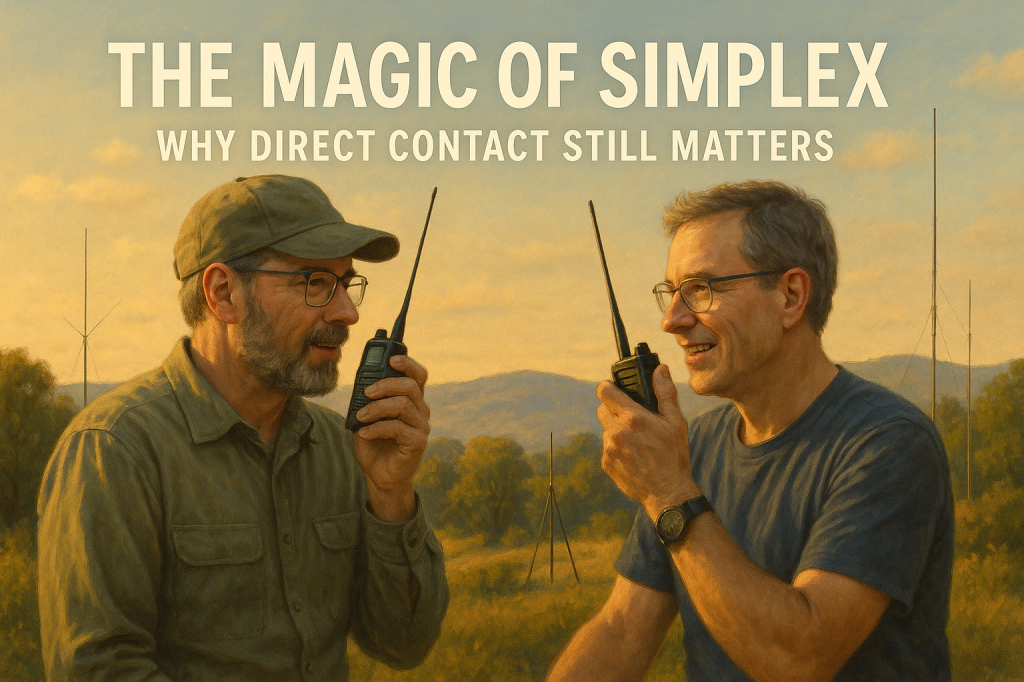
AI made this image, but even it can’t handle the tension of a simplex stare-down. 😄📻
There’s a particular electricity the first time you hear another human voice come through your radio with nothing between you but air and your own equipment. No tower, no internet bridge, no repeater bouncing your signal a county away — just you, your antenna, and someone on the other end who heard you and answered. That feeling is at the heart of simplex: the purest, most elemental form of radio communication. This essay is written by someone who’s spent decades behind microphones and on metal masts, teaching newcomers, troubleshooting nets, and running emergency exercises. My aim here isn’t to walk you through licensing steps — it’s to help you understand why simplex matters, why it makes ham radio rewarding, and how practicing simplex will shape you into the kind of operator who’ll pass the test with confidence someday.
What Simplex Is — and Why the Definition Matters
At its simplest, simplex means two stations transmit and receive on the same frequency, speaking directly to each other with no repeater or relay in between. It’s a technical definition, yes, but it’s also a practical philosophy: when you operate simplex you are dealing with the raw radio path between two antennas, and that forces you to pay attention to fundamentals — antenna placement, power, terrain and timing. The American Radio Relay League (ARRL) describes simplex operation as stations “talking to each other directly, on the same frequency,” which is an intentionally plain description because the implications are where the learning happens.
That deceptively spare sentence explains why simplex is both a teaching tool and a proving ground. In repeater-assisted contacts the repeater masks gaps in your setup: a tall repeater on a ridge can make a weak handheld sound like a full-power mobile. Simplex gives you immediate, honest feedback: if you can’t be heard at a given distance, you need to change antennas, move, raise your radio, change power or accept that the path is blocked. Those decisions — micro-choices about equipment and placement — are what make a good operator. They’re also the kinds of problems the licensing exam assumes you understand at a baseline level.
The Magic of Direct Contact: Why It Feels Different
There’s a reason experienced hams talk about simplex like it’s a rite of passage. Making a solid simplex contact has everything to do with competence and everything to do with a primal human delight: connection. Radios are instruments, and like any instrument you improve by removing layers of assistance. Simplex strips away the scaffolding. You feel every dip in the band, every climb in clarity, and when a voice comes back clear it’s unmistakably yours to celebrate.
That sensation isn’t just emotional. It’s instructive. Operating simplex teaches you to be economical and precise with your transmissions. You learn to watch for when the band opens, to pause so the other station can break in, to make quick, efficient exchanges that minimize airtime. In emergency communications, when time and battery are limited and infrastructure might be down, those simplex skills are the difference between a successful relay and an unanswered call.
Repeaters, Duplex, and the Learning Contrast
To understand simplex fully you have to see it beside its foil: the repeater. A repeater listens on one frequency and retransmits on another, often from a high point, extending your range. Repeaters are wonderful community-built tools; they knit large territories together and let handheld radios reach far beyond their physical capability. But the convenience of repeaters can hide important lessons. If you rely only on repeaters, you may not notice your stock handheld antenna’s limitations, or learn how to coax a signal over a ridge.
Repeaters serve many vital roles, but learning to use simplex first — or at least alongside repeater operation — teaches a deeper relationship with the medium. When you understand your station’s true limits, you become a better repeater operator: you can judge whether a direct simplex test is practical, whether you should call simplex to save repeater airtime, and how to manage power for battery conservation during a long event. The difference is akin to driving: learning to handle a manual transmission gives you intuition about engine speed and control that automatic drivers never develop.
Practical Uses of Simplex: From Backyard to Backcountry
Simplex isn’t just an academic exercise — it’s brutally practical. For neighborhood nets, club check-ins, and quick on-the-ground coordination, simplex is the fastest, simplest solution. If you’re helping set up a field event, you don’t want to rely on a repeater that might be full or out of commission; you want to use a pair of radios and an agreed frequency for point-to-point coordination. In public service events, simplex can act as the glue for localized teams while the repeater handles broader comms.
Emergency response plans explicitly recognize simplex’ role. Field manuals and ARES guidance recommend simplex frequencies and encourage operators to use simplex whenever possible to preserve repeater resources and to ensure communications when repeater infrastructure fails. The ARRL field resources manual puts it plainly: “Use simplex, whenever possible.” That sentence lives in countless emergency plans because when the network is scarce, local, direct contact is reliable.
Simplex is also the backcountry’s ally. When you’re hiking or camping, your partner’s handheld is your lifeline. There’s a set of simple protocols — the Wilderness Protocol is one example used by many backcountry hams — that depend on national simplex calling frequencies and periodic check-ins to conserve battery and keep coordination predictable. In those environments, learned habits like speaking concisely and keeping antenna height up can turn a bad afternoon into a simple, solvable logistics problem rather than a dangerous situation.
Range Realities: How Far Can You Go on Simplex?
One of the most common questions I get is practical and blunt: “How far will my handheld reach on simplex?” There’s no single answer, because range is an outcome of many interacting factors: antenna gain, antenna height, terrain, power, frequency, atmospheric conditions and even the orientation of the people holding the radios. That said, rules of thumb exist because operators need expectations.
If you’re using a typical handheld on VHF or UHF with its stock rubber duck antenna, expect a few miles in suburban settings and perhaps five miles as a rough guideline under favorable conditions. In open country or with an elevated antenna, that same handheld can stretch far beyond what you imagine. The Ham Radio Prep range guide summarizes this neatly: “Handheld, FM Simplex, ~ 5 Miles” — a useful ballpark for planning local nets and public service operations. The precise number isn’t the point; the point is that you can estimate, test, and adapt.
If you’re curious about extending that range, there are engineering moves that pay off more than raw wattage. Elevate the antenna. Use a better antenna. Improve coax and connections. Small changes in height and feedline loss can make bigger differences than cranking up power. Simplex teaches you to choose the smart change.
Building Skills Through Simplex: Antennas, Power, and Propagation
Simplex is an experiential classroom. When you work simplex you confront antenna theory in a way that reading a chapter never quite captures. You’ll learn why a quarter-wave vertical performs differently on a handheld than a properly tuned J-pole does from a pole. You’ll discover how nearby metal and your car roof transform patterns. You’ll learn to judge how much power you actually need — and when lower power is preferable.
One of the great ironies of radio is how many gains come from subtraction. Lowering power forces you to be efficient, and efficient operators are prized in nets and field deployments. The ARES field recommendations emphasize this: use minimum power to accomplish the contact, conserve batteries, and avoid keying unintended repeaters. Those are practical habits you’ll carry into any operation.
Propagation is another lesson. Even on VHF and UHF, openings happen. You’ll experience sporadic-E on 2 meters, temperature inversions that lift signals, and the frustrating line-of-sight shadow of a hillside. Those moments build intuition. When you recognize propagation patterns, you make better choices: you pick times to call CQ, you know when to try a different frequency, and you understand what to log for after-action reports.
Educators and seasoned operators have long encouraged hands-on practice. The modern ham educator Dave Casler, who runs widely used training videos, consistently stresses that hands-on contacts and real-world experience are the fastest ways to internalize concepts like antenna behavior and repeater etiquette. Practice on the air, then reflect, adjust, and try again — that iterative loop is how competence forms.
The Brotherhood of Direct Contact: Community and Culture
There’s an intangible social component to simplex that tends to attract a certain kind of person: someone who likes a challenge, enjoys problem solving, and values direct competence. Simplex nets and local on-the-air meetups cultivate that environment. The conversations tend to be lean and practical: signal reports, equipment notes, weather observations, and human stories. Those exchanges create a deep, sustaining community because people who operate simplex regularly develop mutual respect for skill.
This social fabric isn’t gender-exclusive, but it resonates with men who often appreciate the practical, hands-on aspect of ham radio. Simplex provides a proving ground where competence is visible, not theoretical. It’s not about ego — it’s about doing the job well. When a station answers your call on a clear 2-meter simplex patch despite terrain and marginal power, you get a quiet, satisfying validation that you can build on.
How Simplex Prepares You for Licensing — and for Life on the Air
If you’re aiming for a license someday, practicing simplex now is one of the most effective ways to prepare. The Technician exam (and the broader spirit of amateur radio) assumes you know how to operate respectfully, how to pick frequencies, how to manage power, and how to handle basic equipment. Simplex puts all of those in front of you in short order.
Working simplex teaches you radio etiquette in a practical way. It makes you comfortable with call signs, with the rhythm of giving and receiving information in tight exchanges, and with choosing a frequency that won’t cause interference. The ARRL’s primer on first contacts succinctly tells you how to begin a conversation — “To start a contact, call ‘CQ’ or answer someone calling CQ” — but the subtlety of when to call, how to pause for an answer, and how to complete the contact without hogging the channel comes from doing it on simplex.
There’s also a psychological advantage. Licenses test knowledge, but confidence grows from practice. Whether you’re nervous about making your first CQ or unsure about switching from repeater to simplex, the muscle memory you build during simplex contacts makes the licensing experience less abstract and more like a continuation of what you’ve already been doing. That continuity removes anxiety and lets you focus on the test as a step, not a barrier.
Gear and Setup: What You Need (and What You Don’t)
You don’t need a palace of gear to make simplex fun and instructive. A reliable handheld, a charged battery, and a willingness to learn will get you on the air quickly. Many beginner operators start with an inexpensive dual-band handheld and the stock antenna. That’s a fine place to begin because it teaches you what the equipment can and can’t do.
When you want to step up, the highest-leverage investments are not always the most expensive radios. A better antenna, even mounted on a short pole or clipped to a backpack, will often outperform spending double on a radio that’s otherwise similar. Learn to tune and match antennas for the band you use. Learn to test coax for loss. Improve your connectors. Those are mechanical skills that reward attention.
For mobile or base operations, small investments in a mag-mount, a simple external antenna, or a modest J-pole will multiply your range on simplex dramatically. The design lesson is simple: height and efficiency beat brute force. Moving six feet higher, or replacing a lossy coax, will do more than doubling power in many cases. Simplex makes that obvious — because when you try and fail, you’ll immediately understand why the antenna mattered.
Tactics and Habits That Make You a Good Simplex Operator
Operating simplex well is a blend of engineering and social skill. Pick a clear frequency, listen before transmitting, and make short, clear exchanges. Ask for signal reports using the standard RST system for voice or simple readability comments. When you finish a contact, leave the frequency clear unless you’ve agreed to swap information or log the exchange. In public service and emergency work, use minimum necessary power, conserve batteries, and check in at predetermined times.
One habit to learn early is the national simplex calling frequency. For 2 meters in the United States, 146.52 MHz is the national simplex calling frequency, a place operators can use to find local contacts. It’s a meeting point and a place to learn, but like any gathering spot it can be busy; use it respectfully, and be ready to move to another agreed simplex frequency for extended conversation. Knowing these cultural rules and the rationales behind them keeps you from stepping on others and helps you build goodwill.
Another tactical habit is logging. Keep a simple notebook or digital log of your simplex contacts, noting time, frequency, signal report and what you learned about antenna, location, and conditions. Those notes will be invaluable if you later compile a portfolio of experience for public service groups or if you’re troubleshooting why a link worked one day and failed the next.
Stories that Stick: Real Simplex Moments
I’ll give you two short vignettes because stories are how knowledge lands. The first: I once worked a portable activation from a ridge during a club field exercise. My buddy at the bottom of the ridge had a stock handheld and a two-bay building between us. We tried several repeater tests with middling success. When we agreed to move to simplex, I raised a tiny 2-meter J-pole on a tree and he climbed the car with the handheld elevated above the roof. We made a crisp contact at a time when the repeater we’d both used for years had failed due to a power glitch. The point isn’t the drama — it’s that the choices we made about height and position produced a clear path that repeater infrastructure could not substitute.
The second: during an emergency drill, a set of volunteers used simplex links to move messages between checkpoints while the repeater became a hub for consolidated reports. Using simplex saved repeater airtime and kept the tactical teams nimble. Those drills aren’t glamorous, but they are practical proof that simplex skills save time and lives when required.
Beyond the License: How Simplex Becomes a Way of Operating
Once you get comfortable with simplex, you’ll find it lingers in your approach to radio. You’ll be the person who carries a spare antenna to an event, who suggests a simplex test before assuming repeater coverage, who volunteers for on-the-ground coordination because you know how to make it efficient. Simplex makes you a better technician, a more trustworthy volunteer and a more interesting person on the air.
Over time, that competence becomes community currency. People rely on those who understand the terrain of local VHF/UHF, who know when to call CQ on a simplex channel and when to shift to a different frequency, who can quickly set up a link and then step away. That reputation opens doors to public service roles, to mentoring younger hams, and to friendships formed in the honest, crackling medium between antennas.
Final Thoughts and an Invitation
Simplex is less about nostalgia and more about capability. It strips the artifice of infrastructure and asks you to understand what you can control. For someone on the path to an amateur radio license, that understanding accelerates learning, builds confidence, and makes practical experience more meaningful. You’ll pass the test more easily if you have simplex contacts under your belt, and you’ll enjoy ham radio more because you’ll have tasted its elemental rewards.
If you’re thinking about where to start, take a radio to a hill or a park, pair up with a friend, and choose a simplex frequency. Listen first, then call. Make the contact. Log it. Then ask yourself what worked and what didn’t. Those moments will teach you more than reading alone ever will. The direct voice in your speaker, with no help in between, will remind you why we do this.
If this essay resonated with you, I encourage you to subscribe to our newsletter at this link so you never miss the next conversation about radio, technology, and the craft of communication. You’re also welcome to leave a comment below to share your own simplex experiences, or contact me directly through the contact form. Let’s keep the airwaves alive together.
D. Bryan King
Sources
- ARRL – What is Ham Radio?
- ARRL – Simplex Operation
- FCC – Amateur Radio Service
- N9ZIA – What is Simplex?
- Ham Radio Prep – Simplex vs Repeater
- HamUniverse – What is Ham Radio?
- DX Zone – Simplex Operating Practices
- Ham Radio License Exam – Study Resources
- Ham Radio Guide – Simplex Frequencies
- Wikipedia – Amateur Radio
- Wikipedia – Simplex Communication
- QRZ Now – Simplex Operating Tips
- eHam.net – Amateur Radio Community
- Off Grid Survival – Ham Radio for Preppers
- Ham Radio School – Learning Resources
Disclaimer:
The views and opinions expressed in this post are solely those of the author. The information provided is based on personal research, experience, and understanding of the subject matter at the time of writing. Readers should consult relevant experts or authorities for specific guidance related to their unique situations.
Related Posts
Rate this:
#AmateurRadio #amateurRadioAdventure #amateurRadioCommunity #amateurRadioLearning #amateurRadioSuccess #ARRL #beginnerHamRadio #CQCall #directContact #EmergencyCommunication #fieldCommunication #fieldRadioOperation #hamRadio #hamRadioCommunity #hamRadioGuidance #hamRadioTips #handheldRadio #localRadio #mobileRadio #portableRadio #radioAntenna #radioChallenges #radioClubs #radioCommunication #radioCommunicationSkills #radioConfidence #radioContacts #radioEducation #radioEnthusiasts #radioEquipment #radioEtiquette #radioExercises #radioExperience #radioHobby #radioHobbyist #radioKnowledge #radioLearningCurve #RadioLicensing #radioMentors #radioNetOperation #radioNets #radioOperators #radioPractice #radioPracticeTips #radioPreparation #radioPropagation #radioRange #radioSetup #radioSkills #radioSkillsTraining #radioTeamwork #radioTechniques #radioTesting #radioTraining #repeaterVsSimplex #signalReports #simplex #simplexOperation #UHFSimplex #VHFSimplex