New from Harvard's Library Innovation Lab: if you needed to store data for 100 years, how would you do it?
This is not a hypothetical concern for the @IHI !

Preserving, curating, interpreting the datasets that tell the history of the Internet infrastructure. Join us at https://internethistoryinitiative.org
New from Harvard's Library Innovation Lab: if you needed to store data for 100 years, how would you do it?
This is not a hypothetical concern for the @IHI !
"Vanishing Culture:
A Report on Our Fragile
Cultural Record"
https://blog.archive.org/wp-content/uploads/2024/10/Vanishing-Culture-2024.pdf
Not your average rainy Tuesday in Dublin @ComePeerWithMe presents The Internet’s Past: Gateway to the Future. Eileen Gallagher, @klillington Paul Vixie @mariafarrell and @jimcowie are looking at what can be learned from the past of the Internet and where next.
#INEX #INEXpresents

Also at 09:30 UTC, the Global Access to the Internet for All (GAIA) RG will discuss the Internet History Initiative, the Mesh++ solor-power wifi mesh network, and topics in Internet measurement https://datatracker.ietf.org/meeting/121/session/gaia
Some early work on using Internet measurement as a source of insight into development economics used the PingER data at Stanford's SLAC:
https://confluence.slac.stanford.edu/plugins/servlet/mobile?contentId=42354#content/view/42354
Sadly, when this project ended, it's unclear what happened to the raw observational data that Les meticulously collected over the decades from worldwide measurement points, starting in 1995.
These are experiments that can never be run again. We have to start thinking about preserving our measurement history, folks
The #RIPEAtlas team explains some of the work they've been putting in for the overhaul of the measurement result storage system and the renewal of the probe controlling infrastructure as part of their cloud migration process. Read the article on #RIPELabs:
https://labs.ripe.net/author/kistel/a-detailed-look-at-our-recent-ripe-atlas-infrastructure-migration/
Anne Gant from EYE is thinking like a futurist and admits enjoying thinking about digital preservation 50-100 years from now! #ipres2024
For other future thinkers out there please take a look at the #DPC event on this topic which we are hosting in November: https://www.dpconline.org/events/eventdetail/371/-/digital-preservation-for-an-uncertain-future
(shameless plug but I'm really excited about this one!)
In all of my busyness last fall, I overlooked an important milestone: the Domain Name System turned 40 (!) in November 2023 - and the first UNIX name server implementation for the Berkeley Internet Name Domain (BIND) was written 40 years ago this year. 10 years later, Internet Systems Consortium (hello @carlmalamud and @mibh !) took over BIND development and maintenance, and we have all been benefitting tremendously from DNS ever since.
Deep respect to everybody who did the early work that we have been collectively expanding and evolving on in decades since, that has made our modern world and society possible. <3
@lauren @ChuckMcManis @ai6yr @historianess @jbaggs @vfrmedia Did someone say Usenet? https://www.cs.columbia.edu/~smb/papers/netnews-hist.pdf
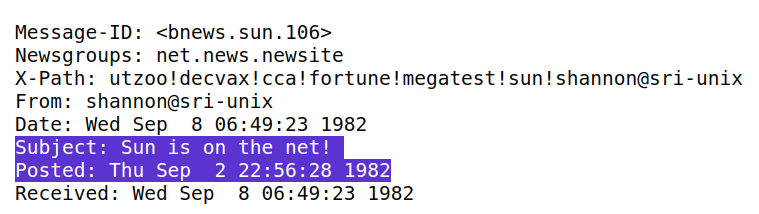
OTD 1982: #SunMicrosystems joins #USENET. https://www.krsaborio.net/bsd/research/1982/0908.htm #Suntember
"Ten years of the Venezuelan crisis - An Internet perspective"
#macroeconomics #InternetHistory
https://estcarisimo.github.io/assets/pdf/papers/2024-sigcomm-venezuela.pdf
How the Hourglass Won
Last week’s post about Internet architecture made several references to the hourglass design and how it has contributed to the Internet’s success. This week we are going back to the early days of the hourglass and considering the competition that was going on then among at least three competing visions for the future of networking. It was far from obvious that the Internet would emerge as the dominant architecture, so this week’s post examines how that competition played out.
https://systemsapproach.org/2024/08/19/how-the-hourglass-won/
IHI's cooperate.social Mastodon instance is now on version 4.2.11.
😢RouteViews archives have been down for over two hours. No access to the MRT files from any collectors as a result. Track the status here: https://status.bgpkit.com/incident/412974
I'll be returning to Internet studies this fall at Harvard, as a dual fellow of the Berkman Klein Center and the Law School's Library Innovation Lab. https://brk.mn/2425fellows
On the menu: preserving and curating the Internet's historical data collections; finding new ways to interpret that history and connect it to researchers and historians beyond our industry's technical core audience.
What a great group of people to be in fellowship with! Can't wait to see what develops this year. @IHI
I'm attending the Royal Society's wonderful celebration of the Internet's fiftieth birthday (+/-, depending on how one counts)! #i50
Beyond the love and admiration we all share for the efforts of the first 50 years, I'm glad to see panelists fielding questions about energy consumption and the challenges of bringing affordable Internet to underserved regions.
The @IHI digs into the second half of this period, curating Internet data history for future historians...
If you'd enjoy somewhat sporadic posts about preserving beloved Internet datasets, and ideas for how to get them into the hands of people studying humanity's hard problems, look no further: https://www.linkedin.com/groups/9806659/
We're delighted to welcome the @IHI to @dnsoarc as our newest blue member! 💙
Their mission to preserve and analyze Internet history aligns perfectly with our goals of advancing DNS understanding and security. Welcome aboard!
Read full article: https://bit.ly/43ZI9ii
Learn more about DNS-OARC at https://www.dns-oarc.net