@davefischer @hairyvisionary I love that I can post about the #EditDroid in the morning then get nuanced answers and discussion around vintage Sun computers in the evening.
Thanks for the clarification. I wouldn’t have known this.
@davefischer @hairyvisionary I love that I can post about the #EditDroid in the morning then get nuanced answers and discussion around vintage Sun computers in the evening.
Thanks for the clarification. I wouldn’t have known this.
Here’s a link to a 1985 USENIX paper describing a Unix window system for LucasFilm https://archive.org/details/1985-proceedings-summer-portland (page 393) related to the #EditDroid.
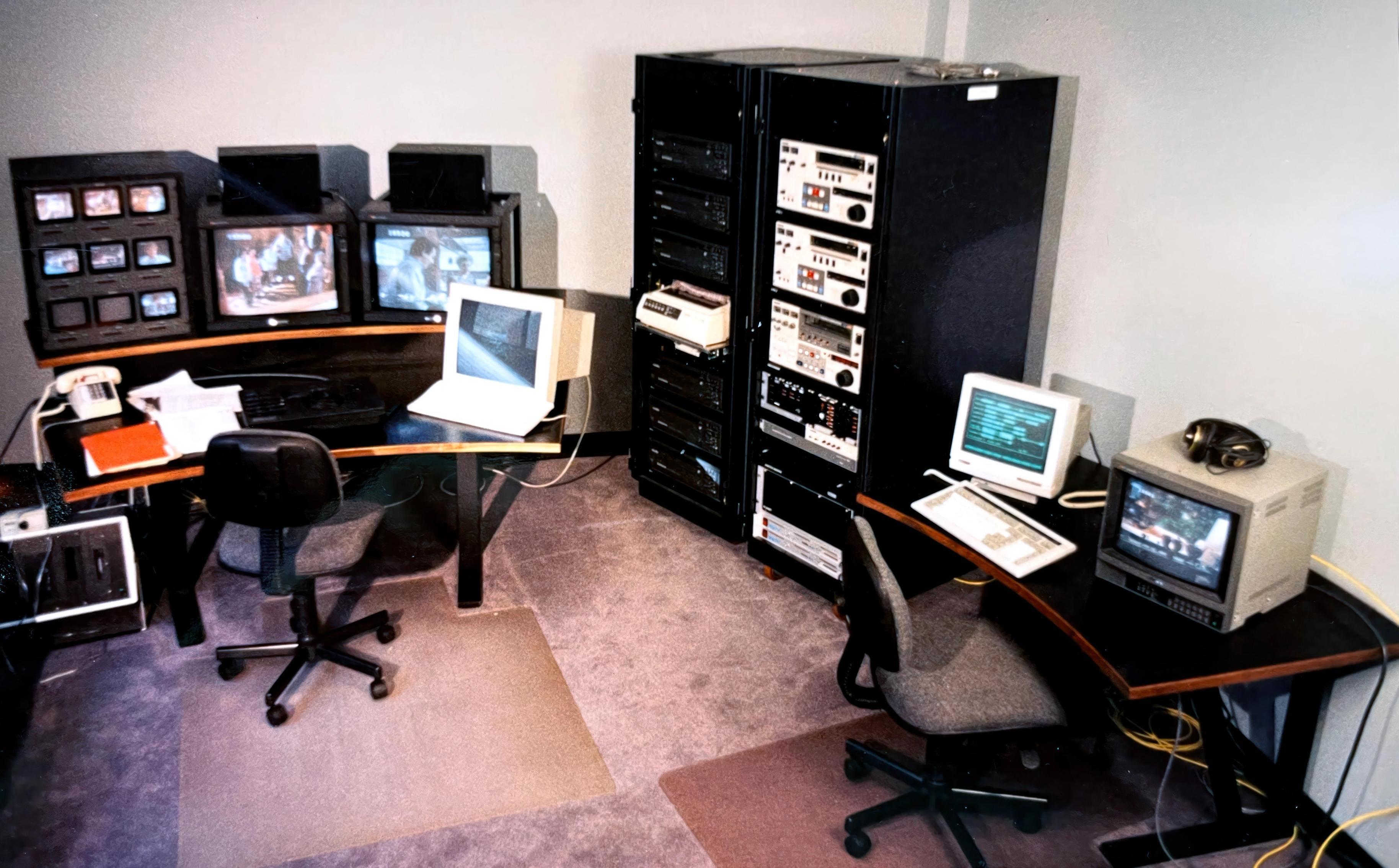
Despite the marketing material, this is what an actual EditDroid setup looked like in practice. Note the array of laserdisc players in the rack.
Someone uploaded a high-resolution copy of the original #EditDroid brochure:
http://typewritten.org/Articles/DroidWorks/ed-485.pdf
A Frequently Asked Questions document on The Droid Works letterhead:
http://typewritten.org/Articles/DroidWorks/qa-485.pdf
As well as a SoundDroid non-linear sound editing brochure, which apparently was developed first before they included video in the design.
http://typewritten.org/Articles/DroidWorks/sd-485.pdf
Very interesting history! I recommend folks go deep dive into this. I’ve literally been researching this topic for over 20 years.
The #EditDroid worked! It was used on a number of productions and was eventually displaced by the Avid/1 NLE system that had the new, superior approach of digitized video on hard drives vs. laserdiscs. Avid bought the EditDroid system from Droid Works and integrated many of its patents and technologies into their system.
I love this kind of retro computing history. It was a system way ahead of its time, like the Pixar Image Computer, had a short life, and relatively few details exist today.
A few years ago a lucky #LaserDisc hunter bought a laserdisc that was used as a demonstration of the #EditDroid system that contained 30 minutes of unedited Return of the Jedi footage.
The footage has since been uploaded to YouTube as well and is a great example of modern lost media. There exists today film, media, and audio that may exist on LaserDisc or VHS but has never been remastered or re-released otherwise. Some folks go around hunting those down as a hobby.
The system used an array of #Laserdiscs to store raw film footage. The players were linked to a control box that was controlled by a SUN Microsystems computer that allowed you to recall footage, make an edit decision list, it kept track of film frame numbers, and had many advanced features that allowed a classical film editor to use the system.
It interfaced with a jog shuttle knob to control the video.
Some footage of the #EditDroid at the NAB conference:
Last night I a wonderful #documentary about the #EditDroid - a non-linear video editor pre-dating the AVID/1 system in 1984. R&D was funded by George Lucas under his company, The Droid Works. Few folks are aware this even existed. I remember trying to research it maybe 20 years ago to no success. Since then many folks have uncovered various artifacts.
The documentary is on YouTube and is worth a watch if you like these types of historical, #retrocomputing deep dives.
Rest in peace Young Indiana Jones Chronicles Digital Editor Edgar Burcksen
#EdgarBurcksen #EditDroid #Lucasfilm
Rest in peace Lucasfilm editor Edgar Burcksen.
https://www.fanthatracks.com/news/film-music-tv/rest-in-peace-young-indiana-jones-chronicles-digital-editor-edgar-burcksen/?feed_id=21869