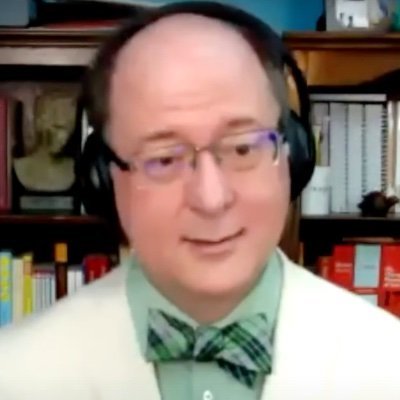
Lexicographer Jesse Sheidlower has been researching and writing about fuck for a fucking long time: nearly three decades. He’s also been an invaluable resource for the Strong Language blog since our very beginnings (almost ten years!). To celebrate the publication of the fourth edition of his magnum opus, The F-Word, we asked Sheidlower to share with Strong Language readers a bit about the book’s history, his research process, and what he likes to do when he’s not reading and writing about fuck. The interview was conducted over email.
[Read an excerpt of the new edition of The F-Word.]
[Buy The F-Word]
Strong Language: How did you land on fuck as your subject back in 1995? Have you always been interested in taboo words?
Jesse Sheidlower: There’s the “prosaic” answer and the “interesting” answer, both of which are true to an extent.
The interesting answer is that yes, I have always been interested in taboo words. In particular, I am interested in things that are, well, interesting, and in the case of taboo words, it’s something that many people have been interested in for a long time, but the subject was considered inappropriate for serious study, even until fairly recently. So in 1995, there just wasn’t that much serious scholarship out there about words like fuck, which meant there was a real opening to make a contribution to the field.
The prosaic answer is that I was particularly interested in the treatment of fuck in Jonathan Lighter’s Historical Dictionary of American Slang, which I was then editing for Random House, and I thought, “Surely everyone wants to know about this, but isn’t going to buy a massive (and incomplete) dictionary to find out more.” And I thought of suggesting publishing the fuck material as a separate volume, but I was also afraid to suggest this. Finally one day in an editorial meeting, where there weren’t many things on the table, I said, “What if we published a whole book on fuck, from HDAS?” and to my surprise and delight, everyone said “That’s a great idea!”
Jesse Sheidlower
SL: The first three editions of The F-Word contained forewords by humorists: Roy Blount Jr. for the first and second, Lewis Black for the third. Was it your decision, or that of your publisher, to treat the subject as humor? (The first edition even has cartoons!) What changed with the fourth edition, which has no foreword?
JS: There were a few things going on. One was that we were genuinely worried that publishing an entire book about the word fuck would lead to legal or political problems; treating it as inherently humorous would be one way to mitigate this. Another was that it is intrinsically amusing, so why not build on this? I don’t think the cartoons were necessary, and I would have preferred a more readable typeface in the first two editions. But I think the decision to include funny but thoughtful commentary from two very different humorists was a good one. As for the fourth edition, by now we felt the material spoke for itself.
SL: Are you surprised that The F-Word is now in a fourth edition? Did you
expect to be involved in the subject for 30 years?
JS: I confess to being a little surprised! At the start, I don’t think I expected it to go through that many updates. But it’s felt appropriate each time: the second edition included additional material outside of what we drew from HDAS; the third edition doubled the size of the text, based on my access to the OED’s archives; this new edition benefits from a greatly expanded range of online resources available to me. And the word continues to be used in new and interesting ways, so there’s more work to do!
SL: Has anything surprised you about the reception to the book (in any edition)?
JS: I was pleasantly surprised at how seriously people took it. As mentioned, I do think the word is extremely interesting, but I was also, as also mentioned, concerned that there would be a strongly negative reaction — that it was “dirty,” that I was making the world a worse place, and so forth. That didn’t happen at all. So I’m glad people can appreciate that studying this is a way to learn more about humanity, and not just an excuse to be vulgar.
SL: Was any entry a particular joy to work with? A particular pain in the ass?
JS: The entry for fuck interjection was especially challenging. The OED only records a single sense, as an interjection “expressing anger, despair, frustration, alarm, etc.,” with a first quotation from 1929. This is the kind of use that’s particularly hard to research: It’s chiefly spoken, and not the kind of speech that tends to get written down; it’s not sexual, so it’s unlikely to get recorded for prurient purposes; it’s not the kind of insulting use that might get recorded in legal records.
In the early 2010s, there was extensive research done on sound recordings from the Volta Laboratories, an institution founded by Alexander Graham Bell to develop various telecommunication technologies. Archivists were able to restore some extremely early recordings, from 1885. One of these recordings, in which a lab assistant recited “Mary Had a Little Lamb,” was interrupted midway by some kind of technical failure, and the speaker said something very indistinct, but which may be “Oh, fuck!” After consulting with Mark Liberman, a phoneticist at the University of Pennsylvania, I decided to include this as the earliest example of this use, a significant and important antedating.
Another possible antedating of this sense appears in the Clara Bow film Hula, a 1927 silent. This film is known in particular for its scandalous opening scene, featuring Bow bathing nude in a stream. Less widely discussed is the fact that in this scene, Bow is stung by a bee, and appears to utter the word “Fuck!” This can’t be cited directly, but I did include this in brackets as a possible example.
I also added an even earlier sense, the use of fuck interjectionally, chiefly reduplicatively, during intercourse. This is rather common in Victorian erotica, and thereafter. The modern examples feel like the regular current use, and could be interpreted as “Oh!” or the like, but this is clearly a different use than the OED interjection of anger or despair, with an unbroken history back to the early 1870s.
Another new addition is the chiefly British use of fuck after an auxiliary verb and a pronoun to indicate dismissal of a previous statement, as in “Will I fuck!” or “Do I fuck!” Jonathon Green has an example from T.E. Lawrence in 1922.
Finally, I added the phrasal entry fuck yeah or fuck yes, which is found from 1962, in reference to World War II, and likely to have been used then, but not recorded.
SL: You cite the Internet Archive as a valuable resource this time around. Any specifics you can share?
JS: I can’t overstate the importance of the Internet Archive; it might not have been possible to do this edition without it. It holds an immense of amount of material about everything, so you don’t just get mainstream fiction (which is itself, of course, very useful), but all sorts of things you don’t normally think of. For example, high school and college yearbooks are an immensely valuable source for informal writing, but hardly anyone has used them for linguistic research before. I quote over a dozen yearbooks, all from the Internet Archive, in this edition, in many cases providing the earliest example we have: “fuck ’em if they can’t take a joke,” from Baltimore in 1971; “fuck you and the horse you rode in on” in Massachusetts in 1964; MFWIC ‘motherfucker what’s in charge’ from the US Air Force Academy in 1963. This material just can’t be found anywhere else.
SL: Are there any fuck-expressions you’re continuing to track – perhaps
discovered too late for this edition, but worth keeping an eye on?
JS: Tons. Mostly not ones that I discovered too late, but ones that I didn’t really have enough evidence for. Some of these include Fuckeye ‘a student or supporter of [The] Ohio State [University],’ found in the (University of Michigan) slogan Buck the Fuckeyes; the initialism FYTW ‘fuck you that’s why’; and Nofuck, a mocking term for Norfolk, Virginia. In most such cases, I did have a number of quotations, but it just felt like the entries weren’t really ready.
There’s also a large variety of terms collected from pornography; in the introduction I mention fuck canal, fuck cave, and fuck channel, all referring to the vagina, all attested more than once, and all omitted from the book. Many such terms feel like they’re literary affectations, not in genuine use, and if they didn’t appear anywhere other than pornography, I often decided to leave them out.
SL: What are your other lexicographical and non-lexicographical interests?
JS: I love historical lexicography in general, and I love researching things that need attention! My main non-offensive project is the Historical Dictionary of Science Fiction; this was based on an OED project that I revived at the start of the pandemic. It’s in very good shape now, though I continue to add to it. I’m interested in expanding this into other, semi-related fields; in particular, gaming terminology, especially RPGs and videogames, is something that’s culturally important but under-researched. But I don’t have enough personal knowledge to take it on myself; if I had a collaborator and an academic institution interested in the research, I’d love to take it on.
Apart from the language game, I’m very interested in cocktails. A colleague and I had a high-end cocktail bar, the Threesome Tollbooth, that had to close with the pandemic; since then I’ve been involved with some private or underground events, but we hope to reopen the bar, or perhaps start something new.
SL: What’s your favorite F-word/expression? One you wish had greater
currency? One that amuses you?
JS: In general lexicographers try not to identify “favorite” expressions; we have to give attention to everything, not just the ones we especially like. So I’ll beg off this one.
SL: One last self-interested question: Was the Strong Language blog a resource? It’s OK if it wasn’t. But if it was, we’ll preen a little.
Of course I’ve always been a big fan of our site! In general, though, I try not to quote from linguists directly; a blog talking about the linguistics of offensive language is not the best source for this reason. I do have one quotation, though: Stan Carey using AMF ‘adios, motherfuckers!’ in his entry “OMFG! Sweary Abbreviations FTFW!” from 2015.
https://stronglang.wordpress.com/2024/11/05/jesse-sheidlower-answers-our-questions-about-the-f-word/
#JesseSheidlower #TheFWord