#publicDomainDayCountdown

Who ordered this timeline?

There’s the 1980 we know from memory and history, and there’s the 1980 of Just Imagine, where people have names like “J-21”, need permits to marry, and travel in both dirigibles and Mars rockets. For Wonder Stories, the movie, 27 days away from the public domain, was “for those who do not take their science fiction too seriously”, and the mix of futuristic setting with already-dated vaudeville bits was a box-office bomb. But the Oscar-nominated visuals remain striking. #PublicDomainDayCountdown

#publicdomaindaycountdown

Project Gutenberggutenberg_org
2025-12-05

“Harlem is today the Negro metropolis”

James Weldon Johnson's "Black Manhattan" traces Black New Yorkers' lives and art from 17th-century New Amsterdam through the Jazz Age, showing the Harlem Renaissance as culmination, not miracle.

By John Mark Ockerbloom

everybodyslibraries.com/2025/1

Cover image of the book Black Manhattan
by Johnson, James Weldon, 1871-1938

The 1930 first edition cover of James Weldon Johnson's "Black Manhattan," published by Alfred A. Knopf. The minimalist design features bold black typography overlaid on an abstract red grid pattern suggesting city streets or architecture.

https://archive.org/details/blackmanhattan00john_1/page/n10/mode/1up

“Harlem is today the Negro metropolis”

By 1930, the Harlem Renaissance was undeniably a major force in American culture. While to many the rising visibility of New York Black artists might seem like “a miracle straight out of the skies”, James Weldon Johnson wrote that it was a long time coming. His Black Manhattan tells the story of Black New Yorker’s lives and artistic creations from 17th century New Amsterdam through the Great Migration and the Jazz Age. Johnson’s book joins the public domain in 28 days. #PublicDomainDayCountdown

#publicdomaindaycountdown

Project Gutenberggutenberg_org
2025-12-04

Ogden Nash makes a splash

Ogden Nash found success after The New Yorker hired him in 1930, launching a long career of humorous, playful verse. His earliest published poems enter public domain pretty soon.

By John Mark Ockerbloom

everybodyslibraries.com/2025/1

Photo of panelist Ogden Nash and Dagmar from the television game show Masquerade Party.

This 1950s photo shows poet Ogden Nash with actress/TV personality Dagmar on the game show "Masquerade Party." Nash, wearing glasses and bow tie, sits at a panel desk while the glamorous Dagmar stands beside him.

via ABC Television

https://en.wikipedia.org/wiki/Ogden_Nash#/media/File:Ogden_Nash_Dagmar_Masquerade_Party_1955.jpg

Ogden Nash makes a splash

"I would live all my life in nonchalance and insouciance
Were it not for making a living, which is rather a nouciance"

Ogden Nash had tried to make a living teaching, selling bonds, and writing ad copy. But after he sent some satirical lines to The New Yorker, the magazine offered him a job. Nash’s verse debuted there in 1930, the start of a long career of humor and wordplay. His earliest published poems, including the couplet above, join the public domain in 29 days. #PublicDomainDayCountdown

#publicdomaindaycountdown

Project Gutenberggutenberg_org
2025-12-03

Destry’s long ride to the public domain

Max Brand's Destry became a symbol of Western clichés through multiple adaptations since 1930, though the famous versions strayed far from his original revenge-and-redemption tale of wrongful conviction.

By John Mark Ockerbloom

everybodyslibraries.com/2025/1

This is the front cover art for the book Destry Rides Again (novel). The book cover art copyright is believed to belong to the publisher or the cover artist.

Destry Rides Again was first published in 1930, in a series of installments under the title "Twelve Peers" in Frank Blackwell's Western Story Magazine. It was republished, as a paperback, later that year under the title Destry Rides Again. The word "again" in the title refers to Destry's renewed freedom to ride after being let out of prison, not to any previous story; this novel was the Destry character's fiction debut.

https://en.wikipedia.org/wiki/Destry_Rides_Again_(novel)#/media/File:Destry_Rides_Again_(novel).jpg

Destry’s long ride to the public domain

Destry Rides Again and Again and Again” quipped John D. Weaver in a 1963 article that uses Max Brand’s character as a symbol of western cliches. By then Destry’s story, first serialized in 1930 in Western Story Magazine as “Twelve Peers”, had multiple adaptations, but the best-known had little to do with Brand’s novel, a tale of Destry’s revenge and repentance after a stacked jury wrongly convicts him. The original Destry Rides Again joins the public domain in 30 days. #PublicDomainDayCountdown

#publicdomaindaycountdown

Project Gutenberggutenberg_org
2025-12-02

“It takes two people to make you, and one people to die”

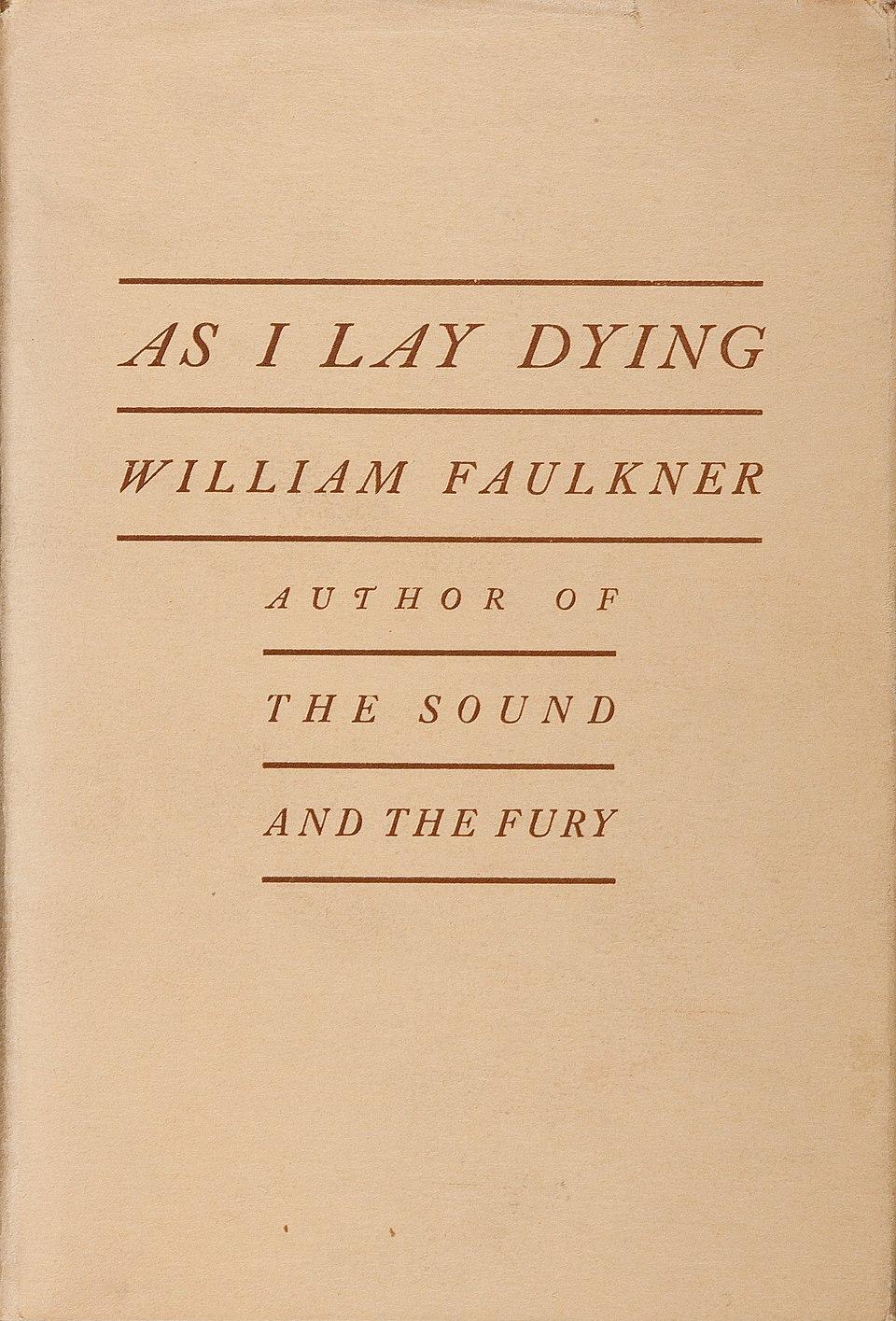
Faulkner's "As I Lay Dying," set in Yoknapatawpha County, enters US public soon. Despite 15 stream-of-consciousness narrators making it challenging, Holly at Nut Free Nerd explains why it's worth reading.

By John Mark Ockerbloom

everybodyslibraries.com/2025/1

First-edition dust jacket cover of As I Lay Dying (1930) by the American author William Faulkner.

Published in New York by Jonathan Cape and Harrison Smith.

https://en.wikipedia.org/wiki/As_I_Lay_Dying#/media/File:As_I_Lay_Dying_(1930_1st_ed_jacket_cover).jpg

“It takes two people to make you, and one people to die”

The Public Domain Review has begun its own #PublicDomainDayCountdown to 2026, featuring works and authors joining the public domain in countries around the world.

It leads off with William Faulkner’s As I Lay Dying, a sprawling family drama set in his Yoknapatawpha County that joins the public domain in the US in 31 days. With 15 different characters narrating in stream-of-consciousness style, it’s not the easiest book to get into. Holly at Nut Free Nerd writes why the book’s worth the effort.

#publicdomaindaycountdown

Project Gutenberggutenberg_org
2025-12-01

Betty Boop has her moment

Fleischer Studios' Bimbo cartoons succeeded in 1930, but Betty Boop stole the show debuting in "Dizzy Dishes" singing "I Have to Have You." She starred in 100+ cartoons, undergoing makeovers due to censorship, per Emily Wishingrad.

By John Mark Ockerbloom

everybodyslibraries.com/2025/1

The caption claims that Betty Boop was indeed based on Helen Kane. This was published before the lawsuit in May.

Photoplay, April 1932

This is an image from Photoplay magazine showing a side-by-side comparison. On the left is a black and white photograph of Helen Kane, a performer dressed in an elaborate ruffled costume with tiered skirts and decorative trim, posing against a curtained background. On the right is a drawing of Betty Boop in her iconic cartoon style - with her characteristic large round eyes, short curly black hair with a spit curl, and a short black dress showing her distinctive garter.

The caption below reads: "Folks, meet Betty Boop (right). You'll be seeing a lot of her because she is the new animated cartoon character who is trying to cut in on Mickey Mouse's popularity. Does she look familiar to you? Now look at little boop-a-dooper Helen Kane. Helen was the cartoonist's inspiration for Betty, the first time a real life character has been used for the popular jumping comics"

This is significant because it was published in April 1932, before Helen Kane filed her famous lawsuit against Fleischer Studios in May 1932, claiming that Betty Boop was an unauthorized use of her likeness and persona. The magazine's straightforward acknowledgment that Kane was the inspiration for Betty Boop provides important historical documentation of how the character's origins were publicly understood at the time.

https://archive.org/details/photo42chic/page/n491/mode/2up

Betty Boop has her moment

The Fleischer Studios found success in 1930 with a series of cartoons starring Bimbo, a rascally anthropomorphic dog. But when a curvaceous human with some canine features sang “I Have to Have You” in Dizzy Dishes, both Bimbo and movie audiences fell hard for her. Betty Boop went on to star in over 100 cartoons, with multiple makeovers prompted in part by censors, as Emily Wishingrad chronicles in Smithsonian. Her first appearances join the public domain in 32 days. #PublicDomainDayCountdown

#publicdomaindaycountdown

Project Gutenberggutenberg_org
2025-11-30

“From the chintz-covered drawing-rooms… straight into hell”

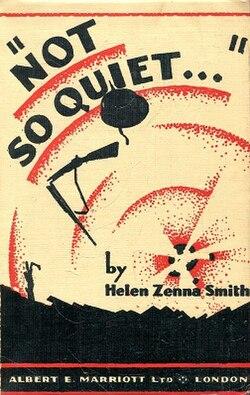
Evadne Price's "Not So Quiet...Stepdaughters of War," inspired by a real ambulance driver's diary, powerfully depicts war's horrors. Lucy Scholes calls it "a shattering denunciation of the jingoism that kept the war machine turning."

By John Mark Ockerbloom

everybodyslibraries.com/2025/1

More about it:
en.wikipedia.org/wiki/Not_So_Q

Cover of the book Not So Quiet: Stepdaughters of War is a 1930 novel by British author Evadne Price writing under the pseudonym "Helen Zenna Smith". 

The image shows the cover of the novel Not So Quiet… by Helen Zenna Smith. The design uses a stark, graphic style in black and red on a cream background. At the top, the title is printed in large, bold, uneven lettering: “NOT SO QUIET…”, with quotation marks placed dramatically before and after.

The central illustration is abstract and wartime-themed: a silhouetted rifle hangs from the left, and concentric red arcs radiate outward like shock waves or explosions. Near the bottom right, small black silhouettes suggest figures or shapes caught in the blast zone. The landscape at the bottom is a jagged black horizon, evoking a battlefield.

https://en.wikipedia.org/wiki/Not_So_Quiet:_Stepdaughters_of_War#/media/File:Not_So_Quiet.jpg

“From the chintz-covered drawing-rooms… straight into hell”

Evadne Price was asked to write a lighthearted spoof of All Quiet on the Western Front, but went a different way after reading the diary of a woman ambulance driver in France. Not So Quiet…Stepdaughters of War pulls no punches describing people put into the meat-grinder of war by those comfortably far from danger. Lucy Scholes calls her feminist novel, joining the US public domain in 33 days, “a shattering denunciation of the jingoism that kept the war machine turning.” #PublicDomainDayCountdown

#publicdomaindaycountdown

Project Gutenberggutenberg_org
2025-11-29

“The road leads back to you”

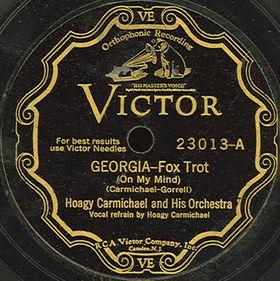
"Georgia on My Mind" by Hoagy Carmichael is likely about the state, not his sister. Ray Charles' version became Georgia's official song. Legend says Carmichael paid royalties to lyricist Stuart Gorrell after omitting him from copyright, but both names appear on the 1930 record.

By John Mark Ockerbloom

everybodyslibraries.com/2025/1

This is a photograph of a vintage Victor Records label from 1930. The label features the classic Victor design with ornate golden decorative scrollwork framing the text against a black background. At the top is the Victor company logo.

The record label shows:

Catalog number: 23013-A
Song title: "GEORGIA—Fox Trot" with "(On My Mind)" in parentheses
Composer credit: "(CARMICHAEL-GORRELL)"
Artist: "Hoagy Carmichael and His Orchestra"
Vocal credit: "Vocal Refrain by Hoagy Carmichael"

This is significant historical evidence showing that both Hoagy Carmichael and Stuart Gorrell were credited as co-writers from the original 1930 recording, contradicting the legend that Carmichael initially left Gorrell off the copyright and later voluntarily paid him royalties. The label clearly shows both names were credited from the beginning.

https://en.wikipedia.org/wiki/Georgia_on_My_Mind#/media/File:Hoagy-georgia-on-my-mind.jpg

“The road leads back to you”

“Georgia on my mind” has a long and legendary history. While some say the song’s “Georgia” was composer Hoagy Carmichael’s sister, it’s now generally understood to be the state, particularly since Georgia’s own Ray Charles recorded it. His version was made Georgia’s official state song.

Another legend says Carmichael voluntarily paid royalties to lyricist Paul Gorrell after he was left off the copyright, which ends in 34 days. But I found both names on the 1930 record. #PublicDomainDayCountdown

#publicdomaindaycountdown

Project Gutenberggutenberg_org
2025-11-28

“You must sometime fight it out or perish”

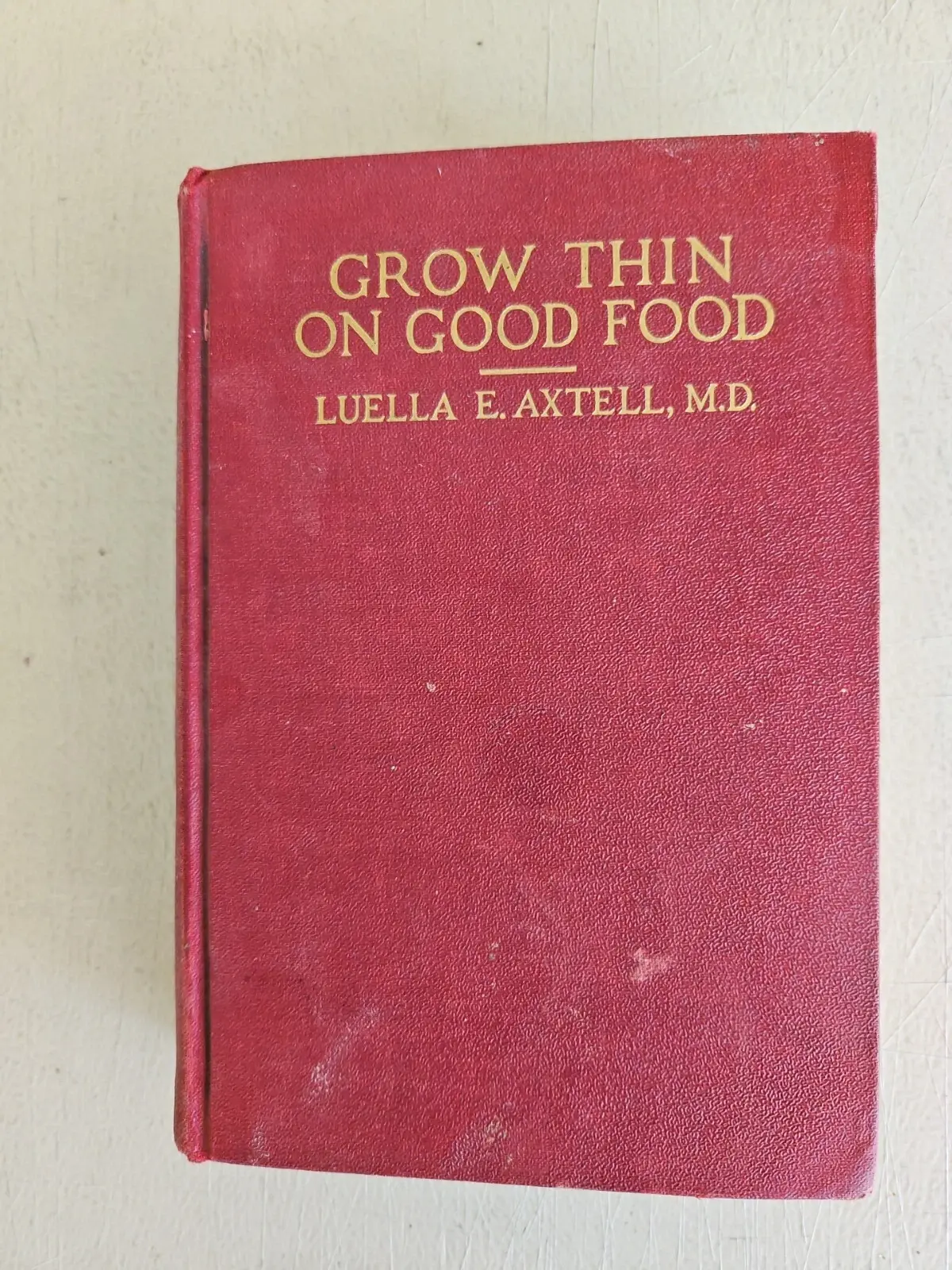
Dr. Luella Axtell, a Marinette physician and civic advocate, promoted public health, the environment, and women’s rights. Her book Grow Thin on Good Food offered sensible diet-and-exercise advice ahead of its time.

By John Mark Ockerbloom

everybodyslibraries.com/2025/1

Cover image of the book Grow Thin on Good Food by Luella E. Axtell, M.D.

he book cover shown is a plain, deep red hardback with a textured surface. Centered near the top, the title “GROW THIN ON GOOD FOOD” is printed in bold, gold uppercase lettering. Beneath it, also in gold, is the author’s name: “LUELLA E. AXTELL, M.D.”

“You must sometime fight it out or perish”

Dr. Luella Axtell set up practice with her husband in 1900 Marinette, Wisconsin, and remains a local hero for her public service and advocacy for public health, environmental protection, and women’s rights. She even features in a recent local murder mystery.

Her well-reviewed Grow Thin on Good Food gives diet and exercise advice similar to today’s, avoiding pop culture’s “one weird trick” fads (if not entirely its fat-shaming). It joins the public domain in 35 days. #PublicDomainDayCountdown

#publicdomaindaycountdown

Project Gutenberggutenberg_org
2025-11-27

“No-one in the room but the corpse”

Charles Williams, a lesser-known Inkling who influenced Lewis, Tolkien, and Eliot, debuted with War in Heaven, a supernatural thriller mixing mystery, Christian themes, and a mystical quest for a powerful artifact.

By John Mark Ockerbloom

everybodyslibraries.com/2025/1

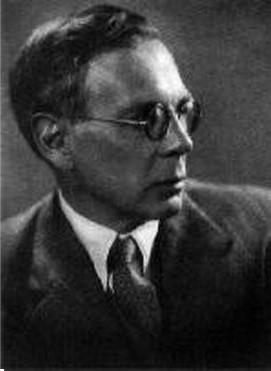
Charles Walter Stansby Williams

Williams is shown from the chest up, seated and facing slightly to his right while looking toward the camera with a thoughtful expression. He wears round spectacles, a dark suit, and a neatly knotted tie. His hair is combed back, slightly tousled on top.

https://en.wikipedia.org/wiki/Charles_Williams_(British_writer)#/media/File:Charles_Walter_Stansby_Williams.jpg

“No-one in the room but the corpse”

Charles Williams is not as well known today as his fellow Inklings CS Lewis and JRR Tolkien. But his work influenced theirs, and that of other writers like TS Eliot. The first of his supernatural thrillers, War in Heaven (reviewed here), opens like a detective story with a dead body, and closes like a mystical experience with another one, along the way including Christian themes and a quest focused on an object of great power. It joins the US public domain in 36 days. #PublicDomainDayCountdown

#publicdomaindaycountdown

Client Info

Server: https://mastodon.social
Version: 2025.07
Repository: https://github.com/cyevgeniy/lmst