#renewingTheMind

Intentional Faithmhoggin@pastorhogg.net
2026-01-16

Rescued for Obedience

As the Day Ends

“For I delight in the law of God in my inner being, but I see another law at work in my members, waging war against the law of my mind… Who will rescue me from this body of death? Thanks be to God—through Jesus Christ our Lord.”
Romans 7:22–25

As the day draws to a close, many of us feel the quiet tension Paul describes so honestly in Romans 7. There is a part of us that genuinely longs for God, that delights in His ways and desires to walk faithfully. Yet there is another part that resists, grows weary, or slips back into old patterns. Evening has a way of making this tension more visible. The noise of the day subsides, defenses lower, and we become more aware of the gap between who we want to be and how we actually lived. Paul does not deny this struggle, nor does he excuse it. He names it as a real battle, one that takes place not only in our actions, but in our minds.

The striking insight in Paul’s confession is that obedience begins before behavior. He delights in God’s law internally even while wrestling externally. This tells us something important as we wind down tonight: long-term obedience does not begin with flawless performance, but with faith. Faith that God’s rescue is real. Faith that transformation is possible. Faith that we are not destined to remain trapped in the same cycles forever. The mind becomes the battlefield where surrender or resistance takes root. When we believe we are incapable of change, obedience feels impossible. When we trust that God has already acted decisively through Christ, obedience becomes a response rather than a burden.

Paul’s cry, “Who will rescue me?” is not despair; it is clarity. He understands that self-effort alone cannot win this war. The rescue he names is not future-only, but present and ongoing. “Thanks be to God—through Jesus Christ our Lord.” In Christ, the sentence of captivity has been broken. The power of sin has been confronted at its root. As the evening settles in, this truth invites us to release the weight of self-condemnation. The day may have revealed weaknesses, but it has not revoked grace. We are not prisoners forced to obey sin; we are redeemed people learning how to live free.

Ending the day in communion with God means allowing this rescue to shape our thinking before sleep. The mind rehearses either accusation or truth as we rest. Paul’s prayer-like confession reminds us that surrendering the mind to God is an act of trust. We do not have to solve everything tonight. We place the unresolved struggles, the repeated failures, and the unfinished obedience into God’s hands. Tomorrow’s faithfulness begins with tonight’s surrender.

A Triune Prayer

Father, as this day comes to an end, I come before You honestly and without pretense. You know the desire of my heart to walk in Your ways, and You also see where I struggled, resisted, or grew weary. I thank You that Your love for me does not fluctuate with my performance. You are faithful even when I am inconsistent. Tonight, I lay down the false belief that I must conquer sin by my own strength. Help me trust Your wisdom and Your patience as You continue Your work in me. Teach me to rest in Your authority rather than striving in fear.

Jesus, my Deliverer and Savior, I thank You that You entered fully into human weakness so that I would never face this battle alone. You rescued me not only from the penalty of sin, but from its claim over my life. When I feel discouraged by repeated struggles, remind me that obedience flows from relationship, not from shame. I place my failures from this day at the foot of Your cross, trusting that Your grace is sufficient and Your power is still at work. Shape my desires so that following You becomes my deepest joy, not my heaviest burden.

Holy Spirit, Comforter and Spirit of Truth, I invite You to guard my mind as I rest tonight. Where accusations try to linger, speak truth. Where fear whispers that change is impossible, remind me of the freedom Christ has already secured. Help me understand that the battle over my body begins in my thoughts, and teach me to yield my mind to You daily. Renew my inner life as I sleep, preparing me to walk more faithfully tomorrow than I did today. I rest in Your presence, trusting Your quiet and steady work within me.

Thought for the Evening:
Long-term obedience begins by trusting tonight that God’s rescue is real, active, and still at work in you.

For further reflection on Romans 7 and the struggle between flesh and Spirit, see this helpful resource from Desiring God:
https://www.desiringgod.org/articles/what-does-romans-7-mean

FEEL FREE TO COMMENT, SUBSCRIBE, AND REPOST, SO OTHERS MAY KNOW


#ChristianEveningPrayer #freedomInChrist #obedienceAndFaith #renewingTheMind #Romans7Devotion

Clear Your Mind Without Losing Your Soul: Why Jesus Succeeds Where Stoicism Stops

1,230 words, 7 minutes read time.

Why Modern Men Feel Mentally Under Siege

There’s a reason so many men today feel like their minds are under constant attack. We wake up already behind, already reacting, already measuring ourselves against lives we don’t live and standards we didn’t choose. Notifications hit before our feet touch the floor. Old regrets resurface at night like ghosts with unfinished business, replaying conversations, decisions, and failures on a loop. Anxiety no longer feels like a medical condition reserved for the fragile; it feels like the default operating system for modern life. In that relentless mental noise, it’s not surprising that men go looking for anything that promises order, clarity, and strength—something that can quiet the chaos without requiring vulnerability.

Why Stoicism Appeals to the Modern Mind

Into that chaos, Stoicism makes a compelling pitch. And to be clear from the outset, there is much within Stoic thought that can be learned from. Stoicism takes the inner life seriously. It emphasizes discipline, attention, responsibility, and the refusal to be ruled by impulse. Those are not small virtues, and dismissing them outright would be intellectually lazy. But where Stoicism ultimately points inward for the solution, I believe the answer lies elsewhere. Stoicism promises calm without faith, discipline without dependence, and control without vulnerability. For men tired of emotional fragility and spiritual ambiguity, it sounds strong, clean, and rational. It tells you the problem isn’t the world. The problem is your reaction to it. Christianity agrees that the mind matters—but it insists that lasting peace does not come from mastering the self. It comes from surrendering the self to God.

Stoicism Was Forged in Hard Times—And That Matters

To be fair, Stoicism is not naïve or shallow. It was forged in a brutal world of war, exile, disease, and political instability. Marcus Aurelius ruled an empire during plagues and invasions. Epictetus lived as a slave before becoming a teacher of philosophy. These were not men lounging in ivory towers offering abstract self-help advice. They were men under pressure, searching for a kind of peace that could not be stripped away by external circumstances. That historical context explains why Stoicism still resonates today. We recognize ourselves in their instability, and we admire their refusal to collapse under it.

Where Stoicism Gets the Diagnosis Right—but the Cure Wrong

Here is the uncomfortable truth. Stoicism correctly identifies the battlefield of the mind, but it misidentifies the source of power. It diagnoses the disease accurately while prescribing a treatment that ultimately collapses under the weight of human limitation. Stoicism believes the mind can be trained into sovereignty through awareness, discipline, and detachment. Christianity does not deny the need for discipline, but it denies the myth of self-sufficiency. The human will, no matter how refined, is not strong enough to save itself from itself.

Self-Mastery Versus Surrender to God

Stoicism teaches you to stand unmoved at the center of the storm. Jesus teaches you to kneel—and in kneeling, to find a kind of rest Stoicism can never produce. That difference is not semantic; it is foundational. Stoicism aims for independence from circumstance. Christianity aims for dependence on God. The Stoics were right about one thing: the mind matters. Where they went wrong is believing the mind could redeem itself through effort alone.

Attention, Rumination, and the Power of Thought

Stoicism’s central insight is that attention feeds suffering. Obsess over what you cannot control, and anxiety multiplies. Rehearse the past, and bitterness deepens. Fixate on imagined futures, and fear becomes prophetic. Modern neuroscience confirms this pattern. Rumination amplifies stress responses. Attention strengthens neural pathways. What you rehearse, you reinforce. On this point, Stoicism and modern psychology shake hands. But agreement on mechanism does not equal agreement on meaning.

Mental Discipline Without a Throne for the Self

The Stoic solution is mental discipline. Observe thoughts without attachment. Redirect attention toward what is within your control. Detach emotion from identity. In short, become sovereign over your internal world. Christianity does not reject discipline, but it refuses to crown the self as king. Scripture presents the mind not as an autonomous observer but as contested territory. The apostle Paul describes thoughts as something that must be actively captured and submitted, not merely watched as they drift by. The mind is not neutral. It is bent. It wanders. Left to itself, it does not become calm; it becomes clever in self-deception.

“You Are Not Your Thoughts” — A Half-Truth

Stoicism says you are not your thoughts; therefore, do not be disturbed by them. Christianity responds that your thoughts reveal what you love, fear, and trust; therefore, they must be confronted and transformed. That difference matters more than it appears. Passive detachment can produce numbness, but it cannot produce repentance, wisdom, or holiness. Christianity does not merely ask you to observe your thoughts. It asks you to judge them in the light of truth.

Anger, Fear, and Suffering: Two Very Different Roads

The Stoic approach to anger is detachment. The Christian approach is discernment followed by repentance or righteous action. The Stoic approach to fear is acceptance. The Christian approach is trust anchored in the character of God. The Stoic approach to suffering is endurance. The Christian approach is endurance infused with hope rooted in resurrection. Stoicism seeks order. Christianity seeks obedience. One wants equilibrium; the other wants alignment with reality as God defines it.

The Quiet Overreach of Stoic Self-Confidence

This is where Stoicism quietly overreaches. It assumes that with enough awareness and training, the human will can govern itself. History, Scripture, and lived experience all disagree. If self-control were sufficient, humanity would have solved itself long ago. The Bible does not flatter our mental strength. It assumes weakness and builds grace into the system. Transformation is not self-authored; it is received, practiced, and sustained by the Spirit of God.

Why Stoic Calm Cracks Under Real Weight

This is why Stoic calm often fractures under real trauma, grief, or moral failure. When control is the foundation, collapse becomes catastrophic. Christianity offers something sturdier. It offers rest that exists even when control is lost. Jesus does not say, “Master your thoughts and you will find peace.” He says, “Come to me, all who are weary, and I will give you rest.” That is not an invitation to passivity. It is an invitation to reorder authority.

Christian Mental Discipline Starts With Surrender

Christian mental discipline begins with surrender, not assertion. The mind is renewed not by isolation but by exposure to truth. Scripture does not merely replace bad thoughts with neutral ones; it replaces lies with reality. That is why biblical renewal is not visualization or redirection. It is confrontation. Truth crowds out distortion. Worship displaces anxiety. Prayer redirects attention not inward but upward.

Suffering, Preparation, and the Larger Story

There is also a crucial difference in how each system handles suffering. Stoicism prepares for loss by imagining it until its sting fades. Christianity prepares for suffering by placing it inside a larger story. One reduces pain through mental rehearsal. The other redeems pain through meaning. Stoicism can make you resilient. Christianity makes you anchored.

Focus, Distraction, and Modern Overstimulation

The modern man doesn’t need more detachment. He needs clarity rooted in something bigger than his own mental stamina. Attention discipline matters, but attention must be ordered under truth, not autonomy. Focus without purpose becomes obsession. Calm without hope becomes numbness. Jesus does not promise the absence of storms. He promises presence within them. That distinction changes everything.

Grace Does Not Replace Discipline—It Redirects It

When you submit your mind to Christ, you are not abandoning discipline. You are relocating it. Thoughts are still examined. Distractions are still resisted. Focus is still cultivated. But the source of strength is no longer internal grit. It is grace. That grace does not make men weak. It makes them honest.

The Goal Is Not an Empty Mind, but a Faithful One

The goal is not an empty mind. It is a faithful one. A mind aligned with reality. A mind that knows when to fight, when to rest, and when to trust. Stoicism offers silence. Jesus offers peace. One teaches you to stand alone. The other invites you to walk with God. And that is why, for all its insights, Stoicism will always stop short of what the human soul actually needs.

Call to Action

If this article challenged you, sharpened you, or unsettled you in a good way, don’t let the thought drift away unused. Subscribe for more, share a comment about what God is teaching you, or reach out and tell me what you’re reflecting on today. The mind matters—but only when it’s anchored to something strong enough to hold it.

D. Bryan King

Sources

Disclaimer:

The views and opinions expressed in this post are solely those of the author. The information provided is based on personal research, experience, and understanding of the subject matter at the time of writing. Readers should consult relevant experts or authorities for specific guidance related to their unique situations.

#anxietyAndFaith #attentionDiscipline #biblicalCounselingConcepts #biblicalFocus #biblicalMindfulness #biblicalWorldview #ChristianApologetics #christianContentMarketing #ChristianEthics #ChristianGrowth #ChristianMasculinity #ChristianMeditation #christianMentalDiscipline #christianPhilosophy #christianPhilosophyBlog #ChristianReflection #christianSelfDiscipline #ChristianSpirituality #ChristianTruth #ChristianWisdom #ChristianWorldview #christianWorldviewBlog #clearYourMind #controllingThoughts #disciplineAndGrace #faithAndReason #faithBasedMindset #faithFocusedMindset #faithOverSelfControl #gospelCenteredLiving #gospelTruth #jesusAndMentalHealth #jesusOverStoicism #maleChristianAudience #menAndSpirituality #mentalClarityFaith #mentalPeaceJesus #mindRenewalScripture #overcomingAnxietyBiblically #peaceThroughChrist #philosophyAndFaith #philosophyForMen #practicalChristianLiving #renewingTheMind #scriptureBasedLiving #spiritualFocus #spiritualFormation #spiritualResilience #spiritualWarfareMind #stoicPhilosophyAnalysis #stoicismAlternatives #stoicismCritique #stoicismExplained #stoicismVsChristianity #surrenderToGod #theologyOfTheMind #thoughtDiscipline #thoughtLife #toxicThoughts

Man standing between Stoic rigidity and warm spiritual light, representing the contrast between self-mastery and faith-based peace.
Intentional Faithmhoggin@pastorhogg.net
2025-12-10

The Quiet Power That Shapes Your Day

As the Day Begins

Meditation

“As he thinks in his heart, so is he.” Few verses capture the inner architecture of the spiritual life as clearly as Proverbs 23:7. Scripture reveals that your thoughts are not merely drifting ideas; they are formative forces. They build the pathways your feet will naturally follow. Long before your words are spoken or your actions are taken, your inner meditations have already charted the direction of your life. This is why Solomon consistently points us back to the heart—the true center of your beliefs, motives, and desires. What lives there will inevitably shape who you are becoming.

As you enter this new day, consider how gently but powerfully your inner world shapes your outer world. If you carry anxious thoughts, your responses will often be marked by fear. If you carry resentful thoughts, your conversations will slowly grow sharp. But when your thinking is anchored in God’s truth—when you hold fast to His promises, His character, and His presence—your words become gracious, your actions reflect Christ, and your relationships grow healthier. Your inner life becomes a wellspring, not a battlefield. God’s wisdom is not simply calling you to “try harder”; it is inviting you into a transformed way of thinking that naturally produces a transformed way of living.

Your thoughts also determine how you perceive people and situations. If you assume the worst, you will treat others with guarded suspicion. If you assume God is absent, you will face challenges with discouragement. But when your thinking is aligned with God’s heart, you begin to see people through His compassion and circumstances through His sovereignty. This is the spiritual recalibration that Scripture offers you each morning—a chance to orient your thinking toward what is true, noble, and life-giving. Today, let your mind become the sacred space where God renews you from the inside out, guiding your steps in ways that honor Him and bless those around you.

Triune Prayer

Father, as I enter this new day, I ask You to examine the quiet places of my mind and heart. You see the thoughts that swirl beneath the surface—some shaped by faith, some shaped by fear. I ask You to meet me in those inner places and teach me to think with clarity, grace, and trust. Renew my beliefs where they have grown tired or uncertain, and strengthen my confidence in Your presence. Father, help me carry thoughts today that reflect Your truth rather than my worries, and let my thinking become a place where Your wisdom takes root.

Son of God, thank You for showing me what it means to live with a mind guided by love and obedience. Your earthly life displayed a calm focus, a steady purpose, and a heart aligned with the Father’s will. I ask You to shape my thinking today so that it resembles Yours—patient, compassionate, and discerning. Help me bring to You every burden that would cloud my mind. Help me remember that You have already carried my guilt, healed my shame, and secured my identity. Teach me to think not as the world thinks but as a child of God—confident in Your grace and ready to love others as You have loved me.

Holy Spirit, guard my thoughts as I walk through this day. Remind me quickly when I drift toward assumptions, irritations, or unhelpful patterns of thinking. Fill me with the insights that come only from You—those gentle nudges that bring conviction, reassurance, and direction. Make my mind alert to Your movements and my heart open to Your renewal. Help me cultivate thoughts that bring life, peace, and clarity so that my actions and words become extensions of Your gentle work within me. Shape the inner world of my mind so that my outer life honors Christ more fully.


Thought for the Day: What I hold in my mind will shape the character of my day. When my thoughts are guided by God’s truth, my attitudes, choices, and relationships begin to reflect His grace.

Thank you for beginning your day in God’s presence.

For further encouragement, consider reading this insightful article from The Gospel Coalition: https://www.thegospelcoalition.org/

FEEL FREE TO COMMENT, SUBSCRIBE, AND REPOST, SO OTHERS MAY KNOW


#ChristianMeditation #morningDevotional #Proverbs237 #renewingTheMind #spiritualFormation

Intentional Faithmhoggin@pastorhogg.net
2025-11-29

Guarding the Gate of the Mind

As the Day Ends

As this day draws gently to a close, Paul’s words in Philippians 4:8 offer us a place to rest our thoughts and steady our hearts: “Whatever is true, whatever is noble, whatever is right, whatever is pure, whatever is lovely, whatever is admirable… think about such things.” These words come from a man who understood hardship, confinement, and uncertainty. Yet instead of surrendering to discouragement, Paul learned how to direct his mind toward the goodness of God—even inside a Roman prison. This verse invites us to do the same as we end our day: to choose where our thoughts will dwell, and to allow the Spirit to shape us through intentional reflection.

Every evening presents us with a closing doorway. We can step through it carrying worries, frustrations, or negativity from the day… or we can lay those burdens at the feet of Christ and let His peace guard our minds. Scripture teaches us that our attitude is not dictated by circumstances but by the focus of our meditation. If we meditate only on difficulty, we magnify the challenge. But when we think on what is true, noble, right, pure, lovely, and admirable, we magnify the presence of God. This does not mean ignoring hardship—it means seeing God’s goodness even in the midst of it. It means recognizing that how we think tonight will shape how we live tomorrow.

The reflection shared earlier about John illustrates this beautifully. John chose to maintain a positive, thankful spirit even while struggling financially. His circumstances did not change immediately, but his attitude kept him open to God’s unexpected movement. And when the moment came—a medical emergency at his workplace—John’s readiness and kindness became the vessel through which God surprised him. John’s good attitude didn’t earn him a blessing; rather, it positioned his heart to recognize God’s hand at work. That is what Philippians 4:8 teaches us: that our internal posture shapes our spiritual perception.

As the evening settles in around you, consider the unexpected blessings God has woven through your life—not always dramatic, but always purposeful. A kind word from a friend, a moment of clarity in prayer, strength you didn’t know you had, or simply the quiet assurance that God has not left you alone. Tonight, God invites you to think on such things, to close the day not with anxiety but with trust, and to let Him renew your spirit as you rest. No matter what you faced today, you can choose—right now—to meditate on what is good, pure, and stabilizing. And in doing so, you prepare your soul to greet tomorrow with hope.


Triune Prayer

Heavenly Father, as the day ends, I come before You with gratitude for the moments You wove into this day—moments of strength, moments of challenge, moments of quiet grace. I confess that my thoughts do not always settle where Your Word invites them to settle. At times I dwell on frustrations, fears, or uncertainties. Father, forgive me for the times I allowed negativity to take root in my heart. Tonight, I ask You to reorient my mind toward what is true and noble so that I may end this day resting in Your goodness. Teach me to see the blessings I overlooked and the mercies I took for granted. Let Your peace guard my thoughts as I release the weight of the day into Your hands.

Lord Jesus, my Savior and Shepherd, thank You for walking with me through every moment of this day. Thank You for Your nearness in difficulty and Your strength in my weakness. As I reflect on the events of this day, I surrender to You every anxious thought, every moment of frustration, and every place where I tried to carry burdens on my own. You invite me to learn from You—to take Your yoke upon me and discover rest for my soul. Jesus, help me set my thoughts tonight on Your beauty, Your truth, and Your faithful love. Let the meditation of my heart be shaped by Your presence so that even as I sleep, You renew and restore me.

Holy Spirit, my Comforter and Guide, I ask You to fill the quiet spaces of this night with Your peace. Search my heart and reveal any attitude that needs reshaping, any thought that needs releasing, any fear that needs silencing. Lead me toward what is pure, lovely, and life-giving. I open myself to Your insightful work—reshape my desires, reorder my priorities, and refresh my spirit as I rest. Spirit of God, settle over me like a gentle covering so that my mind may be anchored in truth and my heart may be strengthened for the day ahead. Let Your presence linger in the stillness of this evening, drawing me closer to the Father and the Son.


Thought for the Day

Choose tonight where your thoughts will rest—because a mind fixed on God’s goodness becomes a heart ready for tomorrow’s grace.

Thank you for your service to the Lord’s work today and every day. May He bless your rest and strengthen you for what lies ahead.

For further evening reflection on shaping your thoughts, consider this related article from Christianity Today:
https://www.christianitytoday.com/

Additional scriptural tools for meditation can be found at BibleHub or BibleGateway for deeper reflection on Philippians 4.


FEEL FREE TO COMMENT SHARE SUBSCRIBE


#asTheDayEnds #biblicalReflection #christianPeace #eveningDevotional #nighttimePrayer #philippians48Meditation #renewingTheMind #spiritualRest

Greg Johnsonpteranodo
2024-09-03

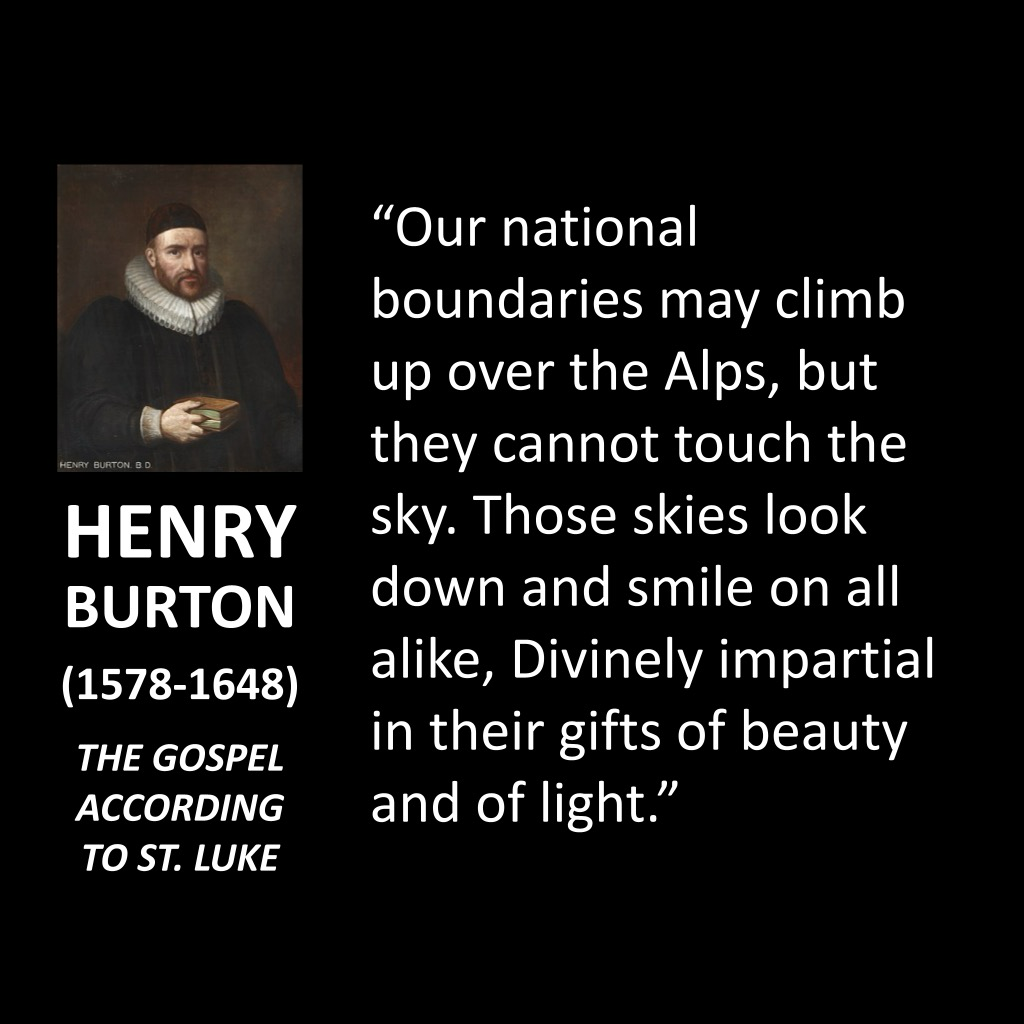
Henry Burton, English Puritan, reflects on the Good Samaritan in Luke 10 aiding a foreigner. National borders can climb the very Alps, but not touch the sky. The skies in turn, look down and smile upon all alike, Divinely impartial in their gifts of beauty and light.

Do some in our culture draw boundaries around people in need?

How can you act as a Samaritan today?

"Our national boundaries may climb up over the Alps, but they cannot touch the sky. Those skies look down and smile on all alike, Divinely impartial in their gifts of beauty and of light."

Client Info

Server: https://mastodon.social
Version: 2025.07
Repository: https://github.com/cyevgeniy/lmst