Corey S Powell

Writer, editor, magazine maker, podcaster, procrastinator.

Former editor of Discover and American Scientist magazines. Co-host of podcast. Invisible Universe on Substack: invisibleuniverse.substack.com/

Co-founder of OpenMind magazine.

Corey S Powellcoreyspowell
2026-01-22

Comets are cold, but they're full of silicate crystals that form at high temperatures. (These crystals, left, were collected from Comet Wild 2, right.)

Now we know how that happens! Newborn stars blow fast, crystalline winds away from their hot inner regions.

science.nasa.gov/missions/webb

Tiny crystals from the Wild 2 comet, captured by NASA’s Stardust mission, resemble fragments of the molten mineral droplets called chondrules, shown here, found in primitive meteorites. That similar flash-heated particles were found in Wild 2, a comet formed in the icy fringes of outer space, suggests that solid materials may have been transported outward in the young solar system.This image shows the comet Wild 2, which NASA's Stardust spacecraft flew by on Jan. 2, 2004. This image is the closest short exposure of the comet, taken at an11.4-degree phase angle, the angle between the camera, comet and the Sun. The listed names on the diagram (see Figure 1) are those used by the Stardust team to identify features. "Basin" does not imply an impact origin.
Corey S Powellcoreyspowell
2026-01-22

Crystal winds blow through the picturesque gas clouds where stars are forming.

JWST caught the process in action: A protostar called EC53 had an outburst & crystals of forsterite and enstatite formed before our eyes. The future of our galaxy is taking shape here.

science.nasa.gov/missions/webb

NASA’s James Webb Space Telescope’s 2024 NIRCam image shows protostar EC 53 circled. Researchers using new data from Webb’s MIRI proved that crystalline silicates form in the hottest part of the disk of gas and dust surrounding the star — and may be shot to the system’s edges.
Image: NASA, ESA, CSA, STScI, Klaus Pontoppidan (NASA-JPL), Joel Green (STScI); Image Processing: Alyssa Pagan (STScI)
Corey S Powellcoreyspowell
2026-01-22

@Michkov

Is it OK if the banana is measured in light years? The clumps are gas and dust (carbon and silicon compounds).

This image of the Helix Nebula, captured by the NIRCam (Near-Infrared Camera) instrument on NASA’s James Webb Space Telescope includes compass arrows, scale bar, and color key for reference.
Corey S Powellcoreyspowell
2026-01-22

@georgetakei

Media writers are reflexively submissive to aggressive power. Biden was safe to attack because he appeared weak. Trump can go full crazy and they won't call him out so long as he still acts like strong bully.

Corey S Powellcoreyspowell
2026-01-21

A breathtaking look at a dying star. This new image of the Helix Nebula is just in from JWST.

We've never seen this level of detail, as the star's remains stream back out to interstellar space. Our Sun will look something like this 7 billion years from now.

science.nasa.gov/missions/webb

This image of the Helix Nebula from the ground-based Visible and Infrared Telescope for Astronomy (left) shows the full view of the planetary nebula, with boxes highlighting Webb’s field of view (right). The new image of a portion of the Helix Nebula from NASA’s James Webb Space Telescope highlights comet-like knots, fierce stellar winds, and layers of gas shed off by a dying star interacting with its surrounding environment.
Image: ESO, VISTA, NASA, ESA, CSA, STScI, J. Emerson (ESO); Acknowledgment: CASU
Corey S Powellcoreyspowell
2026-01-21

I also want to express my admiration for the people who devote their lives to discovery, collaboration, & expanding the human imagination. That's not only a noble task, these days it counts as a form of protest against crass power politics.

Full paper at link:
iopscience.iop.org/article/10.

Pictured here are several of the radio telescopes comprising the Atacama Large Millimeter/submillimeter Array (ALMA). ALMA studies the Universe in wavelengths invisible to the human eye. Above the antennas, intricate dust clouds weave through the Milky Way. The prominent diamond shape of the Southern Cross (Crux) shines above the middle antenna, bordered on the left by a dark, dusty patch that blocks out the stars behind it. This is the Coalsack Nebula, also known as the head of the Emu in the Sky, an ancient constellation known to Aboriginal Australians. In front of this nebulous region are two bright stars: Alpha and Beta Centauri, both triple star systems where three stars are bound together by gravity.

Credit: ESO/Y. Beletsky
Corey S Powellcoreyspowell
2026-01-21

The universe is full of natural magnifying glasses--gravitational lenses--pointed in random directions. By chance, this one points toward a galaxy cluster forming in the early universe, 11 billion years ago.

It's a rare peek into how the modern cosmos took shape.

almaobservatory.org/en/press-r

The galaxy cluster lens J0846 in optical light (bottom right), the ALMA view of dust-enshrouded, star-forming galaxies strongly lensed into bright arcs (top right), and a composite view (left) revealing at least 11 dusty galaxies in a compact protocluster core more than 11 billion light-years away, magnified by the foreground cluster’s gravity. Credit: NSF/AUI/NSF NRAO/B. Saxton; NSF/NOIRLab
Corey S Powellcoreyspowell
2026-01-19

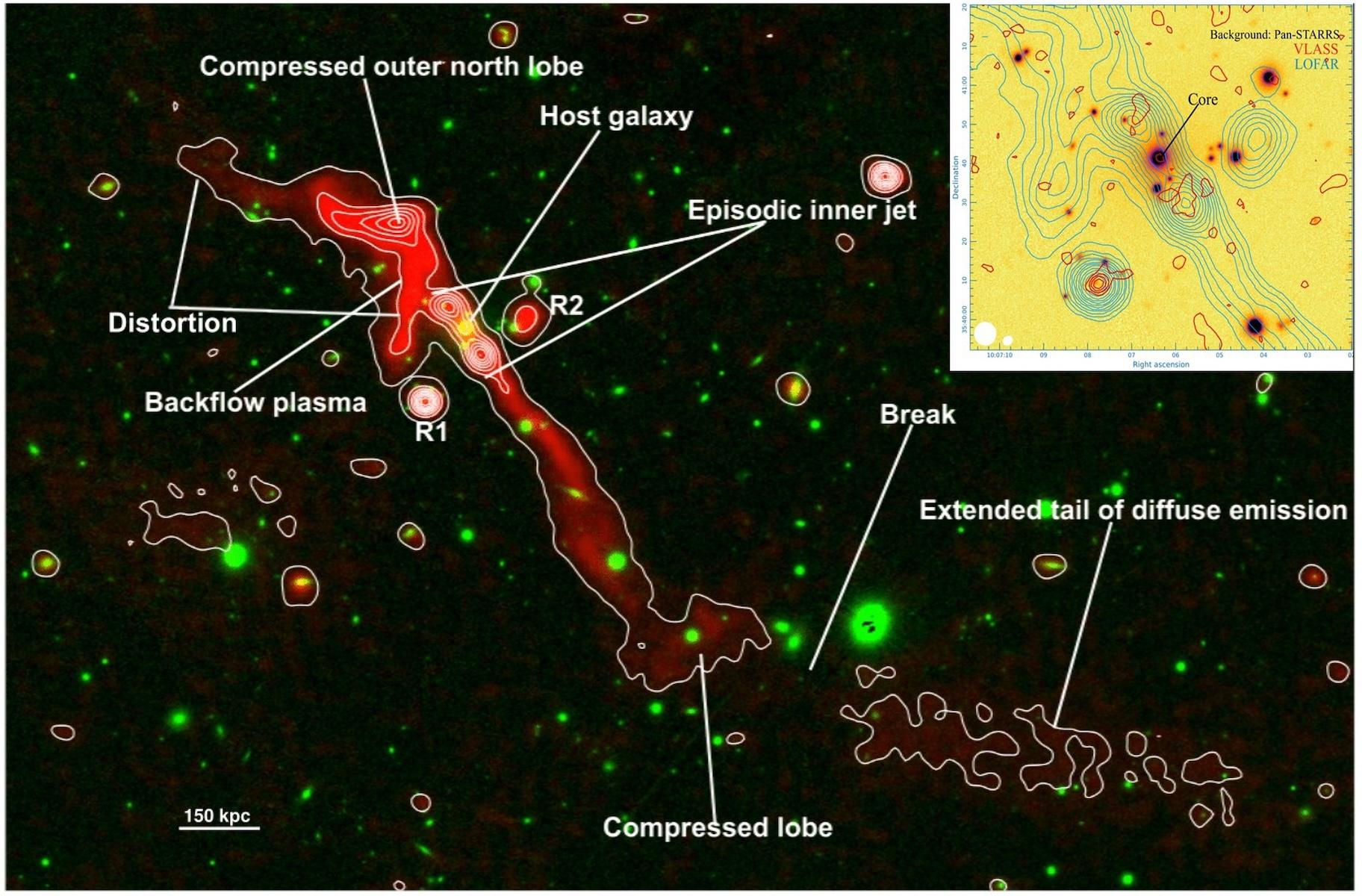
To give you a sense of how powerful a supermassive black hole is: This one blew out a structure 30 times the size of our Milky Way.

The galaxy where the action started looks like a dot in this image. The black hole itself is an invisibly tiny dot within that dot.

academic.oup.com/mnras/article

This LOFAR DR2 image of J1007+3540 superimposed over an optical image by Pan-STARRS shows a compact, bright inner jet, indicating the reawakening of what had been a ‘sleeping’ supermassive black hole at the heart of the gigantic radio galaxy.
Corey S Powellcoreyspowell
2026-01-19

Written in the sky: A history of unrest, then rest, then even more unrest happening in deep space.

New radio observations show that a supermassive black hole shot out plasma jets at a large fraction of the speed of light, paused for 100 million years, then roared back to life.

ras.ac.uk/news-and-press/resea

Corey S Powellcoreyspowell
2026-01-16

JWST captured a missing link in galaxy evolution: the time when their central black holes began to form. These young, fast-eating black holes look a lot different than expected, creating the enigmatic Little Red Dots.

Look new places, discover new things! (2/2)

nature.com/articles/s41586-025

Hydrogen spectra shed light on ‘little red dots’. The light emitted by excited hydrogen gas exhibits intensity peaks called emission lines at well-defined frequencies. Rusakov et al.1 investigate the nature of mysterious astronomical objects called little red dots (LRDs) using their hydrogen spectra. It has been proposed that the light emitted by LRDs could come from stars in a young galaxy, or from a galactic centre called an active galactic nucleus (AGN), in which light is emitted by material that is pulled towards a supermassive black hole. The authors show that LRD emission lines have the shape of exponential functions, indicating that the light photons had travelled through an ionized gas in which they scattered off electrons. The authors’ models indicate that the observed emission lines are produced by AGNs. When the authors subtracted the effects of electron scattering from their model of hydrogen spectra, this left a narrow Gaussian peak, which they used to calculate the masses of the black holes.
Corey S Powellcoreyspowell
2026-01-16

Astronomers may have cracked the mystery of the "Little Red Dots": strangely bright but tiny galaxies found in the most distant reaches of the universe.

Giant black holes? Huge bursts of new stars? Neither explanation seemed to make sense. (1/2)

nature.com/articles/d41586-025

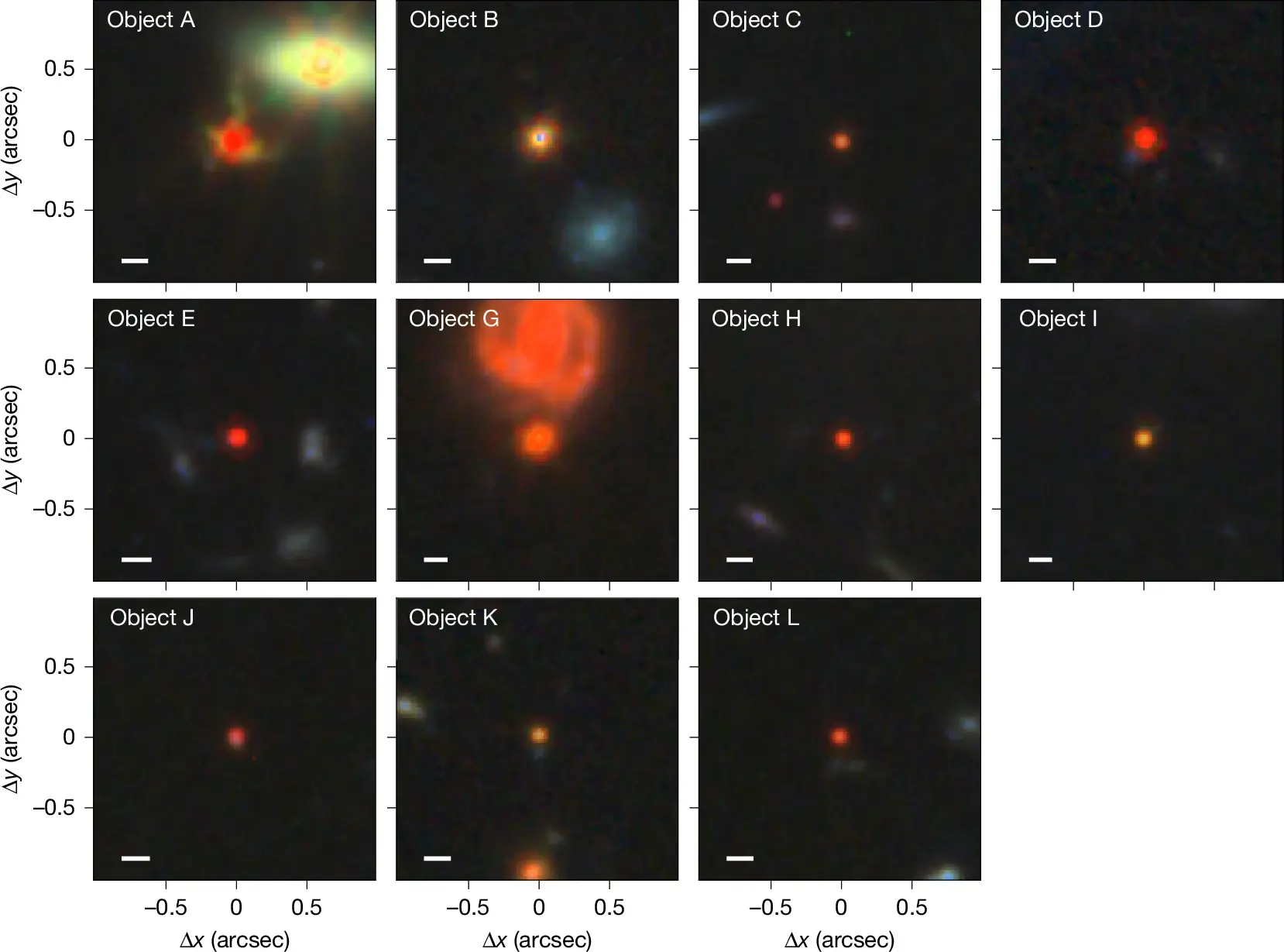
Despite being selected based on the presence of broad Hα components, all of these "little red dot" objects appear to be point-like or very compact, occasionally with some nebulosity. Rest frame optical colors are mostly red.
Corey S Powellcoreyspowell
2026-01-14

@grimaldi

There's a lot more detail in the research paper. The authors infer a radius of 300 million km for the star. The outflow doesn't have a well defined boundary.

arxiv.org/abs/2512.03156

Corey S Powellcoreyspowell
2026-01-13

@60sRefugee

Anybody up for a 50-meter space telescope?

Corey S Powellcoreyspowell
2026-01-13

57 ways of looking at a dying star.

The Alma Observatory tuned in to 57 different molecules pouring out of the star W Hydrae as it spills its guts into space. That material will later get recycled into the next generation of stars and planets.

almaobservatory.org/en/press-r

Corey S Powellcoreyspowell
2026-01-13

JWST spotted point-like lights at the edge of the visible universe. Black holes? Nope. Colliding galaxies? Nope. Something never seen before.

These may be primordial clumps of gas collapsing directly into dense clusters of stars--some of the very first galaxies.

arxiv.org/abs/2509.12177

Four of the nine galaxies in the newly identified “platypus” sample were discovered in NASA’s James Webb Space Telescope’s Cosmic Evolution Early Release Science Survey (CEERS). One key feature that makes them distinct is their point-like appearance, even to a telescope that can capture as much detail as Webb. Image: NASA, ESA, CSA, Steve Finkelstein (UT Austin); Image Processing: Alyssa Pagan (STScI)
Corey S Powellcoreyspowell
2026-01-13

See the little dot? New studies of that blue flash from the distant universe (a "Luminous Fast Blue Optical Transient") indicate it was caused by a black hole swallowing an entire star. For a moment, it blazed as bright as 100 billion Suns.

public.nrao.edu/news/radio-tel

A new, extremely luminous fast blue optical transient, AT2024wpp, flares as a bright blue point of light in the left panel, located just off the edge of its faint host galaxy, while the right panel shows the same region of sky after the outburst faded. Credit: Astrophysics Research Institute, Liverpool John Moores University/Daniel Perley
Corey S Powellcoreyspowell
2026-01-13

A hellish world: Planet TOI-561 b, slightly larger than Earth, orbits an ancient, sunlike star so closely that a "year" lasts just 11 hours and its surface is lava. Yet somehow it has a thick atmosphere, hinting at how old, battered planets might rejuvenate themselves.

eos.org/articles/a-lava-world-

The seemingly thick atmosphere of exoplanet TOI-561 b, seen here in an artist’s rendition, is most likely composed of material outgassed from its molten surface. Credit: NASA, ESA, CSA, Ralf Crawford (STScI)
Corey S Powellcoreyspowell
2026-01-13

In happier news, it's been a great week for learning strange new things about the universe. A few highlights:

The Rubin Observatory opened its eyes & immediately discovered 1900 asteroids, including the fastest-spinning large asteroid (once every 1.88 minutes!).

noirlab.edu/public/news/noirla

The lightcurve of 2025 MN45 — the fastest-rotating asteroid with a diameter over 500 meters that scientists have ever found. The y-axis shows the asteroid’s brightness, and the x-axis shows its phase, or where it is in its rotation. When plotted, the resulting curve shows the asteroid's fluctuating brightness as it spins. Lightcurves can help scientists determine an asteroid's rotation period (the total time it takes to complete one rotation), size, shape, and surface properties.

The discovery of 2025 MN45 was made using data from NSF–DOE Vera C. Rubin Observatory, jointly funded by the U.S. National Science Foundation and the U.S. Department of Energy's Office of Science. The asteroid is about 710 meters (0.44 miles) in diameter, and it completes a full rotation every 1.88 minutes.
Corey S Powellcoreyspowell
2026-01-09

Venezuela is one of the world's top methane emitters, releasing more methane relative to production than any other country. It's a major economic problem as well as an environmental one.

bloomberg.com/news/newsletters

Satellite image of methane billowing from Venezuela’s dilapidated energy infrastructure.Source: Kayrros SAS, processed L1B image from DLR's EnMAP
Corey S Powell boosted:
Daniel Pomarèdepomarede
2026-01-08

It's Stephen Hawking's birthday. The occasion to share this fantastic video he produced as part of his Genius documentatry series. Hawking elaborates on our place in the Universe, including our membership to the Laniakea supercluster of galaxies that we discovered back in 2014.

The complete documentary: pbslearningmedia.org/resource/

Client Info

Server: https://mastodon.social
Version: 2025.07
Repository: https://github.com/cyevgeniy/lmst