
#CosmicMagnetism

Dr. Juande Santander-Velajuandesant@mathstodon.xyz
2025-12-01

Dr. Dana Alina from Nazarbayev University has lead a team that has revealed the magnetic field structure of the ring-like molecular cloud G111 (near NGC7538, an active star forming region).

The ring shape could have several origins: it could be a remnant of a past massive supernova explosion, or very strong stellar winds; or the result of two colliding clouds of molecular gas. Each option has different magnetic signatures.

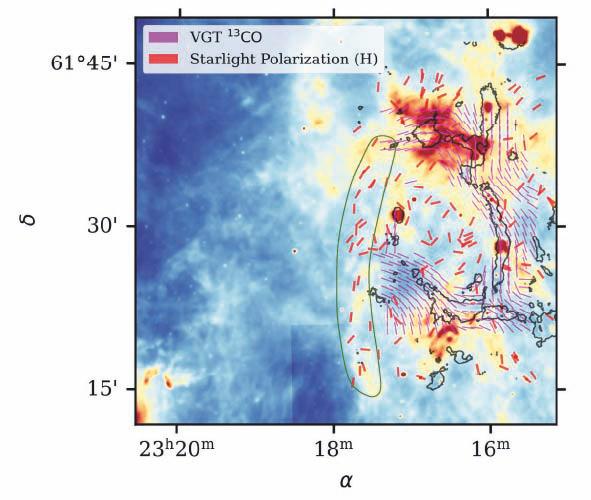
Thanks to the IRAM 30-meter telescope, the team obtained high-sensitivity observations of carbon monoxide (CO). Using the Velocity Gradients Technique, they derived a detailed magnetic blueprint of the cloud. Then, they combined these observations with data from telescopes such as the Kanata telescope (Japan) and the Planck satellite.

Their study revealed an ordered magnetic structure that follows the ring’s curvature, the same structure traced by the cold dust.

This suggests that magnetic forces were strong enough to remain organized throughout the cloud’s evolution, possibly guiding the gas motion during either an expansion or a large-scale interaction. This supports the hypotheses of G111 being a past supernova explosion remnant, or a stellar wind-blown structure.

This is not related to ALMA, but enabled by the IRAM-30m, the second largest millimeter-length radio telescope in operation. It is very dear to me because I did my first observations with it… on my namesake's day, March 8 (St. Juan de Dios). And is based in Granada, where I was born!

iram-institute.org/newsroom/ge

#StarFormation #MolecularClouds #IRAM #InstitutoRadioAstronomíaMilimétrica #InstituteRadioAstronomieMillimetrique #IRAM30m #MMAstronomy #MillimeterAstronomy #MagneticFields #CosmicMagnetism
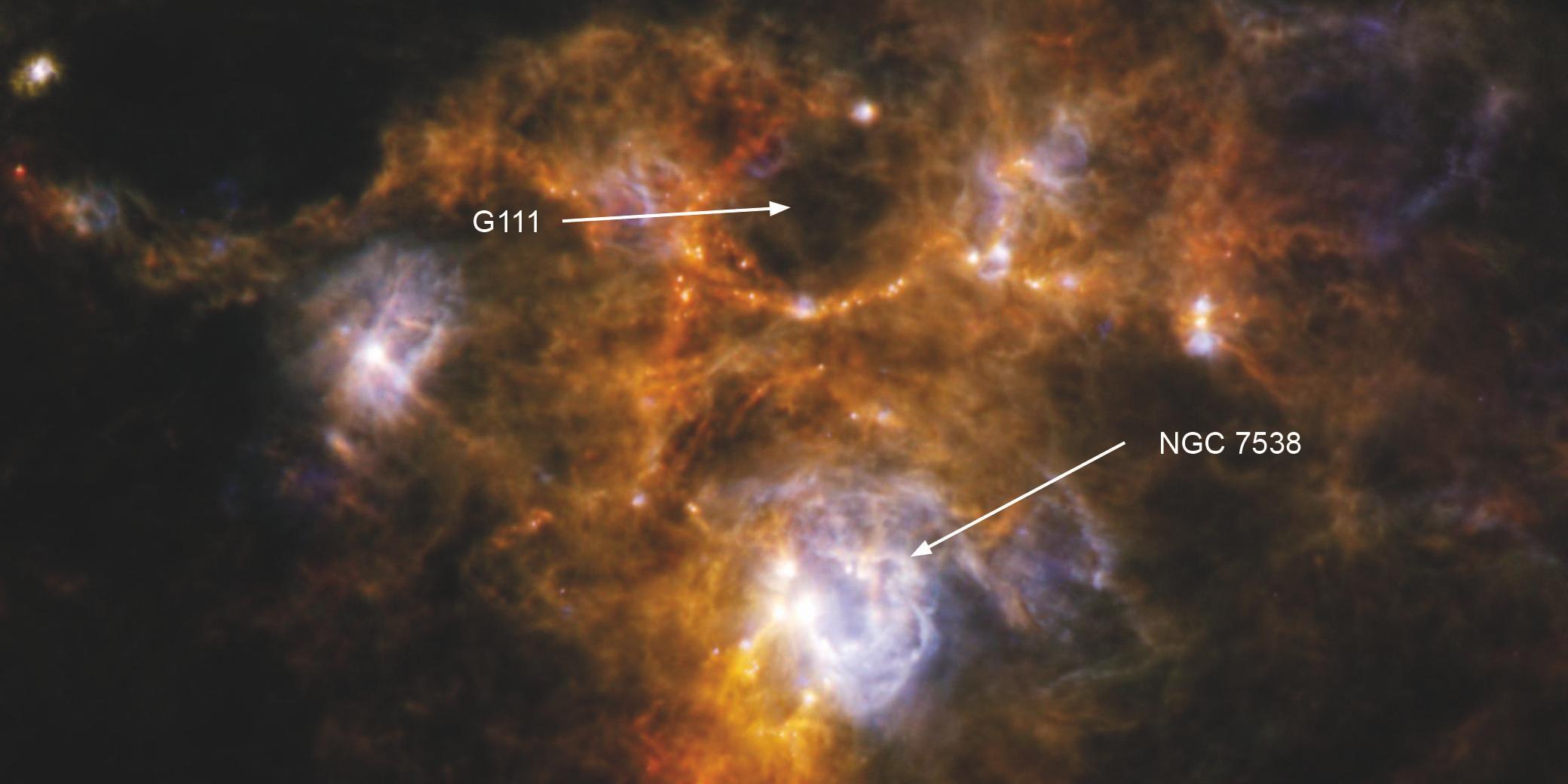
Annotated version an image taken by several instruments of the Herschel infrared mission.

The image shows a wispy, filamentary structure in orange filling around two thirds of the image, with some whiter, brighter highlights on the mid left and bottom center regions.

One arrow, labelled G111, points to the center of a ringed-shaped void in the top center of the image. A few bright white spots appear around the rim of the ring. Another arrow, labelled NGC 7538 (a star forming region), points to the bottom center near the brightest spots in the bottom of the image.

Credits: ESA/Herschel/PACS/SPIRE. Acknowledgements: Cassie Fallscheer (University of Victoria), Mike Reid (University of Toronto) and the Herschel HOBYS team.Figure showing magnetic fields for the G111 region, overlaid over the Plank emission (dark blue to dark brown, passing through yellow, white, and shades of orange).

There are purple line markings overlaid (Iabeled VGT ¹³CO in the legend) representing magnetic field orientation derived from carbon monoxide (¹³CO) observations using the Velocity Gradients Technique.

There are also red line segments —labeleled Starlight Polarization (H)— showing magnetic field orientations derived from polarized starlight measurements in the near-infrared H-band.

The vertical axis (labeled δ) shows Declination from approximately 61°15' to 61°45'; the horizontal axis (labeled α) shows Right ascension from about 23h20m to 23h16m.

See referenced paper for detailed caption.
Dr. Juande Santander-Velajuandesant@mathstodon.xyz
2025-11-25

Teams using our ALMA Observatory have been able to clearly show how magnetism has a pre-eminent role in young star accretion and growth!

The best part is that the lead scientist for that paper is our colleague Paulo Cortés, who apart from doing notable science is also responsible for the scientific acceptance of ALMA software releases!

almaobservatory.org/en/press-r

#ALMA #AtacamaLargeMillimeterArray #AtacamaLargeMillimeterSubmillimeterArray #YoungStars #StarFormation #Magnetism #CosmicMagnetism

Client Info

Server: https://mastodon.social
Version: 2025.07
Repository: https://github.com/cyevgeniy/lmst