The Woman Who Found Redemption: My Journey from Darkness to Light
6,560 words, 35 minutes read time
I stand before you now, no longer the woman I once was. You may have heard stories about me—whispers in the wind, murmurs in the temple, or perhaps you know me from what has been written about me in the Scriptures. Mary Magdalene, the one from whom Jesus cast out seven demons. But there’s so much more to my story than just that. You might hear this and think you know what happened, but trust me, you don’t. I was not the woman you think I was, nor was I the woman I wanted to be. And, honestly, I’m not sure I ever knew who I truly was, until that moment.
Before the darkness consumed me, before the whispers turned to screams within my mind, I was simply Mary, a woman of Magdala. Our town, nestled on the western shore of the Sea of Galilee, was a vibrant hub. The clatter of commerce filled the air – fishermen mending their nets, merchants haggling over prices of dried fish and grains, the exotic scents of spices brought by traders from distant lands. My family, though not of the highest standing, was comfortable. My father, a respected fisherman, taught me the rhythms of the lake, the way the light danced on its surface, the signs of an approaching storm. My mother, a woman of quiet strength, instilled in me the traditions of our faith, the comforting cadence of the Psalms.
We lived in a modest but sturdy home, the whitewashed walls reflecting the relentless Galilean sun. I remember the scent of baking bread that often wafted from our small kitchen, the rough feel of the fishing nets I sometimes helped mend, the warmth of the Sabbath candles casting long shadows on the walls as my family gathered for prayer. I had dreams, as young women do. Dreams of a loving marriage, of a family of my own, of contributing to the life of our community. I was headstrong, perhaps too much so, with a restless spirit that often chafed against the expected roles for women. I yearned for something more, though I couldn’t articulate what that “more” truly was. Perhaps it was a deeper understanding of the world, a sense of purpose beyond the daily routines.
Then, slowly, insidiously, the darkness began to creep in. It wasn’t a sudden invasion, but a gradual erosion of my inner peace. At first, it was just unsettling thoughts, whispers at the edges of my awareness that I couldn’t quite grasp. They were like shadows flickering in my peripheral vision, always just out of reach when I tried to focus on them. But these whispers grew louder, more insistent, morphing into voices that were not my own. They mocked, they accused, they filled my mind with chaos and confusion.
It felt as though something alien had taken root within me, twisting my thoughts, turning my desires into something ugly and uncontrollable. My own will seemed to weaken, replaced by an inner turmoil that dictated my actions. I would lash out in anger at those I loved, say cruel things I didn’t mean, driven by a force I couldn’t comprehend. My moods swung wildly, from moments of hollow gaiety to deep, crushing despair. I was a prisoner within my own mind, a puppet dancing to the strings of these unseen tormentors.
The societal stigma was a heavy burden. In our close-knit community, whispers spread like wildfire. I became the subject of hushed conversations, pointed fingers, and averted gazes. People spoke of curses, of divine punishment, of a soul tainted by sin. The women in the marketplace would draw their children away as I passed. The men would offer pitying glances mixed with fear. I was an outcast, labeled as “unclean,” someone to be avoided. The isolation was agonizing, a constant reminder of my brokenness. Even within my own family, though they tried to be supportive, I could see the fear and the strain in their eyes. They didn’t understand what was happening to me, and their helplessness only amplified my own despair.
Desperate for relief, I sought out every avenue I could find. I visited the local healers, their remedies of herbs and poultices offering no solace. I consulted the village elders, their prayers and pronouncements feeling hollow and empty. I even turned to those rumored to practice magic, clutching at amulets and chanting incantations, but the darkness within remained unmoved. My wealth, inherited from my father, became a tool in this desperate search, but it bought me nothing but false hope and fleeting promises. The more I sought a cure, the more entrenched the torment seemed to become. It was a vicious cycle, my desperation only feeding the power of the darkness that held me captive.
Looking back, I can see the threads of my own making in this tapestry of suffering. My ambition, that yearning for something more, had at times led me down paths that were not wholesome. I had sought validation in fleeting pleasures, in the approval of those whose values were shallow. There was a pride within me, a belief that I could navigate life on my own terms, without truly seeking the guidance of God or the wisdom of those who walked in His light. This self-reliance, this desire to control my own destiny, had perhaps created an opening for the darkness to enter. It wasn’t just the external forces; it was the internal vulnerabilities, the unacknowledged emptiness that the demons seemed to exploit.
Then, He came. Jesus. The memory of that first encounter is etched into my soul. He walked into Magdala, not with the pomp and circumstance of a visiting dignitary, but with a quiet authority that drew the eye and stilled the restless energy of the town. There was a light about Him, an aura of peace and compassion that was unlike anything I had ever witnessed. His eyes, when they met mine, held no judgment, only a profound understanding. It was as if He saw past the broken exterior, past the torment that twisted my features, and saw the wounded soul within.
I don’t know how He knew the depths of my affliction, but He did. Perhaps it was the way I flinched from the touch of others, the frantic energy that radiated from me, or the haunted look in my eyes. But He looked at me, truly looked at me, and in that gaze, I felt a flicker of something I hadn’t experienced in years – a moment of stillness, a break in the relentless storm within.
He spoke, His voice calm and resonant, cutting through the cacophony in my mind. He didn’t shout, didn’t recoil. He simply spoke words of authority, words that seemed to vibrate with a power that was not of this world. And as He spoke, I felt a wrenching within me, a violent shaking as the demons that had held me captive for so long began to resist. It was a terrifying and yet liberating sensation. For the first time in what felt like an eternity, I felt a glimmer of control returning.
One by one, He cast them out. I can’t describe the sensation fully – it was like a physical expulsion, a tearing away of something dark and clinging. With each departing spirit, a wave of relief washed over me, a lightening of the oppressive weight that had burdened me for so long. The voices that had tormented me fell silent. The chaos within began to subside, replaced by a fragile but growing sense of peace. By the time He was finished, I felt… empty, but in a way that was clean, pure. The darkness was gone, and in its place was a void that, for the first time, felt like it could be filled with something good.
Was I deserving of such grace? Absolutely not. In my darkest moments, I had felt utterly worthless, a vessel of corruption. Why would this man, this holy man, waste His time and power on someone as broken as me? It defied all logic, all societal expectations. But that was the essence of His being, wasn’t it? He didn’t come for the righteous, but for the sinners. He didn’t offer healing based on merit, but on boundless compassion. He saw not what I was, but what I could be. His grace was a gift freely given, a light shining into the deepest recesses of my despair.
When the healing was complete, a profound shift occurred within me. The emptiness that remained was not the void of torment, but a space yearning to be filled with the source of that healing. I knew I could not return to my former life. The allure of fleeting pleasures had vanished, replaced by a deep understanding of their emptiness. The hole in my heart, the one I had tried to fill with wealth and influence, now pointed towards Him. He was the answer, the missing piece I had unknowingly been searching for all along.
Without hesitation, I followed Him. There was no grand deliberation, no weighing of pros and cons. It was an instinctive pull, a recognition of the only true north in my suddenly clear sky. I didn’t question His path, His teachings. I simply went where He went, listened to His words, and absorbed the light that radiated from Him. He was the living water to my parched soul, the bread of life to my starving spirit.
For those who have never known the suffocating grip of inner darkness, it is impossible to convey the depth of my gratitude. It was as if He had reached into the abyss and pulled me back into the light. I wasn’t just freed from the demons; I was freed from the self I had become under their influence. I was given a second chance, a clean slate upon which to write a new story. And that story, I knew, would be His.
I became one of His devoted followers, traveling with Him and the others through the dusty roads and bustling towns of Galilee. I witnessed miracles that defied human understanding – the blind seeing, the lame walking, the lepers cleansed. I saw the compassion in His eyes as He healed the sick and the authority in His voice as He commanded evil spirits to depart. But more than the miracles, it was the way He treated people, the way He saw the unseen, the marginalized, the outcasts, that truly amazed me. He spoke to women with respect and dignity, something unheard of in those times. He ate with tax collectors and sinners, offering them a path to redemption. He saw the inherent worth in every soul, regardless of their past or their societal standing.
He allowed us, the women who followed Him, to be a part of His ministry in ways that were revolutionary. We provided for His needs and the needs of His disciples out of our own resources. We listened to His teachings, asked questions, and learned alongside the men. He never looked down on me because of my past. He never reminded me of the darkness that had once consumed me. He accepted me fully, loved me unconditionally, and trusted me to understand and share His message.
I remember the gentle wisdom of His parables – the sower scattering seeds, the lost sheep being found, the prodigal son returning home. These stories, seemingly simple, held profound truths about God’s love, His forgiveness, and the nature of His kingdom. They resonated deeply within me, a soul that had felt lost and now was found. He taught us to love our enemies, to forgive those who wronged us, to seek the kingdom of God above all else. These teachings were a balm to my wounded spirit, guiding me towards a way of living that was rooted in love and compassion.
My relationship with the other disciples and the women who followed Jesus was a tapestry woven with threads of shared experience and growing faith. With Peter, James, and John, there was a sense of awe and respect for their closeness to Jesus, their willingness to leave everything to follow Him. Sometimes, there were misunderstandings, moments when their earthly concerns clashed with Jesus’ spiritual focus, but there was always a core of devotion that bound them together.
The women – Joanna, Susanna, Salome, and others – became my sisters in faith. We shared a unique bond, having experienced the societal constraints placed upon us and finding liberation in Jesus’ presence. We supported each other, shared our burdens, and encouraged one another in our newfound faith. We often discussed His teachings amongst ourselves, trying to grasp the deeper meanings and how they applied to our lives. There was a quiet strength in our collective devotion, a silent understanding of the transformative power of His love. Mary, His mother, held a special place among us, her quiet dignity and unwavering faith a constant source of inspiration. I often sought her out, finding solace in her gentle wisdom and the shared experience of loving Jesus.
Then came the day the shadows gathered, the day He was betrayed. The memory of the soldiers’ torches cutting through the night, the harsh clang of their armor, still sends a shiver down my spine. The fear that gripped us was palpable, a suffocating blanket of dread. They took Him away, the one who had brought light into my darkness, the one who had given me a life worth living. I stood with the other women, a silent, horrified witness to His arrest. We wanted to intervene, to fight, to somehow protect Him, but we were powerless against the might of the Roman Empire and the fury of the Sanhedrin. All we could do was watch as they led Him away, our hearts heavy with foreboding.
The day they crucified Him was the day the world seemed to tilt on its axis. We followed, a small, heartbroken group, as He was forced to carry the heavy cross through the jeering crowds. We saw His face, bruised and bloodied, yet still bearing a trace of that familiar compassion. We stood at the foot of the cross, our tears mingling with the dust and the blood. We watched Him suffer, each nail driven into His flesh a fresh wound in our own hearts. The weight of our helplessness was crushing. We knew He was innocent, yet we could do nothing but bear witness to His agonizing death. It felt as though all the hope He had ignited within us was being extinguished with each labored breath He took.
The joy of the Passover meal we had shared with Him just days before, the sense of anticipation and fellowship, now seemed like a distant, almost dreamlike memory. The night of His arrest had shattered our understanding of everything. The men, the strong, bold disciples who had pledged their loyalty, scattered in fear. Peter, the rock, the one He had entrusted with the keys to the kingdom, denied even knowing Him, not once, but three times. I saw him later, his face etched with a grief that mirrored our own, the weight of his betrayal a visible burden. We were all afraid, huddled together in the upper room, the doors bolted against the unknown dangers that lurked outside. The one who had been our protector, our guide, was gone, and we feared we would be next.
In that fear, the world felt cold and empty. Words of comfort were hollow, prayers felt weak and unanswered. All I could do was weep, a deep, guttural sorrow that seemed to have no end. The days between His death and the dawn of the resurrection felt like an eternity, a bleak and desolate landscape of grief. How could He be gone? How could the one who had shown us the very essence of love and grace be taken away in such a brutal manner? The questions swirled in my mind, unanswered, fueling my despair. The hope He had planted within me felt like a fragile seedling buried under a mountain of sorrow.
His teachings, once so vibrant and life-giving, now echoed in my memory with a painful irony. “I am the resurrection and the life,” He had said. But how could that be true when death had so decisively claimed Him? Without His physical presence, we felt lost, adrift in a sea of uncertainty. All I could think of were His final moments, His pain, the injustice of it all. I didn’t know how we could possibly go on without Him. The future stretched before us, a vast and terrifying unknown.
The morning of His execution, the sky was a bruised and angry purple. I watched, with a horrified fascination, as they led Him to Golgotha, the place of the skull. The jeers of the crowd, the callous indifference of the Roman soldiers, the sheer brutality of the act – it was a scene that will forever be seared into my memory. They offered Him wine mixed with gall, a cruel mockery of comfort, which He refused. Then, the unthinkable happened. They nailed His hands and feet to the rough wood of the cross, the sickening thud of the hammer blows echoing in the stunned silence. I saw them lift Him up, His body suspended between heaven and earth, a testament to the cruelty of humanity and the depth of His sacrifice. My heart shattered into a million pieces. He was innocent, yet He suffered the most agonizing death imaginable. He was dying for us, bearing the weight of our sins, our darkness.
I stood at the foot of the cross, rooted to the spot by a grief so profound it felt physical. His suffering was unbearable to witness, yet I couldn’t tear my eyes away. And then, amidst His torment, He spoke His first words from the cross, a cry that tore through the heavy air: “Eli, Eli, lema sabachthani?” “My God, My God, why have You forsaken Me?” His native Aramaic, spoken in such raw anguish, pierced the very heavens. In that moment, I felt a sliver of His abandonment, not by us, His followers, but by His Father. It was a depth of loneliness I could scarcely comprehend.
A stunned silence fell over the crowd as the sky began to darken, a premature twilight descending upon the land. The earth itself seemed to mourn, a low rumble vibrating beneath our feet. Then, His voice, though weak, still carried a note of divine authority: “I thirst.” It wasn’t just a physical thirst for water, I knew. It was a deeper longing for the completion of His mission, the fulfillment of the sacrifice He was making. He had taken upon Himself the sins of the world, and in that moment, He bore the full weight of that burden.
Then, with a final, deliberate act, He uttered the words that would forever echo in eternity: “Tetelestai – It is finished.” The work was done. The debt was paid. The barrier between God and humanity, erected by our sin, was broken. It was as though the universe itself held its breath, waiting for that moment to pass into the annals of time.
But even in those final pronouncements, His love and obedience shone through. With His last breath, He whispered, “Father, into Your hands I commit My spirit.” And then, He was gone. The light that had illuminated our world was extinguished. I couldn’t believe it. He was truly gone.
The earth convulsed beneath our feet, a violent tremor that shook the very foundations of our world. And then, a sight that defied understanding: the curtain of the temple, the massive veil that separated the Holy of Holies from the outer court, was torn in two, from top to bottom. It was a symbolic act, a divine tearing away of the barrier that had separated God from His people. His presence was no longer confined to a sacred space; His Spirit was now free to dwell among us.
And then, the graves opened, and the dead rose. It was a terrifying and awe-inspiring sight, a glimpse into the power of His death, a foreshadowing of the ultimate victory over the grave. But in the immediate aftermath, the finality of His death was overwhelming. He, who was life …itself, was gone.
Yet, even in the depths of my inconsolable grief, a tiny spark of hope flickered within me, fueled by His own words, His promises. “I am the resurrection and the life. He who believes in Me will live, even though he dies.” But in that moment, shrouded in darkness and despair, it felt impossible to grasp. How could the one who had given me life now be dead?
The morning of the third day dawned with a heavy, oppressive stillness. Driven by a desperate need to honor His body, to perform the last rites of burial, I made my way to the tomb. The other women, their faces pale and drawn with grief, accompanied me. As we walked through the silent streets, a new fear began to take root. The tomb was guarded. Roman soldiers, their expressions stern and unyielding, stood watch. Would they even allow us near? Would they desecrate His memory further? And the stone… the massive stone that sealed the entrance. How could we, a small group of grieving women, ever move it? These anxieties gnawed at my heart, but the need to be near Him, even in death, was stronger than any fear.
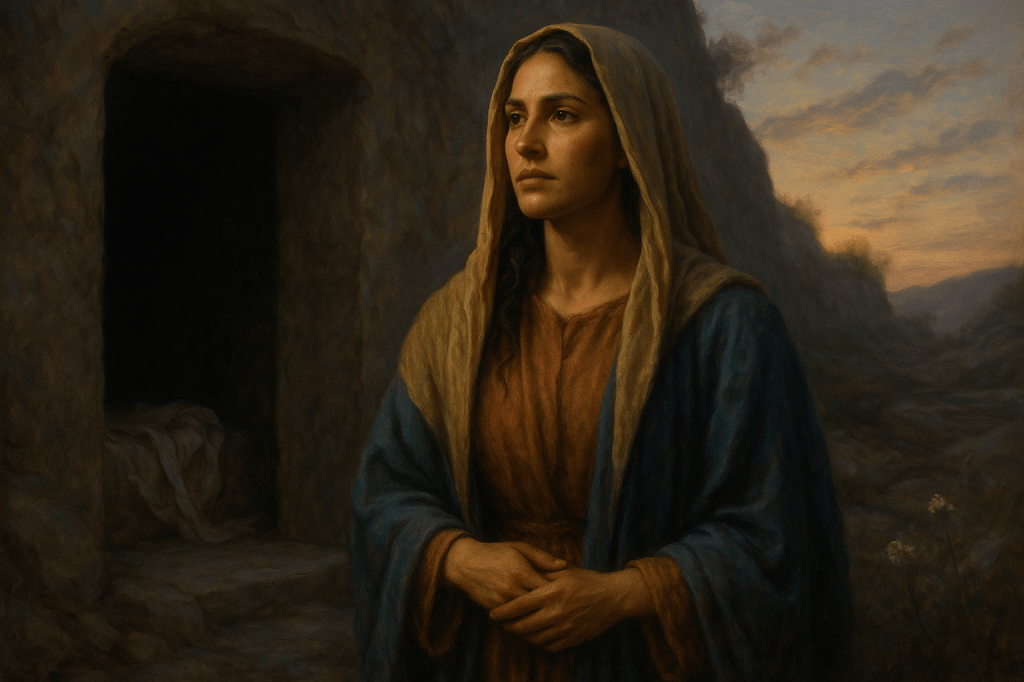
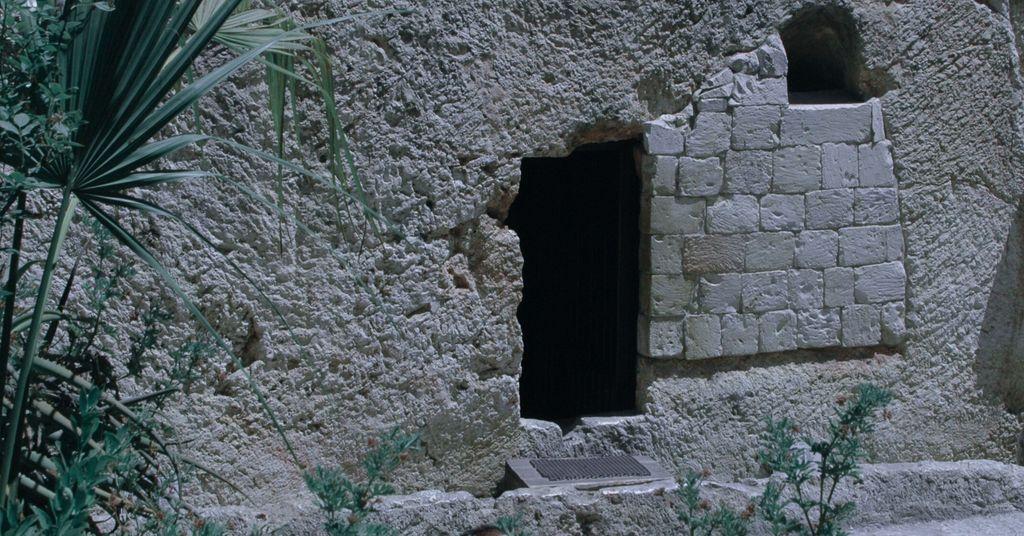
When we arrived, our breath caught in our throats. The stone was rolled away. It defied all logic, all expectation. My mind reeled, a cold wave of panic washing over me. Had someone stolen His body? Had they subjected it to further indignity? I stood there, paralyzed by a mixture of fear and confusion. I peered into the dark recess of the tomb, and it was empty. The linen cloths, neatly folded, lay where His body should have been. It was a sight that made no sense, deepening the mystery and the dread.
But then… I turned, and there He was. Standing just a short distance away, bathed in the soft light of the early morning sun. At first, I didn’t recognize Him fully. Perhaps it was the tears blurring my vision, or the shock that had numbed my senses. I thought He was the gardener, the one who tended the grounds around the tomb. My voice, thick with unshed tears, trembled as I asked, “Sir, if you have carried Him away, tell me where you have put Him, and I will get Him.” My only thought was to find His body, to give Him the respect He deserved.
And then, He spoke my name. Just one word, but it resonated through me like a lightning strike: “Mary.” It was His voice. The familiar cadence, the gentle inflection, the love that echoed in that single syllable. In that instant, the scales fell from my eyes. The gardener vanished, replaced by the radiant figure of my Lord. My heart leaped within me, a joy so profound it was almost unbearable. “Rabboni!” I cried out, my Aramaic bursting forth in a torrent of love and recognition. I reached out to Him, wanting to hold Him, to cling to the reality of His presence.
But He held back, a gentle sadness in His eyes. “Do not cling to Me,” He said softly, “for I have not yet ascended to the Father. But go to My brothers and say to them, ‘I am ascending to My Father and your Father, to My God and your God.’” His words were both a gentle rebuke and a momentous commission. He was alive, but His time with us in this earthly form was not yet fully restored. He had a greater purpose, a return to the Father. And He entrusted me, the woman who had been healed from darkness, the one who had witnessed His death, to be the first messenger of His glorious resurrection.
I stood there, trembling with awe and disbelief, the weight of His words settling upon me. He was alive! Death had not held Him. The darkness had been conquered. The promise He had made had come true. The despair that had clung to me for days vanished, replaced by an unshakeable hope. The resurrection wasn’t just about Him returning to life; it was about the promise of new life for all who believed in Him.
I ran, my feet barely touching the ground, to find Peter and John, the other disciples who were closest to Him. “I have seen the Lord!” I exclaimed, my voice filled with a joy that could no longer be contained. “He is alive!” I poured out the story of my encounter, the empty tomb, the figure I had mistaken for the gardener, and the sound of His voice calling my name.
They were initially skeptical, their grief still a heavy shroud upon their hearts. Peter and John, driven by a mixture of disbelief and a flicker of hope, rushed to the tomb themselves. I followed, my heart pounding with anticipation. I watched as John, being the younger and swifter, reached the tomb first but hesitated at the entrance. Peter, ever impetuous, went straight inside. They found the linen cloths lying there, just as I had described, and the burial shroud folded neatly by itself. The sight stirred something within them, a dawning realization that this was no ordinary grave robbery.
Peter and John left soon after, still wrestling with the implications of what they had seen. But I couldn’t tear myself away from that sacred place. I stood outside the tomb, tears of joy and wonder streaming down my face. And then, He appeared again, His presence radiating peace.
“Woman, why are you weeping?” He asked gently.
Still caught in the wonder of it all, I replied, “Sir, if you have carried Him away, tell me where you have put Him, and I will get Him.”
Again, He spoke my name, “Mary.” And this time, there was no mistaking Him. It was truly Him, alive and whole.
“Rabboni!” I cried again, reaching out to embrace Him.
“Do not cling to Me,” He repeated, His voice filled with tenderness, “for I have not yet ascended to the Father. But go to My brothers and say to them, ‘I am ascending to My Father and your Father, to My God and your God.’” He entrusted me, a woman, a former outcast, to be the primary witness to His resurrection, a testament to His radical love and the overturning of societal norms.
I went again to find the disciples, my heart overflowing with the incredible news. This time, my conviction was unwavering, my joy infectious. The despair that had clung to us in the days following His crucifixion was shattered by the glorious reality of His resurrection. It wasn’t just a miracle; it was the ultimate victory over death, a promise of eternal life for all who believed.
His resurrection had not only restored my Lord to life; it had restored my soul. The darkness that had defined me was gone, replaced by the radiant light of His love and the unshakeable hope of eternal life. I didn’t just follow Him because I had been healed. I followed Him because I had witnessed the impossible, because I had seen death itself defeated. I had seen love and mercy triumph over the greatest evil, and I knew then that my life would forever be dedicated to sharing this truth.
I wasn’t just a witness to His resurrection; I was reborn through it. The old Mary, the tormented and lost woman of Magdala, had died with Him on that cross. The Mary who stood before the empty tomb, who heard His voice call her name, was a new creation, filled with purpose and an unyielding faith. Jesus had pulled me from the deepest darkness, and in His victory over death, He showed me that no sin was too great, no burden too heavy for His love to conquer.
The miracle of His resurrection was not just a singular event; it held a profound and universal meaning. He had shown us that death was not the end, that there was hope beyond the grave. His victory was not only for Himself but for all of humanity, for the broken, the lost, the ones who had stumbled and fallen, just like me. In that moment, I knew that I would never be the same again. Neither would the world.
But even after His resurrection, my journey didn’t end. It wasn’t just about basking in the joy of that first encounter; it was about continuing to live in the light of what He had done for me. As the days passed, I remained among His followers, just as He had instructed us. We gathered together, sharing stories of His appearances, our hearts filled with a mixture of joy and anticipation. We waited, prayed, and hoped for the promise of the Holy Spirit, just as Jesus had told us before He ascended to the Father. There was a palpable sense of something divine about to happen, a new chapter unfolding that we could not yet fully comprehend.
And when Pentecost came, the promise was fulfilled in a way that exceeded all our expectations. We were gathered in the upper room, perhaps the same room where we had shared that last Passover meal with Him, when suddenly, there was a sound like a rushing wind, and tongues of fire appeared, resting on each of us. The Holy Spirit filled us in a way that was both overwhelming and transformative. It was as though a divine power surged through us, igniting a fire within our souls. We began to speak in other tongues, languages we had never learned, yet we could communicate the wonders of God.
Pentecost wasn’t just a moment of personal transformation; it was the birth of the Church, the beginning of a movement that would change the world forever. I could feel the Spirit’s presence in me and around me, urging us to go beyond the walls of our homes, to step out and preach the gospel to all who would listen. No longer would we be waiting in the shadows for Him to return; now, we were called to carry His message of love, redemption, and eternal life to every corner of the earth. I had experienced Jesus’ resurrection and His transformative power in my life, but now I experienced the full force of His Spirit, uniting us all in a shared purpose and mission. It was as if He had not left us alone at all; He had empowered us to do greater things than we could have ever imagined.
I traveled, often in the company of those who had been closest to Jesus—those who had shared the pain of His crucifixion and the joy of His resurrection. Alongside me was John, whom Jesus had called His beloved disciple, a man whose love for the Lord was as deep and unwavering as the sea. And Mary, His mother, her quiet strength and profound understanding a constant source of comfort and wisdom. It was a bond that transcended everything we had known before—an unspoken commitment to share the love of Jesus and to keep His message alive. Together, we had witnessed the greatest sorrow and the greatest joy, and now, we shared a common purpose. The grief of losing Him on the cross was still a scar upon our hearts, but in the radiant light of His resurrection, the hope He had given us now became our fuel, our driving force. We had been entrusted with a sacred mission—to spread His gospel, to heal the sick in His name, to preach salvation to the lost, and to teach others to live in His love.
We no longer just mourned the loss of the man we had loved; we celebrated His glorious victory over death. We knew that He had come to give us life, abundant and eternal life that could never be taken away, and through the power of the Holy Spirit dwelling within us, we could now offer that same life-giving message to others. I could see the Spirit working in us and through us, giving us a courage and strength that was not our own, enabling us to face the challenges and opposition that inevitably arose. And though the road was often difficult, the tangible presence of the Holy Spirit was undeniable, a constant reminder that we were not alone.
The world around us had begun to change, slowly but surely, touched by the ripples of the resurrection and the power of the Holy Spirit. And we, His followers, were irrevocably changed. John, with his powerful words and unwavering faith, Mary, with her quiet strength and profound understanding, and I—we were all transformed by our encounter with Jesus and the indwelling Spirit. We were now part of something far greater than ourselves, a movement of love and redemption that was beginning to take root and spread throughout the land. We knew that what we were doing was not just about preserving a memory; it was about ushering in the Kingdom of God and sharing the life-altering message of Jesus Christ with a world desperately in need of hope.
Together, we faced many trials, enduring persecution and misunderstanding, but we also experienced countless moments of divine intervention, miraculous healings, and profound encounters with those whose lives were touched by the message we carried. And though it often felt humbling and even impossible to comprehend, every day, I felt myself becoming more like Him, reflecting His love and compassion in my own actions and words. Through the continuous work of the Holy Spirit within me, I was not only following Jesus but striving to embody His teachings in my heart, mind, and spirit. The words He had spoken to us before His death—about loving others as He had loved us, forgiving those who trespassed against us, and making disciples of all nations—took on a new and urgent meaning. With the Holy Spirit as our guide and empowerer, we knew we were fulfilling His command, one soul at a time.
But we understood that our journey wasn’t solely about proclaiming the message to the far corners of the earth. It was equally about cultivating the inner life, about becoming the people He had called us to be: loving, faithful, and unyielding in our conviction. The Holy Spirit had ignited a fire within us, a fervent desire to see His Kingdom come to fruition in our lifetimes, and we could no longer remain silent. We had personally experienced His boundless love, His transformative grace, and His glorious resurrection, and now we were compelled to share that life-changing truth with everyone we encountered.
I walked often in the company of John, his steadfast presence a constant source of strength. He was the disciple who had leaned on Jesus’ breast at the last supper, the one whom Jesus had entrusted with the care of His mother, Mary. John’s love for Jesus was a deep and abiding wellspring, a love that did not waver even in the face of the world’s harshest opposition. He continued to proclaim the truth of the gospel with unwavering boldness, even when it cost him dearly. And beside him, Mary, the mother of Jesus, was a pillar of quiet strength and profound wisdom. She had already endured the unimaginable pain of watching her son suffer and die, but she had also experienced the unique and deeply personal joy of His resurrection. Together, we were united in our purpose, bound by our shared love for Jesus and empowered by the Holy Spirit to press onward in His name.
Now, our lives were not simply about following the memory of Jesus; they were about actively living out His teachings, embodying His love, and extending His grace to a world still shrouded in darkness. And though we missed His physical presence with an ache that never fully subsided, the Holy Spirit was with us in a way that we had never imagined, a constant companion and guide. It was as though He had never truly left us at all; His presence was more profound, more tangible in the Spirit than it had ever been in the flesh. And that was the moment everything truly shifted for me—when I realized that Jesus had not only saved me from my past but had also given us the greatest gift of all: His Spirit, which would empower us to do even greater things than He had done.
As for me, I never sought earthly recognition or accolades. My deepest desire was to be a faithful servant of Christ, a living testament to His transformative power. I knew that my story, the story of a woman rescued from darkness and brought into His marvelous light, had a purpose within His grand narrative, and that was more than enough. I had been healed by Him, loved by Him, and entrusted with the sacred task of sharing His message with the world. That was the only honor I ever needed.
Now, I stand before you, not as a woman lost and broken, defined by her past afflictions, but as a woman redeemed, transformed by the boundless grace of God. He took my darkness, my mistakes, my suffering, and through His death and resurrection, He turned it into a story of hope and healing. If you can hear my words today, I want you to know that you, too, can experience that same healing, that same liberation. You, too, can be freed from whatever binds you, whatever darkness consumes you, just as I was. Jesus didn’t come to save the perfect, the righteous. He came to seek and save the lost, the broken, the ones who know their desperate need for a Savior. And if you are willing to open your heart and accept Him into your life, He will change everything.
I may not be the woman I once was, the woman defined by seven demons and a shadowed past. But I am also not the woman I once thought I could be, striving for a fleeting sense of worth in a world that offered only emptiness. I am His. I am a child of God, redeemed by His grace, empowered by His Spirit, and called to share His love. And that, my friends, is the only identity that truly matters, the only identity that will last for eternity.
D. Bryan King
Sources
Disclaimer:
The views and opinions expressed in this post are solely those of the author. The information provided is based on personal research, experience, and understanding of the subject matter at the time of writing. Readers should consult relevant experts or authorities for specific guidance related to their unique situations.
Related Posts
#apostleToTheApostles #BibleStory #biblicalFigure #biblicalNarrative #biblicalWomen #ChristianFaith #ChristianHistory #Crucifixion #demons #disciples #divineIntervention #divineLove #earlyChurch #empoweredWomen #emptyTomb #encounterWithJesus #eternalLife #Faith #faithJourney #faithStory #firstWitness #forgiveness #Galilee #gospel #grace #healing #historicalAccount #HolySpirit #Hope #hopeAndHealing #innerPeace #inspirationalStory #Jesus #lifeTransformation #love #Magdala #MaryMagdalene #miracle #NewTestament #overcomingAdversity #overcomingDarkness #Pentecost #personalTestimony #powerOfFaith #Redemption #religiousHistory #religiousText #Resurrection #salvation #scripture #secondChance #spiritualAwakening #spiritualHealing #spiritualJourney #Testimony #Transformation #witness #womenInMinistry #womenOfTheBible