#HTTPSignatures

2025-07-09

Important work happening around HTTP Signatures in the Fediverse. Stronger key validation, better digest handling, clearer test vectors—all steps toward more secure and trustworthy ActivityPub communication.
HTTP Signature Upgrades Coming Soon

activitypub.blog/2025/07/03/ht

#Fediverse #CyberSecurity #ActivityPub #DigitalIdentity #HTTPsignatures #Decentralisation #WebSecurity

Fedify: ActivityPub server frameworkfedify@hollo.social
2025-06-07

We're excited to announce the release of #Fedify 1.6.1, which marks the beginning of the 1.6 series following the retraction of version 1.6.0. This release introduces significant new capabilities that expand Fedify's deployment options and enhance security compatibility across the #fediverse.

🌐 Cloudflare Workers support

Fedify 1.6 introduces first-class support for Cloudflare Workers, enabling #serverless deployment of #ActivityPub applications at the edge.

New components

Key features

  • Seamless integration with #Cloudflare's serverless runtime
  • Automatic handling of queue message processing through Workers' queue() method
  • Support for Node.js compatibility flag required for Fedify's cryptographic operations
  • Manual queue processing via Federation.processQueuedTask() method

For a complete working example, see the Cloudflare Workers example in the Fedify repository.

🏗️ Federation builder pattern

Fedify 1.6 introduces the FederationBuilder class and createFederationBuilder() function to support deferred federation instantiation. This pattern provides several benefits:

  • Deferred instantiation: Set up dispatchers and listeners before creating the federation object
  • Better code organization: Avoid circular dependencies and improve project structure
  • Cloudflare #Workers compatibility: Accommodates binding-based architectures where resources are passed as arguments rather than globals
  • Modular setup: Build complex federations piece by piece before instantiation

The builder pattern is particularly useful for large applications and environments like Cloudflare Workers where configuration data is only available at runtime.

🔐 HTTP Message Signatures (RFC 9421)

Fedify 1.6 implements the official HTTP Message Signatures standard (RFC 9421) specification, the final revision of the HTTP Signatures specification.

Double-knocking mechanism

To ensure maximum compatibility across the fediverse, Fedify 1.6 introduces an intelligent double-knocking mechanism:

  1. Primary attempt: RFC 9421 (HTTP Message Signatures) for modern implementations
  2. Fallback: Draft cavage version for legacy compatibility
  3. Adaptive caching: The system remembers which version each server supports to optimize future requests

This approach ensures seamless communication with both modern and legacy ActivityPub implementations while positioning Fedify at the forefront of security standards.

Interoperability testing

The RFC 9421 implementation has been thoroughly tested for interoperability with existing ActivityPub implementations that support RFC 9421 signature verification:

  • Mitra 4.4.0: Successfully verified Fedify-generated RFC 9421 signatures
  • Mastodon 4.4.0 development version: Tested RFC 9421 signature verification against Fedify's implementation (refer to Mastodon PR #34814, though Mastodon 4.4.0 has not yet been released)

These tests confirm that other ActivityPub implementations can successfully verify RFC 9421 signatures generated by Fedify, ensuring proper federation as the ecosystem gradually adopts the official specification. While these implementations currently support verification of RFC 9421 signatures, they do not yet generate RFC 9421 signatures themselves—making Fedify one of the first ActivityPub implementations to support both generation and verification of the modern standard.

🔍 WebFinger enhancements

Dedicated WebFinger lookup

The new Context.lookupWebFinger() method provides direct access to WebFinger data, offering developers more granular control over account discovery and resource resolution beyond the higher-level Context.lookupObject() method.

🛠 Context API improvements

Context data replacement

The new Context.clone() method enables dynamic context data replacement, providing greater flexibility in request processing and data flow management. This is particularly useful for middleware implementations and complex request routing scenarios.

🚀 Migration considerations

Backward compatibility

Fedify 1.6 maintains full backward compatibility with existing applications. The new HTTP Message Signatures and double-knocking mechanisms work transparently without requiring any code changes.

Node.js version requirement

Important: Fedify 1.6 requires Node.js 22.0.0 or later for Node.js environments. This change does not affect applications using Deno or Bun runtimes. If you're currently using Node.js, please ensure your environment meets this requirement before upgrading.

New deployment options

For new deployments, consider leveraging Cloudflare Workers support for:

  • Global edge deployment with low latency
  • Serverless scaling and automatic resource management
  • Integration with Cloudflare's ecosystem of services

🎯 Looking forward

Fedify 1.6 represents a significant expansion of deployment possibilities while maintaining the framework's commitment to broad compatibility across the fediverse. The addition of Cloudflare Workers support opens new architectural patterns for federated applications, while the RFC 9421 implementation ensures Fedify stays current with emerging ActivityPub security standards.

For detailed migration guides, API documentation, and examples, please visit the Fedify documentation. Join our community on Matrix or Discord for support and discussions.

#fedidev #RFC9421 #HTTPSignatures #HTTPMessageSignatures #CloudflareWorkers

2024-12-13

Any C# developer want to contribute a C# example of how to do HTTP Signing to go along with our existing Java, JavaScript, Python and Go examples?

docs.upvest.co/documentation/g

github.com/upvestco/http-signa

#dotnet #csharp #http #httpsignatures

洪 民憙 (Hong Minhee) 🤏🏼hongminhee@todon.eu
2024-04-11

When an #ActivityPub server implements authorized fetch (aka secure mode), how does it associate the keyId in an HTTP request with the actual actor? I know major implementations (like Mastodon) use a fragment appended to the actor IRI as a keyId, but in theory a keyId could be any IRI that seems unrelated to the actor IRI, right? Should I maintain a table of actor–keyIds somewhere in the server?

#fedidev #httpsignatures #authorizedfetch

洪 民憙 (Hong Minhee) 🤏🏼hongminhee@todon.eu
2024-04-11

This document, edited by @snarfed.org, is really helpful for implementing #Fedify in practice.

swicg.github.io/activitypub-ht

#fedidev #ActivityPub #httpsignatures

2024-03-25

Okay, so I wasn’t wrong that these are two very and hilariously different things maddeningly named the same.

STANDARDS! 🥴

#HTTPSignatures

hachyderm.io/@thisismissem/112

2024-03-19

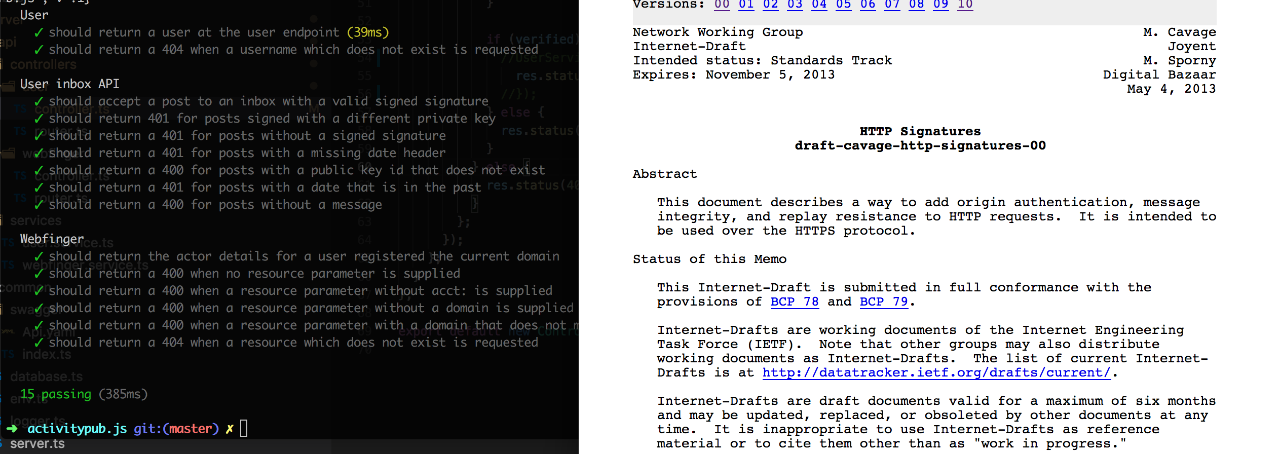
There's a pretty big incompatible design gap between the"Signing HTTP Messages” draft proposal ¹ and the “HTTP Message Signatures” RFC-9421², right…?

Doesn't the Fediverse basically run on the former? And, according to the reference below, no one’s implemented the latter. Seems… odd.

Implementation reference: fedidevs.org/reference/signatu

¹ datatracker.ietf.org/doc/html/
² datatracker.ietf.org/doc/html/

#HTTPSignatures

2023-11-29

Si no ho he entés malament, si vols que un servidor #Mastodon et faci cas quan li envies una activitat #Activitypub, per exemple "Follow", et cal signar amb la clau privada del usuari emissor, xifrada amb el hash SHA256, l'activitat en format json que li envies.
Si el servidor Mastodon receptor no rep la signatura vàlida en els "headers", no fa ni cas.
#HTTPSignatures

@reiver ⊼ (Charles) :batman:reiver
2023-09-13

I hate this requirement of having to sign the HTTP request to see the Activity-JSON for ActivityPub actor.

I hate it so much.

...

It makes it so I cannot do a simple "curl" command to get an ActivityPub actor's activity-JSON.

2023-05-25

My #SolidProject client and server are now ready for efficient access control demos on #BigData using the HTTP WG's 's "Signing HTTP Messages".

I can demo with a server publishing N resources (in this case, #LinkedData Event Stream (#LDES) data.
The client is implemented in #Scala using #http4s, and the server uses #Akka.
The libraries can be compiled to JS for use on #nodeJS frameworks too. Native is not far off, either.
The client need make no more than N+2 requests:

1. Request 1 on a resource R returning a "401 Unauthorised"
2. a max of 2 requests to get the access control rules
3. from there on, N signed requests using #HttpSignatures (when those all fall in the same container space)

Solid clients are essentially like Search Engine crawlers fetching data on the web, so they need to jump around from website to website. Having approx 2 requests extra per website for auth is very interesting in that scenario.

Note: those 2 requests can be cached, so those may be only needed once over a long period of time. The connection efficiency is possible by combining the following pieces:

• using the IETF's HTTPSig (a version from the beginning of the year)
• using default rules (part of the spec)
• caching of ACLs on the client
• the use of a "defaultAccessContainer" link header to reduce the number of requests.

I am trying to work out who may be interested in such a technical demo, what a good time for it may be, ...
so please just comment here or send me a mail at henry.story@bblfish.net

2023-03-28

I think, I've discovered another strange behavior of Mastodon. When Lemmy announces a post, It creates an Announce with a Create with an Note. It appears that Mastodon then fetches the Create with a signed HTTP get and then fetches the Note without the signature. I'm not 100% sure if that's all the 401 showing up in my log file, but it seems likely to be the case.

If anyone has a test setup, where they can verify this behavior, feel free to check and then report it.

I'm not confident in my conclusions, as I have no idea how I would go about implementing it.

Kingsley Uyi Idehenkidehen
2023-03-20

@helge,

Is github.com/HelgeKrueger/bovine your Client built to work with a generic server?

I am interested in clients that want to work with our backend.

Note, and Authentication matters are none issues since our servers implement most of these protocols (including the likes of etc).

/cc @gabek @mike @atomicpoet @davew @judell @Mastodon @smallcircles

2022-12-04

Notes so far on #Mastodon's #ActivityPub implementation, covering basics on #WebFinger, #HTTPSignatures, #JSONLD signatures, and #ActivityStream vocab. Pretty much a loosely-organized collection of links to useful specs and implementations for understanding how Mastodon specifically does things.

raphaelluckom.com/posts/Things

naturzukunftnaturzukunft
2022-01-16

Just found this how to. I think that is very well explained! Thanks for that! It's to earley for , but I'm looking forward to it.

youtu.be/Cu51fHkmkkA

2018-07-24

Progress marches on! 💂 💂 💂

Client Info

Server: https://mastodon.social
Version: 2025.07
Repository: https://github.com/cyevgeniy/lmst