Some of the western defences of Rough Castle Roman Fort on the Antonine Wall, near Falkirk. Built in around 142 AD, the fort is the second smallest on the wall, but the best preserved. 📸 My own. #RomanFortThursday #RomanBritain #RoughCastle
#RomanFortThursday

Some of the western defences of Rough Castle Roman Fort on the Antonine Wall, near Falkirk. Built in around 142 AD, the fort is the second smallest on the wall, but the best preserved. 📸 My own. #RomanFortThursday #RomanBritain #RoughCastle


The Ödes Schloss stones are actually a rare Roman bridgehead fort, the only one ever found in Austria. It is located just two miles from the Roman fort of Carnuntum. These forts were military installations placed on the opposite side of a border river at strategic locations. #RomanFortThursday

Caerleon in winter. The Legionary Fortress of Isca Augusta was founded in AD 75 as a permanent defence point. It was operational for 200 years. #RomanFortThursday

The remains of the bathhouse at Bar Hill Roman Fort on the Antonine Wall, near Twechar in East Dunbartonshire. The fort is the highest of the 16 known forts on the wall. 📸 My own. #RomanFortThursday #RomanBritain #BarHill

The faint outline of the granary building at Rough Castle Roman Fort on the Antonine Wall, near Falkirk. Built in around 142 AD, the fort is the second smallest on the wall, but the best preserved. 📸 My own. #RomanFortThursday #RomanBritain #RoughCastle #AntonineWall

Aesica (modern name Great Chesters) was the 9th fort on Hadrian’s Wall. Its main purpose was to guard the Caw Gap. It is believed that the fort was completed in the year 128 AD. It was rectangular in plan with towers at each corner and relatively small, only 3 acres (12,000 m2). #RomanFortThursday

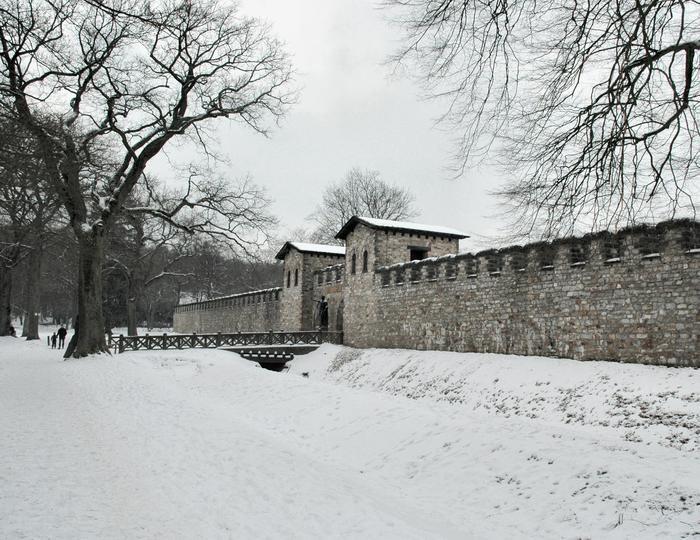
The Saalburg Roman fort in snow. It is located northwest of Bad Homburg, Hessen, Germany. It is a cohort fort, part of the Limes Germanicus. The earlier fort from 90 AD was replaced late in the reign of Hadrian, c. AD 135, with a much larger (3.2 hectare) fort. #RomanFortThursday
Happy New Year and good fortune to everyone during 2026! Below is a relief of the Roman goddess Fortuna which was found at Castlecary Roman Fort on the Antonine Wall. Now part of the collections at the Hunterian Museum in Glasgow. 📸 My own. #RomanFortThursday #NewYear


Zerzevan Castle (Diyarbakır Province) in Turkey is a Roman garrison and a UNESCO site. This vast fortress has subterranean homes, a church, Mithras temple, and water systems and pre-Roman remains. #RomanFortThursday

A wintery view of the remains of the Roman fort at Barr Hill on the Antonine Wall, near Twechar in East Dunbartonshire. The fort is the highest of the 16 known forts along the Antonine Wall. 📸 My own. #RomanFortThursday #RomanScotland

An image of a Roman fort in the region of Syria and Iraq from the spy images of the 1950s. One more of the findings of the Darthmouth College. See Casana et al in Antiquity 2023. #RomanFortThursday

A team from Dartmouth College identified the Roman forts while carrying out an extensive remote sensing survey from western Syria to northern Iraq. The survey located 396 Roman forts. The forts are easily identified by their standardized square shape and size. #RomanFortThursday

Hypocaust remains from the Commanding Officer’s House (Praetorium) at Chesters Roman Fort on Hadrian’s Wall in Northumberland. 📸 My own. #RomanFortThursday #RomanBritain #ChestersRomanFort #HadriansWall

The remains of the commanding officer’s house at Ambleside Roman Fort in the Lake District. Built during the 2nd century AD, the fort guarded the Roman road from Brougham to Ravenglass, and replaced an earlier 1st century fort. 📸 My own. #RomanFortThursday #RomanBritain

Volubilis in Morocco contains essentially a fortified Roman municipium. Covering an area of 42 hectares, it demonstrates urban development and Romanisation at the frontiers of the Roman Empire and is at the interface between the Roman and indigenous cultures. #RomanFortThursday

The northern gate of Roman fort in Bu Njem in Libya. This place was called Gholaia and was founded by the emperor Septimius Severus (AD 193-211). It was part of the so-called Limes Tripolitanus. #RomanFortThursday

Researchers led by Emil Jęczmienowski of the University of Poland's Institute of Archaeology found traces of a first-century AD Roman fort near the Romanian-Serbian border and mapped it with geophysics. It was for 1,000 auxiliary forces near the Iron Gate. #RomanFortThursday

Fort Ala Nova, or Schwechat Fort, is a former Roman cavalry fort (alae fort for 500 horsemen) within the Upper Pannonian Limes. The fort was in the municipality of Schwechat. In the picture excavation area between Alanovaplatz and Wienerstraße in 2010. #RomanFortThursday

Client Info
Server: https://mastodon.social
Version: 2025.07
Repository: https://github.com/cyevgeniy/lmst