
Watched the whole of Ben Hur tonight. I had no idea Jesus made an appearance. Not a great film, and how Heston won an Oscar for that is beyond me. But I did enjoy the chariots. #BenHur
#benhur

Movie TV Tech Geeks #MovieFeatures #BenHur 34 Years Before ‘Ben-Hur,’ This Underrated Classic Told the Exact Same Story in a Way That’s Just As Epic http://dlvr.it/TQ4pvB

Silent classic "Ben-Hur: A Tale of the Christ" turns 100 this week! Find out what other movies are celebrating milestone anniversaries in Hotchka's Movies by the Decade!
https://hotchka.com/movies-by-the-decade-283
#Hotchka #MoviesByTheDecade #BenHur #Entertainment #Movies #Film #Cinema

#BenHur (2016)
A betrayed prince returns from slavery to face his brother in a deadly chariot race, discovering forgiveness over revenge.
2/5⭐️ Will never reach the Original

“That’s the artist’s job, really: continually setting yourself free, and giving yourself new options and new ways of thinking about things”*…
Further, in a fashion, to last week’s post on literacy (and post-literacy), Nathan Gardels alerts us to a conversation between Ken Liu and Nils Gilman, in which Liu suggests that, in a way analogous to the the camera’s ability to capture motion (and thus, transform storytelling), AI is emerging as a new artistic medium for capturing subjective experience…
For the celebrated novelist Ken Liu, whose works include “The Paper Menagerie” and Chinese-to-English translation of “The Three-Body Problem,” science fiction is a way to plumb the anxieties, hopes and abiding myths of the collective unconscious.
In this pursuit, he argues in a Futurology podcast, AI should not be regarded as a threat to the distinctive human capacity to organize our reality or imagine alternative worlds through storytelling. On the contrary, the technology should be seen as an entirely new way to access that elusive realm beneath the surface and deepen our self-knowledge.
As a window into the interiority of others, and indeed, of ourselves, Liu believes the communal mirror of Large Language Models opens the horizons of how we experience and situate our presence in the world.
“It’s fascinating to me to think about AI as a potential new artistic medium in the same way that the camera was a new artistic medium,” he muses. What the roving aperture enabled was the cinematic art form of capturing motion, “so you can splice movement around … and can break all kinds of rules about narrative art that used to be true.
“In the dramatic arts, it was just assumed that because you had to perform in front of an audience on the stage, that you had to follow certain unities to make your story comprehensible. The unity of action, of place, of time. You can’t just randomly jump around, or the audience wouldn’t be able to follow you.
But with this motion-capturing machine, you can in fact do that. That’s why an actual movie is very different from a play.
You can do the reaction shots, you can do the montages, you can do the cuts, you can do the swipes, you can do all sorts of things in the language of cinema.
You can put audiences in perspectives that they normally can never be in. So it’s such a transformation of the understanding of presence, of how a subject can be present in a dramatic narrative story.”
He continues: “Rather than thinking about AI as a cheap way to replace filmmakers, to replace writers, to replace artists, think of [it] as a new kind of machine that captures something and plays back something. What is the thing that it captures and plays back? The content of thought, or subjectivity.”
The ancient Greeks called the content, or object of a person’s thought, “noema,” which is why this publication bears that name.
Liu thus invents the term “Noematograph” as analogous to “the cinematograph not for motion, but for thought … AI is really a subjectivity capturing machine, because by being trained on the products of human thinking, it has captured the subjectivities, the consciousnesses, that were involved in the creation of those things.”
Liu sees value in what some regard as the worst qualities of generative AI.
“This is a machine that allows people to play with subjectivities and to craft their own fictions, to engage in their own narrative self-construction in the process of working with an AI,” he observes. “The fact that AI is sycophantic and shapeable by you is the point. It’s not another human being. It’s a simulation. It’s a construction. It’s a fictional thing.
You can ask the AI to explain, to interpret. You can role-play with AI. You can explore a world that you construct together.
You can also share these things with other humans. One of the great, fun trends on the internet involving using AI, in fact, is about people crafting their own versions of prompts with models and then sharing the results with other humans.
And then a large group, a large community, comes together to collaboratively play with AI. So I think it’s the playfulness, it’s that interactivity, that I think is going to be really, really determinative of the future of AI as an art form.”
So, what will the product of this new art form look like?
“As a medium for art, what will come out of it won’t look anything like movies or novels …They’re going to be much more like conversations with friends. They’re going to be more like a meal you share with people. They are much more ephemeral in the moment. They’re about the participation. They’re about the consumer being also the creator.
They’re much more personalized. They’re about you looking into the strange mirror and sort of examining your own subjectivity.”
Much of what Liu posits echoes the views of the philosopher of technology, Tobias Rees, in a previous conversation with Noema.
As Rees describes it, “AI has much more information available than we do, and it can access and work through this information faster than we can. It also can discover logical structures in data — patterns — where we see nothing.
AI can literally give us access to spaces that we, on our own, qua human, cannot discover and cannot access.”
He goes on: “Imagine an AI model … that has access to all your data. Your emails, your messages, your documents, your voice memos, your photos, your songs, etc.
Such an AI system can make me visible to myself … it literally can lift me above me. It can show me myself from outside of myself, show me the patterns of thoughts and behaviors that have come to define me. It can help me understand these patterns, and it can discuss with me whether they are constraining me, and if so, then how. What is more, it can help me work on those patterns and, where appropriate, enable me to break from them and be set free.”
Philosophically put, says Rees, invoking the meaning of “noema” as Liu does, “AI can help me transform myself into an ‘object of thought’ to which I can relate and on which I can work.
“The work of the self on the self has formed the core of what Greek philosophers called meletē and Roman philosophers meditatio. And the kind of AI system I evoke here would be a philosopher’s dream. It could make us humans visible to ourselves from outside of us.”
Liu’s insight as a writer of science fiction realism is to see what Rees describes in the social context of interactive connectivity.
The arrival of new technologies is always disruptive to familiar ways of seeing that were cultivated from within established capacities. Letting go of those comforting narratives that guide our inner world is existentially disorienting. It is here that art’s vocation comes into play as the medium that helps move the human condition along. To see technology as an art form, as Liu does, is to capture the epochal moment of transformation that we are presently living through…
Is AI birthing a new art form? “From Cinema To The Noematograph,” @kyliu99.bsky.social and @nilsgilman.bsky.social in @futurologypod.bsky.social.
See/her the full conversation:
https://youtu.be/q8ZR9-y4ik8?si=gqRnE4ppMic6K7zb
See also: “O brave new world, that has such people in ‘t!“
* Miranda July
###
As we observe, with William Gibson, that the street finds its own uses for things, we might recall that it was on this date in 1959 that perhaps the pinnacle of cinema’s ability to capture motion was released: the most famous the the six films of Ben Hur, “the Charlton Heston version.”
At the time, Ben Hur had the largest budget ($15.175 million), the largest sets, a wardrobe staff of 100, over 200 artists, about 200 camels and 2,500 horses and about 10,000 extras.
Filming began on May 18, 1958, and didn’t wrap up until January 7, 1959. The film crew worked between 12 to 14 hours a day, six days a week.
The chariot race scene lasts for nine minutes in the finished film and Miklos Rozsa’s film score is the longest ever composed for a film.
– source
https://youtu.be/1LVp4tvl5O4?si=jdb5fLkiRCJQQCgP
#ai #art #artifcialIntelligence #benHur #charltonHeston #cinema #culture #film #history #kenLiu #noematograph #subjectivity #technology #thought #tobiasRees

Movie TV Tech Geeks #Movie #TheElectricState #Megalopolis #BenHur 8 Worst Epic Movies of the Last 10 Years, Ranked http://dlvr.it/TP8qMj


Movie TV Tech Geeks #Movie #Oscars #BenHur #Titanic All 3 Movies That Won 11 Oscars, Ranked http://dlvr.it/TNRRLg

Movie TV Tech Geeks #Movie #TheCriterionCollection #BenHur 10 Epic Movies That Deserve to Be in the Criterion Collection, Ranked http://dlvr.it/TN0f2P
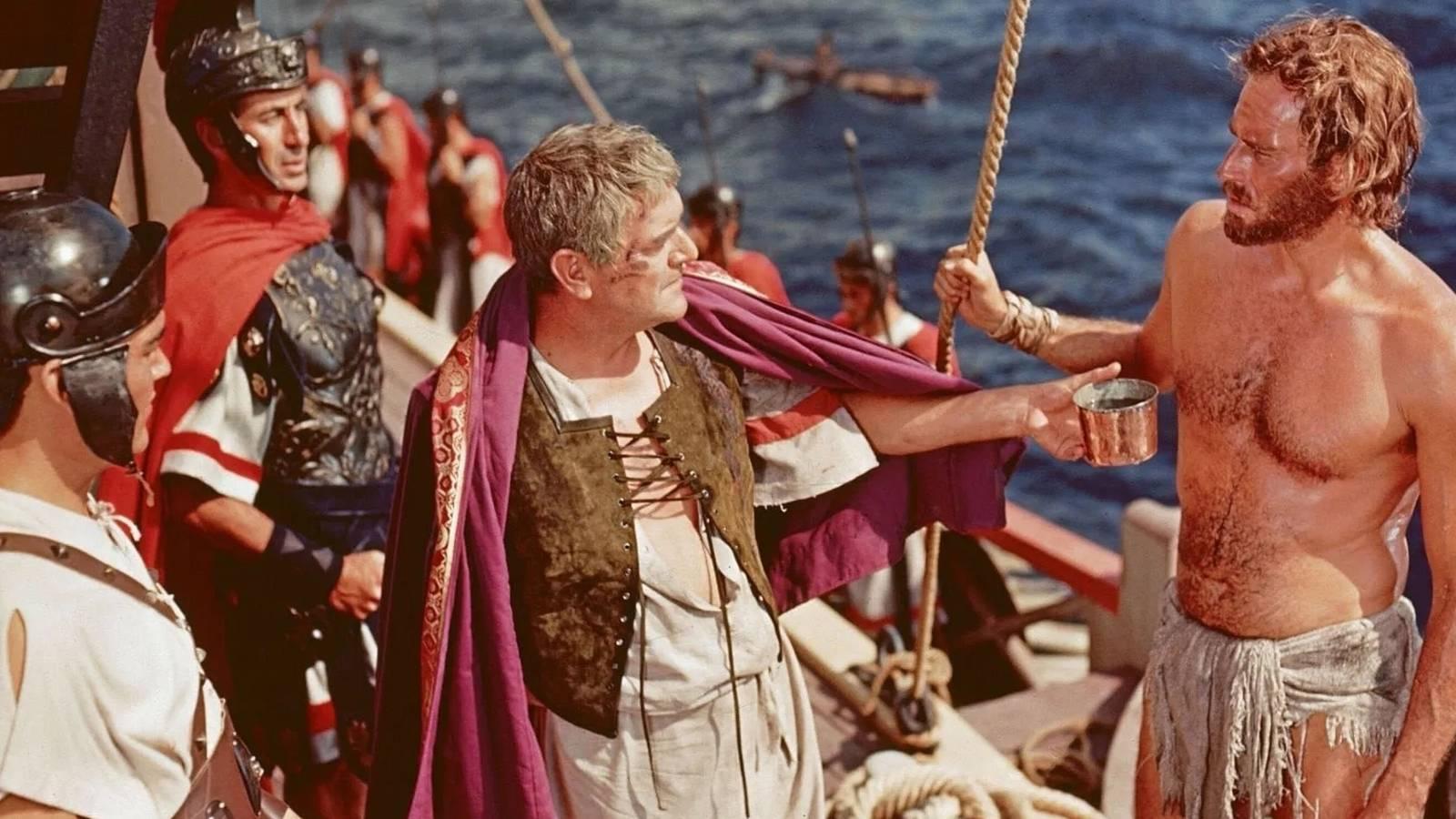
(5/6) ... hydraulique #eau de Malpasset à Fréjus #agriculture après des pluies diluviennes = vague haute 30 m. déferle à 80 km/h -> décès 423 habitants dont dont 151 enfants.
- USA : #censure morale anti #femme #lgbtq Code Hayes #cinema -> #films #BenHur #SoudainlEteDernier scénarios de #GoreVidal d'après #theatre #TennesseeWilliams implicite homosexualité/scènes coupées montage (cf 1958 + 2025 Donald #woke).
#year1959 #anthropocene #climat #climate #climatechange #climatechange
I was lucky enough to get to see Ben-Hur (1959) on the big screen at the NFSA yesterday. A wonderful movie experience for myself and a couple of like-minded friends!
My review of Ben-Hur on Letterboxd https://boxd.it/9RgBKh


"El apagón podía pasar y pasó, como Fukushima" – 15/15\15
https://www.15-15-15.org/webzine/2025/05/23/el-apagon-podia-pasar-y-paso-como-fukushima/
> (Carlos de Castro) Hay que ver la película entera [Ben Hur] para ver de qué va el asunto este del apagón y de cómo funciona nuestro sistema energético y también político.
Muy recomendable artículo, para mí, que aporta una mirada sistémica al marco en el que sucedió el apagón, más allá de los pequeños detalles concretos de esta vez (porque esto irá pasando más y más, en mi opinión). También sus notas a pie, por cierto!
#GranApagón #Apagón #Sistemas #BenHur #Colapso #Transición #TransiciónEnergética #CarlosDeCastro #151515
https://www.15-15-15.org/webzine/2025/05/23/el-apagon-podia-pasar-y-paso-como-fukushima/
> (Carlos de Castro) Hay que ver la película entera [Ben Hur] para ver de qué va el asunto este del apagón y de cómo funciona nuestro sistema energético y también político.
Muy recomendable artículo, para mí, que aporta una mirada sistémica al marco en el que sucedió el apagón, más allá de los pequeños detalles concretos de esta vez (porque esto irá pasando más y más, en mi opinión). También sus notas a pie, por cierto!
#GranApagón #Apagón #Sistemas #BenHur #Colapso #Transición #TransiciónEnergética #CarlosDeCastro #151515

Hoy en la #pelisiesta tenemos una obra de excepción, sin duda una de las películas siesteras por excelencia, Ben-Hur. Así que voy preparando pijama y orinal porque la siesta de hoy se prevé épica.

Nach entspannten zwei Stunden und vierundvierzig Minuten beginnt dann mal das döschige Wagenrennen. Der @fledermaus.bsky.social ist es VIEL zu spannend. #BenHur
"You think you can treat my horses like animals?" #BenHur
Aber krass, wie viel George Lucas sich da abgeguckt hat, und das Rennen kommt erst noch. #BenHur
Sind noch ja noch ein paar Stunden, aber ich schätze schon mal #BenHur besteht den Bechdel-Test nicht. Es wurde aber schon einmal geknutscht.
Man wartet eigentlich die ganze Zeit, dass jemand den Purchen zu Poden chleudert. #BenHur
Client Info
Server: https://mastodon.social
Version: 2025.07
Repository: https://github.com/cyevgeniy/lmst