Blame Marie Curie For the Loss of the Chiming Watch
Once upon a time, the most-common complicated watches would ring out the time on demand. Why are they so rare today? It’s not because they were too complex to build and maintain or too difficult to build; many companies were working on these issues even in the 1890s. And the chiming pocket watch met a special market need, allowing the owner to tell the time in the dark. But the popularity of luminous dials, painted with Marie Curie’s radium salts, allowed everyone to tell the time in the dark. Competition pushed the chiming watch into obscurity, where it remains today.
Buyers of fine watches had a multitude of choices as the 20th century arrived, with fantastic upscale makers from Breguet to Paul Buhré to Patek Philippe to Audemars Piguet and many more. Then as now, high-end watchmakers sought to differentiate their offerings with complications like calendars, chronographs, and especially chimes. Though these additional functions had been developing for a century or more, the one that caught the attention of the rising moneyed gentleman was the so-called repeating watch, which rang out the time on command.
At the same time, industrialized production and the automated cutting machines made it possible for firms across Switzerland, Germany, and France to produce reliable, accurate, and affordable watches. This lead to broad availability of chiming watches from mainstream brands like Le Phare, Invicta, Vulcain, and Angélus. But just as chiming movements were becoming more common and affordable, the entire genre collapsed. This is the story of the fall of a complication and the rise of radium.
The Four Complications
Anything added to a basic watch movement is called a complication, and these fall into a few general categories:
- Automatic winding is the most common today. Some would not even consider this to be a complication, but it was certainly included on the list in historic times and took over a century to perfect.
- Calendar functions, and particularly a date window, are also familiar enough to be taken for granted. This category includes related complications like 24 hour hands, GMT, second timezone, and world time indicators, and astronomical displays.
- The chronograph and stopwatch are perhaps the most recognizable complications today, and still command a premium price. These too took a century to perfect.
- Few modern watch buyers are even familiar with the chiming watch, but sonnerie, répétition, and réveil were the defining achievement of generations of watchmakers before the modern era. Today only the alarm watch is produced in any volume, and even this is a rarity.
This situation was entirely reversed at the turn of the 20th century. Chiming watches, and repeaters in particular, were the most common and popular complication. Various calendar functions were well-known, but customers saw little need for them. The chronograph was still in its infancy, though it had found customers in military and sporting circles. And automatic winding would still take a few decades to appear.
The most popular form of chiming watch was the repeater, which rings the time on demand. Most used a pushbutton that both powered and triggered the chime, which rang the hours, quarters, and five or even one minute count. Many people use the term “minute repeater” generically to refer to all such watches, but it refers only to watches that specifically chime to the minute. Five-minute or simply quarter repetition was far more common a century ago.
There are two other categories of chiming watches:
- A sonnerie chimes the hour or the quarters autonomously (“en passant”), as is common in a grandfather or church clock. A grande sonnerie chimes the quarters, while a petite sonnerie chimes only the hour.
- A réveil operates like an alarm clock, ringing at a pre-set time in the future. These have been produced for centuries but were never in great demand until the 1950s and rapidly fell out of favor.
Anxiety About Time
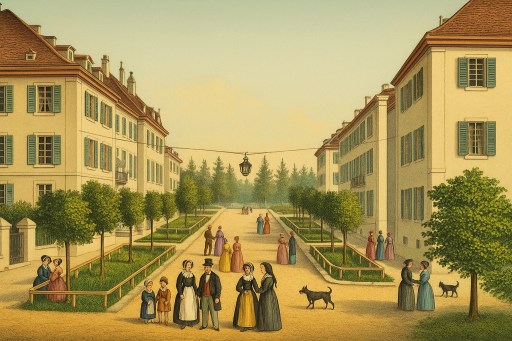
Rue de la Promenade was considered the finest address in La Chaux-de-Fonds, but dozens of members of the Brandt family (founders of Omega) lived and worked together in a single house at the end, despite being members of the BourgeoisieWe live in a culture obsessed with time, but this was not the case before the 20th century. Most people lived communally and rose, ate, worked, and played along with those around them rather than on the whims of a clock. Extended families lived together, and beds were shared with family members and even strangers. There was very little need to set an alarm to wake at a certain time when the whole house arose together. Since the week was tightly associated with the schedules of the church, no one needed to know the date. Very few activities needed precise time measurement.
All this changed as industrialization allowed more people access to the comforts of life that had previously been reserved for the ownership class. The expanding middle class began moving to larger houses with more bedrooms and experiencing a new feeling: Privacy. Unused to sleeping alone they likely woke in the middle of the night, wondering how much longer they could stay in bed.
At the same time, workers and managers alike began commuting to workshops and factories, even taking trains to other towns and villages. By the turn of the 20th century, anxiety had a risen about waking and schedules, even among the working class. Many of these were served by bells, increasingly attached to factories rather than churches, that alerted them when to arrive at work.
The Repeating Chime Craze
Repeating watches solve a problem: Rather than feeling for the position of the hands or waiting for a chime en passant, a repeater could “speak” the time even in pitch dark. In the 1890s, once industrialization and invention made them more practical, demand for repeating watches exploded.
Many familiar brands, including Invicta, Vulcain, Martel, and Lemania, began with chiming watchesA few watchmakers deserve special credit for the repeating watch craze. These were centered in the Swiss Jura and the Vallée de Joux.
Le Locle, Ponts-de-Martel, and La Chaux-de-Fonds brought us Le Phare, Martel, Angélus, and Invicta:
- Charles Barbezat-Baillot (1846-1938) went from apprentice to partner of Henri Guye (1838-1877) of Le Locle in the 1870s, taking over the company after his early death. His Barbezat-Baillot watch factory was formed in 1888 to capitalize on a patented repeating watch design, sold as Le Phare (“the lighthouse”) by 1896. This would become the leading producer of repeating watches in the era until it was taken over by Jämes Favre of Zenith in 1914.
- Georges Pellaton-Steudler (1865-1950) invented the Le Phare movement. He formed his own company in Le Locle in 1910 before moving to Ponts-de-Martel to establish the Martel Watch Company there. Georges was the son of Albert Pellaton-Favre (1832-1914), inventor of the practical tourbillon, and brother of Jämes-César Pellaton (1873-1954), who continued his father’s work at the Le Locle watchmaking school. The Martel factory became a leading producer of chronographs after the repeating watch bust, eventually creating the El Primero for Zenith!
- Edmond Mathey-Tissot (1858-1929) was already producing complicated watches in Ponts-de-Martel with Albert Guye (1867-1952) when Georges Pellaton-Steudler arrived. The three watchmakers worked closely together, promoting the repeater as well as the chronograph.
- Henri Barbezat-Bôle was a specialist in the finest watches and complications. Working in Le Locle, he was likely related to Charles Barbezat-Baillot. His firm was founded a bit earlier and continued longer, merging with Paul Buhré in 1928. Barbezat-Bôle had a patented minute repeater with four hammers.
- Stolz Frères of Le Locle rapidly expanded their factory, producing the Angélus repeating pocket watch there. Like Excelsior Park and Martel, Angélus was able to pivot from the repeater to the chronograph and became a successful producer of clocks in the 20th century.
- The Invicta brand was originally specific to a repeating watch manufactured by Fils de R. Picard of La Chaux-de-Fonds. It was manufactured alongside the company’s Military Watch using standardized and mass-produced components. The factory took the Invicta name in 1908 and this remains one of the most famous brands in watchmaking.
The Vallée de Joux was long a center for complicated watchmaking and some of these firms produced larger quantities of repeating watches:
- Henri Magnenat-Lecoultre formed a specialized company in Le Sentier to manufacture minute repeaters of his own design in 1887. He sold the company to Jeanneret-Brehm, maker of Excelsior Park chronographs, in 1910. They closed the Le Sentier factory in 1917 after the repeater bubble burst.
- John-W. Meylan (1877-1938) was born into watchmaking in the Vallée de Joux, patenting a pusher mechanism to wind and trigger the chime. He partnered with Charles Aubert and supplied many high-end watch brands with repeating movements, including Audemars Piguet.
- Alfred Lugrin (1858-1920) produced complicated watches in l’Orient in the Vallée de Joux, including chronographs and repeaters. He sold these using the Lemania brand exclusively until the repeater watch lost favor. His factory joined SSIH, the holding company for Omega and Tissot, in 1932 and is today known as Manufacture Breguet.
There are many others who could be included on this list, but it should be clear that the repeating watch was a major industry trend from the 1890s through the beginning of World War I. But it should also be noted that most of these watchmakers went out of business or switched to chronographs around this time.
Though forgotten today, the reason for the collapse of the repeating watch market was well known at the time: Luminous radium dials allowed one to tell the time at night without a complex chiming mechanism.
H. Barbezat-Bôle of Le Locle produced some of the finest complicated watches of the eraRevue Internationale de l’Horlogerie, December 1903
Radium: The Miraculous New Material
Marie Curie and her husband Pierre were inspired by the work of Röntgen and Becquerel to search for new elements in their Paris laboratory in the late 1890s. She focused on pitchblende and chalcolite ores, noting that they were “much more active than uranium.” In 1898 the Curies published papers announcing the existence of polonium and radium, coining the word “radioactivity” but not understanding the dangers.
The Curies’ discovery caused a worldwide sensation, with speculation about the application for “the luminous glow and spontaneous heat” of radium salts. The watch industry buzzed about the new element, with one article speculating about a “radium watch” that could be powered for life by a small lump of radium rather than a spring. More intriguing was the suggestion in Revue Horlogére and others that radium was a “philosopher’s stone” that could transmute corrundum into topaz or ruby. The potential to combine radium and phosphorous to produce lasting luminance was also noted, though this was one of many potential uses.
“Radium” was just a brand name for this 1903 Moutier watchPerhaps the oddest result of the radium craze was the trend to name completely-unrelated things after the new material. A quick search of products using the name include a type of silk fabric, a movie theater, cigarette paper, and a brand of watches: The struggling Moutier Watch Company used the Radium brand name on watches as early as 1903, receiving a trademark on the word in October. This was five years before a luminous radium painted dial would be produced! It didn’t save the Société d’Horlogerie de Moutier, however; The company was bankrupt by the end of 1913.
Junghans, LIP, and Utinam
This June 1909 advertisement features the “Darling” alarm clock “avec cadran radium lumineux”Radium was incredibly rare and expensive, requiring tons of ore to produce a single gram of radium salts. At first, access was limited to scientists and companies associated with the major French and German academies, and this is likely how the Junghans brothers of Schramberg in the German Kingdom of Württemberg became the first to produce a dial with luminous radium paint. On June 27, 1907 Arthur Junghans applied for a patent that covered the use of “improved luminous substance for indicators containing radium … of a clock, speed-gauge, or the like.”
The Junghans patent was granted in Germany, France, and America, and the German factory began producing an alarm clock with a radium painted dial in 1908. The “Darling” alarm clock included the company’s patented alarm movement and had luminous radium painted numerals and hands, allowing it to be seen in the dark. The early Darling clock did not use much of the precious radium salts, but it didn’t need to be very bright to be read at night.
Desiring to take advantage their “first mover” advantage, Junghans purchased advertisements in major newspapers in 1910 announcing that they would protect their patents vigorously, even requesting that any other radium-painted watch or clock be seized by the authorities. Needless to say, this did not go well with their competitors, especially LIP, which was already preparing to release a radium painted alarm clock of their own.
Junghans patented the use of luminous radium paint on watches and clocks in 1907, warning that competing products would be seized!Revue Internationale de l’Horlogerie, November 1910
The validity of the Junghans patent was challenged with centuries of prior art for the use of luminous material in watchmaking and was quickly overturned. But LIP and others were quick to point out that there were patentable elements, from the formula and mixing, application technique, and the physical properties of the hands and dials. Indeed, the same people involved in the patent controversy quickly registered patents of their own, including Arthur Junghans.
LIP and Utinam released watches with luminous radium dials in November 1909LIP was next to market, announcing in November 1909 that their latest watches show “time in the dark with Radium luminous dials and hands.” Swiss/French brand Utinam made a similar announcement later that same month, perhaps using LIP as a supplier. And Junghans continued refining their technology, releasing a pocket alarm watch with a radium dial that was ten times brighter.
The Radium Watch Craze
By 1914 nearly every watchmaking firm was offering luminous painted hands and numerals powered by radium. This same period saw an explosion of interest in alarm clocks, many of which included glowing dials as well. And the price of radium came down dramatically as demand grew and mixing techniques improved. Soon, even so-called economic watches would have glowing hands and dials.
This boom spelled the end of the repeating watch, however. Although the pushbutton chime was undoubtedly a joy, these complex watches were far more expensive than a simple alarm clock, even one with a radium dial. Demand crashed, with nearly every chiming watch specialist closing or changing hands between 1910 and 1920. The best were able to pivot to chronographs, compact watches for ladies, wristwatches, or other trends. But many, including specialists like John-W. Meylan and Henri Magnenat-Lecoultre, simply vanished into obscurity.
Eterna combined everything in 1914: A wristwatch with alarm, luminous radium dial, and optional automobile mount!One of the most remarkable new luminous radium dial watches introduced in this period used a compact 13 ligne alarm movement from Schild Frères. Sold under the Eterna brand as a tiny pocket watch, it was also available with a novel wrist strap and matching attachment for use in an automobile. This was the first mass-produced alarm wristwatch, and would remain in production for three decades. Incredibly, production stopped just two years short of the introduction of the trend-setting Vulcain Cricket!
Customers weren’t ready to carry an alarm watch, however. They saw the utility in cheaper fixed alarm clocks, and these rose in popularity among factory workers and managers alike. And they loved the glowing radium numerals, especially once prices came down. A post-war boom and bust, followed by the Great Depression and World War II limited the market for complicated watches generally. It wasn’t until watchmakers tried to find novelty in the 1950s that calendars and automatic winding, and to a lesser extent chronographs and alarm watches, came back. But the repeater remained dormant for decades.
The Radium Girls
The radium craze had a darker side as well. Although it was well known at the time that there were powerful rays emanating from radium and other materials, the impact of radiation on the human body was not understood. Marie Curie would ultimately die of radiation exposure, as would dozens of so-called “radium girls” in America who pointed their brushes by touching them to their lips. The health effects of radium exposure was known but hidden from these workers, leading to lawsuits and a revolution in workplace safety regulations.
Radium-related illnesses were much less common in Europe. Junghans, LIP, and Swiss makers used glass pens and rods rather than camel hair brushes to apply the paint, and the technique and mixture was different. This resulted in far less exposure than the “lip, dip, paint” method taught to the American workers. And the Swiss workers in particular had social funds to provide medical care rather than being forced to sue the corporation.
Once the American radium dial companies adopted basic safety standards the health impact of radium was dramatically reduced. Although it is likely that some workers still succumbed to radium poisoning in America and Europe, the widespread illnesses suffered by the Radium Girls in the 1920s did not reoccur in the five decades of radium dial painting that followed.
I strongly recommend reading the 2018 book, “Radium Girls” by Kate Moore to learn more. Sadly, the 2020 film adaptation is poorly-written and full of anachronisms and non-sequiturs.
The Return of the Repeater
Gérald Genta’s 1978 grande complication combined a perpetual calendar and minute repeater in a platinum pocket watch set with diamonds and rubiesEuropa Star 166, 1978
Although he is usually remembered for other innovations, it was Gérald Genta that brought the repeating watch back from its slumber in the 1970s: His 1978 gem-crusted grande complication pocket watch reminded the world what Swiss watchmakers were capable of producing. IWC and Audemars Piguet also brought the repeater back in exclusive pocket watches at the end of that bruising decade.
In the 1980s, Swiss watchmakers realized that complicated watches could be a path forward for the industry. Blancpain introduced an exclusive minute repeater at Basel in 1986 and paired it with a perpetual calendar the following year. IWC combined a minute repeater with a perpetual calendar and chronograph for the 1992 Il Destriero grande complication. Jaeger-LeCoultre even brought a minute repeater to the Reverso in 1994.
The Grail Watch Perspective: The Loss of a Charming Complication
Chiming watches are charming to the un-initiated. When I ring my Jaeger-LeCoultre Memovox movement everyone stops to listen. And the AMVOX and Reverso are the only watches in my collection that my kids took an interest in. Given this kind of appeal, and the fact that modern manufacturing makes chiming watches practical once again, one would think they would be more common. But chimes have remained exclusive and limited.
This changed in 2022 when Christopher Ward introduced the GPHG-winning C1 Bel Canto. Priced under $4,000, the Bel Canto is the first repeater to come close to the widespread appeal of the turn of the century repeating watches from Invicta, Le Phare, and Vulcain. My friend owns one, and it’s just as charming as I imagined. Enough to tempt me to consider buying another watch!
#alarm #Angelus #BarbezatBôle #ChristopherWard #ComplicatedWatches #Eterna #ExcelsiorPark #GéraldGenta #Invicta #Junghans #LePhare #Lemania #LIP #MagnenatLecoultre #MarieCurie #Martel #MatheyTissot #Radium #Repeater #Utinam #Vulcain