#ngc281

Dr N Karnkar
2026-01-05

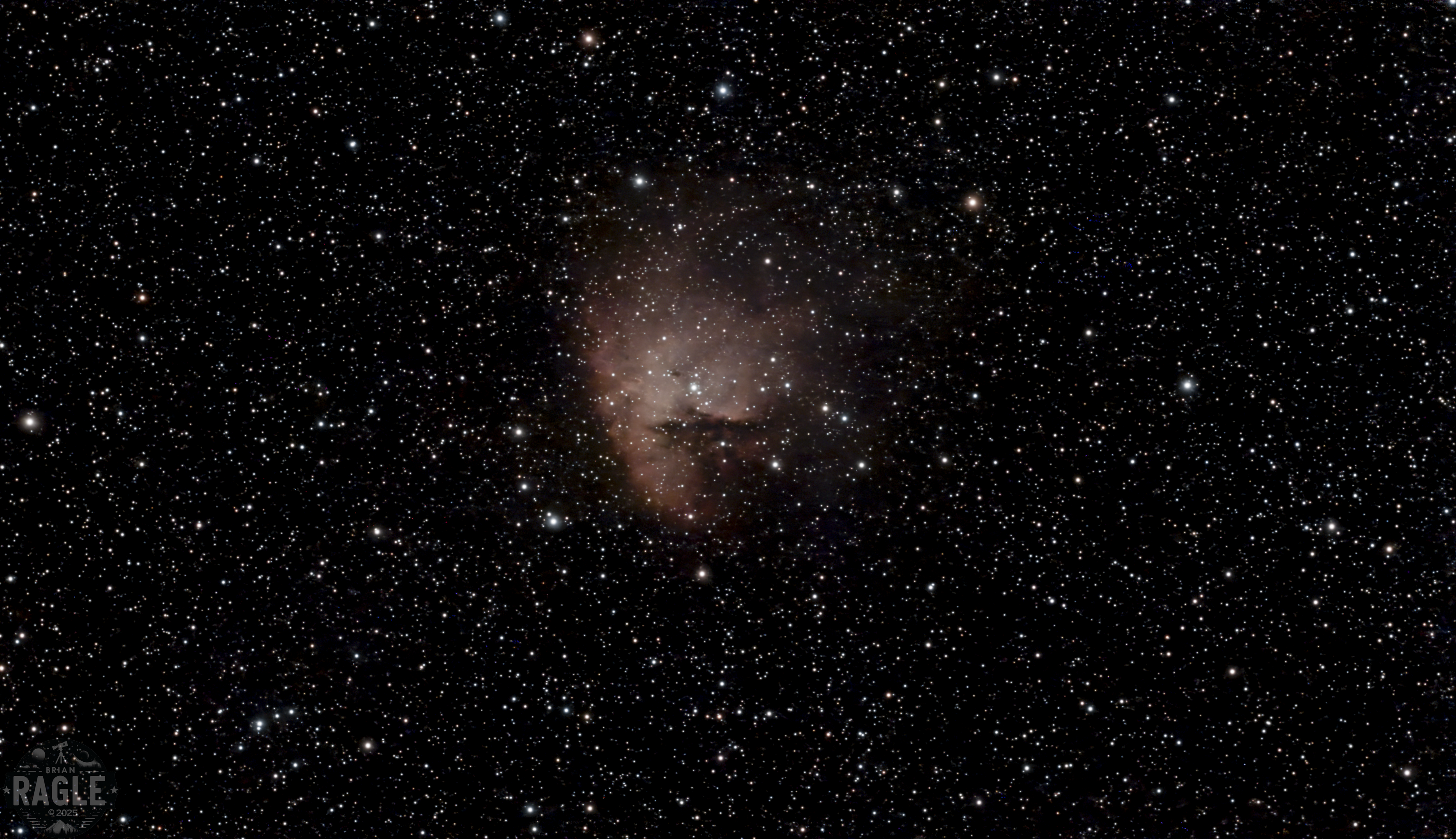
My only accomplishment this winter. Clear Skies!

(, IC11 or Sh2-184):
32x4min Ha-Oiii dual NB filter
stacked in DSS
processed in Siril and PixInsight
Bortle 5.

Oskar Contrerastg8arc
2025-10-23

Good Thursday morning. Weather improved yesterday evening so was able to set up the s50. Set the telescope to see again. These images are made up of 672 frames at 20 second duration exposures - 3 hours and 43 minutes total. It is a bit better than a 1 hour 32 minutes from an earlier observation, but never as details as the 46 1/2 minute duration observation with the onboard LP filter.

NGC 281 The Pac-Man Nebula - telescope processed image with Moon and Sky Light Filter.  NGC 281 is a bright emission nebula in Cassiopeia, nicknamed the Pac-Man Nebula for its shape created by a dark dust lane. It's an H II region where new stars are forming.NGC 281 The Pac-Man Nebula - unprocessed image with Moon and Sky Light Filter.   Its "mouth," which gives it the Pac-Man nickname, is a thick lane of dark dust blocking the light of the glowing gas behind it.
2025-10-21

The Pacman Nebula NGC 281, 9500 light years away. Processed and raw. #astrophotography #seestar #ngc281

A bright emissions nebulaA bright emissions nebula
2025-10-12
Photo 1: Pacman Nebula (NGC 281)
Captured with a DWARF 3 smart telescope from Tennessee skies, this image reveals the Pacman Nebula’s glowing clouds of hydrogen and dark dust lanes devouring starlight like its pixelated namesake. The nebula sits about 9,200 light-years away in Cassiopeia and is a stellar nursery where new suns ignite amid cosmic chaos. The black "mouth" cutting through the red haze is a dense molecular cloud silhouetted against ionized gas—proof the universe has both beauty and bite.
Hashtags: #Astrophotography #DWARF3 #Nebula #PacmanNebula #NGC281 #Cassiopeia #DeepSky #Cosmos #SpacePhotography #AstroGear #TelescopeLife #StarNursery #AstroImaging #NightSky

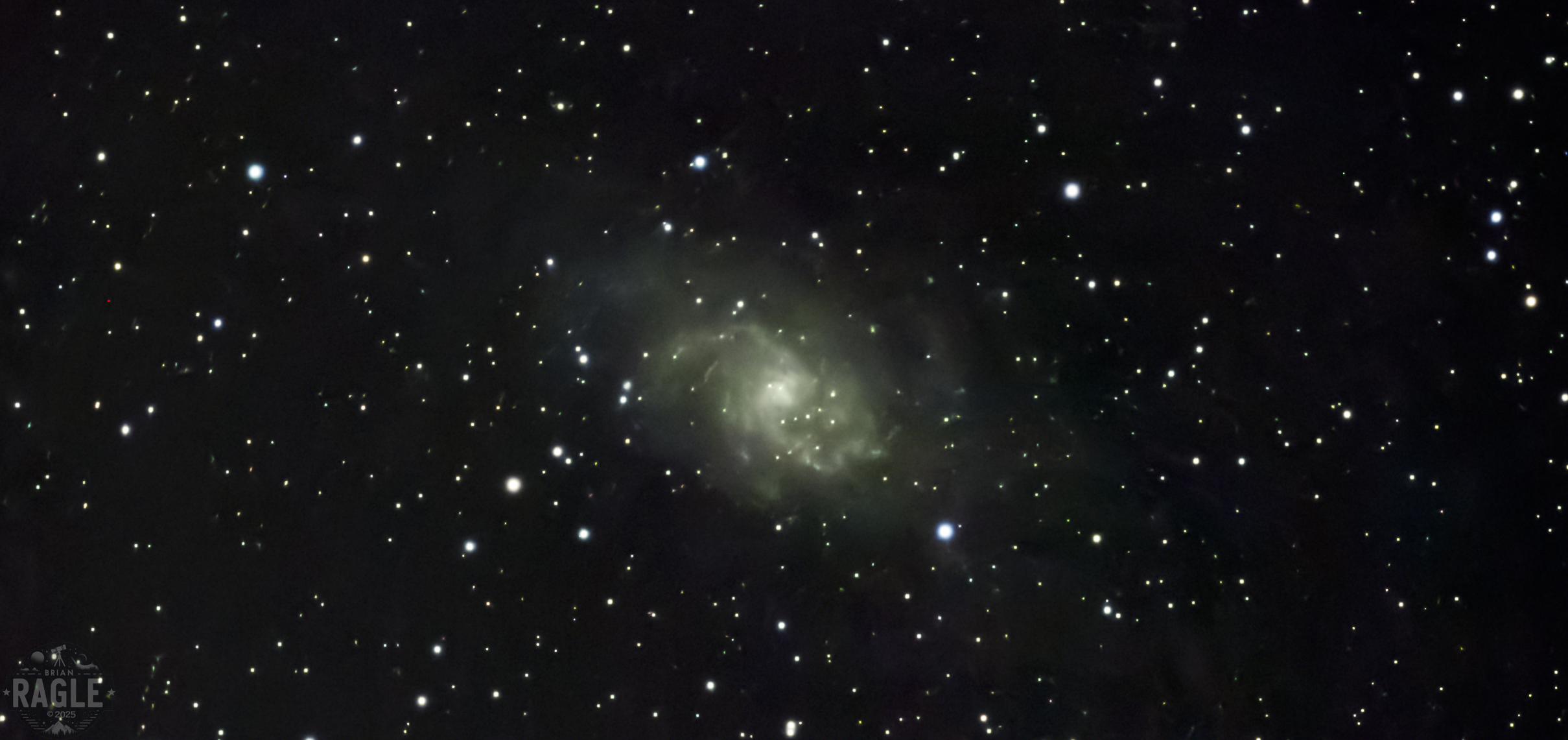
Photo 2: Triangulum Galaxy (M33)
Captured with a DWARF 2 telescope, this shot of the Triangulum Galaxy—our Local Group neighbor about 2.7 million light-years away—shows its faint spiral arms swirling through a sea of stars. The pale green glow reveals hydrogen regions where new stars are born, while the galaxy’s subtle rotation hints at its cosmic dance with the Andromeda and Milky Way galaxies. Even from our tiny vantage point, this spiral whispers: everything spins, everything changes, everything burns bright before fading.
Hashtags: #TriangulumGalaxy #M33 #DWARF2 #DeepSkyAstro #GalaxyPhotography #LocalGroup #Astrophotography #Cosmos #SpaceArt #SpiralGalaxy #StarFormation #AstronomyLovers #TelescopeView
Alt text: A detailed image of the Pacman Nebula showing a reddish-pink emission cloud with a dark notch resembling an open mouth, surrounded by a dense field of stars against a black background.Alt text: A close-up view of the Triangulum Galaxy showing faint greenish spiral arms filled with star clusters and nebular regions, surrounded by numerous white and blue stars scattered across a dark sky.
Oskar Contrerastg8arc
2025-10-10

Continuing with the Moon and Sky Light Filter vs No Filter vs LP Filter, still using as our subject, processed images below. Places of images in my opinion - 1st - LP Filter, 2nd - Moon and Skylight Filter, 3rd -No Filter.

NGC 281 The Pac-Man Nebula - telescope processed image with Moon and Sky Light filter. With the denoising the  image did come out nice. More detail than the no filter option. NGC 281 The Pac-Man Nebula - telescope processed image with no filter. Not even close to the level of detail of the logger images. NGC 281 The Pac-Man Nebula - telescope processed image with LP filter. Most detail of the nebula compared to the other 2 option. Still a more reddish tint to the image.
Oskar Contrerastg8arc
2025-10-10

Another test for the Moon and Skylight Filter vs No Filter vs LP Onboard filter on the s50. Using as the target. All images roughly the same duration. No question the onboard LP filter gets the most details. All these images are unprocessed. Will share the processed images as well.

NGC 281 The Pac-Man Nebula - unprocessed image with Moon and Sky Filter. This seems to be just slightly better than the no filter option. I can’t say it’s halfway to the LP either. NGC 281 The Pac-Man Nebula - unprocessed image without filters. The worst of the 3 options. NGC 281 The Pac-Man Nebula - unprocessed image with LP filter. Definitely the best though it has a more reddish tint to it.
Oskar Contrerastg8arc
2025-09-24

When you are imagining nebulas the s50 normally has the Light Pollution (LP) filter on. I wondered what the results would be with it off. Here is observations of with and without the LP filter.

NGC 281 The Pacman Nebula - telescope processed image without LP filter. NGC 281 The Pacman Nebula - unprocessed image without LP filter. NGC 281 The Pacman Nebula - telescope processed image with LP filter. NGC 281 The Pacman Nebula - unprocessed image with LP filter.
Oskar Contrerastg8arc
2025-09-21

Next of the planned observation, went back to .

NGC 281 The Pacman Nebula - telescope processed image.  NGC 281 is an emission nebula in Cassiopeia nicknamed the "Pacman Nebula" due to a dark dust lane that makes it resemble the classic arcade character.NGC 281 The Pacman Nebula - unprocessed image.  This star-forming region is home to Bok globules (dark, dense cosmic dust clouds) that are resisting powerful radiation from hot, massive, young stars.
Oskar Contrerastg8arc
2025-09-13

Another from this morning. . The s50 does amazing with the nebula for sure.

NGC 281 Pacman Nebula - telescope processed image. NGC 281 is an emission nebula in the constellation Cassiopeia. Its nickname, the Pacman Nebula, comes from its resemblance to the iconic video game character. Imaging NGC 281 (a.k.a. 'The Pacman Nebula'). NGC 281 Pacman Nebula - unprocessed image. In infrared light, the Pacman Nebula looks like it has teeth! It's also an active star-forming region.
Oskar Contrerastg8arc
2025-08-16

Tried to get again. Not very successful compared to the last times I tried. Best observation to date was on July 20th.

Area where NGC 281 (Pac-Man Nebula) is. Spice the first time I have not been very successful imaging the nebula.
Oskar Contrerastg8arc
2025-07-20

Last image for this morning. . Noticed this area using a separate star gazing app. I think I found tomorrow morning’s astronomy target.

Nebula NGC 281 The Pac-Man Nebula processed image. A stellar nursery in Cassiopeia, where young stars illuminate gas and dust, creating its distinctive game-character shape. Nebula NGC 281 The Pac-Man Nebula - unprocessed image.
Frank Adleradfr
2024-11-04

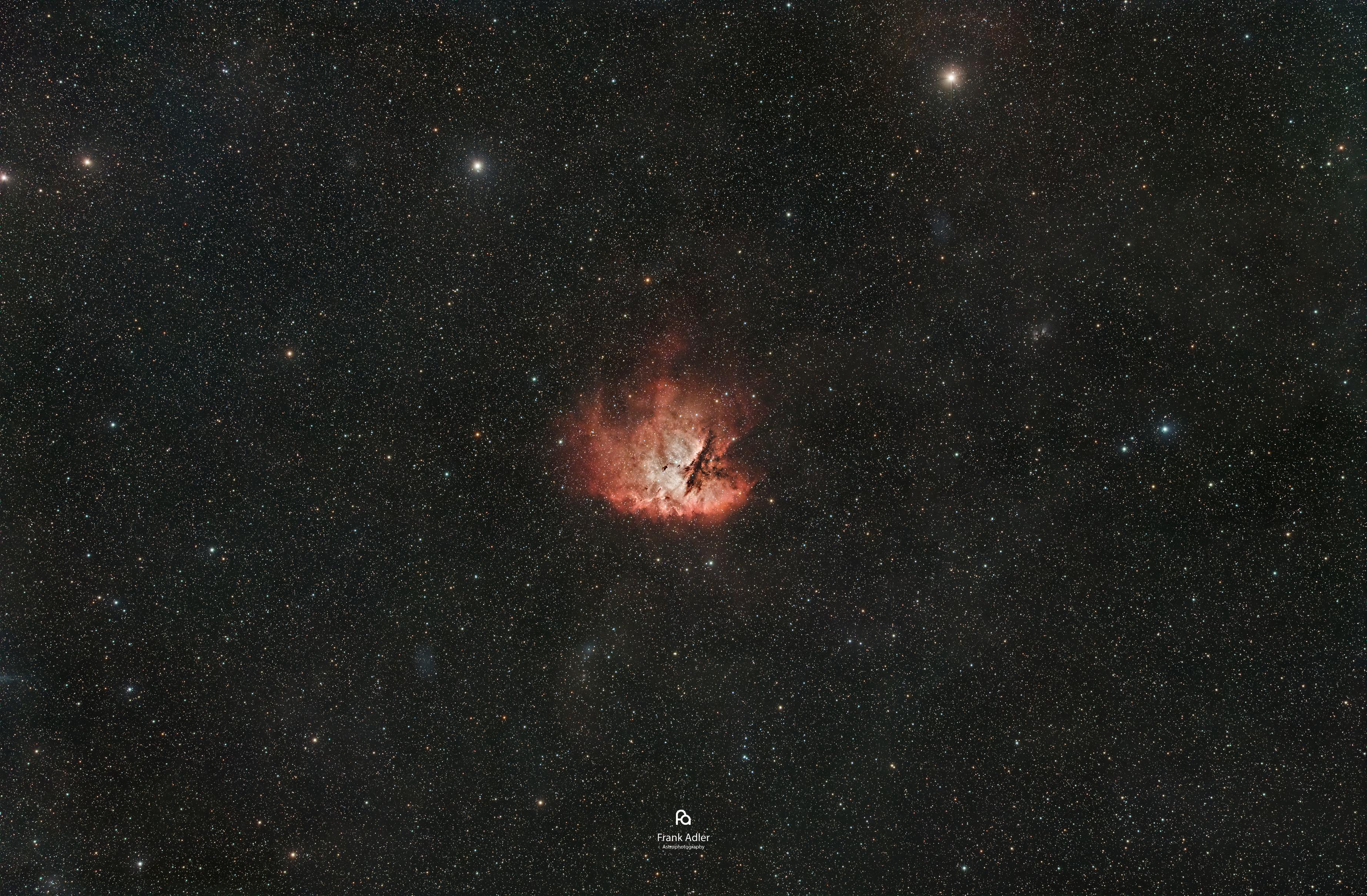
Das ist - der Pacman Nebel im Sternbild Kassiopeia, benannt wegen seiner Ähnlichkeit zum Videospiel-Charakter. Er befindet sich 9200 Lichtjahre entfernt von uns im Perseus Spiralarm der Milchstraße. In seinem Zentrum befindet sich - ein offenes Cluster junger Sterne, die das umegebende Gas zum leuchten bringen.

Mehr Details: adfr.io/astro/20241023_pacman

2024-10-17

NGC 281, 1 hour exposure

#ngc281 #deepsky #astrophotography

Photograph of the emission nebula NGC 281
wrdlbrmpft — #UnPlugTrumpwrdlbrmpft@social.tchncs.de
2024-08-28

Last night's attempt to capture #NGC281 with my #Seestar50. Post-processed with @Siril_Official

Astro image of deep sky object NGC281
2024-03-05

I bought a telescope a year ago.

Tonight is the first time there's no cloud cover and it's dark enough to look at stuff.
Pic 1 : #NGC281 10 sec exposure
Pic 2 : #NGC281 20 minutes of 10 sec exposures stacked just before the scope ran out of battery.

I'm gonna need a bigger battery.

The next clear dark sky is scheduled to be around October 2025. Can't wait. 🤣

#DwarfLab
linktr.ee/dwarflab
#AstroPhotography

Sparse sky showing NGC287 captured using DwarfLab2 smart telescope with 6 second exposure and gain of 60sky showing significantly more detail with NGC287 captured using DwarfLab2 smart telescope with 6 second exposure and gain of 60 over a 15 minute period. Just before the battery gave up
wrdlbrmpft — #UnPlugTrumpwrdlbrmpft@social.tchncs.de
2023-12-09

Was geht mit #ngc281, wenn 500m entfernt #fcunion unter Flutlicht spielt.

#s50 #astrodon

NGC281 mit Seestar S50
AstroHallthorrAstroHallthorr
2023-11-04

Die heutige Ausbeute aus dem Stream:
Pacman Nebula
Galaxiegruppe
NGC 281 hat ca. 18 Min. und NGC 7331 ca. 32 Min. Integrationszeit. Leider zogen zwischenzeitlich immer wieder Wolken auf. 🥲

Guillaume a pris en #astrophotograhie #NGC281 #nébuleuse de Pac-Man en 25 pauses de 600 secondes
Setup: lunette 125/950 TRIPLET APO de TS. Monture NEQ6PRO , lunette guide 80/480 caméra de guidage zwo asi mini120 et Canon 50d pour les prises de vues
#astrophotography #astronomy #astronomie #NGC #nebula #pacman

Client Info

Server: https://mastodon.social
Version: 2025.07
Repository: https://github.com/cyevgeniy/lmst