
The Sinclair QL was my third computer. As always a great concept of Sir Clive Sinclair. The Sinclair QL was not a gaming machine but a computer aimed at serious office work. Of course gaming was also possible but not one of the strength of the QL.
#ql




An interesting thought exercise, it’s 1983 and you should launch a new computer for the mass market next year: what would you do?
I’m thinking back to the failure of the #Sinclair #QL. >50% of that was, in my view, a marketing and sales strategy error, but what of the hardware? What would you change but keeping the price in the same ballpark?
What other type of home computer would you launch (given knowledge you have today)? What would be exciting and bring buyers? What innovation was missed?

These are parts of code in Brataccas that may have been written originally targeting the 68008 processor of the Sinclair QL before they were ported to the Atari ST
After some cursory scanning of the Brataccas code, some patterns emerged:
Case 1: Bit-reversal lookup table
This seems unusual and suggests graphics conversion between platforms with different pixel bit-ordering. The QL stored pixels in a different bit order than the ST - this table appears to be useful to convert graphics assets that were originally in Sinclair QL format.
; Bit-Reversal Table (L00A0-L00A4)

L00A0:DS.W      128,0
L00A2:LEA       L00A0(PC),A0
      MOVE.W    #$FF,D7
L00A3:MOVE.B    D0,D1
      MOVEQ     #6,D2
      ROXR.B    #1,D1
      ROXL.B    #1,D4
L00A4:ROXR.B    #1,D1
      ROXL.B
Case 2 Excessive byte operations
Throughout the code, there's an unusual preference for byte operations:
MOVE.B    (A0)+,D0
MOVE.B    (A0)+,D1
On the 68000 (ST/Amiga/Mac), word operations are typically preferred for performance. But the QL's 68008 CPU had an 8-bit external bus - byte vs word operations had similar performance. This coding style hints at optimisation for the 68008, not the 68000.
The disassembly available at the Brataccas website seems to have been produced from a QL to Atari ST port, not the Amiga as I originally thought.
https://www.brataccas.com/Page28.php
The first part of the code (first 1000-1500 lines or so) is a music tracker, and it's clearly a separate module from the rest, clearly designed to be reusable. There are hints that the I/O ports are Atari-specific and that the engine allows for developers to perform hot-editing of music notes via the MIDI port, which was something incredibly sophisticated for 1985. Some other parts of the code deal with vibrato, legato, and effects during realtime play.
After that block there's what seems to be a sprite blitting engine, but that's as far as I got.
To be continued...
#brataccas #retrocomputing #retrogaming #m68k #SinclairQL #QL #asm #assembler #m68008
"Fancy a Brataccas bombshell"
#brataccas #bandersnatch #retrocomputing #retrogaming #Amiga #QL #M68k

Earlier I posted a little tale about the 18 months of existence of Imagine Software, and Bandersnatch, one of the impossible pieces of expensive vapourware that never came to fruition (which has since become the inspiration for one of the TV series under the Black Mirror brand).
I knew that some of the ZX Spectrum code had ended up as part of the game Gift of the Gods, which was ultimately published by a different company who hired a surviving former Imagine Software team.
But I didn't know this other part of the story on how another part of the original Banderstnatch code ended up becoming part of the Amiga, Atari ST, and 68k Macintosh game Brataccas.
It makes sense now, because the Sinclair QL featured an earlier version of the Motorola 68000, so the port from the QL to the Amiga must have been relatively straightforward.
Says Wikipedia:
https://en.wikipedia.org/wiki/Brataccas
In October 1984, Sinclair Research paid a rumoured £100,000 for the rights to Bandersnatch and contracted Fire Iron, a new company set up by Hetherington and Lawson, to produce the game for the Sinclair QL[6] for release in early 1985.[10][11][12] Sinclair withdrew funding in 1985 when the QL version never appeared, and the directors then formed Psygnosis, with their first title Brataccas introduced at the 1985 Personal Computer World show.[13][14] It featured many of the concepts originally intended for Bandersnatch, and was released on the Atari ST, Amiga, and Macintosh[15] in January 1986.[2]
Look at those graphics! They are untranslated tetra-colour QL graphics on the Amiga, Atari ST, and the 68k Macintosh!
Download Amiga version here:
https://www.myabandonware.com/game/brataccas-6rv
Atari ST version here:
https://www.myabandonware.com/game/brataccas-6rv#Atari%20ST
#Amiga #QL #Sinclair #ZXSpectrum #speccy #Spectrum #retrocomputing #retrogaming #brattacas #bandersnatch



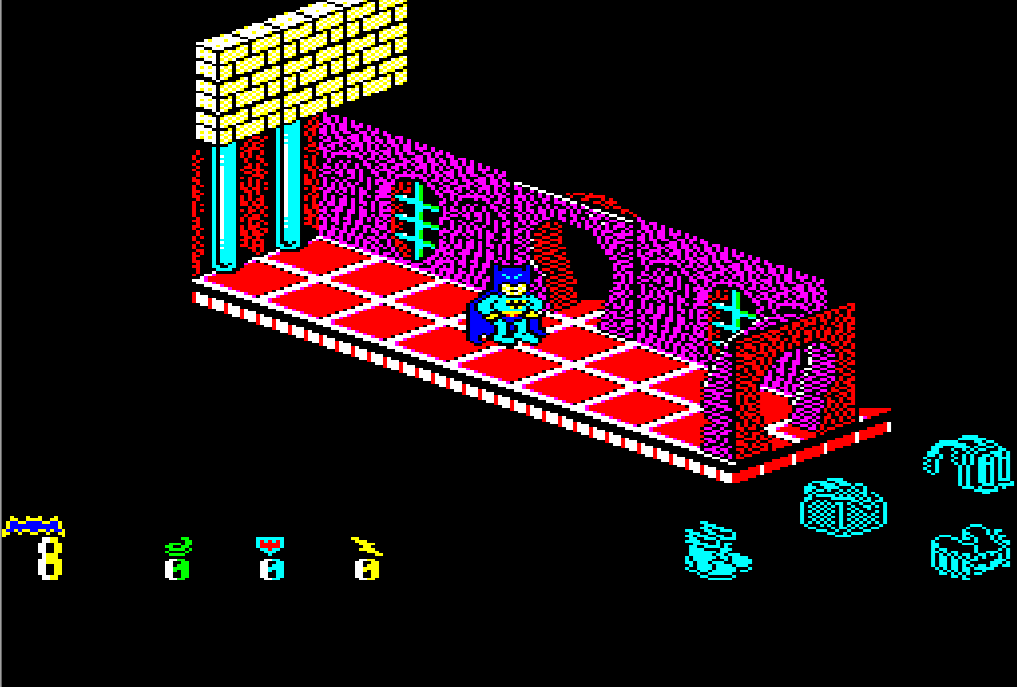
:blobcatgamer: Batman — Classic Isometric Game by Ocean Software looks super on the Sinclair QL.
Many of you probably remember the 1980's Isometric games of Batman by Ocean Software, a great game for systems such as the Amstrad and ZX Spectrum. Now is a port from the classic game available for the Sinclair QL.
https://badared.com/badaman/ql/batman/
#sinclair #ql #batman #port #retro #gaming #engineer #artist #media #retrocomputing #art #programming #tech #news
"Quantum Leap" Demo
Few tech brands maintain their appeal so many decades after their disappearance. Maybe the other two are Atari and Commodore.
https://www.youtube.com/watch?v=Je_1AXvNyu0
via Retro Gaming News
"A demo for the Sinclair QL that also has support for Qsound (AY soundcard) released at the party; 68k Inside 2024. It was made by Noice & SMFX and can be downloaded here"
https://www.pouet.net/prod.php?which=97019

Nueva entrada en mi blog Type-In Listings:
ORDI-5 (France, 1982-1985)
#revistas #listadosBASIC #programas #Sinclair #ZX81 #ZXSpectrum #QL
https://basictypeins.blogspot.com/2025/07/ordi-5-france-1982-1985.html

Are you a fan of the Sinclair ZX Spectrum?
There are lots of PeerTube videos about the Spectrum (and other Sinclair machines) on this playlist:
:zxspectrum: https://fedi.video/w/p/fKcNNx7EdTxa4pcV5AcfgE
- On a phone: Swipe up first two videos at bottom to browse rest of playlist
- On a computer: Choose video by scrolling through playlist on right of screen
- If you're watching embedded: Click ⏭️ or ⏮️ to see next or previous videos in playlist
cc @zxspectrum

Quartier latin
🔸 Inauguration du parcours « Arborescences »
https://actualites.uqam.ca/2025/inauguration-parcours-arborescences/
#UQAM #université #campus #art #sculpture #Arborescences #QL #QuartierLatin #Montréal #Québec #culture

GREAT! Joan Gayón has made a port of Jon Ritman's Batman to the #QL
Download it here:
https://sinclairqles.wordpress.com/2025/05/09/batmanql-descarga-download/
Source:
https://www.elmundodelspectrum.com/bombazo-el-clasico-batman-de-jon-ritman-llega-al-sinclair-ql/

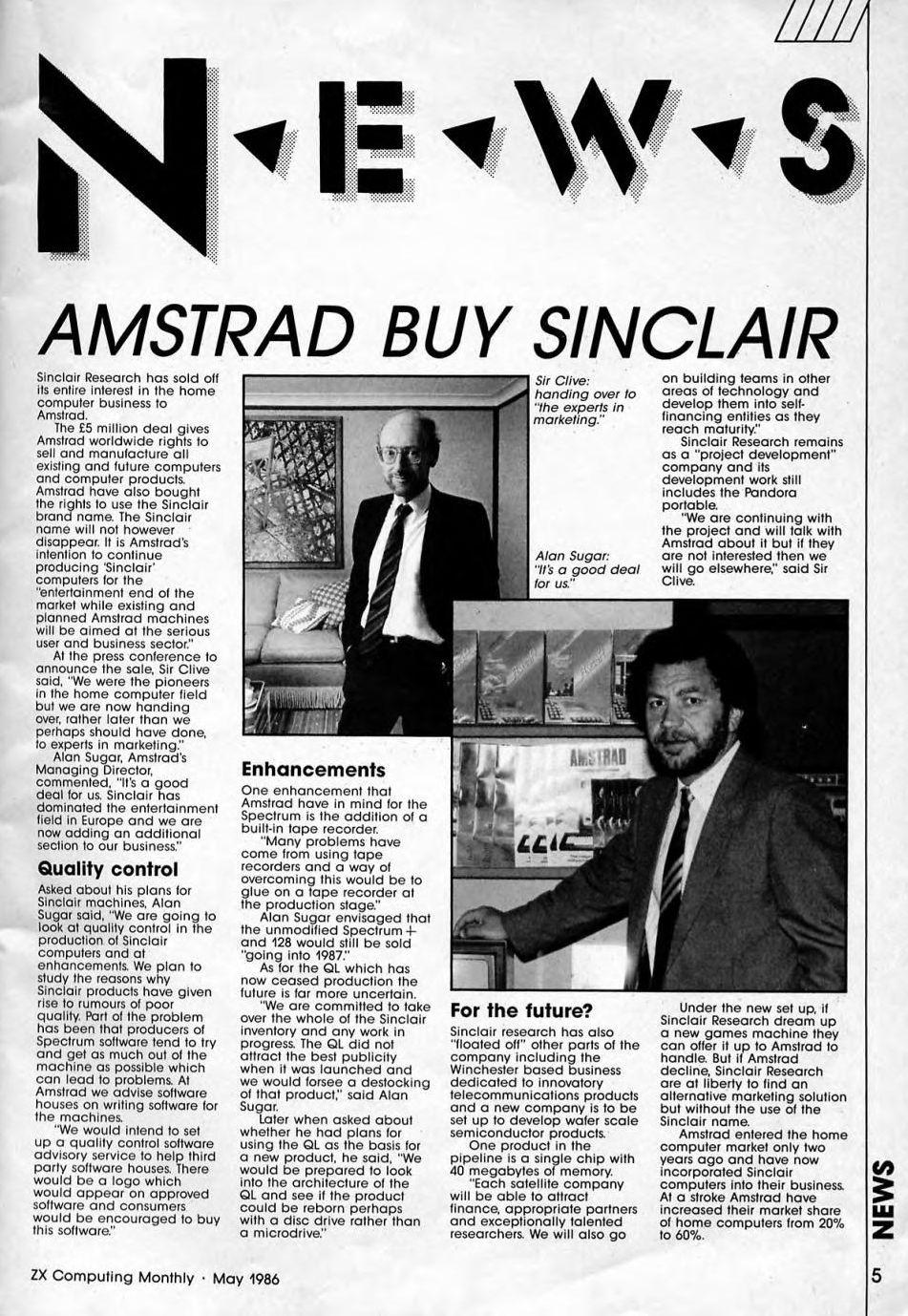
May 1986: #zxcomputing magazine tells Sinclair Research has sold its home computer business to Amstrad, which increases its share of home computer market from 20% to 60%
The future of #QL , + & 128 models and rumours of a new machine with a built-in tape recorder
@quazarsamcoupe @loke I think what really could’ve turned the table was if #Sinclair had just stretched a little bit with the #QL and had graphic modes closer to the #SAMCoupe and done something innovative with sound.
Oh and also if they had not been so fixated on the idea of it as a ‘business machine’. But just a great all purpose Quantum Leap.
@ExtentOfTheJam I think 'synthesizer' is a big word for what is there! :D
Basically it's an Intel 8049 controller that, amongst some other things, can play 1 channel 'tweaked beeps'.
The params are: pitch (0–255), duration, pitch-to-step-to (0–255), step-speed (in 72 microsecond resolution), step ... amount (unclear), how the pitch step warps/bounces, random (how much randomness in steps) and 'fuzz' (0–15, noisificates pitch).
I don't have a #QL but as an old #Sinclair guy, I'm fascinated.
I think too few #SinclairQL demos use the #QL’s own rather eccentric sound chip, instead using the generic and boring #AY extension board!
Even finding exact specs of how the parameters affect sound output is a chore, with many missing spots. Sounds like an interesting challenge.
Taking a look at ICE, a little known GUI for the Sinclair QL
https://www.youtube.com/watch?v=Dlu6yMa4H0I
#retrocomputing #gui #sinclair #ql #sinclairql #zxspectrum #speccy #spectrum
My brain is stuck in the past. There's something that I keep forgetting how to do in #PowerShell but I can completely remember how to do it in #Sinclair #QL #SuperBasic . I expect it's because I don't get enough sleep!

@jon I had a few #sinclair computers as well, it is where I started on this #it stuff. Always wanted a #QL back then but instead when the time came bought an #Amiga followed by an #atari #falcon then a #pc.. Now I use a #mac but mainly for personal stuff. The #falcon was a nice piece of kit but tanked.
Client Info
Server: https://mastodon.social
Version: 2025.07
Repository: https://github.com/cyevgeniy/lmst