
ASCII characters are not pixels: a deep dive into ASCII rendering. https://alexharri.com/blog/ascii-rendering

Demallien
D&D nerd that likes astronomy
Demallien boosted:


Demallien boosted:

This iconic photograph captures the massive ash cloud from the catastrophic 1980 eruption of Mount St. Helens.....
The photo was taken on May 18, 1980, by Richard Lasher, a Boeing employee who was on his way to ride his dirt bike near Spirit Lake. As the ash cloud rapidly approached, Lasher was forced to abandon his red Ford Pinto and escape on his motorcycle.
The eruption was a lateral blast, considered the most disastrous volcanic eruption in U.S. history.

Demallien boosted:

See the little dot? New studies of that blue flash from the distant universe (a "Luminous Fast Blue Optical Transient") indicate it was caused by a black hole swallowing an entire star. For a moment, it blazed as bright as 100 billion Suns.
https://public.nrao.edu/news/radio-telescopes-uncover-invisible-gas-around-record-shattering-cosmic-explosion/ #space #science

@glass @daringfireball well Chris, I have _some_ good news. iPadOS 26 actually has a resize sffordance on its windows - talk about “cat chases dog”
@kottke this really is quite an amazing read
Demallien boosted:

1/2 Astronomers surprised by mysterious shock wave around dead star 😲
As it moves and interacts with the interstellar gas, a white dwarf observed by our VLT creates a type of shock wave called a bow shock — a curved arc of material, similar to the wave that builds up in front of a ship.
None of the known mechanisms can fully explain the observations.
https://www.eso.org/public/news/eso2601/
📷 ESO/K. Ilkiewicz and S. Scaringi et al.

Demallien boosted:
"I was completely overwhelmed by the beauty of it all, to the point of forgetting everything around me! A sky of absolute purity, free from artificial light.”
This is how astrophotographer Julien Looten remembers the night he captured this extraordinary view of our VLT at Cerro Paranal, #Chile
Wondering what all those cosmic objects and phenomena in the image are?
Find out: https://www.eso.org/public/images/potw2602a/
📷 J. Looten /ESO
#astrodon #astronomy #astrophotography #astrophysics #space #science

@SecurityWriter i know this wasn’t the point of the post but now I really want to learn more about low background steel


One. Thousand. Percent. https://equestria.social/@cloudhop/115861419337789753
Demallien boosted:


Demallien boosted:

The Red Rectangle Nebula from Hubble
Image Credit: NASA, ESA, Hubble; Processing & License: Judy Schmidt
Explanation: How was the unusual Red Rectangle nebula created? At the nebula's center is an aging binary star system that surely powers the nebula but does not, as yet, explain its colors. The unusual shape of the Red Rectangle is likely due to a thick dust torus which pinches the otherwise spherical outflow into tip-touching cone shapes. Because we view the torus edge-on, the boundary edges of the cone shapes seem to form an X. The distinct rungs suggest the outflow occurs in fits and starts. The unusual colors of the nebula are less well understood, however, and speculation holds that they are partly provided by hydrocarbon molecules that may actually be building blocks for organic life. The Red Rectangle nebula lies about 2,300 light years away towards the constellation of the Unicorn (Monoceros). The nebula is shown here in great detail as a reprocessed image from Hubble Space Telescope. In a few million years, as one of the central stars becomes further depleted of nuclear fuel, the Red Rectangle nebula will likely bloom into a planetary nebula.

Demallien boosted:
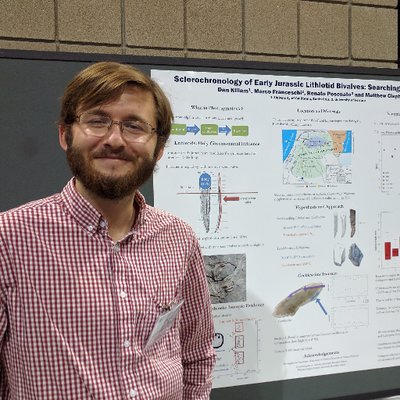
Note: if you want to discover a new clam species, you will have to train to be a taxonomist first. Taxonomists are biology's Batmen. They spend much of their time in seclusion deep in the cave of the specimen stacks, trying to discern fungus gnats by their genitalia and writing long letters arguing about how that exciting new species from last year is actually old news from an 1878 expedition of the Austro-Hungarian empire. Occasionally they emerge to collect new stuff, which is quite exciting, since they increase our understanding of the size and intricacies of our tree of life through their work. I can't think of anything more profound. They are mysterious and their skills impossible to replicate. They are also chronically under-appreciated, underfunded and a dying breed, despite the fact that their work is absolutely crucial to understanding biodiversity and the threats our biosphere faces from human activity. Having biology without taxonomy is like trying to run a business without accountants. They are the heroes we need but don't deserve. I could never be a taxonomist because I will never be that competent lol
Demallien boosted:

Vaccines, esp Zoster, lower dementia and cardiovascular risks: “many infections are associated with the onset of dementia, both Alzheimer’s and vascular”
https://www.nytimes.com/2026/01/03/health/vaccines-dementia-heart-elderly.html
COVID really drove this home because of the scale of simultaneous infections, but many suspected before. Many viral infections damage vessels and can involve the brain.
OTOH - extremely hard to study as most vaccine avoiders are not terribly bright.
Demallien boosted:

#News #Australia 'See it to believe it': Storm chaser captures rare red sprites across WA sky https://w.st/LKgvc
Demallien boosted:

This question is fantastic because it explains why Mars has blue sunrises and sunsets with orange daytime skies, while Earth has red sunrises/sunsets and blue daytime skies. The difference comes down to what's in the atmosphere and how light scatters.
Mars has a really dusty atmosphere. Those dust particles are about the size of the wavelength of visible light, so scattering on Mars is dominated by something called Mie scattering, not Rayleigh scattering like on Earth.



@astropartigirl did you count the one under the sofa?
Demallien boosted:
Apollo 17's Moonship
Image Credit: Apollo 17, NASA, (Image Reprocessing: Andy Saunders)
Explanation: Awkward and angular looking, Apollo 17's lunar module Challenger was designed for flight in the near vacuum of space. Digitally enhanced and reprocessed, this picture taken from Apollo 17's command module America shows Challenger's ascent stage in lunar orbit. Small reaction control thrusters are at the sides of the moonship with the bell of the ascent rocket engine underneath. The hatch that allowed access to the lunar surface is seen at the front, with a round radar antenna at the top. Mission commander Gene Cernan is clearly visible through the triangular window. This spaceship performed gracefully, landing on the Moon and returning the Apollo astronauts to the orbiting command module in December of 1972. So where is Challenger now? While its descent stage remains at the Apollo 17 landing site in the Taurus-Littrow valley, the ascent stage pictured was intentionally crashed nearby after being jettisoned from the command module prior to the astronauts' return to planet Earth.

Client Info
Server: https://mastodon.social
Version: 2025.07
Repository: https://github.com/cyevgeniy/lmst