On vaccines in today's Economist, worth a read https://www.economist.com/leaders/2023/10/05/in-an-ugly-world-vaccines-are-a-beautiful-gift-worth-honouring

Mucosal Immunology ETHZ
Account of the ETH Zürich Mucosal Immunology Lab, Zürich, Switzerland
Prof. Emma Slack
Views are my own!
www.slacklab.ethz.ch
Group Website

Mucosal Immunology ETHZ boosted:
My latest piece (and my last for a while) is out. It tackles what we know about how #climatechange is going to impact #infectiousdiseases around the world. It's also about communication, complexity and nuance.
My piece is here (and a thread or two coming in next days):
https://www.science.org/content/article/malaria-cases-could-ebb-even-hotter-world-other-diseases-will-get-worse
Mucosal Immunology ETHZ boosted:
If you're UK Apocalypse Horsemen watch, here's one:
"Private equity firms have bought up dozens of UK healthcare companies including ambulance fleets, eye-care clinics and diagnostics businesses over the past two years"
https://www.ft.com/content/94184d66-517b-4893-8e06-df16efd135b3
Mucosal Immunology ETHZ boosted:

Our escape calculator (https://jbloomlab.github.io/SARS2-RBD-escape-calc), which integrates deep mutational scanning from
@yunlong_cao, shows sites 408, 411, & 414 are rarely targeted by neutralizing antibodies elicited by SARSCoV2 vaccines/infections in humans without prior SARS-like virus exposure.
Mucosal Immunology ETHZ boosted:

"Some days I think that if we lose the climate battle, it’ll be due in no small part to this defeatism among the comfortable in the global north, while people in frontline communities continue to fight like hell for survival." — Rebecca Solnit
https://www.theguardian.com/commentisfree/2023/jul/26/we-cant-afford-to-be-climate-doomers
Mucosal Immunology ETHZ boosted:
"A developed country is not a place where the poor have cars. It's where the rich use public transportation."

Out now! Lovely collaboration with Zenobi lab and Markus Arnoldini!
Congratulations the co-first authors Jiayi Lan, Giorgia Greter!
Measuring the metabolic activity of gut microbiome in ambient gases/breath around a live animal!
https://www.cell.com/cell-reports-methods/fulltext/S2667-2375(23)00176-5#%20
Mucosal Immunology ETHZ boosted:

A bit rich coming from
someone who has to buy Kinder Surprise eggs on the black market, @gruber

Mucosal Immunology ETHZ boosted:

Meta says that Threads is going to support the fediverse ActivityPub protocol "soon." So there's no need to go to Threads and give more data to Meta. Make Threads come to you! https://www.wired.com/story/meta-threads-privacy-decentralization/
Mucosal Immunology ETHZ boosted:

My first "reviewed preprint" on @eLife !
A Timeline of Bacterial and Archaeal Diversification in the Ocean
https://elifesciences.org/reviewed-preprints/88268
Lots of hard work from former PhD student in my lab Carolina Martinez. Part of a collaboration with @pseudacris
We are enjoying the new process so far and working on revisions to address some of the concerns raised by reviewers.
Mucosal Immunology ETHZ boosted:

What do you mean secret nuclear files in my bathroom?
Oh.
Mucosal Immunology ETHZ boosted:

Development: The hidden depths of zebrafish skin. https://elifesciences.org/articles/88597?utm_source=mastodon&utm_medium=social&utm_campaign=organic_insights
Mucosal Immunology ETHZ boosted:
Tools
" In this study, we used a CRISPR nuclease that targets a site within an exon of an essential gene and designed a cargo template so that correct knock-in would retain essential gene function while also integrating the transgene(s) of interest. Cells with non-productive insertions and deletions would undergo negative selection. This technology, called SLEEK (SeLection by Essential-gene Exon Knock-in), achieved knock-in efficiencies of more than 90% in clinically relevant cell types without impacting long-term viability or expansion."
Mucosal Immunology ETHZ boosted:
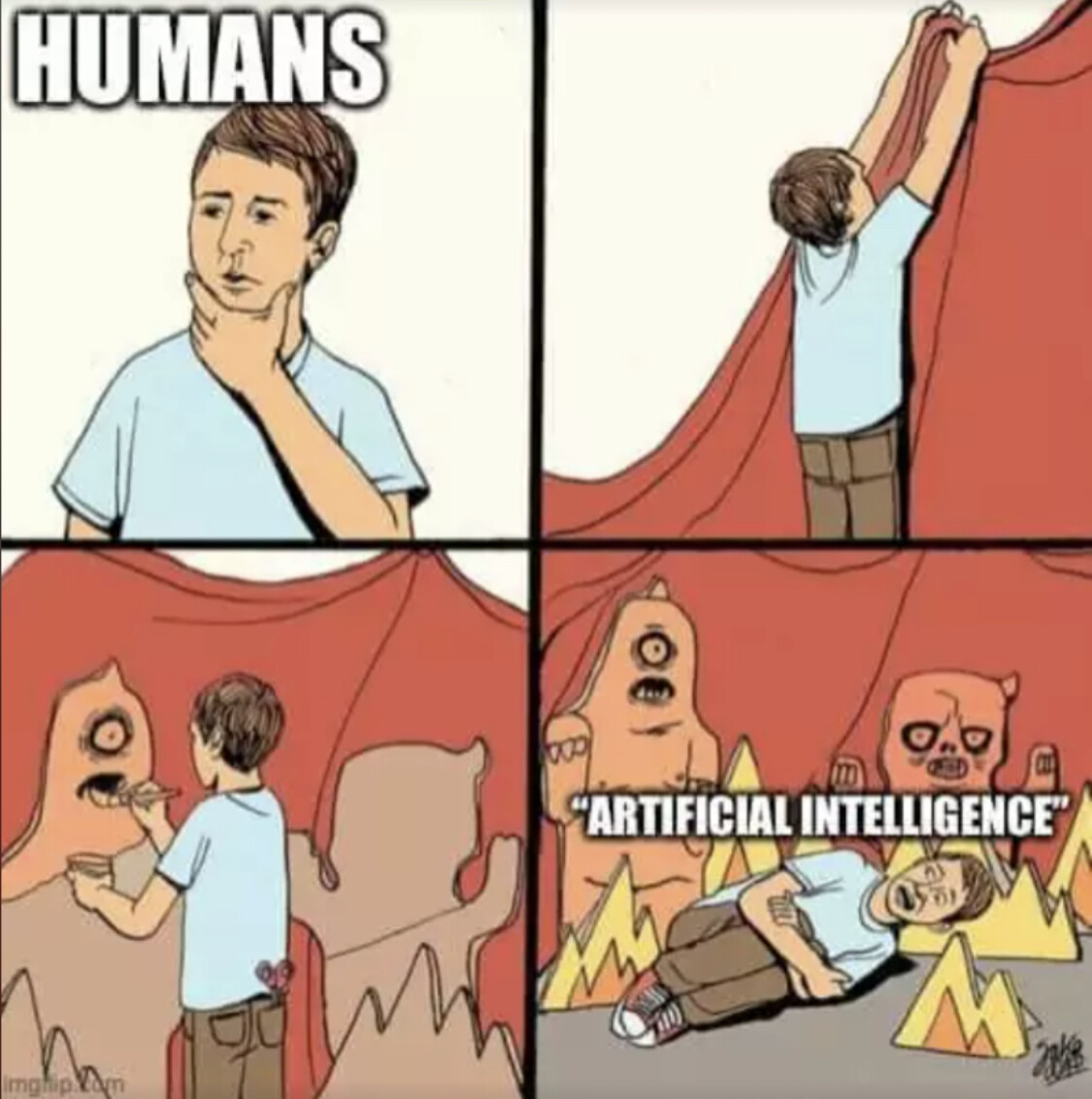
Artificial Intelligence: What to Worry About
Misinformation tsunami, mass unemployment, Skynet - when it comes to modern AI, what should we be worried about? Strangely, few people talk about what I consider the biggest concern.
https://engineeringprompts.substack.com/p/artificial-intelligence-what-to-worry

Mucosal Immunology ETHZ boosted:
"The model was trained on only a few thousand antibody sequences, out of the nearly 100 million protein sequences it learnt from. Despite this, a surprisingly high proportion of the model’s suggestions boosted the ability of antibodies against SARS-CoV-2, ebolavirus and influenza to bind to their targets."
Mucosal Immunology ETHZ boosted:

(Thread)
1/ What is the physiological impact of dietary proteins on steady-state T cells? Nelson Vaz and Ana Faria, my undergrad mentors, wondered about this question for decades.
Mucosal Immunology ETHZ boosted:
9/ These findings provide important insights into the mechanisms underlying the ability of the intestinal immune system to tolerate food antigens, and could have implications for the development of new therapies for food allergies.
Mucosal Immunology ETHZ boosted:
4/ Our study found that dietary proteins contribute to the accumulation and clonal selection of antigen-experienced CD4+ T cells in the intestinal epithelium, imprinting a tissue-specific transcriptional program on both conventional and regulatory CD4+ T cells.
Client Info
Server: https://mastodon.social
Version: 2025.07
Repository: https://github.com/cyevgeniy/lmst