
#TechRadar The Fujifilm Instax Mini 12 is our favorite instant camera — and it's now down to a record-low price on Amazon https://techrad.ar/9KDu #InstantCameras #Cameras
#InstantCameras

#AnalogPhotography in 2024, film's best year in decades: https://zorz.it/cyCCk
#AbbyFerguson #analog #FilmPhotography #KodakProfessional #Pentax17 #Rollei35AF #WideluxX #InstantCameras


#TechRadar Fujifilm’s upgraded Instax mini LiPlay+ can add audio clips to photos, and now has twin cameras https://techrad.ar/oNr8 #InstantCameras #Cameras
#TechRadar This £45 Fujifilm instant camera is a fun and cute gift for all ages https://techrad.ar/NYYJ #InstantCameras #Cameras
#TechRadar After testing the stylish new Fujifilm Instax Wide Evo, I've been won over by the charm of hybrid instant cameras https://techrad.ar/nf5q #InstantCameras #Cameras

Tom’s Hardware: This Raspberry Pi Zero camera instantly prints photos using thermal paper. “We’re living in an age where digital photos reign supreme, but that hasn’t stopped maker and developer Spacerower, as they are known as over at Reddit, from creating a Raspberry Pi-powered camera that creates physical photos for you on the spot. This handheld Pi camera was made from the ground up from […]

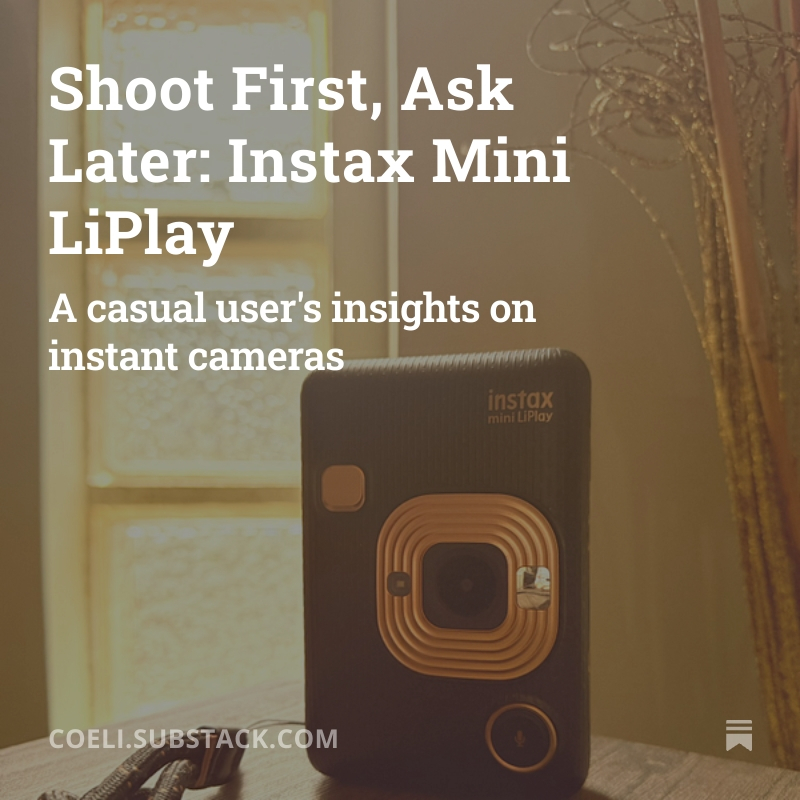
I'm starting a new series where I talk about the different instant cameras that I own and how to use them -- all without ever reading user manuals!
#instax #instantphotography #instantcameras #photography #camera #substack
A short rundown of the things I use when I take photos.
#instantcameras #instantphotography #analogphotography #instax

Lomography Reveals Stylish Travel Versions of Its Lomo’Instant Cameras https://petapixel.com/2024/03/27/lomography-reveals-stylish-travel-versions-of-its-lomoinstant-cameras/ #lomographyinstantcamera #instantcameras #lomoinstant #lomography #Equipment #Analog #News
Leica Sofort 2 Review: Elevating the Instant Camera https://petapixel.com/2024/01/26/leica-sofort-2-review-elevating-the-instant-camera/ #digitalinstantcamera #hybridinstantcamera #instantcameras #instantcamera #leicasofort2 #leicasofort #Equipment #Reviews #Analog #leica


Polaroid’s The Button is a Surprisingly Good Instant Camera
There's no shortage of Polaroid instant cameras from the pre-bankruptcy era. Throughout the 1970s and '80s, especially, the local-to-me brand from Cambridge, MA produced over 40 models for the average non-professional photographer. Most of these similar models were actually identical in specification, they simply differed from each other in name, color way, or the marketing material that surrounded them.
I've spent a couple of days shooting one of these somewhat anonymous cameras, a model from 1981 which Polaroid named The Button, and it has surprised me in a number of ways. To start, it takes great photos. Next, I love the way it looks. And finally, the more I shot it the more I realized that The Button is all the instant camera that most of us would ever need. It's everything a vintage instant camera should be.
What is Polaroid's The Button
In 1972, Polaroid made history by producing the Polaroid SX-70, an SLR instant film camera that could take five instant photographs in ten seconds and fold down to fit inside a suit jacket pocket (famously demonstrated by Polaroid founder Edwin Land in front of a live audience). The impact of the folding SX-70 can't be overstated - Polaroid sold 700,000 units in the first eighteen months of production, and photographers from Ansel Adams to Andy Warhol have praised the machine. The folding SX-70 was (and remains) a marvel of engineering, a timeless product design, and a legendary camera.
When new in 1972, the folding SX-70 cost $180. This was a lot of money, and most households weren't splurging on Polaroid's specialized camera. To target a wider segment of the market, Polaroid set out to develop a cheaper camera that would use the same integral SX-70 instant film that the folding SX-70 camera used.
Their final design was a non-folding box camera made mostly of plastic called the One Step 1000. It was cheap to build, simple to use, and pleasantly priced at just $40. The One Step 1000 became the best-selling camera of the 1977 holiday shopping season. Polaroid had found their formula. For the two decades after the original One Step launched, Polaroid would continue to develop and release hugely successful products in the lower-spec, simple-to-use instant film camera market.
In 1981 they released The Button, a camera that, true to form, was identical in spec to the original One Step.
Specifications of the Polaroid The Button
- Camera Type - Instant film camera
- Film Type - Integral Polaroid SX70 film (3.1 x 3.1 inch image area / 4.2 x 3.5 inch with border)
- Lens - 103mm F/14.6 plastic lens
- Exposure - Automatic exposure with user-adjustable +/- 1 EV exposure compensation dial
- Focus - Fixed focus (from 4 ft to infinity)
- Viewfinder - Direct, no user aids or information display
- Shutter - Automatic with speeds from 1/200 of a second to 1 second
- Flash - Flash bar socket
- Built in strap
The Button in Use Today
The original advertisement for The Button attempted to sell the camera to children. Or rather, it attempted to sell the camera to the parents of children, encouraging them to give The Button to their kids as a gift. The ad suggested that The Button was perfect for kids because it would encourage them to learn to share, because it would nurture creative instincts, because it would help them understand their world and themselves, and because the images developed quickly (since kids don't have patience, I guess). Wow, that's a lot of wholesome stuff for a simple camera.
Marketing fluff aside, The Button actually is a great camera for kids (or anyone) because it truly is simple to use. We load the film by pressing a little switch on the side of the camera. This opens up the film compartment. We load the pack of film, which conveniently (or destructively, depending on your environmental bent) contains the disposable battery pack that powers the camera, and the machine pops to life. it ejects the dark slide and we're ready to shoot our first shot.
To shoot that shot, we look through the direct viewfinder, which is massive and bright and essentially featureless, frame our photo, and press the eponymous button (which is a pretty, white pearl). The image pops out, it develops over the span of about ten minutes, and we've understood our world a little bit better (best-case scenario).
There's nothing much beyond that.
The Button fits in the hands beautifully, like any old Polaroid box camera. It's small at 5.5 x 4.2 x 3.8 inches, which is slightly smaller than the modern I-Type Polaroid cameras. And it's light at 14 oz (396 grams), which is about the same weight as the modern Polaroids.
Showing a slight adjustment (1/4 turn) of the exposure compensation dial.
Polaroid Film and The Button
Polaroid - formerly bankrupt, and then formerly Impossible Project (kind of), and then formerly Polaroid Originals (kind of again), and now (finally and thankfully) just Polaroid - make four types of film. These are SX70 film, 600 film, I-Type film, and Polaroid Go film.
The Button was made in the 1980s to use Polaroid's original SX70 film, which had an ISO of 100. Modern Polaroid SX70 film is a little bit more sensitive with an ISO of 160 - this effectively changes nothing. Put a new film pack into the machine and take some pictures. If things are too dark or too light for your liking, simply twist the exposure compensation dial on the front of the camera in the appropriate direction and take another shot. The camera does all of the math of exposure and you don't have to think.
I used a test pack of new SX70 film that I bought from B&H Photo and the shots were a little dark for my taste. On a whim I decided to load up a pack of 600 series Circle Border Polaroid film. This film is much more sensitive to light than the appropriate SX70 film - 600 series film has an ISO of 640. As expected, the first shot was very light, so I cranked the exposure compensation dial to darken things. The result was really great, surprisingly. My shots were exposed correctly and I really enjoyed what I was seeing.
Caveats and Final Thoughts
Polaroid photos in the modern era aren't as sharp or punchy as they were in the heyday of Polaroid. For some people, this is a big turnoff. The old men who fondly remember the days of their original SX70 and who have binders full of Polaroid photos that still look amazing some fifty years after they were shot just can't get over the fact that the days of high fidelity instant film are over. I don't blame them.
For these users, Fujifilm's Instax film and their cameras may be a better choice. Fuji's film and cameras make images that are punchier and contrastier, the film develops faster, and the colors and sharpness are truer to life. It should also be said that buying a retro Polaroid camera, even from a shop like mine that guarantees full functionality, is inherently riskier than buying a new camera. The newest The Button is more than 40 years old. A new Polaroid or Fuji Instax will probably outlive the cleanest The Button.
These caveats noted, The Button is a lovely camera. Instant photography today is less about making technically perfect, high fidelity photographic record and more about capturing the art of a feeling, a vibe, a mood. We make instant photos today to remember a fleeting moment, a time we'll never live again, the way we felt on a certain day, with a certain person, in a certain place. With instant photos, we're making memories as much as we're capturing them. For me, The Button is exactly the camera for the job.
You can get your own Polaroid The Button at F Stop Cameras (my shop)
Get your Polaroid on eBay here
Follow us on Twitter, Facebook, Instagram, and Youtube
[ Some of the links in this article will direct users to our affiliates atB&H Photo, Amazon, and eBay. By purchasing anything using these links, Casual Photophile may receive a small commission at no additional charge to you. This helps Casual Photophile produce the content we produce. Many thanks for your support.]
The post Polaroid's The Button is a Surprisingly Good Instant Camera appeared first on Casual Photophile.
#camerareviews #filmcameras #instantcameras #polaroid #camerreview #filmcamera #instantcamera #instantfilm

CT Scans of Instant Cameras Reveal Their Inner Workings
#educational #equipment #computedtomography #ctscan #fujifilm #fujifilminstaxmini11 #instantcamera #instantcameras #polaroid #polaroid600af #polaroidgo #scanofthemonth
Getting to Know the Cameradactyl Rex
I’ve been a big fan of Ethan Moses’ work for a while. If you’re not familiar, he’s the design wizard behind Cameradactyl, makers of fine 3D printed grips and frankencamera bodies. He also built an insane 20×24 instant camera system. Who am I kidding, if you’re reading this, you’re probably well familiar with him. While I’ve enjoyed his work from afar, I’d never plunked down any of my hard earned cash for his wares.
But in 2022, I made a bit of a promise to myself to only buy new cameras, or at least cameras where my money is going to someone involved in their manufacturing. So when I saw the In An Instant video hyping the Cameradactyl Rex, it seemed like the perfect time to take the plunge.
As a really quick overview, the Cameradactyl Rex is a camera body that takes Mamiya Press lenses, able to shoot directly onto Instax Wide film with the Lomograflock without the cumbersome focusing shim, as well as 120 film with a Mamiya RB back. So you could use Instax to proof your film shot and not have to refocus.
This is not a full review of the Cameradactyl Rex system. I haven’t had enough time or run enough film through it to really be able to review it. But I’ve already learned quite a bit about it. It’s an intriguing system, so if you’re interested in learning from my initial fumbles with it, here they are.
It’s not an idiot-proof system
This might not come as a surprise. Mamiya medium format cameras are generally geared at professionals, and couldn’t care less about people who don’t bother to read the flipping manual. As a simple enthusiast using a whole new camera system, I should have been prepared to be humbled. I added to the challenge by using a Mamiya 100mm f3.5 lens straight from eBay, unsure if it worked or what condition the glass was really in. My first shot was… let's say, underwhelming.
How did I bungle focusing to infinity on my first shot, the biggest gimme in all of zone focusing? Was the lens at fault, was the Rex not designed for this lens and I missed the memo in the product listing? The answer was user error. It turns out that the 100mm f3.5 is a retracting lens, something indicated by a cryptic “Normal” sticker with a diagram of how to extend the lens. A panicked Instagram DM to Ethan later, I had the lens extended and was able to get the rather pedestrian test shot in focus.
You can use it inside without a flash
When I first committed to getting the Rex, I wasn’t sure how versatile it would be. The Lomograflock is a great 4×5 accessory, but having a camera bound to a tripod means I would realistically only ever use it on dedicated photographic excursions. The Rex held the promise of using it handheld.
When it arrived, I was a bit snowed in by a recent storm, so if I wanted to play with it, I had to take a lot of shots indoors. Mamiya Press lenses top out at f2.8, but since I didn’t want to spend upwards of $500 on a lens, I settled for the much cheaper aforementioned 100mm f3.5. To my surprise, I was often able to take shots inside with reasonable shutter speeds. A lot of this has to do with Instax’s 800 ISO. Wide open I was able to shoot at 1/60 with decent window light. With quiet leaf shutters, that’s pretty manageable without hand shake becoming an issue.
Framing takes some practice
While the Rex comes with a ground glass to let you focus your shots, when you’re using it handheld, realistically you need a viewfinder. Ethan helpfully made ones for the common standard lenses in the Press system, even providing an adorable drawing of how to use it (by the way, the entire Rex manual is hand written and worth the price of the camera by itself). Even still, you need to get a feel for how to properly frame the camera. Plan on your first two packs of film to have some miscues. I found it most challenging using the camera vertically. And without parallax compensation, shots within five feet or so mean you have to guess a bit.
I ended up getting a different lens after using the 100mm for a while, and it came with one of Mamiya’s viewfinders. It’s a fantastically solid piece of kit, with manual parallax compensation. Even still, it also requires a bit of an adjustment, since the Instax negative is about 6×10 versus the 6×9 frame lines.
Focus at your own risk
My current favorite 35mm camera is the Rollei 35. I’ve never had a camera that gives me pure joy every time I hold it up to my eye. It’s a zone focus 40mm f3.5 lens, and while I generally only consider shooting it at f8 and up, I’ve become really comfortable at estimating distances and have more keepers than I thought when I first got it.
While the 100mm lens has about a 40mm equivalent field of view, it’s a very different beast to focus. I knew this going in, and figured I’d have to be more rigorous than the person-people-mountain focusing I can pull off on the Rollei. I used my iPhone’s Measure app to get a distance, dialed it in on the lens and basically front-focused every time.
Even backing up when things get more merciful and stopping down to f5.6, I was still just missing.
Now I know this is not the ideal use case right. I’m sure I’d have a much better hit rate outside stopping down to f16. But I live in northeast Ohio, so about a third of the year we’re inside, and that’s where I wanted to test it. In the end, I was having some shutter issues with the 100mm lens, so I opted to return it and get the 75mm f5.6. While it makes it a little less applicable inside (only enough windows light on sunny days to really use it), the difference is night and day.
It’s not a handheld portrait system
The Rex has many wonderful strengths, but handheld portraits are not among them. The focusing issue I mentioned above contributes, although with a flash you could comfortably shoot stopped down and it wouldn’t be too bad. But the bigger issue are the designs of the Press lenses themselves. There’s a reason most of the other Mamiya system cameras use bellows, they let you get really freaking close. I used to own a Mamiya C33 and that thing could do near macro. The Press lenses, though, were designed for a rangefinder system. As such, the closest focus you get is about 1 meter. On the 100mm that’s good for about 1:10 reproduction, in my view the best choice for portraits. The 127mm will give you more compression, but you can only focus at 1.5 meters. Here is the 100mm at minimum focusing distance.
So head shots are out of the question. You definitely can do portraits with this camera, but I’d use a tripod and the ground glass for it. While I haven’t had a chance to use it as such, I’m really looking forward to testing the 75mm for environmental portraits, since it has a wide 30mm equivalent field of view, but can still pull off some nice compression. It’s not the Rex’s fault these lenses weren’t designed for close focus, but compared to something like the SX-70, or the Mint RF-70 for a more direct comparison, it loses out on a bit of the fun factor.
Everyone will ask why the picture is upside down
People are used to instant photos that have the chemical pouch on the bottom of an image. I’m sorry, you’re going to have to explain this is just how the camera works. You’ll get used to it.
**The Rex finally lets Instax Wide sing **
I’ve listed more than a few caveats about the Rex here, but let me be clear, it’s an amazingly fun camera. Instax can soak up all the detail these Mamiya lenses throw at it.
While you have to operate with very limited dynamic range, Instax colors make it worth getting it right. Blues lean into the cerulean hues to make them extra dramatic. Reds have a little extra saturation to make them pop, it’s just a great contrasty look. Underexposed skin tones can go a little green, but then if you’re missing exposure by over a stop, they’ll probably go to black anyway. And unlike volatile, if beautiful, Polaroid chemistry, Instax is stable enough that you don’t have to baby it. While you have to learn how to get the most out of the Rex, the stability of Instax film means you’re at least dealing with one less variable. I can’t tell you how many SX-70 shots have had me questioning whether they were metered poorly by the camera or were exposed by 0.5 seconds too long.
For all these reasons, I feel like I’m still getting to know the Rex as a camera and figuring out how exactly I want to use it. I used it only once on a tripod, so I need to explore its capabilities there. Heck I’ve only used it outside twice due to snow storms striking exactly when I get a free moment. I’ve also not shot any 120 film with it, so I think more than a few rolls of Acros are in the Rex’s future. None of the things I’ve learned in these first few packs of films has diminished my excitement for the camera, or for the ingenuity it took to make it. After I really run it through it’s paces, I can’t wait to put together a full review.
Want your own Cameradactyl camera? Visit their site
Want a regular camera? Find one at F Stop Cameras
Follow Casual Photophile on Twitter, Facebook and Instagram
[ Some of the links in this article will direct users to our affiliates atB&H Photo, Amazon, and eBay. By purchasing anything using these links, Casual Photophile may receive a small commission at no additional charge to you. This helps Casual Photophile produce the content we produce. Many thanks for your support.]
The post Getting to Know the Cameradactyl Rex appeared first on Casual Photophile.
#120film #filmcameras #fujifilminstaxcamerasandfilm #instantcameras #mediumformat #cameradactyl #fujifilminstax #instaxwide
NONS SL660, an Interchangeable Lens SLR for Instax Square Film, Now on Kickstarter
An instant camera from NONS which is now funding on Kickstarter will allow photographers to create sharpness and bokeh on Instax Square film with Canon EF, M42, Nikon F, Pentax K, and Contax/Yashica mount lenses.
The NONS SL660, as it is named, is an interchangeable-lens SLR instant film camera that works with Fujifilm instax Square Film and allows photographers creative control that's lacking in all Fujifilm-made and Polaroid-made instant cameras today.
It's natively fitted with a Canon EF lens mount (passive) and is fully compatible with EF lens. By using adapters it's also possible to use lenses of M42, Nikon F, Pentax K, Contax/Yashica, and even medium format mount.
In addition to this lens versatility, the NONS SL660 offers full manual control of the lens aperture and shutter speed, as well as bulb mode for long exposures, multiple exposures, and a hot shoe for flash photography (synch at 1/250th). The NONS SL66 also has a light meter to ensure accurate exposures for people who aren't perfectly comfortable shooting in full manual mode (metering by eye).
The camera is a true SLR with a big bright viewfinder, making manual focus and precise focus possible (again, something that's lacking in all of the current instant cameras from the major manufacturers). The viewfinder has been formulated to offer complete coverage of the image area, and the camera itself has optical elements built into the camera to ensure that vignetting on the final image is kept to a minimum (this was a problem on NONS first interchangeable lens SLR, the Instax Mini format NONS SL42). These elements ensure that lenses made for 35mm film cameras will expose all or most of the larger image area of Instax Square film.
It's made out of aluminum (at least the front plate is - the film processing part is plastic), and it's got a wooden handle. Premium!
Full Specifications of the NONS SL66
- Passive EF mount (no electronic signal to auto-focus or adjust electric control aperture)
- Shutter Speed (10 modes): 1/250, 1/125, 1/60, 1/30, 1/15, 1/8, 1/4, 1/2, 1 second and Bulb mode
- Recommended F/# based on current shutter speed
- Counter up to 999 seconds when using bulb mode
- Film counter and battery status display
- Standard hot shoe, flash sync to 1/250
- Power supply: 3200mAh internal Li-ion battery. Input: DC 5V, 1A
- Film: Fujifilm instax square film
- Film size: 72 x 86 mm (width x height)
- Picture size: 62 x 62 mm (width x height)
- Mechanical dimension: 135 x 131 x 92 mm (width x height x depth)
- Weight: 850 g
- Package: Camera body, USB Type-A to Type-C cable, Manual
My Take
I wrote an article introducing the NONS SL42 many years ago, when that camera was Kickstarter. It was a similar device to the new SL660, but I wasn't totally sold on it mostly because of the vignetting and the limitations inherent in the Instax Mini format (that film is too small to care about image quality). The SL660, however, addresses both of these complaints.
Instax Square is the best instant film available today, as I mentioned in this review. I think it strikes the best balance between image quality, physical dimensions, and importantly, price. It's cheaper than Polaroid film and better looking, even if it is physically slightly smaller. And the fact that the new SL660 will not vignette in most situations is a big plus.
If I can make images as nice as the sample images provided to me by NONS, I will indeed be buying this camera. It seems to finally offer everything I need - the right format, the creative control, a decent price (at approximately $445 USD this is all relative - this is about as "professional" as an instant camera gets in 2022). And I think it would be great fun to experiment with all sorts of lenses produced in the past sixty-odd years.
Why am I so excited to use a tilt-shift lens on this thing?
I should mention the usual Kickstarter caveat. I've backed about ten projects on Kickstarter over the years and I believe six of them have delivered on their promise. NONS has a track record of success in this area, and the project is funded already. This, and their experience with the SL42, leads me to suggest that anyone interested in backing the project need not worry that it become vaporware. If you want a NONS SL660 and back it, you'll get it.
NONS has told me that I'll get a hands on with the SL660 closer to launch and I'll be sure to provide granular detail of my use and results. You can wait and see until then or you can back the project on Kickstarter now.
Find an instant camera on eBay
Buy an instant camera from our shop, F Stop Cameras
Follow Casual Photophile on Twitter, Facebook and Instagram
[ Some of the links in this article will direct users to our affiliates atB&H Photo, Amazon, and eBay. By purchasing anything using these links, Casual Photophile may receive a small commission at no additional charge to you. This helps Casual Photophile produce the content we produce. Many thanks for your support.]
The post NONS SL660, an Interchangeable Lens SLR for Instax Square Film, Now on Kickstarter appeared first on Casual Photophile.
#filmcameras #fujifilminstaxcamerasandfilm #instantcameras #news #slrcameras
Instant Camera Buyer’s Guide for the Holidays and 2022
In today's article I’ll round up every Fujifilm Instax and Polaroid instant camera currently available to buy from the major manufacturers, as well as briefly mention a few of the more specialized options. By the end of this article you'll know which instant film camera is perfect for you or the person on your shopping list.
But first, some quick thoughts on instant film cameras, generally.
We’re heading into the holidays in a year where film photographers have seen price increases, discontinuations of beloved emulsions, and supply chain issues. But if there’s one thing we know about the future of film, it’s that instant film isn’t going anywhere. Fujifilm and the latest incarnation of Polaroid are still manufacturing loads of film, and if you walk into a Target or CVS you’re more likely to find instant film and instant cameras than rolls of 35mm film. It's the most popular product in Fujifilm's stable.
Instant cameras may not satisfy every advanced photographer who wants the highest image quality or creative control, but they make fun gifts for people who just like to take pictures, and sometimes the control freaks among us just need to let go and have fun. And you know how people are always saying to print your pictures? With instant cameras, you can’t not print your pictures! (With a few exceptions.) In fact, as roll film becomes more expensive, you might find that the price per image of instant film is actually pretty competitive these days.
Let's get to the cameras.
Here's Every Fujifilm Instax Instant Film Camera
Fuji Instax cameras are ubiquitous and the film is everywhere. The film comes in three sizes: the cheap, credit-card-size Instax Mini, the mid-sized Instax Square, and the largest aptly named Instax Wide.
Fujifilm Instax Mini 11 - There are lots of camera options which use Instax Mini film, ranging from brightly colored to more classically styled. The Mini 11 is the latest iteration of the entry-level Instax camera. This is the camera you get for your tween, or for your friend who wants an instant camera but doesn’t know much about photography, or for your friend who knows everything about photography but wants a camera that’s not black or chrome. The main improvements from earlier Minis are automatic exposure (no more setting for sunny/cloudy etc.) and better flash compensation. There’s a selfie mode that also works for closeups and… basically no other features.
The Instax 11 costs just $59 and also comes in a variety of bundles with film, cases, frames, albums, stickers, and anything else you can imagine attaching to a camera or its resulting images for fun. If you have a child (or just an inner child) they probably want one, even if they don’t know it yet.
Fujifilm Instax Mini 40 - If your inner child is trying to act more grown up, there are slightly less cute Instax options. The Instax Mini 40 has retro black-and-chrome styling but still shoots auto-everything. Its creative features (or lack thereof) are basically identical to those of the Instax Mini 11, but it wouldn’t even think of existing in purple or having stickers on it. It costs $89.
Fujifilm Instax Mini Neo 90 / Neo / Classic - A step up from both the Mini 11 and Mini 40 in creative control, the Instax Mini 90/Neo/Classic (some combination of those words) comes in analog-looking combinations of black, red, and brown with silver, and offers bulb mode, double exposure mode, and exposure compensation. The macro mode behaves similarly to the Instax 11's and 40’s selfie mode, allowing for subjects as close as 30 cm, but the name is geared toward photographers who are more likely to take a picture of a flower than themselves. It costs $119.
Fujifilm Instax Mini LiPlay - The final mini camera in Fujifilm’s lineup is the hybrid Mini Liplay. The main advantage of this camera is that it allows you to take images digitally and select which ones you want to print, so you don’t need to waste film, although it somewhat dampens the serendipity and slightly delayed gratification of direct-to-film instant photography. It also offers a bunch of filters and frame options to customize your prints, and through some curiously applied wizardry it allows you to save a sound as a scannable QR code to turn your image into a multi-sensory memory. It also allows you to use your phone as a remote shutter release (my ears finally perked up). Most of these are features I would never have thought to ask for, but they might be perfect for you or someone on your list. It costs $159.
Fujifilm Instax Mini Evo - Alas the Instax Mini Evo arrives too late for Christmas in the USA and Canada, but your Valentine might take a shine to the Instax Mini Evo, another hybrid that offers ten different “lens effects” (double exposure, light leak, etc.) and ten “film effects” (pale, vivid, sepia, etc.) to apply to your digital images, including images from your smartphone, before printing. The fast 28mm lens, classic styling, and extensive features (including exposure compensation as well as selective printing and all the effects) will appeal to more serious photographers. It will cost around $200, which is a lot for an Instax camera, but may be worth it for a camera that can give you the images and user experience you’re looking for. A full preview of the newest Instax camera can be seen here!
If your head is spinning from all that, take a deep breath and get ready for the Square and Wide Instax cameras!
Let’s talk about squares, first. Most people of my generation (I’m a youngish Gen X-er) grew up with Polaroid instead of Instax, and that classic square image is still what we think of when we think of instant film. The Instax square image is a little smaller than regular Polaroid film, but like all Instax, its colors are more saturated (the black and white film is cooler than Polaroid’s, tending toward purply), it develops more quickly, and the developed image is more stable than Polaroid’s current emulsion. Plus, while Instax Square costs more than Mini film and doesn’t come in a zillion frame options, it’s cheaper than Polaroid.
Fujifilm makes three cameras for its Instax Square film.
Fujifilm Instax Square SQ1 - The SQ1 is the most basic Instax Square camera that Fujifilm currently makes. It offers no user control besides selfie mode. Even so, James loves his for its simplicity and its ability to take great photos despite (or because of?) its lack of features [see his full review here]. It also comes in colors like terracotta and glacier blue that are fun but a little less tween-girly than the Instax Mini 11 colors. If you’re looking for a point-and-shoot Instax camera that is a little more mature and shoots a bigger image than the Mini options, this could be it. It costs $99.
Fujifilm Instax Square SQ6 - The Instax SQ6 is a more advanced camera than the SQ1. It includes features such as double exposure, selfie, macro, and landscape modes, and exposure compensation (well, light and dark modes). It comes in a variety of metallic colors, something rather different from the candy-colored Instax Mini 11 and the retro styled Mini 90. It comes with three flash filters in different colors, and more importantly for a lot of photographers, allows the flash to be turned off - which you’d think would be a given, but isn’t, for a lot of Instax cameras. This camera has been quietly discontinued by Fuji, so in a couple of months it may be difficult to find one. This likely means that a new mid-level Fuji Square camera is coming soon. For this reason, your best bet to buying one will be to find one on eBay. It costs around $139
Fujifilm Instax Square SQ20 - The Instax square also comes in a digital/film hybrid option, the SQ20. Like the Liplay, it gives the user the ability to select images for printing (adding a “time grab” feature to select a frame from a short video) and add various filters to images. It also takes advantage of the larger print area to allow for collages. Bulb, double exposure, and brightness control allow more creativity to the more experienced photographer. This camera has been quietly discontinued by Fuji, so in a couple of months it may be difficult to find one. This likely means that a new digital/film hybrid Fuji Square camera is coming soon. For this reason, your best bet to buying one will be to find one on eBay. It costs around $200.
Want the biggest Instax instant photo you can get? Then you want to shoot Instax Wide film. And to do that with an official Fuji camera, there's only one option.
Fujifilm Instax Wide 300 - The only camera option from Fujifilm for this format is the Instax Wide 300. There’s one color choice (black and silver). There’s a flash that you can use for fill lighting in backlit situations, but you can’t turn it off. There’s exposure compensation. There’s a tripod socket. And that’s it. But it takes big photos If you want an Instax Wide camera with more features, there are a few offered by other companies, and we'll get to those later in this article. It costs $109.
Fuji is the most prolific of the instant camera manufacturers. Now that we've covered them, let’s turn to Polaroid.
Here's Every Polaroid Instant Film Camera
Polaroid, which has metamorphosed from the Impossible Project to Polaroid Originals and now back to just Polaroid again (with maybe a little DNA from the original Polaroid), still makes cameras that use that big square film that Outkast says you should shake it like. But don’t! Stick it in a dark place and don’t look at it for half an hour or so. Polaroid refurbishes classic SX-70 and 600 cameras for resale, and also makes several new cameras that can shoot both 600 film and the company’s i-Type film that uses the battery in the camera instead of each pack coming with its own. It’s a little cheaper than SX-70 and 600 film, and a little more environmentally friendly.
Polaroid Now - The Polaroid Now is the entry-level Polaroid camera, perfect for beginners, or those who are looking to have fun and not worry about photography beyond pointing and shooting. If you've a young kid who's interested in a Polaroid camera, this may be the one to buy. It is an autofocus point-and-shoot camera in typical Polaroid boxy form that comes in black with that nifty little rainbow as well as a bunch of bright color options like Mint Green and Yellow. Along with ease of use, it offers basic features like double exposure and self timer modes. It uses I-Type film and costs $120.
Polaroid Now+ -The Now+ is a more advanced but very similar camera to the Polaroid Now. The biggest difference is that the Polaroid Now+ connects to a mobile app that allows for far more creative control (finally, a camera with aperture priority!) and comes with five experimental starburst/color/vignette filters. Both cameras have internal rechargeable batteries. It uses i-Type film and costs $150.
Polaroid Go - Polaroid has its own recently introduced teeny film format for its almost equally teeny Polaroid Go camera. Instax Mini cameras shoot small formats in what are often bubbly, boxy cameras, but the Polaroid Go literally fits in the palm of your hand, or close, depending on your hands. Like the Polaroid Now, it features double exposure and self timer modes, but is otherwise an itty bitty point and shoot instant camera. For the shooter who likes the Polaroid aesthetic and small versions of big things, the Polaroid Go is the perfect gift. It even comes with a necklace so you can wear your camera. It shoots the tiny Go Film and costs $99.
So we’ve covered the cameras from the current mass-market manufacturers of instant film. “But wait!” you (or your giftee) will say. “I’m a serious photographer! I don’t want hinky digital filters, I don’t want to connect my phone with Bluetooth. I want some control over my photos, and I want to stick my hinky filters to the outside of the camera!” Well, has Lomography got some cameras for you!
Lomography Instant Cameras
Lomography makes instant cameras for all three sizes of Instax film. We'll cover those first .
Lomography Cameras for Instax Mini Film - The Lomo’ Instant and Lomo’ Instant Automat use Instax Mini film and come in a variety of colors, tending more toward the retro/analog look than the basic Instax Mini cotton candy shades. The two cameras are similar in appearance and features, but the original Lomo’Instant has a wider 48mm lens (27mm equivalent in 35mm) vs. the Automat’s 60mm lens (35mm equivalent). Both cameras automatically set exposure but give the user multiple creative options, including multiple exposure, bulb mode, exposure compensation, and flash control (i.e. you can turn it off, or add funky color gels). Optional add-on lenses allow for wide-angle, closeup, and fisheye shooting, and the lens cap on the Automat can be used as a remote shutter release. The Lomo Instant Automat Glass pairs these features with an even wider 38mm f/4.5 glass lens that allows more depth of field control than is possible with any other mass market instant camera, if you can nail the zone focusing.
Lomography Cameras for Instax Square Film - Lomo also sells two quirky cameras that use Instax Square film and offer more creative features than Fujifilm’s own Square cameras. The Instant Square Glass, like the Automat Instant, features multiple and long exposure options, exposure compensation, flash, and remote and self timer shutter release. It has a folding bellows design and comes in black, white, and red. The Diana Instant Square camera shoots square film in a Diana body with a fixed 1/100 second shutter speed (plus bulb) and aperture control for different lighting situations, as well as a pinhole setting. It works with all the Diana interchangeable lenses, from fisheye to telephoto.
Finally, Lomo makes one standalone camera for Instax Wide film, and one instant back. The Lomo Instant Wide shares multiple and long exposure features, flash control, and exposure compensation with its siblings, and also includes a PC sync socket that allows the use of external flashes.
The LomoGraflok 4 ×5 Instant Back might be hard to get under the tree this year if you haven’t preordered, but it is something entirely different from everything else we’ve covered so far: a film back for Instax Wide film that attaches to any 4×5 camera with a Graflok back. Of course you need to have such a camera already, but if you do, the LomoGraflok allows ultimate exposure control, and at the reasonable price of $149 (reasonable, that is, if you have a camera to attach it to). It’s clearly not meant for snapshots and requires an existing large format setup, but for the experienced photographer with the right gear who wants to make their own decisions about exposure settings and doesn’t want to spend a ton of money to shoot instant film, it’s a good way to get started.
These are the major manufacturers of instant cameras. There are a lot of other players, so I’ll briefly take a look at a few. These cameras tend to be more specialized, expensive, wonky, or some combination of the three.
Everyone Else Making Instant Cameras
Mint Camera refurbishes classic Polaroid SLR cameras and upgrades them with features such as shutter speed control, dual format compatibility (SX-70 and 600 film), and external flash sync. The prices reflect the amount of time and customization; they are not cheap, but they offer the most features of any Polaroid camera. They also produce modern Instax cameras: the InstantKon RF70 [see our full article here], a bellows-folding rangefinder with full shutter and aperture controls that shoots Instax Wide film, and the InstantFlex TL70 [see our full article here], a TLR with shutter speed control and exposure compensation that shoots Instax Mini film. The price of these cameras (also not cheap) is offset by Mint’s free film program, which sends registered Mint camera users a free pack of film for every four images taken by the camera that they post on social media (Instagram/Facebook) and get 45 likes on.
Like Mint, other companies such as Brooklyn Film Camera and Retrospekt refurbish classic Polaroid cameras, offering them for sale on their websites or restoring cameras which customers already own. They’ll also convert SX-70 cameras to use Polaroid’s higher ISO 600 films.
Jollylook is in the preorder stage for three instant cameras that look like little view cameras with folding bellows: the Auto Instant film camera in Instax square and mini sizes, and the Pinhole Zoom in mini size. The Auto cameras let the user choose the aperture aperture and automatically set the shutter speed, while the Pinhole comes with a fixed aperture and a neutral density filter to allow for longer shutter speeds with the fast (ISO 800) Instax film. They also sell Square and Mini development units for photographers who want to cobble together a back for their own camera.
The Nons42 SL42 shoots Instax Mini film in an SLR body that can accept a variety of lenses from different manufacturers, with a native non-electronic Canon EF mount. The camera can be purchased with a suitable 50mm lens to save the trouble of finding something compatible. The shooter chooses a shutter speed and the camera recommends an aperture for correct exposure. It’s an expensive way to shoot Instax mini film, but entirely unique among all the available options.
And then of course there are the hundreds of classic Polaroid cameras which you can buy from reputable camera shops such as F Stop Cameras (which is run by James, the founder of Casual Photophile) and Blue Moon Camera. You can also try your luck buying a used Polaroid camera on eBay, though when these are untested it is a definite risk.
That just about covers the easily available cameras for shooting instant film in 2021. If I’ve missed any (and I probably have!), please offer your suggestions in the comments. There might not be something for everybody, but there are so many choices that you should be able to find something for yourself or the aspiring instant film photographer on your list.
Get your favorite instant camera from B&H Photo here
Shop for instant cameras on eBay
Follow Casual Photophile on Twitter, Facebook and Instagram
[ Some of the links in this article will direct users to our affiliates atB&H Photo, Amazon, and eBay. By purchasing anything using these links, Casual Photophile may receive a small commission at no additional charge to you. This helps Casual Photophile produce the content we produce. Many thanks for your support.]
The post Instant Camera Buyer's Guide for the Holidays and 2022 appeared first on Casual Photophile.
#buyersguides #filmcameras #fujifilm #fujifilminstaxcamerasandfilm #instantcameras #lomography #polaroid #instantcamera #instantfilm #instax
Fujifilm Announces the Instax Mini Evo, a New Digital Instant Film Camera
Fujifilm has just announced the Instax Mini Evo, their latest instant film camera. A hybrid film/digital camera, the Mini Evo looks poised to offer everything that Instax shooters crave; instant printing to Instax film, creative control and 100 different film and lens effects, the ability to edit shots digitally and share them to the users' cell phones for sharing on social media, an analogue-like lever for printing images, and "luxurious styling."
Wow, that's a lot of stuff! But wait, there's more!
From Fujifilm 's press release :
"The “mini Evo” comes with ten lens effects including “Soft Focus” and “Light Leak” as well as ten film effects including “Monochrome” and “Retro.” These two types of effects can be combined freely to create 100 different shooting effects so that users can express their emotions through instax prints. Furthermore, resolution of exposure has been doubled compared to the previous models to achieve greater print quality. The “instax-Rich” mode for rich colors and the “instax-Natural” mode for softer touch can be also chosen according to personal preference.
The camera’s main body sports a classic design with a sense of luxury. The use of silver coating on its body results in sophisticated presence. The print lever, lens dial and film dial are designed with attention to the finest details including operation sound to create an operational feel similar to analog cameras.
Using the smartphone app “instax mini Evo” will significantly broaden the enjoyment of photography with instax. The “DIRECT PRINT” function allows the use of the “mini Evo” as a smartphone printer, printing pictures taken with a smartphone. The app also has the “SAVE PRINTED IMAGES” function for the first time, allowing users to save a photo, printed with the “mini Evo,” in a smartphone as an image decorated with an instax frame, making it possible to share pictures with popular instax frames on social media with ease.
The Instax Mini Neo also sports a handful of functions that elevate it above most standard instant cameras. These include :
- Dedicated app (Android and iPhone) to link with a smartphone for further broadening photographic enjoyment.
- 3.0 inch LCD display on the back for live view photography, reviewing photos, and choosing which photos to print.
- 28mm (equivalent) F/2.0 lens.
- Built-in memory for storage of 45 photos.
- Micro SD card slot for additional storage.
- Adjustable ISO from 100 to 1600
- Shutter speeds from 1/4 to 1/8000th of a second (that's fast!).
- Auto exposure system with Through the Lens metering.
- Exposure compensation +/-2.
- Built-in rechargeable Lithium Ion battery (can print approximately 100 photos per charge).
The new camera releases in Japan in December of 2021. Those of us in other territories will be waiting a little longer. The United States and Canada will get their first shipments in February of 2022. The camera will cost $199.95 USD ($249.99 CAD).
My Thoughts on the Instax Mini Evo
The takeaways of this announcement, for me, are primarily concerned with a few key points.
Here's what I like.
To start, the camera's 28mm F/2 lens sounds wide and fast, two things I appreciate in a lens. This fast lens paired with the camera's adjustable ISO means that there's some versatility here for low light shooting, which sounds great. Through the lens metering sounds great, as does exposure compensation and a pretty versatile shutter speed range.
As I mentioned the last time I reviewed one of Fuji's hybrid digital Instax film cameras, the ability to keep shooting when we run out of film is great, and not being forced to print every shot is also great. I expect I'll enjoy these features in the new Mini Evo as well.
Lastly, it's a great looking camera. Though I'm now a bit spoiled by the high design of the Instax Square SQ1 that I reviewed not long ago. Give me this new Mini Evo in a mint green colorway and I may just swoon.
So, all of that sounds great.
Here's what I'm not so sure about.
The resolution, though Fuji says it's better than any of their Instax cameras which came before, is still pretty paltry (about 4 megapixels). While that's probably enough to max out the potential of Instax Mini film, I'm always wishing for more clarity. Some shots on earlier Instax cameras are simply lacking in detail. While that's probably a limitation imposed by the film, more resolution might help.
The analog-style advance lever which is used to print the images seems neat. My only concern is that it's built well enough to withstand a lot of actuations, and I hope that it doesn't feel cheap. We'll see when I get my hands on one.
I have some reticence about Instax Mini as a film format. As I mentioned in my Square SQ1 review, I think Mini film is just a little too… mini. But then again, it's the least expensive instant film around, so there's a value trade there.
The dedicated phone app? I may use it if it allows two way photo transfer, but it seems from the text in Fuji's press release that transfers of images are strictly one-way; from the camera to the phone. This, I suppose, means that the camera cannot act as a printer to print your cell phone photos onto Instax film. If I'm right, this makes sense. Fuji probably doesn't want to make a product which makes a handful of their other products (Instax printers) obsolete. But we'll see, again, when I get my hands on the Instax Mini Evo.
I love instant film cameras, and I'm pretty excited to try the newest model from Fuji. As soon as the Instax Mini Evo is released in the USA (February, 2022), I'll have my friends at B&H send me a copy for review, and I'll let you all know what I think.
See all of our Instant Film Camera reviews here!
Shop my store for your own (vintage) instant camera
Buy a new instant camera from B&H Photo
Follow Casual Photophile on Facebook and Instagram
[ Some of the links in this article will direct users to our affiliates atB&H Photo, Amazon, and eBay. By purchasing anything using these links, Casual Photophile may receive a small commission at no additional charge to you. This helps Casual Photophile produce the content we produce. Many thanks for your support.]
The post Fujifilm Announces the Instax Mini Evo, a New Digital Instant Film Camera appeared first on Casual Photophile.
#digitalcameras #filmcameras #fujifilm #fujifilminstaxcamerasandfilm #instantcameras #news #fuji #instantcamera #instax

Polaroid launches the Go, the ‘world’s smallest analogue instant camera’
#news #filmphotography #instantcameras #polaroid #polaroidgo
Client Info
Server: https://mastodon.social
Version: 2025.07
Repository: https://github.com/cyevgeniy/lmst