#JezeroDeltaScience

V MartĂ­nsharponlooker
2026-01-21

Hard to catch up with all the science when papers for 2 years of campaigns (upper delta, margin unit and / ) all get released within a few weeks đŸ€Šâ€â™‚ïž

Jones et al: "A Fluvio-Lacustrine Environment Preserved in the Jezero Crater Inlet Channel, Neretva Vallis"
doi.org/10.1029/2025JE009420
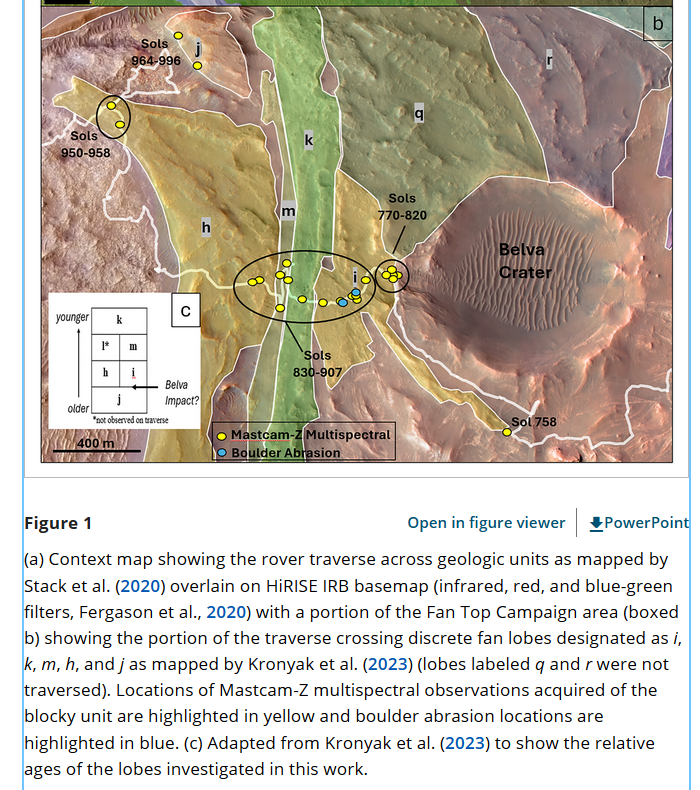
Fig. 20 from the linked paper: cross sections of Bright Angel & Neretva Vallis.Fig. 22: proposed geologic history for the Bright Angel deposition.
V MartĂ­nsharponlooker
2026-01-07

Referenced in the above paper, had escaped me due to a different journal. Another detailed description of, imho, the most complex part of traverse.

Ives et al: "Sedimentology and stratigraphy of the fluvial–deltaic Skrinkle Haven member, Tenby formation"
doi.org/10.2110/jsr.2025.019

Crop of fig. 1, showing the studied area on a Perseverance route map.
V MartĂ­nsharponlooker
2026-01-07

All the "gory" details on the Jezero margin unit 😉

Jones et al: "Stratigraphy of Carbonate-Bearing Rocks at the Margin of Jezero Crater: Evidence for Shoreline Processes?"
doi.org/10.1029/2025JE009111

Figure 24 from the linked paper, with a putative model for the margin unit formation.
V MartĂ­nsharponlooker
2025-12-17

There's also a reference to a new paper on the margin unit, with an excellent sketch of its proposed formation and alteration.

Williford et al : "Carbonated ultramafic igneous rocks in Jezero crater"
science.org/doi/10.1126/scienc

Fig. 7. Schematic diagram of proposed formation and evolution of the Margin unit
V MartĂ­nsharponlooker
2025-11-24

The greenish spots at the southern bank of Neretva are also astrobiology-interesting.

Broz et al: "Green reduction spots in red sedimentary rocks of the Bright Angel formation..."
agu.confex.com/agu/agu25/meeti

Companion figure of the preview abstract: views of the Malgosa Crest abrasion with greenish reduction spots.
V MartĂ­nsharponlooker
2025-10-07

Detailed analyses of the Jezero regolith.

Shumway et al: "Mineralogically Diverse and Salt-Rich Regolith in Jezero Crater Characterized Using X-Ray Spectroscopy"
doi.org/10.1029/2024JE008912

Figure 3 of the paper, images from the ripple sampling on the crater floor.Figure 5, example of the detailed analysis of "sand" enabled by the rover's instruments.
V MartĂ­nsharponlooker
2025-10-07

Final peer reviewed version of mastodon.social/@sharponlooker

Vaughan et al: "The Boulder-Rich Blocky Unit of the Western Jezero Upper Fan: Discriminating Olivine and Pyroxene Compositions and Constraining Provenance"
doi.org/10.1029/2025JE009159

Figure 10 of the linked paper, examples of boulders through the different image processings applied for classification.Figure 12, catchment area map of Jezero crater with mineralogy identification.Last 2 paragraphs of the paper's conclusions.

Extract: "Olivine-bearing boulders are predominant across the entire fan top. Lobes h and i have similar type distributions, whereas lobes k and m have a notable lack of pyroxene-bearing boulders. These observations support the hypothesis put forth by Kronyak et al. (2023) that lobes h and i were deposited together as one lobe that was later cut by lobes k and m. Olivine-bearing boulders are generally more round and exhibit smoother natural surfaces marked by ventifacts with some examples of exfoliation. Pyroxene-rich boulders are more angular with rougher surface textures. ... Both types of boulders have compositions and grain-scale textures that indicate an igneous origin.

Though igneous in origin, we find the contextual evidence presented here of the boulder-rich unit to be inconsistent with a volcanic emplacement and more consistent with an emplacement via fluvial deposition. ... We suggest that the dominant and more rounded olivine-bearing boulders could be sourced from the regional olivine unit present in the Jezero watershed, and that the less populous and more angular LCP-bearing boulders are sourced from LCP-rich deposits in the more proximal Jezero crater rim, although we cannot rule out the possibility that they are impact ejecta. This work suggests and supports earlier claims that high-energy fluvial activity played a role in the later stages of the Western Fan formation in Jezero crater."Figure 1b, including an updated version of the fan lobes chart and relative emplacement dating from Kronyak et al.
V MartĂ­nsharponlooker
2025-09-10

Hurowitz et al: "Redox-driven mineral and organic associations in Jezero Crater, Mars"
doi.org/10.1038/s41586-025-094

V MartĂ­nsharponlooker
2025-08-11

Munguira (EHU) et al: "Nighttime and Early Morning Atmospheric Waves and Transient Turbulence at Jezero Crater observed by "
doi.org/10.1029/2025JE009114

V MartĂ­nsharponlooker
2025-08-03

Ovchinnikova et al: "Exploring the connection of the Northern and the Western Deltas in Jezero Crater"
doi.org/10.5194/epsc-dps2025-7

"We interpret the uppermost LCP/smectite unit within the northern delta as material from the western inlet deposited over already existing topography of the ND. ...conclude that the main body of Jezero's ND is older than the WD but covered with the relatively thin and younger layer of silt deposits from the western inlet."

Fig. 3."a) Overview map with studied features; b) Results of modeling, showing that fine silt will be deposited on the southern part of the northern delta, which coincides with the appearance of the LCP/Smectite units."
V MartĂ­nsharponlooker
2025-08-01

Poster session with another iteration on the story of the Jezero delta formation as prograding on a shrinking lake

Mangold et al: "Paleolake variations of Lake Jezero, recorded by the deltaic architecture of Jezero crater western fan"
doi.org/10.5194/epsc-dps2025-2

CW IANAGℱ: I still can't wrap my head around disregarding the curvilinear stuff as point bars, awaiting the final paper 😉

Figure 1: "(a) Map of the western delta of Jezero with topographic contours in color. Elevations in blue boxes indicate the benchmarks of the paleolake level (topset-foreset transition, red-blue disks) or minimum paleolake elevation (foresets only, blue disks). The elevations in white boxes and the related black, dashed lines are extrapolations of these elevations showing a consistent downstepping from -2410 m at the fan top (Belva crater) toward -2500 m at the Eastern Cape and at Kodiak. (b) Schematic cross-section of the area highlighting the local deltaic morphologies expressed and corresponding paleo-lake levels. (c) Interpretative sketch of a deltaic downstepping sequence during a forced regression (adapted from 9)."
V MartĂ­nsharponlooker
2025-08-01

Sounds like a long shot, but linking observations of nickel over-abundance at to the

Manelski et al: "Ore-Grade Nickel Hosted in Fine-Grained Sedimentary Rocks, Jezero Crater"
doi.org/10.5194/epsc-dps2025-4

Snapshot of the Discussion section, highlighted last paragraph: "Ni impurities in greigite (Fe3S4), a precursor to authigenic sedimentary pyrite on Earth, resemble proteins that are essential to early microbial carbon fixation and have therefore been proposed as key to abiogenesis. The detection of major Ni enrichments in fine-grained sedimentary rocks, spatially related to zones of locally reduced sulfur (‘leopard spots’) and the first detection of G-band organics with SHERLOC Raman spectroscopy, could provide another hint at potential organic processes.
V MartĂ­nsharponlooker
2025-08-01

Here's a new iteration on the geology, with some new interpretations compared to the previous one (mastodon.social/@sharponlooker). Unfortunately the figures are missing.

Jones et al: "A fluvio-lacustrine environment preserved in the Jezero crater inlet channel, Neretva Vallis"
doi.org/10.5194/epsc-dps2025-8

Snapshot of the whole Interpretation section in the linked paper, the second paragraph reads: "This lacustrine environment occurs 10–50 m above the paleolake level implied by the western fan, suggesting the Bright Angel formation was deposited either (1) during a lake highstand, pre-dating breach of the eastern rim and western fan deposition [9], or (2) in a later-stage, valley-confined lake. The latter are common in terrestrial valley networks, where slope failure leads to channel blockage and formation of a lake upstream. These can produce successions similar to the
BA formation, and may explain the absence of BA-like materials beyond
Neretva Vallis. However, it remains unclear whether sufficiently thick deposits could accumulate to enable hydrofracturing of the lower members. Thicker deposits may accumulate in a more stable, pre-delta, lake highstand phase as proposed by [9]. In this model, the BA sediments may
have been deposited up to 100 m below the highstand lake level [9]."
V MartĂ­nsharponlooker
2025-07-27

The kind of comparison with Eberswalde I've been waiting for...

Carlot et al: "Stratigraphic analysis of the Eberswalde sedimentary fan using orbital imagery and comparison with the Jezero delta"
doi.org/10.5194/epsc-dps2025-92

Figure 1: "Map of the meandering inverted channels on the Eberswalde sedimentary fan and their stratigraphic relationships, from oldest to youngest lobes.""Preliminary conclusions

The stratigraphic and geomorphologic data of the present study indicate that the Eberswalde sedimentary fan did not emplace as a Gilbert-type delta, as is the case for the Jezero delta. It is therefore necessary to understand how the Eberswalde fan formed. Two hypotheses can be proposed:

The fan emplaced in two separate phases, a lacustrine phase first, and a late-stage fluvial phase, emplacing the meandering rivers, with a gap between these two stages.
Eberswalde is a shoal-water delta, that emplaced in a shallow lake, possibly as an aggradational delta, contrary to the progradational settings of the Jezero delta.
Those preliminary conclusions and hypotheses highlight the fact that the processes leading to the formation of the Eberswalde and Jezero fans are different, and the scenario of the Jezero delta should not be taken as the rule on Mars, although we have not explored more fans yet. The in-depth study of other martian sedimentary fans is fundamental for a better understanding of the availability of liquid water at the time they formed."
V MartĂ­nsharponlooker
2025-06-30

Analysis and rough classification of float rocks in the fan front with 's Mastcam + some SuperCam. No big surprises other than the absence of iron meteorites.

Kathir et al: "Multispectral Observations of Float Rocks Used to Investigate the Origin of Boulders on the Western Jezero Fan Front"
doi.org/10.1029/2024JE008702

Fig 4: mapping of the studied rock categories in the Jezero fan front area.Panels A and B of figure 7: Betty's Rock seen through different MCZ filters and colour stretches. Not surprisingly, it's classified as a layered float rock eroded off the close-by Rockytop.Fig 10: examples of light-toned ("bright") float rocks and their spectra.Extract from the 5.3 Absence of Meteorites section, last 2 paragraphs.
V MartĂ­nsharponlooker
2025-05-30

Pinning down Jezero lake to a close/sporadically-open system by closely studying the outlet channel.

Villette et al: "The Sporadic Fluvial Regime of Pliva Vallis, the Outlet Valley of Jezero Crater Lake"
agupubs.onlinelibrary.wiley.co

Figure 2: overview of the studied area.Figure 6: the channel bend used to establish the described four overflow episodes.Figure 10: proposed timeline. Note how the current delta remnant is assumed to have formed AFTER all the breach events (from section 5.3: "Thus, it is likely that the delta was formed after the overflow events and during the lake regression rather than during the filling of the lake.")Conclusions:
"... HiRISE images show alternating fine-grained deposits and meter-scale boulders, suggesting variability in the intensity of the flow creating the deposits. The valley has the following atypical characteristics: (a) a decrease in the valley width and depth from upstream to downstream, which is not consistent with a steady flow over time, and (b) the presence of a perched valley as well as topographic rises on the valley floor, which together suggest a discontinuous and energetic fluvial regime of the outlet valley. In addition, re-incised fluvial deposits and, at least, four bedrock incision terraces on the upstream part of the valley wall are consistent with a strong variability in the fluvial regime of the valley. To account for these observations, we propose a scenario with at least four main episodes of overflow and valley incision. Modeling, gives a minimum estimate of the duration of these episodes of a few days or a few weeks, consistent with our interpretation of discontinuous incision of Pliva Vallis by sporadic fluvial regimes. This study helps us better constrain the activity of the upstream lake. We propose a new scenario for the history of the Jezero crater lake, as a predominantly closed system, which was episodically and temporarily opened during at least the four identified overflow events but never experienced long-term open system conditions."
V MartĂ­nsharponlooker
2025-03-04

Peer-reviewed, open access version of the above (post nr 11)

Beck et al : "From hydrated silica to quartz: Potential hydrothermal precipitates found in Jezero crater"
doi.org/10.1016/j.epsl.2025.11

h/t @IRAP astrodon.social/@IRAP/11410407

Fig. 5. Schematic of the proposed model to explain the precipitation of quartz, chalcedony and opal. Water infiltrates in the bedrock and SiO2 concentration increases as the fluid percolates down. Warm fluids then ascend upward and silica can precipitate within the bedrock at some depth, where quartz may have formed. As the fluid reaches the surfaces, quick cooling and decompression leads to the precipitation of less crystalline forms, namely silica, opal and chalcedony.
V MartĂ­nsharponlooker
2025-02-24

A jump back to Neretva and thread post nr 6 ( mastodon.social/@sharponlooker ), this time with strong measurements of organics.

Murphy and Uckert, et al : "Spatially Resolved Complex Organic Matter Detected in an Ancient River Valley in Jezero"
hou.usra.edu/meetings/lpsc2025

"We report the detection of macromolecular carbon (MMC) by Deep-UV Raman spectroscopy in multiple ancient riverbed rock targets in Jezero crater"

đŸ§” 31/n

Figure 1, Perseverance selfie at Bright Angel by Cheyava Falls and the Apollo Temple abrasion.Figure 2
"Raman spectral variability across Bright Angel targets. G-band detection is highlighted in the inset zoom. The grey line is the Si-O stretching overtone contribution from the SHERLOC optical background, the black line is the G-band fit, and the colored lines are the sum of each contribution to the 1600 cm-1 feature. Spectra shown are 5% trimmed means."extract: "The Raman G-band peak parameters measured on the Cheyava Falls natural surface are distinct from the measurements made in the near sub-surface of the rock exposed during the abrasion process [Apollo Temple], suggesting that
this population of organics is either resistant to degradation, shielded sufficiently by the iron-rich regolith that it survived radiation degradation at the
martian surface, or was relatively recently exposed."Conclusion:
"Bright Angel rocks are uniquely organic-rich relative to other targets that have been measured in Jezero crater by SHERLOC, and represent a mudstone on Mars outside of Gale crater that has been found to contain significant quantities of organic carbon, suggesting that organics may have been widely present and available in ancient (~3.5 Gyr) lakes and rivers on Mars. The carbon observed at Bright Angel is not graphite. Potential organic emplacement (exogenous) and formation processes (endogenous) include:

- carbonaceous interplanetary dust particles (IDPs) and meteoritic infall
- in-situ synthesized abiotic organics
- or in-situ synthesized biological material.

The presence of MMC reported in this work cannot be ascribed at this time to any specific formation mechanism; biological, geological, and meteoritic sources of the organics observed are all possible. Further constraining the origin, distribution, and alteration history of the organic carbon observed at Bright Angel requires high-resolution and high-sensitivity analyses in terrestrial labs, which can only be facilitated by the return of these samples to Earth."
V MartĂ­nsharponlooker
2025-02-23

Sharmili et al: "Exploring the Depositional and Erosional Morphology of Jezero Crater’s Western Fan Using Coupled Numerical Models of Sediment Deposition and Erosion"
hou.usra.edu/meetings/lpsc2025

"Based on the two coupled numerical models, the present study uncovers the potential scenario for the preservation of the Jezero Crater's western fan by erosion-resistant boulder deposits (capping unit), maintaining its shape over billions of years."

đŸ§” 25/n

Figure 2Extract from conclusions: "An erosion-resistant capping unit may have been the main factor in the exceptional preservation of the Jezero fan, but the lack of characteristic delta plain geometries and channel bodies in the Upper Fan group like those seen in Eberswalde is notable. This raises the possibility that the
Jezero fan is a fan shape today because its capping unit —which could represent alluvial fan or crevasse splay deposition— was fan shaped and is not necessarily
reflective of the depositional morphology of deltaic deposits that occur lower in the sequence."
V MartĂ­nsharponlooker
2025-02-22

Another really interesting poster that needs more work. It does already give good time-constraints for Bright Angel, although I could not find anywhere that BA would post-date the fan, as its conference summary says (maybe they mean the deformation folding).

Barnes et al : "Late Deformation of the Bright Angel Formation in Western Neretva Vallis"
hou.usra.edu/meetings/lpsc2025

đŸ§” 23/n

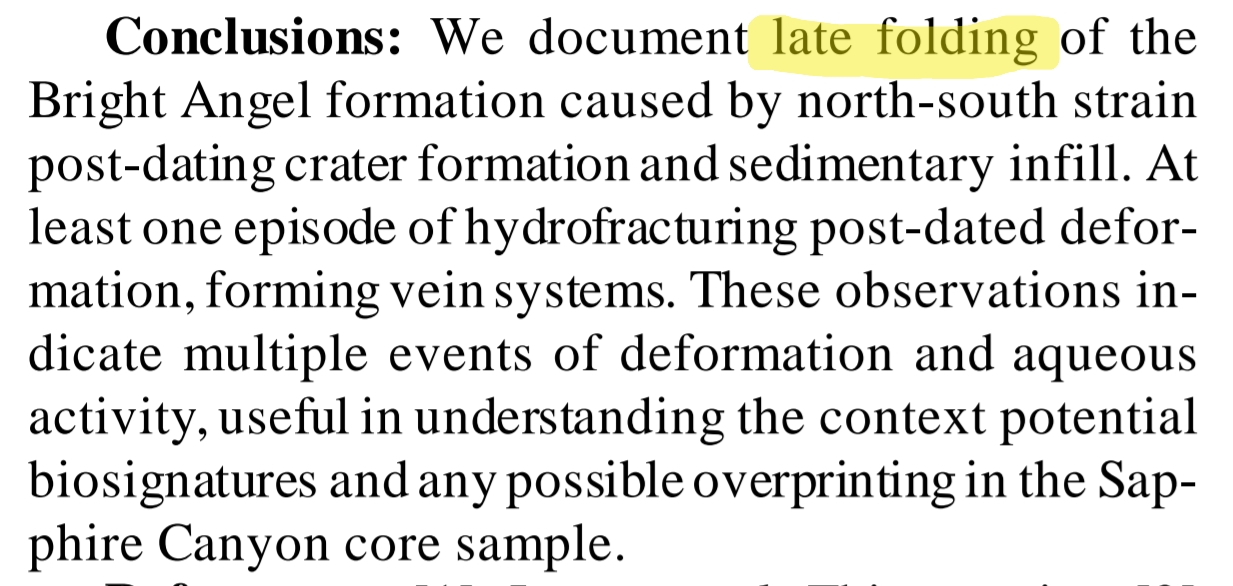
Figure 1.Figure 2.Conclusions: "We document late folding of theBright Angel formation caused by north-south strain post-dating crater formation and sedimentary infill. At least one episode of hydrofracturing post-dated deformation, forming vein systems. These observations indicate multiple events of deformation and aqueous activity, useful in understanding the context potential biosignatures and any possible overprinting in the Sapphire Canyon core sample."LPSC summary: "We document the deformed Bright Angel formation in Neretva Vallis, Jezero crater. Stratigraphic and structural geometries observed indicated that deposition and deformation post-date both formation of the crater and deposition of the western fan."

Client Info

Server: https://mastodon.social
Version: 2025.07
Repository: https://github.com/cyevgeniy/lmst