#crackedRocks

V Martínsharponlooker
2025-10-07

Final peer reviewed version of mastodon.social/@sharponlooker

Vaughan et al: "The Boulder-Rich Blocky Unit of the Western Jezero Upper Fan: Discriminating Olivine and Pyroxene Compositions and Constraining Provenance"
doi.org/10.1029/2025JE009159

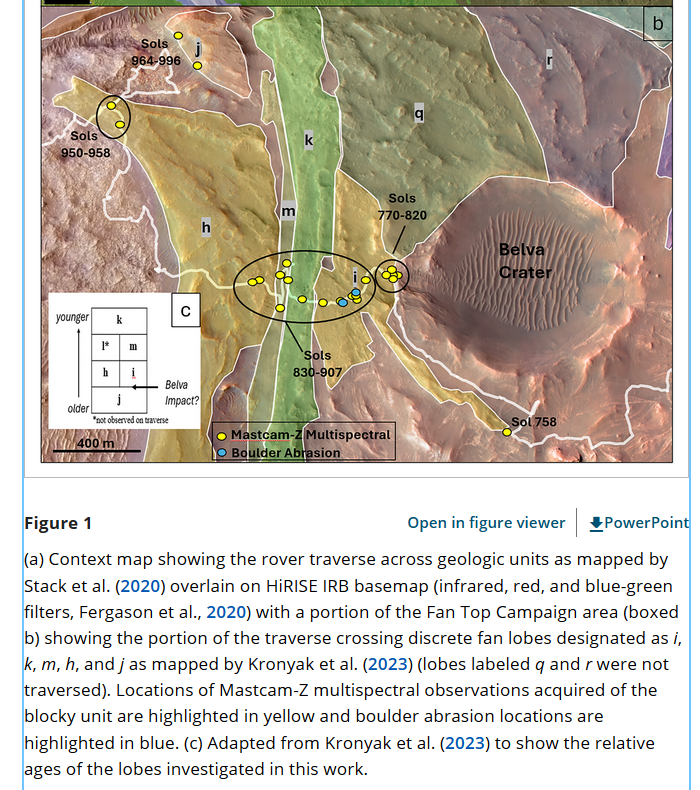
Figure 10 of the linked paper, examples of boulders through the different image processings applied for classification.Figure 12, catchment area map of Jezero crater with mineralogy identification.Last 2 paragraphs of the paper's conclusions.

Extract: "Olivine-bearing boulders are predominant across the entire fan top. Lobes h and i have similar type distributions, whereas lobes k and m have a notable lack of pyroxene-bearing boulders. These observations support the hypothesis put forth by Kronyak et al. (2023) that lobes h and i were deposited together as one lobe that was later cut by lobes k and m. Olivine-bearing boulders are generally more round and exhibit smoother natural surfaces marked by ventifacts with some examples of exfoliation. Pyroxene-rich boulders are more angular with rougher surface textures. ... Both types of boulders have compositions and grain-scale textures that indicate an igneous origin.

Though igneous in origin, we find the contextual evidence presented here of the boulder-rich unit to be inconsistent with a volcanic emplacement and more consistent with an emplacement via fluvial deposition. ... We suggest that the dominant and more rounded olivine-bearing boulders could be sourced from the regional olivine unit present in the Jezero watershed, and that the less populous and more angular LCP-bearing boulders are sourced from LCP-rich deposits in the more proximal Jezero crater rim, although we cannot rule out the possibility that they are impact ejecta. This work suggests and supports earlier claims that high-energy fluvial activity played a role in the later stages of the Western Fan formation in Jezero crater."Figure 1b, including an updated version of the fan lobes chart and relative emplacement dating from Kronyak et al.
65dBnoise65dBnoise
2025-06-02

@sharponlooker
We've seen that paper before, haven't we?

Jezero Mons being a volcano also nicely explains the that look like lava bombs: they may actually BE .

65dBnoise65dBnoise
2024-07-30

@sharponlooker
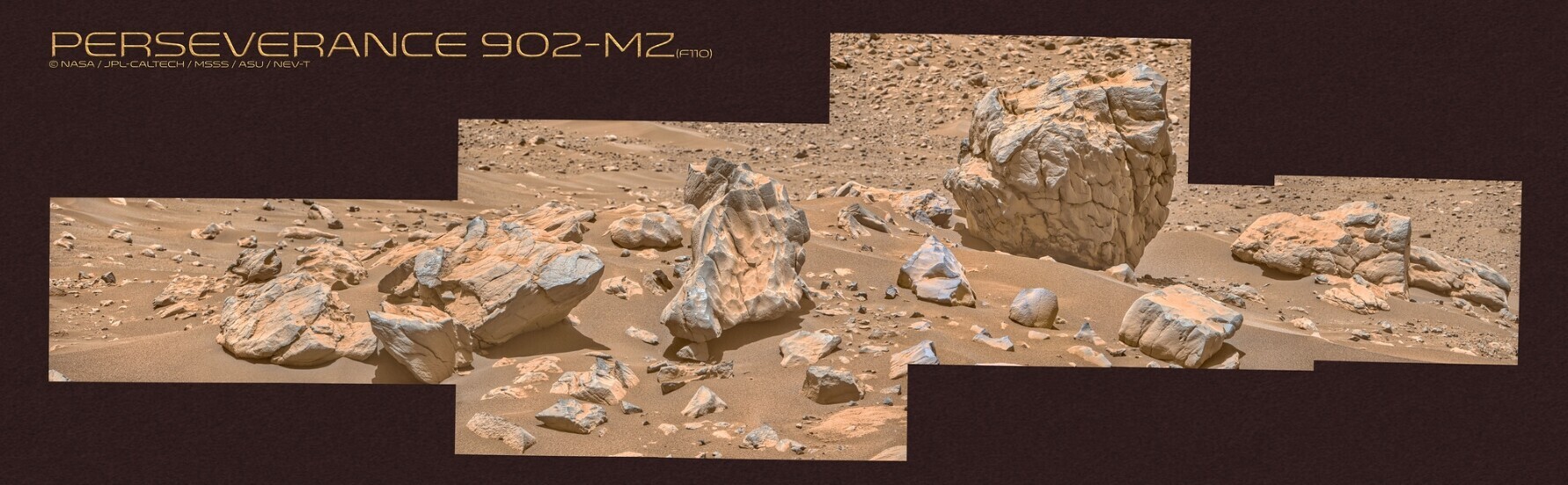
Here are Oli and Dusty a few meters west of and all of them just west of Belva Crater.

On the map, the green area is the field-of-view of MCZ at 34mm.

Processed, leveled MCZ_LEFT, FL: 34mm
looking W (267°) from RMC 39.1170
Sol 812, LMST: 10:19:24
Original: mars.nasa.gov/mars2020-raw-ima

Credit: /JPL-Caltech/ASU/65dBnoise

65dBnoise65dBnoise
2023-08-23

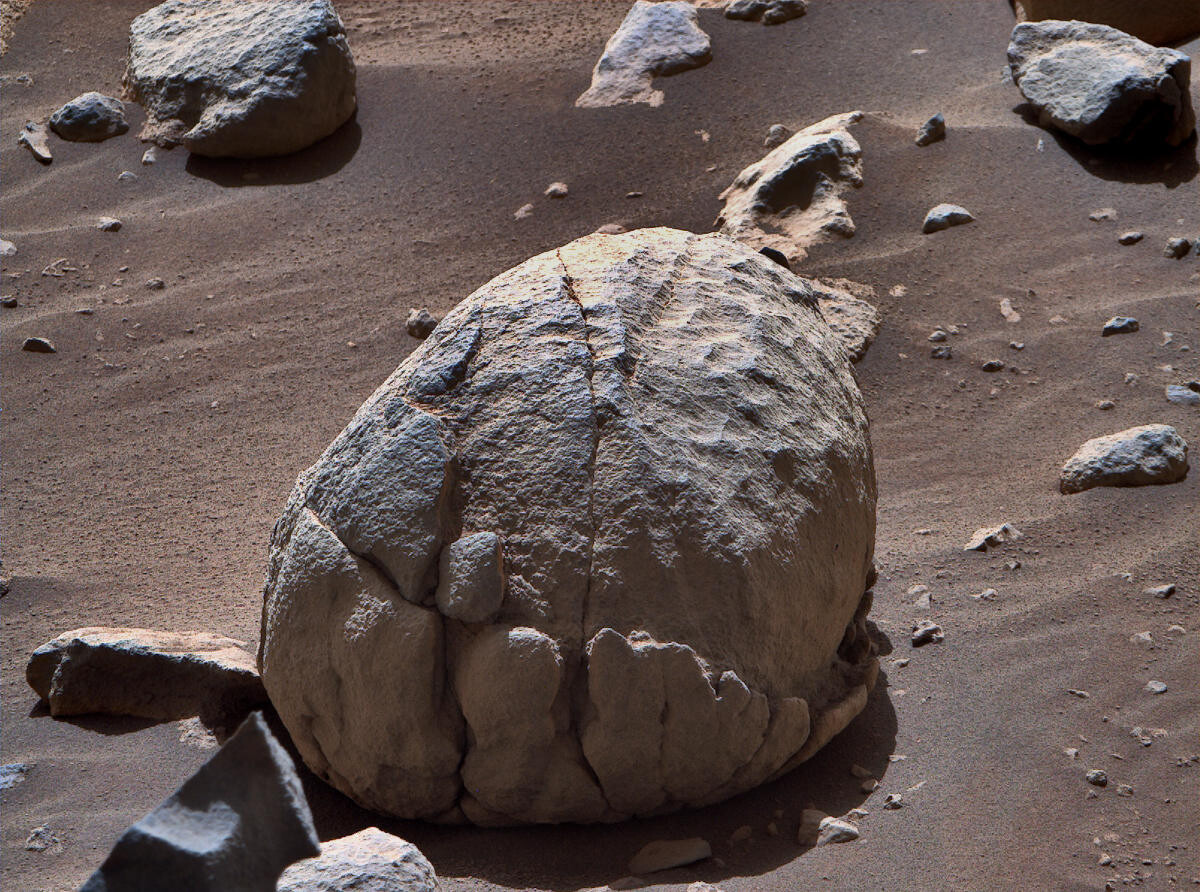
110mm close-up of 'A rock with a lid'

Processed, cropped MCZ_LEFT, FL: 110mm
Sol: 889, RMC: 44.0000, LMST: 14:06:49
Original: mars.nasa.gov/mars2020-raw-ima
Credit: /JPL-Caltech/ASU/65dBnoise

65dBnoise65dBnoise
2023-08-20

A rock with a lid.

Variations on a theme:

Animated zoom

Processed MCZ_LEFT, FL: 63mm
Sol: 888, RMC: 44.0000, LMST: 11:43:53
Original: mars.nasa.gov/mars2020-raw-ima
Credit: /JPL-Caltech/ASU/65dBnoise

65dBnoise65dBnoise
2023-08-16

@mightyspaceman
Thermal stress would be a common cause considering Jezero has a ~60°C temperature swing from day to night. But IANAG™, so, let's wait and see that the geologists will have to say.

Meanwhile, I have a collection of other tagged seen around Jezero Crater.

IANAG™ = I Am Not A Geologist 🙂

65dBnoise65dBnoise
2023-08-16

Mars.

Processed, leveled, cropped MCZ_LEFT, FL: 110mm
Sol: 880, RMC: 43.0000, LMST: 12:07:17
Original: mars.nasa.gov/mars2020-raw-ima
Credit: /JPL-Caltech/ASU/65dBnoise

A Martian scene.
A gray rock cracked open in the foreground on the right, an almost leveled brown regolith field in the middle and a light brown sand field in the upper left background.
65dBnoise65dBnoise
2023-05-16

Variations on a theme:

Zoom animation

Processed MCZ_RIGHT, FL: 34mm
Sol: 789, RMC: 39.0926, LMST: 12:21:22
Original: mars.nasa.gov/mars2020-raw-ima
Credit: /JPL-Caltech/ASU/65dBnoise

65dBnoise65dBnoise
2023-05-13

Cracked open rocks. We've seen them all over the Jezero delta. One day we may learn how they came to be here.

For a bunch of similar , ⬅️ visit that hashtag 🙂

Zoom animation.

De-bayered, processed, rotated for straight horizon MCZ_RIGHT, FL: 34mm
Sol: 789, RMC: 39.0926, LMST: 12:05:30
Original: mars.nasa.gov/mars2020-raw-ima
Credit: /JPL-Caltech/ASU/65dBnoise

65dBnoise65dBnoise
2023-04-08

One more for the collection.

Processed MCZ_RIGHT, FL: 63mm
Sol: 757, RMC: 37.2562, LMST: 09:10:27
Original: mars.nasa.gov/mars2020-raw-ima
Credit: /JPL-Caltech/ASU/65dBnoise

65dBnoise65dBnoise
2023-04-06
65dBnoise65dBnoise
2023-02-26

@tom30519
That might explain why the rocks in the collection look like hot balls that fell from the sky and... cracked open 😜

2022-11-28

Cape NukShak after spring break.

Littered with, well, cracked rocks and overturned slabs.

MCZ_RIGHT
RMC: 30.1344, Sol: 629
LMST: 13:29:29
UTC: 2022-11-27T01:16:29
Credit: #NASA/JPL-Caltech/ASU

#HumanizingMars #Perseverance #Mars2020 #solarocks #space #crackedRocks

2022-11-28

This rock too looks like its surface shrunk and cracked by fast cooling while its interior was still hot. Maybe by falling into the lake water?
Just a guess.

Processed MCZ_RIGHT
RMC: 30.2188, Sol: 629
LMST: 16:24:02
UTC: 2022-11-27T04:15:49
Credit: #NASA/JPL-Caltech/ASU

#Perseverance #Mars2020 #solarocks #space #crackedRocks

2022-11-16

More of these interesting rocks, one from a recent image with pentagonal fragments, and another from an old image (Sol 388, when the rover was next to crater Port Angeles) with hexagonal fragments.

Cropped and processed:

MCZ_LEFT
RMC: 30.1172, Sol: 610
LMST: 09:42:23
UTC: 2022-11-07T08:50:58

MCZ_RIGHT
RMC: 15.0000, Sol: 388
LMST: 08:12:30
UTC: 2022-03-24T04:50:13

Credit: #NASA/JPL-Caltech/ASU

#Perseverance #Mars2020 #solarocks #space #crackedRocks

Rock cracked in pentagonsRock cracked in hexagons
2022-11-15

One more of those interesting cracked rocks, originally posted here: fosstodon.org/@65dBnoise/10928

Processed MCZ_LEFT
RMC: 30.1096, Sol: 606
LMST: 15:55:00
Credit: #NASA/JPL-Caltech/ASU

#Perseverance #Mars2020 #Solarocks #Space #crackedRocks

2022-11-13

I include the one I likened to a lava bomb here, to keep them all together: fosstodon.org/@65dBnoise/10930

Cropped & white balanced MCZ_LEFT
RMC: 30.1172, Sol: 610
LMST: 09:42:23
UTC: 2022-11-07T08:50:58
Credit: #NASA/JPL-Caltech/ASU

#Perseverance #Mars2020 #solarocks #space #crackedRocks

2022-11-13

If you look closely, many of those larger rocks appear to have cracked in a similar way:

Processed, cropped MCZ_LEFT
RMC: 30.1172, Sol: 614
LMST: 09:21:02
UTC: 2022-11-11T11:07:23
Credit: #NASA/JPL-Caltech/ASU

#Perseverance #Mars2020 #solarocks #space #crackedRocks

2022-11-13

One more of those rocks that appear as if they fell from the sky and cracked while they were hot.

But that's nothing more than an impression. Science is more than impressions, takes its time to gather data and establish plausible theories and then prove or disprove them. Until then, imagination plays its game.

Processed, cropped MCZ_LEFT
RMC: 30.1172, Sol: 614
LMST: 09:21:39
UTC: 2022-11-11T11:08:01
Credit: #NASA/JPL-Caltech/ASU

#Perseverance #Mars2020 #solarocks #space #crackedRocks

Hard looking rock cracked to pieces that are still held together as if hastily glued to keep the original shape. Other rocks around are too cracked open.

Client Info

Server: https://mastodon.social
Version: 2025.07
Repository: https://github.com/cyevgeniy/lmst