#Nebulas

earthlingappassionato
2026-01-19

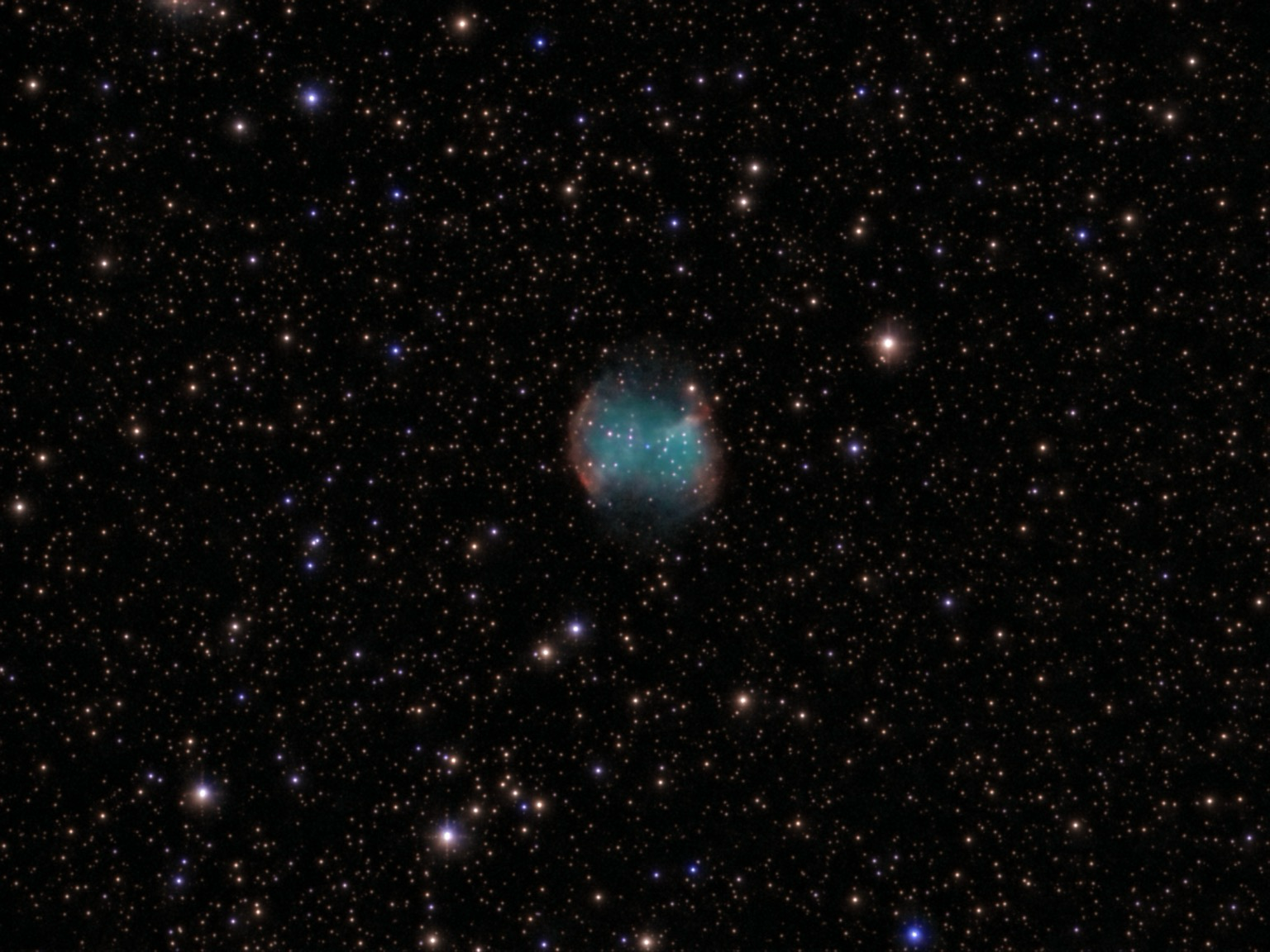
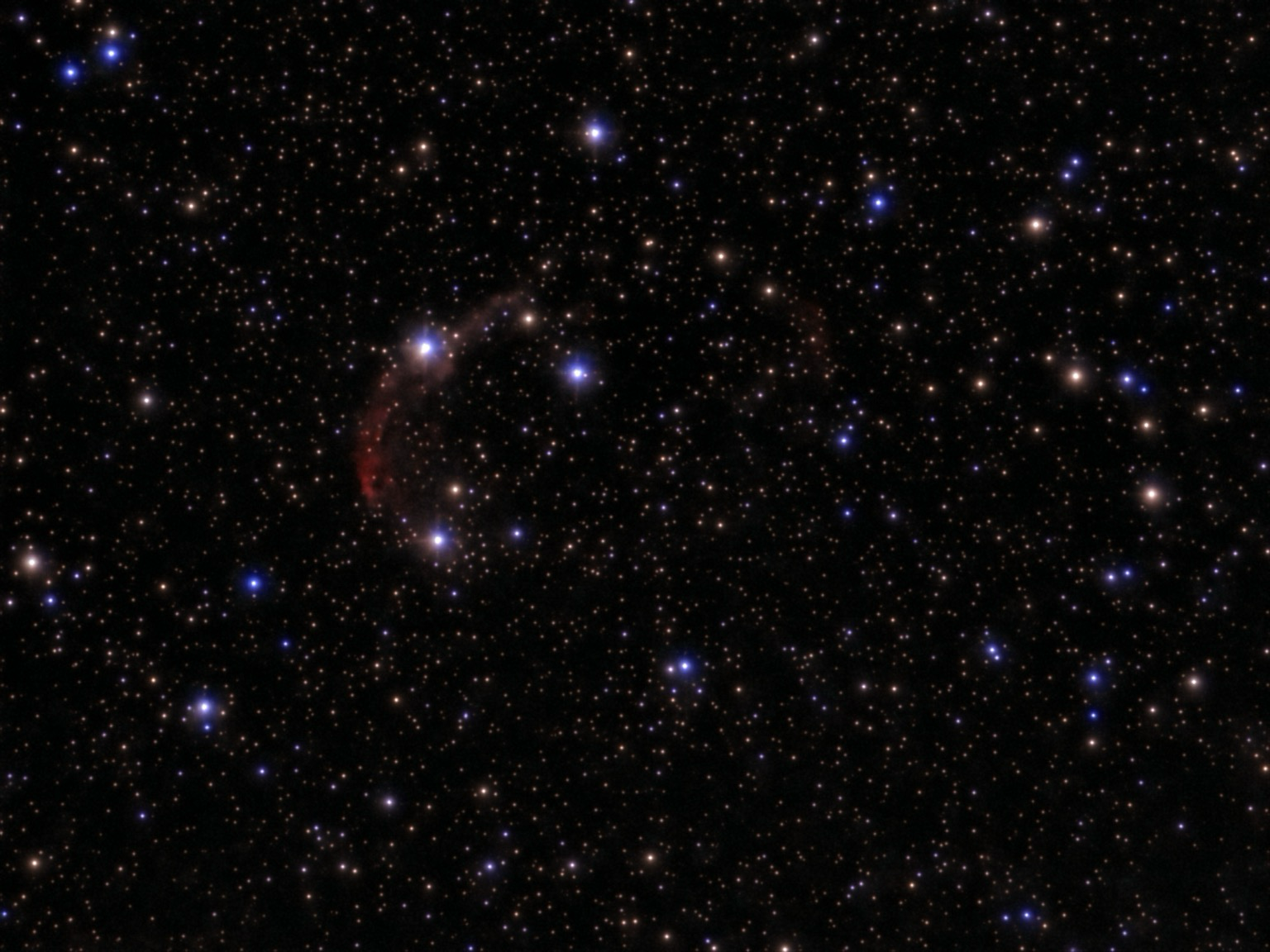
CTB 1: The Medulla Nebula

What powers this unusual nebula? CTB 1 is the expanding gas shell that was left when a massive star toward the constellation of Cassiopeia exploded about 10,000 years ago. The star likely detonated when it ran out of elements, near its core, that could create stabilizing pressure with nuclear fusion.

Image Credit: Pierre Konzelmann


The resulting supernova remnant, nicknamed the Medulla Nebula for its brain-like shape, still glows in visible light because of the heat generated by its collision with confining interstellar gas. Why the nebula also glows in X-ray light, though, remains a topic of research. One hypothesis holds that an energetic pulsar was created and powers the nebula with a fast outwardly moving wind. Following this lead, a pulsar was found in radio waves that appears to have been expelled by the supernova explosion at over 1000 kilometers per second. Although the Medulla Nebula appears as large as a full moon, it is so faint that it took 84-hours of exposure with a small telescope in Texas, USA, to create the featured image.
Oskar Contrerastg8arc
2025-12-30

Last image of the night for the Odyssey Pro. Here is the (center) and (left) .

M78 and NGC 2071 Nebulas - telescope processed image.  M78 (Casper the Ghost): This is the brightest reflection nebula in the sky, famously glowing with a ghostly blue light scattered by dust from young stars.M78 and NGC 2071 Nebulas - unprocessed image.  NGC 2071: Located just north of M78, this nebula acts as a high-mass stellar nursery, hiding powerful protostars that blast out massive jets of gas.
2025-11-12

earth.com/image/young-stars-il

Today’s Image of the Day from the European Space Agency features a stunning reflection nebula known as GN 04.32.8 in the constellation Taurus...

#Taurus #nebulas #space #EuropeanSpaceAgency #constellations #universe #photography

Oskar Contrerastg8arc
2025-11-10

Last observation of the morning. Went to go see - in the center of the image. In the image you can see the other from top to bottom - , (right above M78), (dark nebula above and right of M78), (lower right of of M78 and LDN1627), (small nebula to the lower right of M78).

M78 The Casper Nebula - telescope processed image with Moon and Sky Light Filter.  M78 (Casper Nebula) is a reflection nebula in Orion, about 1,350 light-years away. It appears bright blue as its dust clouds reflect light from nearby young stars.M78 The Casper Nebula - unprocessed image with Moon and Sky Light Filter.  The Casper Nebula (M78) is the brightest part of a reflection nebula complex within the Orion B Molecular Cloud. It is surrounded by other smaller reflection nebulae like NGC 2064, NGC 2067, and NGC 2071. All these nebulae are clouds of interstellar dust that reflect the blue light from nearby hot, young B-type stars.
Knowledge Zonekzoneind@mstdn.social
2025-11-07

#Stars ignite in #Nebulas, spending most time as main sequence stars (like the Sun). Their end depends on mass: low-mass stars become red giants then #White #Dwarfs; high-mass stars end in a #Supernova, forming a neutron star or #BlackHole.

knowledgezone.co.in/posts/Life

Oskar Contrerastg8arc
2025-10-31

Been busy at work so could not post this operation till tonight. Here is a new observation of . The s50 was out there all night and this observation is 586 images at 20 second exposures in total. Captures all the Pleiades plus the around the stars.

M45 The Pleiades Star Cluster - telescope processed image with Moon and Sky Light  Filter.   Also known as the "Seven Sisters," M45 is the nearest and most famous open star cluster (in Taurus), dominated by young, hot blue stars passing through a dusty nebula.M45 The Pleiades Star Cluster - unprocessed image with Moon and Sky Light Filter.  The nine most famous named stars in M45, also known as the Pleiades or the "Seven Sisters," are: The Seven Sisters (Daughters of Atlas and Pleione) • Alcyone (The brightest star) • Electra • Maia • Merope • Taygeta • Celaeno • Asterope (sometimes referred to as Sterope, often seen as a double star) The Parents • Atlas (The Titan who held up the heavens) • Pleione (Their mother, an Oceanid nymph).
Oskar Contrerastg8arc
2025-03-16
M27 - Dumbbell Nebula as seen by the Odyssey Pro.
Oskar Contrerastg8arc
2025-03-08

Looking for according to the app and seem to be fainter than what my telescope can see. Still, nice pictures from the area where the and the should be.

Stars from the area where the Magic Carpet nebula is from the Odyssey Pro. Faint ring nebula area as seen by the Odyssey Pro.
Oskar Contrerastg8arc
2025-01-20
M97 - Owl Nebula as seen through the Odyssey Pro. M57 - Ring Nebula as seen through the Odyssey Pro.
2025-01-14

Compare Observations of Wolf-Rayet 140 (MIRI Images) ✨

#Dust #Nebulas #Stars

⏩ 2 new pictures from Webb (NASA) commons.wikimedia.org/wiki/Spe

Compare_Observations_of_Wolf-Rayet_140_(MIRI_Images)_(2025-103).jpgCompare_Observations_of_Wolf-Rayet_140_(MIRI_Images)_(2025-103).pngWolf-Rayet_140_(MIRI_Compass_Image)_(2025-103).jpg
Galactic JourneyGalacticJourney
2024-12-26

[Dec. 26, 1969] Forget the and the —if you want to know about the BEST and of 1969, look no further than the Galactic Stars. The winners may surprise you...

galacticjourney.org/december-2

Collage of six photos: illustration from Tiptree's "The Snows Are Melted, the Snows Are Gone," from Ellison's "A Boy and His Dog", book cover for Slaughterhouse Five, Patrick Troughton's face in quintuplicate from Dr. Who, a full cover of F&SF, and the cover illustration for Niven's "The Organleggers" (full details in the article)
2024-11-06

Today’s Image of the Day from the European Space Agency features Messier 78 (M78), a reflection nebula located in the constellation Orion about 1,350 light-years away from Earth...
#EuropeanSpaceAgency #messier78
#m78 #imageoftheday #photography #nebulas #orion #constellations #orionconstellation #space #universe earth.com/image/messier-78-you

Steven Saus [he/him]StevenSaus@faithcollapsing.com
2024-10-27

From 27 Oct: ‘Cosmic Dandelion’: A Mysterious 900-Year-Old Nebula Gets Mapped in Stunning Detail - Somewhere out in deep space, there’s a beautiful... gizmodo.com/cosmic-dandelion-a #amateur-astronomy #astronomy #nebulas #space #supernovae

Client Info

Server: https://mastodon.social
Version: 2025.07
Repository: https://github.com/cyevgeniy/lmst