#RomanFort

Brian Lavellebrian@beige.party
2026-01-30

I visited the Roman fort at Rough Castle today, for the first time in probably 40-45 years. I think my dad took me when I was small, although there’s a chance I’m (mis)remembering a visit from having seen photographs and what I otherwise know about sites along the Antonine Wall: the spectre of memory at the edge of empire.

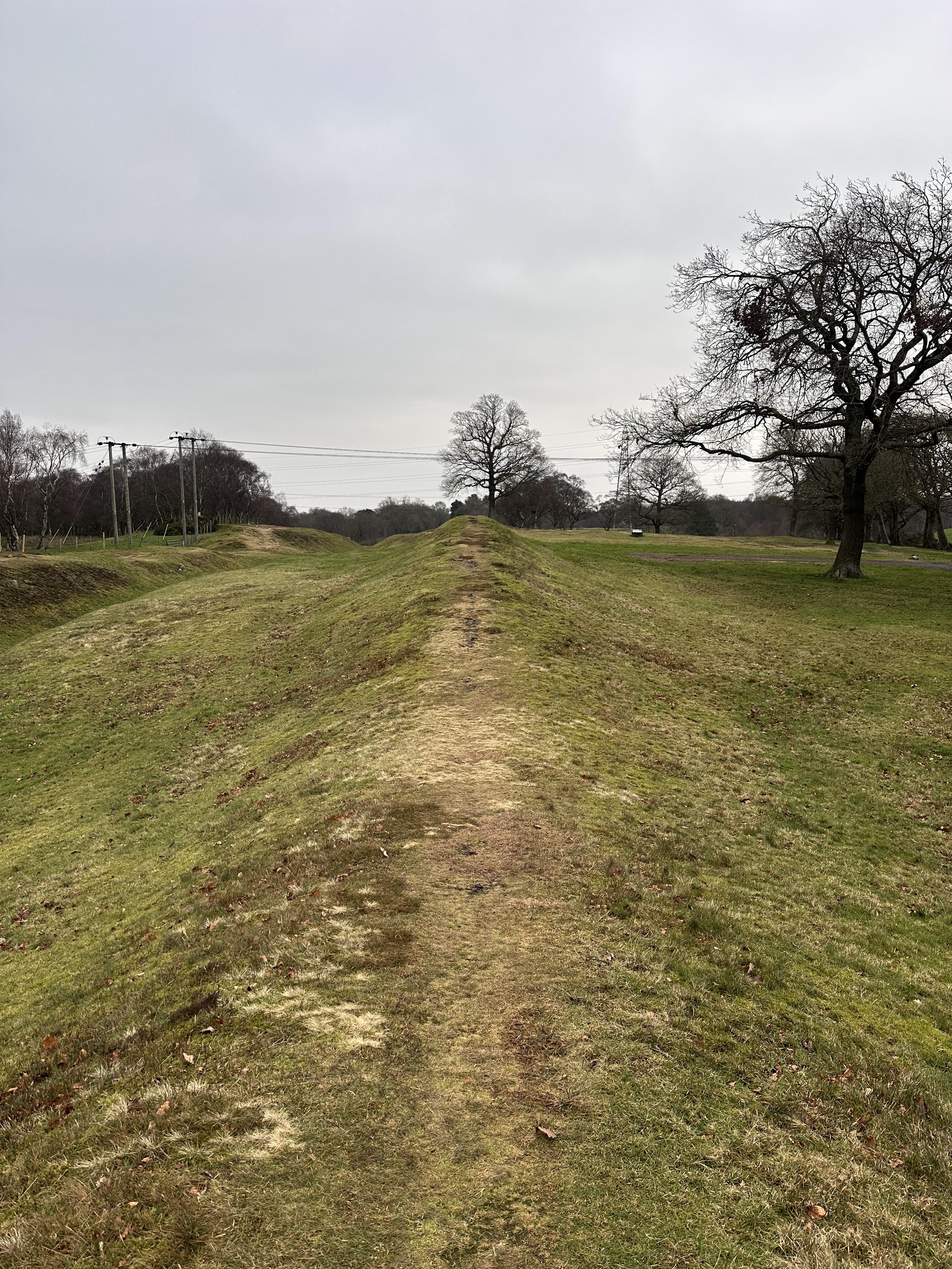
What most sticks in my mind are the lilia, the defensive pit traps on the outside of the wall (seen in the first picture). The last picture shows the line of the Antonine Wall, which was only ever a turf wall with the deep ditch on the left.

It made me a little sad that I was alone there at what is a very impressive Roman site, apart from some dog walkers who seemed oblivious to what was beneath their feet, and a cold and bitter rain that refused to leave my side.

#RoughCastle #AntonineWall #RomanFort #RomanScotland #RomanBritain #Archaeology

The photograph shows a series of oval shaped depressions in a field of grass and moss, with bare trees in the background. 

These are the rather beautiful but chilling “lilia” outside the northern edge of the Roman fort at Rough Castle in central Scotland. These pits were a defensive measure, each one fitted with a sharpened stake, pointed upright and hidden among brushwood.A photograph showing, on the right, the line of the Antonine Wall at Rough Castle, with the defensive ditch in the middle of image stretching into the distance. At the time the fort was active (in the decades after AD 140) the wall would have been much higher and the ditch much deeper.An image showing part of the defensive ramparts around Rough Castle Roman fort in central Scotland. There are ditches and high banks of grass covered earth. In the foreground, water lies in a depression at the foot of one of the ditches. Bare trees can be seen around the edges of the photograph.An image showing the line of the Antonine Wall looking towards the site of Rough Castle Roman fort in central Scotland. The wall was a turf wall and would have been much higher 1900 years ago. The defensive ditch can just be seen on the left of the photograph.
Fiore Di Lunafiore_di_luna_75
2026-01-23

CASTLE - Cardiff Castle is right in the heart of the city and has a history that goes back nearly 2,000 years. Over time, it's been a Roman fort, a Norman stronghold, and even a Victorian fairy-tale castle. The original motte and castle yard were built in the late 11th century by the Normans on top of a Roman fort from the 3rd century. Archaeological digs show that the Romans set up the first fort around 55 AD.

CASTLE - Cardiff Castle is right in the heart of the city and has a history that goes back nearly 2,000 years. Over time, it's been a Roman fort, a Norman stronghold, and even a Victorian fairy-tale castle. The original motte and castle yard were built in the late 11th century by the Normans on top of a Roman fort from the 3rd century. Archaeological digs show that the Romans set up the first fort around 55 AD. CASTLE - Cardiff Castle is right in the heart of the city and has a history that goes back nearly 2,000 years. Over time, it's been a Roman fort, a Norman stronghold, and even a Victorian fairy-tale castle. The original motte and castle yard were built in the late 11th century by the Normans on top of a Roman fort from the 3rd century. Archaeological digs show that the Romans set up the first fort around 55 AD. CASTLE - Cardiff Castle is right in the heart of the city and has a history that goes back nearly 2,000 years. Over time, it's been a Roman fort, a Norman stronghold, and even a Victorian fairy-tale castle. The original motte and castle yard were built in the late 11th century by the Normans on top of a Roman fort from the 3rd century. Archaeological digs show that the Romans set up the first fort around 55 AD. CASTLE - Cardiff Castle is right in the heart of the city and has a history that goes back nearly 2,000 years. Over time, it's been a Roman fort, a Norman stronghold, and even a Victorian fairy-tale castle. The original motte and castle yard were built in the late 11th century by the Normans on top of a Roman fort from the 3rd century. Archaeological digs show that the Romans set up the first fort around 55 AD.
damian entwistleukdamo@mastodon.org.uk
2025-06-11

Today's Flickr photo with the most hits: Housesteads Fort, and a section of Hadrian's Wall.

#HadriansWall #Housesteads #RomanFort #archaeology

foundations or Roman barracks, a section of Hadrian's Wall, copse, horizon
Archaeology News :verified:archaeology@mstdn.social
2025-04-25

First Roman bridgehead fort discovered in Austria solves ‘Deserted Castle’ mystery

Archaeologists have found the first confirmed Roman bridgehead fort ever discovered in Austria, positioned in the Danube floodplains near the site named “Ödes Schloss” close to Stopfenreuth in Lower Austria...

More information: archaeologymag.com/2025/04/fir

Follow @archaeology

#archaeology #archeology #archaeologynews #romanempire #desertedcastle #romanfort #romanarchitecture

First Roman bridgehead fort discovered in Austria solves ‘Deserted Castle’ mystery

Archaeologists have found the first confirmed Roman bridgehead fort ever discovered in Austria, positioned in the Danube floodplains near the site named “Ödes Schloss” close to Stopfenreuth in Lower Austria. The discovery, led by researchers at the Austrian Academy of Sciences (ÖAW) and the Carnuntum Archaeological Park, reveals interesting new insights into the Roman Empire’s northern defense line and its control over trade routes such as the Amber Road.
Archaeology News :verified:archaeology@mstdn.social
2024-11-13

Unique gold artifact discovered at Roman fort in Georgia may hint at lost temple dedicated to god of war

Archaeologists have made a series of remarkable discoveries at the Roman fort of Apsaros in present-day Georgia, highlighting the site’s religious, economic, and military significance during the Roman period...

More information: archaeologymag.com/2024/11/uni

Follow @archaeology

#archaeology #archeology #archaeologynews #romangod #Jupiter #dolichenus #romanfort #romanart #romanempire

Unique gold artifact discovered at Roman fort in Georgia may hint at lost temple dedicated to god of war

Archaeologists have made a series of remarkable discoveries at the Roman fort of Apsaros in present-day Georgia, highlighting the site’s religious, economic, and military significance during the Roman period.

Among the season’s most remarkable finds was a thin gold votive plaque dedicated to Jupiter Dolichenus, an ancient Roman deity associated with war and revered by soldiers. The plaque, inscribed in Greek, reflects a unique merging of cultural elements, combining the attributes of the Roman god Jupiter, known for storm and lightning, with Dolichenus, a Near Eastern thunder deity whose cult originated in what is now southeastern Turkey...
Undiscovered ScotlandUndisScot@mastodon.scot
2024-11-06

Traces of the Roman fort at Cramond, on the south side of the Firth of Forth near Edinburgh. First built in AD140-2, the fort had a role in successive attempts by the Roman empire to extend its influence over the whole of these islands. More pics and info: undiscoveredscotland.co.uk/edi

#Scotland #RomanFort #Cramond #Edinburgh #Roman #UndiscoveredScotland

Traces of the Roman fort at Cramond. The image shows a view over a mown grassy area to a stone wall with an old church beyond it, in the upper right of the frame. Nearer to us are low stone walls, while in the foreground the grass is marked out with rectangular areas formed by flat stone outlines filled with red gravel. The scene is in sunlight.
Archaeology News :verified:archaeology@mstdn.social
2024-08-19

Newly found Roman fort in Pembrokeshire challenges Celtic-Roman peace theory

A researcher in Pembrokeshire, Wales, has uncovered a previously unknown Roman fort, challenging long-held beliefs about the relationship between the region’s indigenous Celtic tribe and the Roman invaders. The fort, concealed beneath an overgrown field, is now regarded as a find of national importance...

More information: archaeologymag.com/2024/08/new

Follow @archaeology

#archaeology #romanempire #Celtics #romanfort

Newly found Roman fort in Pembrokeshire challenges Celtic-Roman peace theory

A researcher in Pembrokeshire, Wales, has uncovered a previously unknown Roman fort, challenging long-held beliefs about the relationship between the region’s indigenous Celtic tribe and the Roman invaders. The fort, concealed beneath an overgrown field, is now regarded as a find of national importance.

This discovery is particularly significant because it overturns the previous assumption that the Celtic Demetae tribe, which inhabited the region during the Roman occupation, had peaceful relations with the Romans. Historically, it was believed that the Demetae were pro-Roman, necessitating little military presence. However, the existence of this fort, along with another discovered in Wiston near Haverfordwest in 2013, indicates that the Romans maintained a strong military presence in the area..
2024-08-02

A previously unknown #Romanfort discovered in Pembrokeshire #Wales🏴󠁧󠁢󠁷󠁬󠁳󠁿overturns assumptions that the area’s indigenous #Celtic tribe was on #peaceful terms with the #Romans.

The #site which has excited #archaeologists was #hidden until now beneath an enormous, overgrown #field. It explains why the land had been unsuccessful for #farming the farmer kept hitting #stone.

theguardian.com/uk-news/articl

Undiscovered ScotlandUndisScot@mastodon.scot
2024-05-11

Some of the ramparts of Ardoch Roman Fort, near the village of Braco in Perthshire. With as manay as six distinct lines of ditches and ramparts, it is amongst the most impressive fort remains to be found anywhere in the Roman Empire. More pics and info: undiscoveredscotland.co.uk/bra

#Scotland #ArdochRomanFort #RomanFort #Roman #Ardoch #Braco #Perthshire #UndiscoveredScotland

Some of the ramparts of Ardoch Roman Fort. The image shows a view over a rough grassy field with trees in its far side. The ground is indented with a sieres of parallel ditch features running from the bottom of the frame and into it. The pattern of the ditches is made more noticeable by snow that has collected in the hollows. The scene is cloudy.
Undiscovered ScotlandUndisScot@mastodon.scot
2024-04-29

Rough Castle Roman Fort, on one of the best preserved stretches of the Antonine Wall near Falkirk. It's a great place to appreciate what the wall was like: and, just possibly, was the origin of the story of King Arthur’s Camelot. More pics and info: undiscoveredscotland.co.uk/fal

#Scotland #RoughCastle #RomanFort #Roman #AntonineWall #Falkirk #KingArthur #UndiscoveredScotland

Rough Castle Roman Fort. The image shows a view across a valley with a narrow stream in the bottom which is crossed by a flat bridge. On the far slope are indentations caught in low sunlight coming from the right. The shape of a Roman fort can be made out. In the left middle ground is a larger ditch going away from the viewer. There are trees in the background and power lines cut across the top of the frame. The ground is frosty.
Archaeology News :verified:archaeology@mstdn.social
2024-03-22

Cold War satellite images reveal nearly 400 Roman forts

Declassified Cold War-era spy satellite images have led researchers to identify 396 previously unknown Roman forts in Syria and Iraq. The research points towards a vibrant network supporting trade and cultural exchange rather than a rigid border defense system...

More information: archaeologymag.com/2023/11/col

Follow @archaeology

#archaeology #archeology #romanempire #coldwar #romanfort

Undiscovered ScotlandUndisScot@mastodon.scot
2024-02-21

The bath house at Bar Hill Roman Fort, close to the Antonine Wall near Kilsyth and looking north over the Kelvin Valley to the Campsie Fells. The Antonine Wall was built from AD142 to 144 and marked the north-west frontier of the Roman empire. More pics and info: undiscoveredscotland.co.uk/kir

#Scotland #BarHill #RomanFort #Roman #AntonineWall #Kilsyth #UndiscoveredScotland

The bath house at Bar Hill Roman Fort. The image shows the outline on the ground of a long narrow building stretching back into the frame. The site is on a hillside that slopes down to the right and drops away in the background. There's a line of trees without leaves beyond the building and there are signs of frost on the ground where it is in shadow.
Undiscovered ScotlandUndisScot@mastodon.scot
2024-01-26

Defensive Roman pits, or lilia, protecting the Antonine Wall at Rough Castle near Falkirk. For a time this formed part of the north-west frontier of a Roman Empire that stretched all the way to the Middle East. More pics and info: undiscoveredscotland.co.uk/fal

#Scotland #Falkirk #RoughCastle #RomanFort #Roman #AntonineWall #Lilia #UndiscoveredScotland

Defensive Roman pits, or lilia, protecting the Antonine Wall at Rough Castle near Falkirk. The image shows rows of oval pits stretching away from the viewer. These are placed on a grassy slope that descends from right to left across the view. The grass and pits are frosty in sunshine. There are trees in the background.
Undiscovered ScotlandUndisScot@mastodon.scot
2023-11-06

Traces of the Roman fort at Cramond, on the south side of the Firth of Forth near Edinburgh. First built in AD140-2, the fort had a role in successive attempts by the Roman empire to extend its influence over the whole of these islands. More pics and info: undiscoveredscotland.co.uk/edi

#Scotland #RomanFort #Cramond #Edinburgh #Roman #UndiscoveredScotland

Traces of the Roman fort at Cramond. The image shows a view over a mown grassy area to a stone wall with an old church beyond it, in the upper right of the frame. Nearer to us are low stone walls, while in the foreground the grass is marked out with rectangular areas formed by flat stone outlines filled with red gravel. The scene is in sunlight.
World History Encyclopediawhencyclopedia@mstdn.social
2023-06-23
Undiscovered ScotlandUndisScot@mastodon.scot
2023-05-11

Some of the ramparts of Ardoch Roman Fort, near the village of Braco in Perthshire. With as manay as six distinct lines of ditches and ramparts, it is amongst the most impressive fort remains to be found anywhere in the Roman Empire. More pics and info: undiscoveredscotland.co.uk/bra

#Scotland #ArdochRomanFort #RomanFort #Roman #Ardoch #Braco #Perthshire #UndiscoveredScotland

Some of the ramparts of Ardoch Roman Fort. The image shows a view over a rough grassy field with trees in its far side. The ground is indented with a sieres of parallel ditch features running from the bottom of the frame and into it. The pattern of the ditches is made more noticeable by snow that has collected in the hollows. The scene is cloudy.
Undiscovered ScotlandUndisScot@mastodon.scot
2023-04-29

Rough Castle Roman Fort, on one of the best preserved stretches of the Antonine Wall near Falkirk. It's a great place to appreciate what the wall was like: and, just possibly, was the origin of the story of King Arthur’s Camelot. More pics and info: undiscoveredscotland.co.uk/fal

#Scotland #RoughCastle #RomanFort #Roman #AntonineWall #Falkirk #KingArthur #UndiscoveredScotland

Rough Castle Roman Fort. The image shows a view across a valley with a narrow stream in the bottom which is crossed by a flat bridge. On the far slope are indentations caught in low sunlight coming from the right. The shape of a Roman fort can be made out. In the left middle ground is a larger ditch going away from the viewer. There are trees in the background and power lines cut across the top of the frame. The ground is frosty.
Undiscovered ScotlandUndisScot@mastodon.scot
2023-02-21

The bath house at Bar Hill Roman Fort, close to the Antonine Wall near Kilsyth and looking north over the Kelvin Valley to the Campsie Fells. The Antonine Wall was built from AD142 to 144 and marked the NW frontier of the Roman empire. More pics and info: undiscoveredscotland.co.uk/kir

#Scotland #BarHill #RomanFort #Roman #AntonineWall #Kilsyth #UndiscoveredScotland

The bath house at Bar Hill Roman Fort. The image shows the outline on the ground of a long narrow building stretching back into the frame. The site is on a hillside that slopes down to the right and drops away in the background. There's a line of trees without leaves beyond the building and there are signs of frost on the ground where it is in shadow.
Undiscovered ScotlandUndisScot@mastodon.scot
2023-01-26

Defensive Roman pits, or lilia, protecting the Antonine Wall at Rough Castle near Falkirk. For a time this formed part of the north-west frontier of a Roman Empire that stretched all the way to the Middle East. More pics and info: undiscoveredscotland.co.uk/fal

#Scotland #Falkirk #RoughCastle #RomanFort #Roman #AntonineWall #Lilia #UndiscoveredScotland

Defensive Roman pits, or lilia, protecting the Antonine Wall at Rough Castle near Falkirk. The image shows rows of oval pits stretching away from the viewer. These are placed on a grassy slope that descends from right to left across the view. The grass and pits are frosty in sunshine. There are trees in the background.

Client Info

Server: https://mastodon.social
Version: 2025.07
Repository: https://github.com/cyevgeniy/lmst