#Solarocks

65dBnoise65dBnoise
2026-03-15

Science fiction?

It sounds like , but 's now shelved project idea envisaged a long (100 km) tether attaching to an approaching spacecraft and helping to reduce its speed as it entered the Martian atmosphere to ½ of a typical entry.

The swing, designed to be made from inexpensive readily available materials, such as Spectra, would need a heavy central body to limit disturbances, like a boulder from one of Mars' moons.
nasa.gov/mars-swing/

65dBnoise65dBnoise
2026-03-15

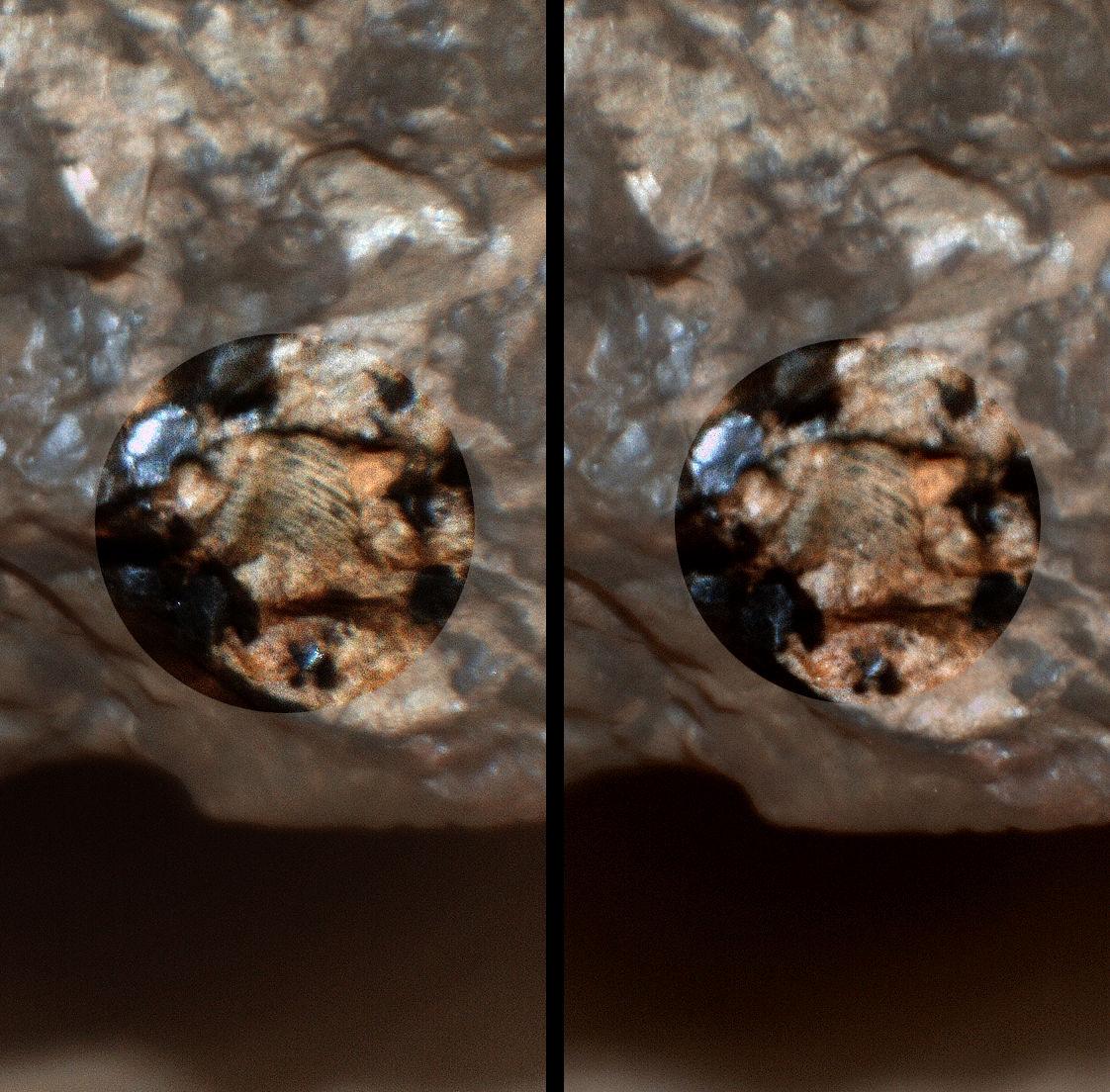
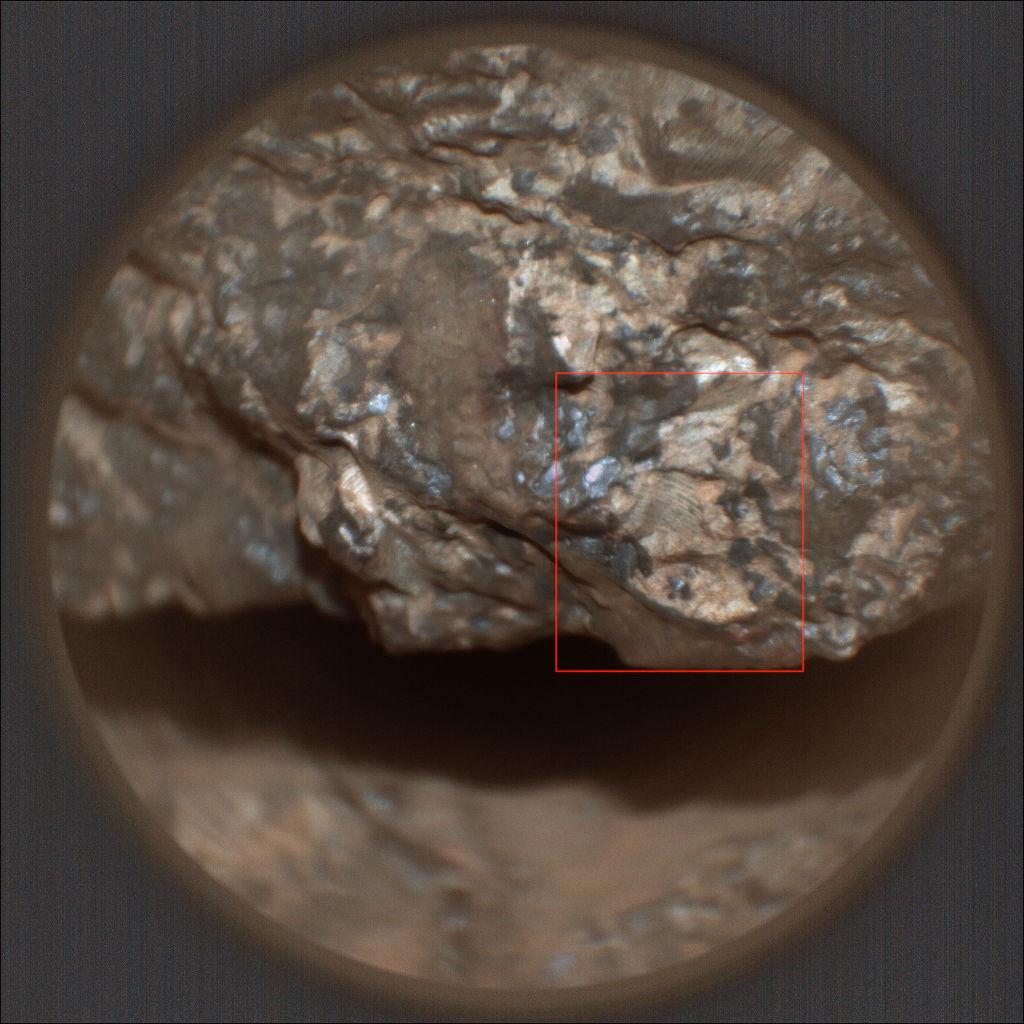
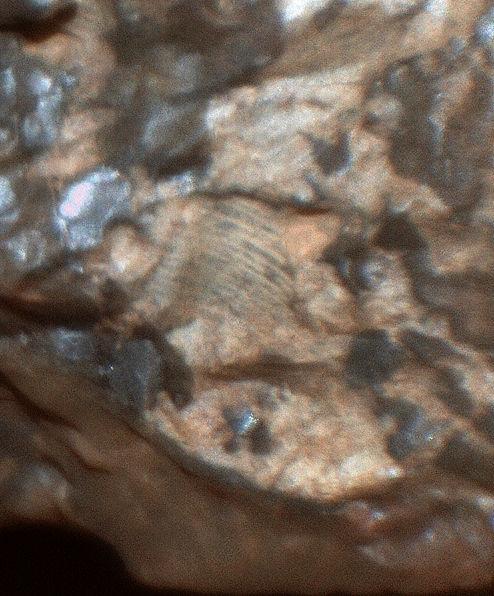
A very interesting closeup of a rock next to , showing some intriguing curved stripes. Millimeter scale.

Full frame, detail, and cross-eyed pseudo 3D images

Processed SUPERCAM_RMI
looking from RMC 87.0000
Sol 1798, LMST: 11:22:33
Original: mars.nasa.gov/mars2020-raw-ima

Credit: -Caltech /65dBnoise

65dBnoise65dBnoise
2026-03-13

The latest abrasion as seen by the WATSON instrument, at around 9 o'clock local Jezero time. Artificial light.

Notice the metallic-looking black mineral. Millimeter size.

Full size, processed SHERLOC_WATSON
looking NNE (23°) from RMC 87.0000
Sol 1798, LMST: 20:54:15
Original: mars.nasa.gov/mars2020-raw-ima

Credit: -Caltech/65dBnoise

Zeitgeisty Aphorismszeitgeisty
2026-03-13

corrects our faults that cannot correct.

Zeitgeisty Aphorismszeitgeisty
2026-03-12

A bit of leads away from but a lot brings it closer.

65dBnoise65dBnoise
2026-03-11

The Mark Of The Beast

(detail)

Processed, leveled MCZ_RIGHT, FL: 110mm
looking from RMC 87.0000
Sol 1797, LMST: 11:51:40
Original: mars.nasa.gov/mars2020-raw-ima

Credit: -Caltech /65dBnoise

65dBnoise65dBnoise
2026-03-11

The Mark Of The Beast¹

The abrasion area was enhanced to show surface details

Processed, leveled SHERLOC_WATSON
looking ENE (59°) from RMC 87.0000
Sol 1797, LMST: 10:24:45
Original: mars.nasa.gov/mars2020-raw-ima
Credit: -Caltech/65dBnoise

¹

2026-03-11

RE: social.beachcom.org/@nasa/1162

What has Curiosity been up to in the previous week inside Gale Crater on the planet Mars. Read the latest blog written by William Farrand, a Senior Research Scientist at the Space Science Institute.

#Curiosity #MSL #MarsRover #NASA #Science #Space #Exploration #Solarocks #Mars #Blog

65dBnoise65dBnoise
2026-03-10

And here is the new abrasion pit, after the dust of the abrasion was puffed off with 's the gDRT instrument. Notice that the dark spots seen on the surface are inclusions (?) extending deeper in the rock.

Processed SHERLOC_WATSON
looking NNE (23°) from RMC 87.0000
Sol 1796, LMST: 13:38:18
Original: mars.nasa.gov/mars2020-raw-ima

Credit: -Caltech/65dBnoise

65dBnoise65dBnoise
2026-03-10

The new abrasion:

Processed, undistorted, cropped NAVCAM_RIGHT mosaic
looking from RMC 87.0000
Sol 1796, LMST: 12:32:20
Original: mars.nasa.gov/mars2020-raw-ima

Credit: -Caltech/65dBnoise

65dBnoise65dBnoise
2026-03-10

Whatever its composition may be, this looks like a very interesting rock:

Processed, cropped MCZ_RIGHT, FL: 110mm
looking NNE (16°) from RMC 87.0000
Sol 1794, LMST: 10:31:25
Original: mars.nasa.gov/mars2020-raw-ima

Credit: -Caltech /65dBnoise

65dBnoise65dBnoise
2026-03-09

Detail of a rock in 's workspace observed with the SUPERCAM telescope. Bright pink areas may be saturated pixels.

Processed SUPERCAM_RMI
looking from RMC 87.0000
Sol 1795, LMST: 10:23:33
Original: mars.nasa.gov/mars2020-raw-ima

Credit: -Caltech /65dBnoise

65dBnoise65dBnoise
2026-03-08

This is how it looked through WATSON's eye, 10 minutes before the abrasion started.

Processed SHERLOC_WATSON
looking N (10°) from RMC 87.0000
Sol 1794, LMST: 11:31:37
Original: mars.nasa.gov/mars2020-raw-ima

Credit: -Caltech/65dBnoise

65dBnoise65dBnoise
2026-03-08

There have been relatively few instances where has operated on a heavily inclined rock surface. This rock appears to be interesting enough for the rover to try it once again. There appears to be an abrasion going on. Just this one image though, so far.

Processed, undistorted FRONT_HAZCAM_RIGHT_A
looking NNE (28°) from RMC 87.0000
Sol 1794, LMST: 11:43:19
Original: mars.nasa.gov/mars2020-raw-ima

Credit: -Caltech/65dBnoise

65dBnoise65dBnoise
2026-03-08

@ottaross
Yes, near-field or closeups offer good parallax for 3D. Here is another one, appearing as a canyon, but in reality of decimeter size, right inside the workspace of the rover:

Processed, undistorted, cropped FRONT_HAZCAM_RIGHT+LEFT
looking NNE (28°) from RMC 87.0000
Sol 1792, LMST: 12:22:59
Original: mars.nasa.gov/mars2020-raw-ima

Credit: -Caltech/65dBnoise

65dBnoise65dBnoise
2026-03-08

One cannot appreciate the shape of this rock in 2d.

Cross-eyed 3D

Processed, cropped MCZ_RIGHT+LEFT, FL: 110mm
looking NNE (32°) from RMC 86.0700
Sol 1792, LMST: 11:31:48
Original: mars.nasa.gov/mars2020-raw-ima

Credit: -Caltech /65dBnoise

2026-03-07

Meanwhile on Mars:
Perseverance rover completed a 15 minute drive to site 87.0 on March 5, 2026 (Sol 1792). This post-drive roughly processed image was assembled / cropped from 6 post-drive NavCam tiles. I'll add the drive details and updated location map in the comments. Image Credits: NASA/JPL-Caltech.

#Perseverance #MarsRover #M2020 #NASA #science #Space #Exploration #Solarocks #Mars #AltText

A composite image acquired by one of the mast-mounted cameras on Perseverance Rover that is exploring the planet Mars. The image looks slightly down onto the front of the Mars rover and its workspace just in front of the rover. The workspace contains a craggy and dark grey rocky outcrop. The exposed rock surfaces contain several fractures, with its near horizontal surfaces being peppered by a fine deposit of ocher coloured dust. Beyond the workspace are several other dark rocky outcrops that are surrounded by a mix of regolith (small crushed rock fragments, sand and pebbles). The view stretches to the horizon and the rolling hills that are northeast of the rover's current location, just outside Jezero crater. On the rover's dusty deck we can observe the stowed robotic arm. At the end of the arm is a turret that contains a large percussion drill, a small tank of compressed gas, as well as a number of science instruments and cameras. The rover arrived at this location after a short drive on March 5, 2026 (mission Sol 1792) it has been exploring this region for just over 5 earth years.
65dBnoise65dBnoise
2026-03-07

First time a human-made object has measurably altered the path of a celestial body around the Sun.

According to the new research, the momentum enhancement factor for DART’s impact was about two, meaning that the debris loss doubled the punch created by the spacecraft alone.

How they measured it? Stellar occultations!

Read more:
nasa.gov/missions/dart/nasas-d

65dBnoise65dBnoise
2026-03-06

We're about to witness whether those Martian rocks will stand up to the alien aggressor, as they've done in numerous other occasions, or submit to it without a fight. In any case, the challenge will show the world what they are made of.

(any resemblance to circumstances on Terra are purely coincidental 🙃)

Processed NAVCAM_RIGHT
looking NNW (342°), RMC 87.0000
Sol 1792, LMST: 12:34:58
Original: mars.nasa.gov/mars2020-raw-ima

Credit: -Caltech/65dBnoise

Simeon Schmaußstim3on@fosstodon.org
2026-03-03

RE: fosstodon.org/@stim3on/1158497

I'm delighted to see that my Mars Express VMC video is featured on today's #APOD

apod.nasa.gov/apod/ap260303.ht

#ESA #Mars #Space #solarocks

Client Info

Server: https://mastodon.social
Version: 2025.07
Repository: https://github.com/cyevgeniy/lmst