RepRap Firmware RRF 3.6.0 beta 1 has a new input shaping algorithm that can be applied to any type of move just like Klipper.
➡️ https://github.com/Duet3D/RepRapFirmware/releases/tag/3.6.0-beta.1
RepRap Firmware RRF 3.6.0 beta 1 has a new input shaping algorithm that can be applied to any type of move just like Klipper.
➡️ https://github.com/Duet3D/RepRapFirmware/releases/tag/3.6.0-beta.1
Installing firmware 5.0.0 on my #prusa #mk4 feels like I just got a new printer! The speeds allowed by the #inputshaping algorithm are crazy, shaved 1h on a 2h print, with no visible quality tradeoffs.
Good job #prusa !
So the #Prusa #Mk4 5.0.0a4 firmware supports #inputshaping. It built a benchy in just over half of the time (38m) as without input shaping (67m). But the result had significant defects.
Useful for drafts? Maybe.
I suspect #Octoprint was not a problem before but rather my lack of the 5.0.0 firmware when using a GCO sliced for input shaping.
The #loadcell is a nice feature. The exact problem my #Mk3 was recently encountering (nozzle collision with sheet) should not be possible with the #Mk4!
Cutting #octoprint out of the mix and instead printing from #PrusaLink. Looking better no. Though no #inputshaping. Reducing variables.
#Prusa #Mk4 Trying to print a #benchy using #inputshaping via #octoprint may have been a bit ambitious for a second print.
The benchy first layer, twice, came out poorly and no additional layers printed. This was undetected by the printer. The extruder kept moving.
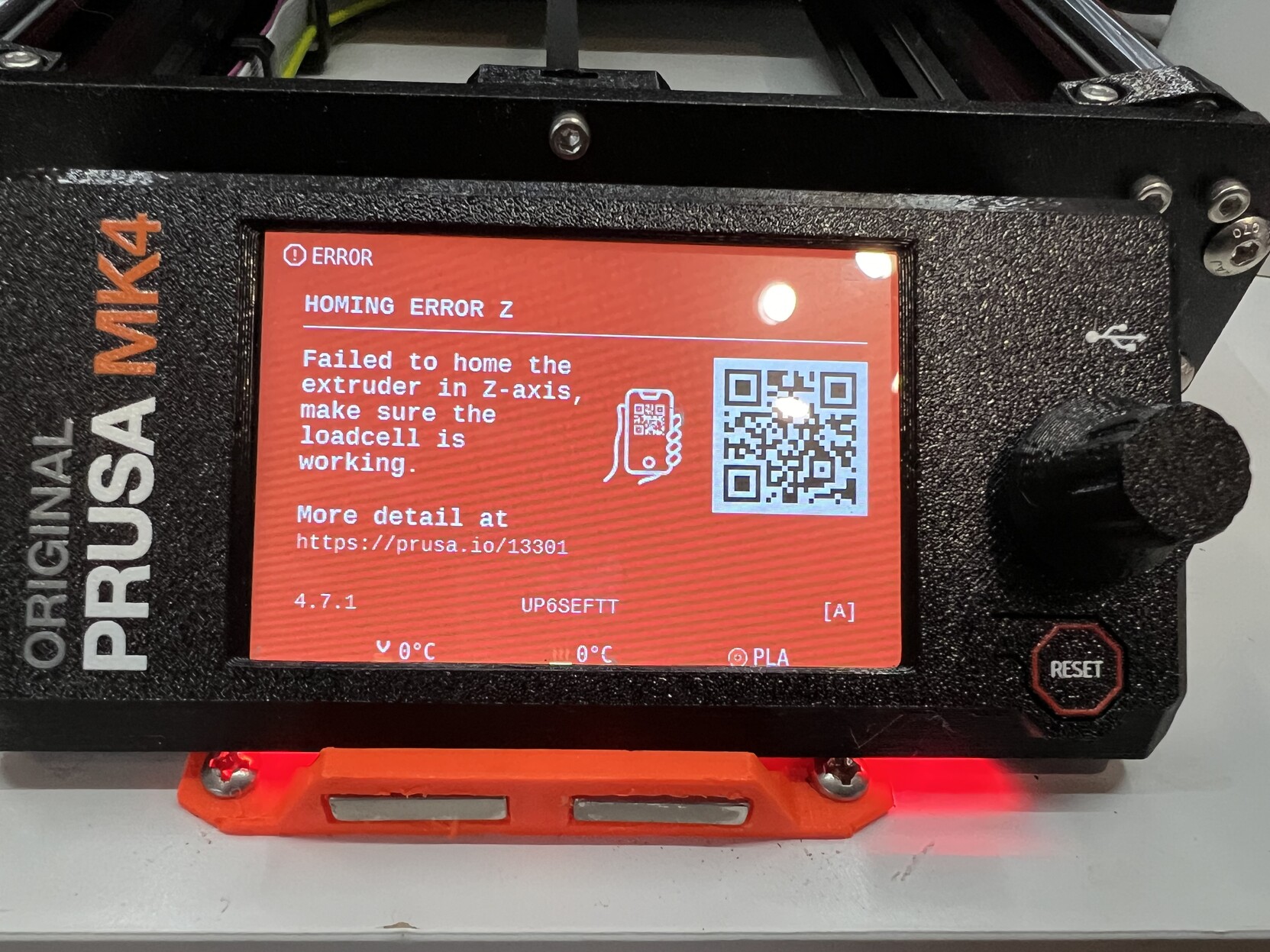
And now I'm seeing this message after 2 failed attempts.
Not great.
Marlin 2.1.2 has been released!
- #Marlin 2.1.2 introduces #InputShaping to compensate for machine vibrations by carefully timing its movement impulses.
- #InputShaping results in much cleaner output and allows for higher print speeds with no loss of quality. Although this implementation has received extensive testing, it is still considered experimental.
Chamfers and fillets were the greatest improvements that I could have made to my designs and completely changed my style.
Not only did it improve my printed and designed parts visually, but also improved strength and printability.
By removing sharp corners from your designs, slower and older printers can more easily print your designs and the printing speed can easily be increased even with the lack of #LinearAdvanced and #InputShaping.
The strength is also improved by creating a small chamfer or fillet where a thin wall connects to a larger surface, by increasing the contact surface and sometimes enlarging the surface enough to allow for extra infill.
Finally, rounded corners also result in more consistent printed results, especially when you are printing many copies of the same part, due to the decrease in possible errors and shifts that could occur on sharp corners.
It's not magic, it's maths! Well, okay, it's actually both. https://youtube.com/shorts/bzNB46Av740 #InputShaping #3Dprinting
*Reads. Looks straight forward.*
WELP. There goes this weekend. I'm already on Marlin 2.1.1 so this should be good to go, @marlinfirmware 😈 #3DPrinting #InputShaping
-
Input Shaping
https://marlinfw.org/docs/gcode/M593.html
Set the Input Shaping damping factor and/or frequency (in Hertz) for axes that support it. Use M593 with no parameters to report the current settings.