
New Video: BREAKING: Stephen Miller Claim US Formal Position "Greenland Should Be Part of the US", & then Rants https://www.youtube.com/watch?v=yP0XOeR5wlQ #BreakingNews #Greenland #NATO #Geopolitics #USPolitics #ArcticSecurity
#Arcticsecurity


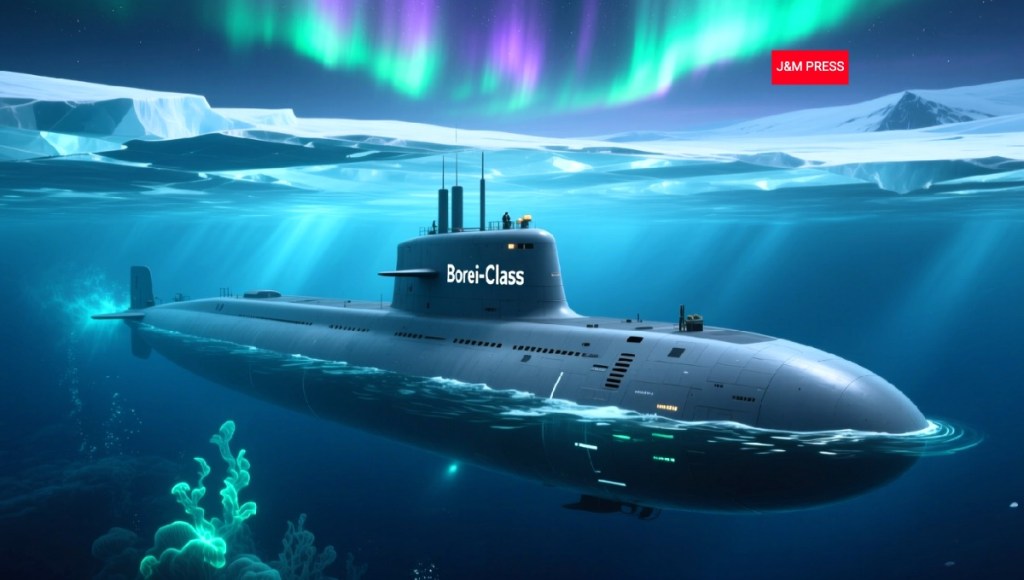
Russia’s Borei-Class Submarines: Silent Sentinels of the Arctic
2025 Updates on Nuclear Power and Arctic Strategy
The image captures a moment of quiet power in the vast, unforgiving expanse of the Barents Sea. Two sleek, black-hulled behemoths rest side by side against a stark white pier, their forms partially mirrored in the calm, steel-gray waters below. Tiny figures of personnel in orange and blue gear dot the dock, underscoring the human scale against these colossal machines. Red ensigns flutter faintly from their sails—unmistakable symbols of the Russian Navy. This is no mere photograph; it’s a snapshot of Russia’s underwater might, likely from the Northern Fleet’s base at Severomorsk, where the Borei-class submarines form the backbone of Moscow’s sea-based nuclear triad. As of October 2025, with global tensions simmering from Ukraine to the Indo-Pacific, these vessels embody a nation’s resolve to project power from the depths.
The Borei-class, known officially as Project 955 and its upgraded variant Project 955A (Borei-A), represents the pinnacle of post-Soviet submarine design. Born from the ashes of the Cold War’s ambitious shipbuilding programs, these submarines were conceived in the late 1970s but only began entering service in the 2010s after years of technical hurdles and budget constraints. The lead boat, Yuri Dolgorukiy (K-535), was laid down in 1996 at the Sevmash shipyard in Severodvinsk, a remote Arctic facility that’s been churning out nuclear subs since Stalin’s era. It wasn’t until 2013 that she was commissioned, a delay that mirrored the broader struggles of Russia’s defense industry in the chaotic 1990s.
What makes the Borei-class a game-changer? At first glance, their profile is deceptively simple: a 170-meter-long cylinder of reinforced steel, displacing 24,000 tons when submerged, with a distinctive “anvil-shaped” sail that houses the conning tower and missile tubes. But beneath the surface lies a symphony of innovation. Powered by an OK-650KPM/3 pressurized water reactor delivering 190 megawatts, these subs can achieve speeds of up to 29 knots submerged, all while remaining eerily quiet thanks to pump-jet propulsors—a technology borrowed and refined from Western designs but executed with Russian robustness. The crew of around 107 lives in relative luxury compared to their Soviet predecessors, with individual bunks, a gym, and even a small library, acknowledging the months-long patrols these vessels endure in the polar darkness.
The heart of the Borei is its offensive punch: 16 vertical launch tubes for the RSM-56 Bulava (SS-NX-32) intercontinental ballistic missiles. Each Bulava, a three-stage solid-fuel rocket, boasts a range exceeding 9,300 kilometers and can carry up to six independently targetable warheads, each with yields up to 150 kilotons—enough to level a major city. This arsenal positions the Borei as a cornerstone of Russia’s strategic nuclear forces, capable of striking targets across North America or Europe from hidden Arctic lairs. But the subs aren’t just doomsday machines; they’re versatile hunters too, equipped with six 533mm torpedo tubes for firing anti-ship missiles like the Kalibr or Oniks, as well as heavyweight torpedoes and anti-submarine rockets. In an era of hybrid warfare, this dual-role capability allows them to pivot from deterrence to direct action, as seen in simulations during the Zapad-2025 exercises.
Fast-forward to 2025, and the Borei fleet is hitting its stride. Russia has commissioned five Borei-A submarines this year alone, with the latest—the Knyaz Pozharsky—entering service in July under the watchful eye of President Vladimir Putin. This brings the total operational count to nine, with three more under construction at Sevmash. The Borei-A variant refines the original design: a slightly enlarged hull for better stability, improved sonar arrays for detecting stealthy adversaries, and enhanced automation that reduces crew fatigue on extended missions. These upgrades address early teething issues, like the Bulava’s developmental glitches, which saw multiple test failures in the 2000s. By 2025, the missile’s reliability has climbed to over 95%, making the Borei a credible second-strike platform.
The strategic calculus behind this buildup is rooted in geography and geopolitics. Russia’s Northern Fleet, based in the Kola Peninsula, controls access to the Barents and Norwegian Seas—gateways to the Atlantic. With NATO’s expansion and the U.S. Navy’s Virginia-class subs prowling these waters, Moscow views the Arctic as its “unsinkable aircraft carrier.” Climate change is melting ice caps, opening new shipping lanes and resource fields, but also exposing vulnerabilities. In September 2025, a Borei-class sub was spotted transiting near Hokkaido, Japan—a first for the class—signaling Russia’s intent to challenge U.S. dominance in the Pacific. This deployment, monitored by Japanese and American assets, underscored the submarines’ global reach, far beyond their traditional Arctic patrols.
Yet, the Borei’s rise isn’t without shadows. Sanctions imposed after the 2022 Ukraine invasion have strained supply chains, forcing reliance on domestic alternatives for high-tech components like advanced composites and electronics. Reports from 2025 indicate delays in integrating next-gen sensors, partly due to Western export controls. Moreover, the fleet’s maintenance is a logistical nightmare; these nuclear behemoths require specialized dry docks and fuel handling, concentrated in just a few Arctic yards vulnerable to sabotage or strikes. Ukrainian intelligence claims to have acquired Borei-A blueprints in August 2025, though experts dismiss their immediate utility—Ukraine lacks the industrial base to exploit them. Still, the leak highlights the espionage risks in an age of cyber and human intelligence warfare.
Comparatively, how does the Borei stack up against Western counterparts? The U.S. Ohio-class, with 24 Trident II missiles, outguns it in raw payload, but the Borei is stealthier, with a noise level akin to the newer Columbia-class under development. France’s Triomphant-class matches it in size and subtlety, but Russia’s edge lies in numbers and rapid production—Sevmash aims for one sub every 18 months by 2027. China’s Type 096, still in trials, promises similar capabilities, but lags in deployment. In simulations run by the RAND Corporation, Borei packs have proven adept at evading ASW hunts, their pump-jets minimizing cavitation noise that betrays older props.
Beyond firepower, the Borei embodies Russia’s maritime renaissance. The Northern Fleet, once a relic of Soviet glory, now boasts over 40 submarines, two-thirds nuclear-powered. Joint exercises with China in the Sea of Japan earlier this year tested Borei integration with surface groups, hinting at a budding axis against U.S. carrier strike forces. Environmentally, these subs navigate melting ice with reinforced hulls and ice-breaking sails, but their reactors pose risks—though Russian protocols claim zero incidents since the Kursk tragedy in 2000.
As 2025 draws to a close, the Borei-class isn’t just hardware; it’s a statement. In a world of hypersonic missiles and drone swarms, these silent sentinels remind us that deterrence still hinges on the unseen. The docked pair in that photograph, perhaps the Yuri Dolgorukiy and her sister Aleksandr Nevsky, await their next dive, ready to vanish into the abyss. They guard not just missiles, but the fragile peace of mutual assured destruction. Will technological parity hold, or will the next arms race submerge us all? The depths hold the answers.
References:
- https://en.wikipedia.org/wiki/Borei-class_submarine (General overview and specifications)
- https://www.navalnews.com/naval-news/2025/07/with-putins-blessing-russia-commissions-fifth-borei-a-ssbn/ (Commissioning of fifth Borei-A in July 2025)
- https://news.usni.org/2025/09/24/russian-nuclear-ballistic-missile-sub-spotted-near-japan-for-the-first-time (Deployment near Japan, September 2025)
- https://www.nti.org/analysis/articles/russia-submarine-capabilities/ (Analysis of Russian submarine capabilities, updated 2024 with 2025 projections)
- https://militarywatchmagazine.com/article/160-nukes-russian-navy-boreia-submarine (Details on Borei-A commissioning and armament)
- https://www.thebarentsobserver.com/security/all-three-northern-fleet-yasen-submarines-at-sea-as-us-carrier-group-sails-outside-northern-norway/435744 (Context on Northern Fleet operations, August 2025)
Share your thoughts in the comments, and explore more insights on our Journal and Magazine. Please consider becoming a subscriber, thank you: https://dunapress.org/subscriptions – Follow J&M Duna Press on social media. Join the Oslo Meet by connecting experiences and uniting solutions: https://oslomeet.org
#ArcticSecurity #nuclearSubmarines #RussianNavy #RussianNavy #SubmarineTech

Canada opening new consulate in Greenland this week, in a bid for closer relations https://www.cbc.ca/news/politics/canada-greenland-consulate-9.6973864 CBC by
Emma Godmere - Excellent news! I had the privilege and pleasure of visiting #Greenland this year! We went first to #Qaanaaq then to #Nuuk we definitely need to strengthen our ties to Greenland. #arcticsecurity #arctic #economic #defence

Ottawa must heed Northern voices on Arctic strategy
#IndigenousPeoples #Canada #NorthernCanada #Nunavut #NorthwestTerritories #Yukon #Arctic #Sovereignty #IndigenousRights #IndigenousLeadership #Arctic #Politics #ArcticSecurity #ArcticStrategy #The14
https://the-14.com/ottawa-must-heed-northern-voices-on-arctic-strategy/

#Canada’s stunning decision to reject Trump’s $20 BILLION submarine DEMAND. With #Germany ’s #ThyssenKrupp and #SouthKorea ’s #Hanwha in the race, #Ottawa ’s move reshapes defense, industry, and alliances. What does this mean for #USjobs, and the future of #Arcticsecurity?
youtu.be/ntdfF1WegTk?...
Canada REFUSES Trump’s $20B Su...

🇩🇰 Denmark’s top general says he’s not losing sleep over U.S. plans for Greenland — cooperation is strong, and no threat is on the radar.
Stay informed with more global defense insights: https://bluewaterhealthyliving.com/news/world-news/exclusive-danish-general-says-he-is-not-losing-sleep-over-us-plans-for-greenland/
#Greenland #Denmark #USMilitary #ArcticSecurity #NATO #GBSMedia

Space Force Commander Removed After Disputing U.S. Stance on Greenland
#SpaceForce #Greenland
#USPolitics #MilitaryNews
#arcticsecurity
https://eng.harbouchanews.com/2025/04/space-force-commander-removed-after.html

🚨 Who controls the Arctic?
The Arctic is quickly becoming the next global flashpoint. Read our full analysis: https://www.ryanjhite.com/2025/03/07/greenlands-geopolitical-crossroads-the-arctics-rising-strategic-tensions/
#Greenland #ArcticSecurity #Geopolitics #Russia #China #USMilitary

Part 2 – Europe Caught Between Two Fires
Europe thought NATO guaranteed its security. But what if the real threat isn't just Russia—but the U.S. too? Trump’s ambitions for Greenland could fracture alliances, forcing Europe to choose between submission or sovereignty.
Source: Morgenbladet, Feb 19, 2025.
My analysis on Medium:
#Geopolitics #EuropeanSecurity #EU #NATO #GlobalStability#UkraineWar
#UkraineCrisis #PeaceTalks #Russia#USForeignPolicy
#ArcticSecurity

🇩🇰 DENMARK
🔴 Arctic Security on the Agenda
🪧 Denmark agrees to discuss Arctic security with the U.S. and Greenland after FM Rasmussen’s call with Secretary Rubio.
🪧 Greenland’s PM insists the island is not for sale, affirming its independence aspirations.
TWEET:
🇩🇰 DENMARK
🔴 Arctic Security on the Agenda
🪧 Denmark agrees to discuss Arctic security with the U.S. and Greenland after FM Rasmussen’s call with Secretary Rubio.
🪧 Greenland’s PM insists the island is not for sale, affirming its independence aspirations.

What might a second Trump regime mean for the future of NATO and NORAD? And for Canada's national security? On Thursday, Bill Blair, Canada's Minister of National Defence was in the Senate for Question Period. And I decided to address the rather large elephant in the room. Here's our exchange. https://youtu.be/olBdrDS-dOE?si=B4L2ITh-TgmuIKPL #SenateofCanada #cdnpoli #NATO #NORAD #ArcticSecurity
NATO to Improve SATCOM Capabilities, Advances Next-Gen Multi-Role Rotorcraft Development
#NATO #SatelliteCommunications #ArcticSecurity #DefenseInnovation #GeopoliticalTensions #StarliftInitiative #NorthLinkProject #RotorcraftDevelopment #MilitaryTechnology

West’s coming war with Russia will be triggered by Arctic climate breakdown https://www.euractiv.com/section/arctic-agenda/opinion/wests-coming-war-with-russia-will-be-triggered-by-arctic-climate-breakdown/?utm_source=dlvr.it&utm_medium=mastodon #Arctic #ArcticAgenda #Arcticregion #Arcticsecurity #climate

NORAD intercepted Russian 🇷🇺 and Chinese 🇨🇳 bombers off the Alaskan coast! This marks the first joint operation of its kind, highlighting increasing military cooperation in the Arctic. While officials note this collaboration is still "somewhat superficial," it raises concerns. 🛩️✈️ #NORAD #Alaska #Aviation #Russia #China #ArcticSecurity #MilitaryCooperation #Defense
🔗https://www.washingtonpost.com/world/2024/07/25/norad-russian-chinese-jets-alaska/
NATO Climate Change and Security Centre of Excellence to open in Montréal: What does it mean for Canadian security?
#Montreal #Quebec #Canada #NorthernCanada #NATO #Security #Arctic #GlobalWarming #ClimateChange #ClimateSecurity #MontrealCentre #ArcticSecurity
https://the-14.com/nato-climate-change-and-security-centre-of-excellence-to-open-in-montreal-what-does-it-mean-for-canadian-security/
West’s coming war with Russia will be triggered by Arctic climate breakdown https://www.euractiv.com/section/arctic-agenda/opinion/wests-coming-war-with-russia-will-be-triggered-by-arctic-climate-breakdown/?utm_source=dlvr.it&utm_medium=mastodon #Arctic #ArcticAgenda #Arcticregion #Arcticsecurity #climate

West’s coming war with Russia will be triggered by Arctic climate breakdown https://www.euractiv.com/section/arctic-agenda/opinion/wests-coming-war-with-russia-will-be-triggered-by-arctic-climate-breakdown/?utm_source=dlvr.it&utm_medium=mastodon #Arctic #ArcticAgenda #Arcticregion #Arcticsecurity #climate

Continued militarization of the Barents Sea by Russia highlighted by the Guardian- includes concerns over future operations by China
https://www.theguardian.com/environment/2023/jul/24/russia-barents-sea-toxic-legacy-military-buildup-mining-shipping-indigenous
#climate #ArcticSecurity

Interesting that today Russia is threatening escalation of military activity in the Arctic, because of Sweden and Finland joining NATO, when that’s exactly what they’ve been doing since the early 2000’s! #russia #arcticsecurity
Client Info
Server: https://mastodon.social
Version: 2025.07
Repository: https://github.com/cyevgeniy/lmst