#ConnectedAtBirth

Alliterative/Endless KnotAllEndlessKnot@toot.community
2026-02-16
A luge is a kind of sled that slides down a track, and etymologically this may make sense. Sled and slide come from the Proto-Indo-European root *sleidh- “to slip, slide”, slide coming into English through Old English slidan and sled through Middle Low German sledde. Luge comes from the Savoy dialect of French, from Medieval Latin sludia, which may come from a Gaulish word from that same Proto-Indo-European root.
Alliterative/Endless KnotAllEndlessKnot@toot.community
2026-02-09

The #ConnectedAtBirth #etymology of the week is CURLING/GRAPE #wotd #curling #grape #grapes #Olympics #Olympics2026 🥌 🍇

What does curling have to do with grapes? Etymology! Curling gets its name from the way the stone curls on the ice, and can be traced back to the root *g(e)r- “curving, crooked”. This also produced Germanic *krappon “hook”, and from that Old French graper “catch with a hook, pick grapes”, so basically the word transferred from referring to the vine hook used for picking grapes to the grapes themselves, replacing the Old English word winberige, literally “wine berry”.
Alliterative/Endless KnotAllEndlessKnot@toot.community
2026-02-02

The #ConnectedAtBirth #etymology of the week is STRIKE/STRESS/STRAIN #wotd #strike #stress #strain

Being on strike can produce a certain amount of stress and strain, but even though this goes along with the etymological territory, ultimately it should have a very different effect. Strike used to have an almost opposite sense, “to touch softly, rub” and is related to stroke, with strike, stroke, strain, and stress all going back to *streig- “stroke, rub, press”. The more violent sense of “hit hard” didn’t appear until the 13th century, and the labour disruption sense developed in the 18th century, from the notion of downing one’s tools, particularly sailors striking the sails when they didn’t want to leave port.
Alliterative/Endless KnotAllEndlessKnot@toot.community
2026-01-26
In his speech at the World Economic Forum, Canadian Prime Minister Mark Carney eloquently pointed out that the middle powers of the world can no longer rely on hegemons like the United States and must instead seek more diversified trading alliances, since America has forsaken a rules-based world order. Hegemon, meaning “a leading power; a dominant state”, is borrowed directly from Greek hegemon “leader, commander, chief” from the verb hegeisthai “to lead” with the original sense “to track down” from Proto-Indo-European *sag-eyo- a suffixed form of the root *sag- “to seek out”, with PIE /s/ regularly becoming Greek /h/. That original /s/ was preserved in the Germanic branch with the suffixed form *sag-yo- leading to Proto-Germanic *sokjan, Old English secan or seocan “to seek”, and Modern English seek. The zero-grade form of this root *səg- also came into Old English, as sacan “to disagree, quarrel; fight; lay legal claim to; blame, accuse”, which when combined with the intensifying prefix for- “completely” formed OE forsacan “refuse; give up, relinquish; deny” and Modern English forsake.
Alliterative/Endless KnotAllEndlessKnot@toot.community
2026-01-19

I’m on strike at my university, so the #ConnectedAtBirth #etymology of the week is union/university! (For more info about the strike: linktr.ee/lufappul) #wotd #union #university #strike
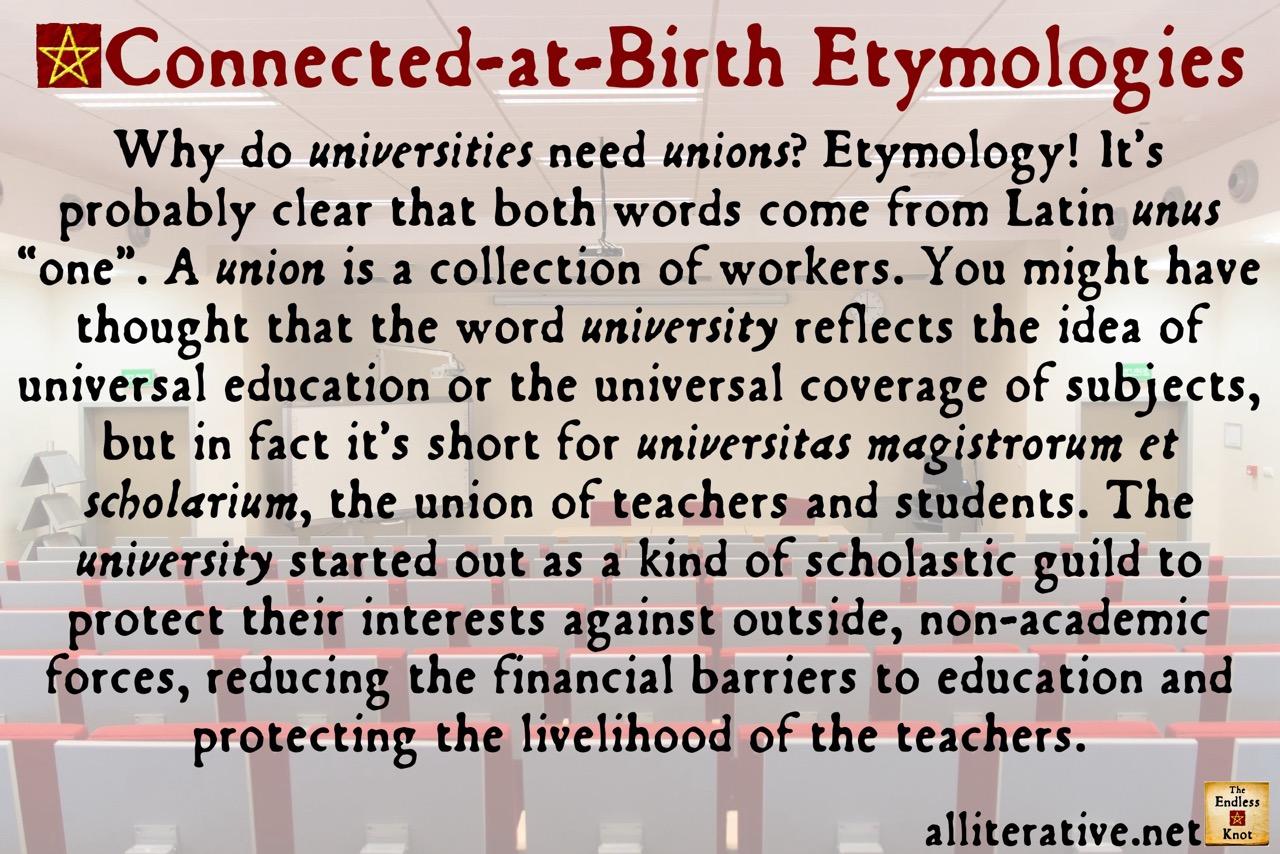
Why do universities need unions? Etymology! It’s probably clear that both words come from Latin unus “one”. A union is a collection of workers. You might have thought that the word university reflects the idea of universal education or the universal coverage of subjects, but in fact it’s short for universitas magistrorum et scholarium, the union of teachers and students. The university started out as a kind of scholastic guild to protect their interests against outside, non-academic forces, reducing the financial barriers to education and protecting the livelihood of the teachers.
Alliterative/Endless KnotAllEndlessKnot@toot.community
2026-01-12

The #ConnectedAtBirth #etymology of the week is VIRUS/WOOZY #wotd #virus #woozy

If you’re feeling woozy, you might want to check to see if you’ve caught a virus, at least that’s what the etymology suggests. The word woozy, an American English colloquialism first recorded in 1897, seems to be an alternation of oozy “muddy”. There are in fact two separate words ooze, one meaning “mud, slime” and the other “to flow, leak out slowly”, the second from the Proto-Indo-European root *wes- meaning “wet”, and the first, from which woozy seems to come, from the root *weis- meaning “to flow”, and from this root probably comes the Latin word virus meaning “poison”, which was the original sense of the English word virus in the 14th century before it developed it’s modern sense related to infectious diseases over the 18th and 19th centuries.
Alliterative/Endless KnotAllEndlessKnot@toot.community
2026-01-05
January 6th is Twelfth Night, a day when many people take the ornaments off their Christmas tree and store them in an orderly fashion for next year, and etymologically this only makes sense. Ornament comes from Latin ornare “adorn” which comes from the Proto-Italic root *ord- “to arrange”, which also leads to Latin ordo “arrangement” and English order.
Alliterative/Endless KnotAllEndlessKnot@toot.community
2025-12-01
Many people are enjoying their chocolate-filled Advent calendars right now, but of course those who are diabetic have to make sure they don’t eat too many sugary treats. Advent, the period preceding Christmas, in reference to the “coming” of Christ, first appeared in English as aduent in late Old English, coming from Latin adventus “a coming, approach, arrival”, with specific reference in Church Latin to “the coming of the Savior”, and is the past participle of the Latin verb advenire “to arrive at, come to”, made up from ad “to, toward” (from Proto-Indo-European *ad- “to, near, at”) + venire “to come”, from *gw(e)m-yo-, a suffixed variant form of the PIE root *gwa- “to go, come”. PIE *gw- typically becomes v- in Latin, pronounced [w], but in Greek this consonant went a number of different ways such as b, d, or g, so *gwa- produced the Greek verb bainein “to go, walk, step”, which, when combined with the prefix dia- “through” (probably from PIE *dwo- “two”), produced the verb diabainein “to pass through” and the Late Greek noun diabetes, literally “a passer-through, siphon”. The 2nd c. CE Greek physician Aretaeus the Cappadocian first used the term diabetes to refer to the disease because of its chief symptom “excessive discharge of urine”.
Alliterative/Endless KnotAllEndlessKnot@toot.community
2025-11-24
Thanksgiving is traditionally a time to be thankful, but it should also be a time to be thoughtful of the colonialist foundation of the holiday. The words thank, thanks, and thankful come from Old English  þancian “to thank, reward”, þanc “thought, grateful though, gratitude”, and þancful “thoughtful, ingenious, clever; grateful, contented” respectively. So thank is basically the same as the word think, and thankful is basically the same as the word thoughtful, and all these words can all be traced back to the Proto-Indo-European root *tong- “to think, feel”. The sense progression here is basically from “thinking, remembering” to “remembering fondly, thinking of with gratitude”, so maybe instead of focusing on thanksgiving we should be focusing on thoughtgiving.
Alliterative/Endless KnotAllEndlessKnot@toot.community
2025-11-17
The cranberry and geranium plants aren't related botanically, but etymologically they are! The cran in cranberry comes from  low German kraan “crane” because of the resemblance of the flower’s stamen to the bird’s bill. The bird’s name comes from Proto-Indo-European *gere- “to cry hoarsely” because of its call. This led to the Greek name for the bird geranos “crane” and thence to geranium from the resemblance of the plant’s seed pod to the bird’s bill.
Alliterative/Endless KnotAllEndlessKnot@toot.community
2025-11-10
The cause of progressivism in the US won a major victory with the election of Zohran Mamdami as mayor of New York City, and etymologically that makes sense. The word mayor, borrowed from Old French maire ca. 1300 in the sense “head of a city or town government” but with the original sense “greater, superior”, comes from Latin maior, the comparative form of the adjective magnus “large, great, big, high, tall, long, broad, extensive, spacious”. Latin maior was also borrowed directly into English in its original sense of “bigger, greater, more important” as major.
Alliterative/Endless KnotAllEndlessKnot@toot.community
2025-11-03

The #ConnectedAtBirth #etymology of the week is NUCLEAR/TEST/NUT/TESTICLES #wotd #nuclear #test #nut #testicle #NuclearTesting

Trump’s plan for the US to restart testing of nuclear weapons is nuts and shows that he’s thinking with his testicles rather than his brains. Nuclear, formed from nucleus in reference to the splitting of the nucleus of the atom, comes from Latin nucleus “kernel” from nucula “little nut”, the diminutive of nux “nut”, which can be traced back to the Proto-Indo-European *knuk-, an extended zero-grade form of the root *kneu- “nut”, which also had the extended zero-grade form *knud- which produced the Proto-Germanic root *hnut- leading to Old English hnutu “nut” and Modern English nut. Since nuts were considered a special treat the plural nuts gained the sense “any source of pleasure or delight” in the 17th c., and in the 18th c. the expression be nuts on meant “be very fond of”, and by the 19th c. nuts came to mean “crazy”. The slang sense of nuts meaning “testicles” first appears by 1915.As for the word testicle itself, it comes from Latin testiculus, a diminutive of testis “testicle”, whose origin is debated, either from another Latin word testis meaning “witness” (source of the English word testify), from the notion that testicles bear witness to male virility, or it might instead be a figurative sense coming from the Latin word testa “pot, shell” — compare for instance French tête “head” which also comes from Latin testa. In Medieval Latin, testum “earthen pot” referred to an earthen vessel, also known as a cupel, in which the purity of a metal was ascertained by exposing it to high temperatures, and by analogy came the English word test by which a teacher may ascertain a student’s knowledge.
Alliterative/Endless KnotAllEndlessKnot@toot.community
2025-10-27

The #ConnectedAtBirth #etymology of the week is FRANKENSTEIN/FRANCHISE/MONSTER/MONEY #wotd #Frankenstein #franchise #monster #money

It’s spooky season, and right on cue there’s a new monster movie in the moneymaking Frankenstein franchise, and etymologically that’s appropriate. Mary Shelley named the creator of the monster Victor Frankenstein, and this German name means literally “stone of the Franks”, the Franks being one of the Germanic tribes that dates back to the middle ages, which moved into Gaul, or modern day France. It’s a common enough German name, often being used to refer to a rocky mountainous terrain, and there are a number of old fortifications in Germany named Burg Frankenstein or Castle Frankenstein. The Franks, who took their name from a type of javelin that was their preferred weapon (or it might have been the other way around), were conquerors, and so the word frank came to mean “superior” or “free” (in contrast to those they conquered who weren’t free), so when you speak frankly you’re speaking “freely” or “openly”.We can see this sense too in the Old French word franchise “freedom, exemption; right, privilege”, which came into English in the late 14th c. with the sense “a special right or privilege (by grant of a sovereign or government)”, later developing into “right to buy or sell” and “right to exclude others from buying or selling, a monopoly” and in the 20th c. “authorization by a company to sell its products or services” and by extension “a series of related works (such as novels or films) each of which includes the same characters or different characters that are understood to exist and interact in the same fictional universe with characters from the other works”. Monster comes from Latin monstrum, which could refer to a “monster” or something with an abnormal shape, but really had the more general sense of “omen” or “portent”, since such abnormalities were taken as a sign, usually bad, of what was to come. The word comes from the verb monere “to remind, admonish, warn, instruct”, so literally a monster is a “warning”, and because of a particular incident in ancient Rome when the sacred geese around the temple of the goddess Juno honked loudly warning the Romans of a surprise nighttime attack by the Gauls, a Celtic tribe, she was given the epithet Juno Moneta from that same word monere, which was transfered to the contents of that temple, which was where coins were struck and stored, passing through Old French to give us the English word money.
Alliterative/Endless KnotAllEndlessKnot@toot.community
2025-10-20

The #ConnectedAtBirth #etymology of the week is CEASEFIRE/SUCCEED #wotd #ceasefire #succeed

Negotiators have succeeded in establishing a ceasefire, and in addition to this being a tremendous relief it’s also etymologically appropriate. Ceasefire first appeared in the 19th c., initially as a military command to stop shooting (as in sounding the ceasefire with bugles), and then as a (temporary) truce itself at the end of the First World War, developing from the verb phrase cease fire. The word cease first appeared in English around 1300, coming from Old French cesser “to come to an end, stop, cease; give up, desist”, from Latin cessare “to be remiss, delay, loiter, cease from, stop, give over”, the frequentative form of cedere “to go, to go from, to yield, withdraw, depart, retire, yield”, ultimately traceable back to the Proto-Indo-European root *ked- “to go, yield”. Latin cedere was also combined with sub “under, below, beneath, underneath, behind” which as a prefix could have the meaning “next to, after, in addition to”, producing succedere “to go below, come under, enter; to follow, follow after, succeed”, which passed into Old French as succeder “to follow on”, and coming into English in the 14th c. initially with the sense “to come next after and take the place of”, as in “succeeding to a position of rule or an estate”, and then by the 15th c. developing its modern sense of “to turn out well, arrive at a happy issue, have a favourable result, terminate according to desire” as a shortening of the phrase to succeed well.And of course for a lasting peace, diplomacy is always necessary, a word also from this same PIE root, from the prefixed and suffixed form *ne-ked-ti- “(there is) no drawing back”, which became Latin necesse “inevitable, unavoidable” before passing through Old French into English.
Alliterative/Endless KnotAllEndlessKnot@toot.community
2025-10-06
No one loves a furlough of government workers, but hopefully it won’t last a livelong time. Furlough, the temporary layoff of workers, originally meant a “leave of absence”, with the first element related to the English intensifying or negating prefix for- meaning “away, opposite, completely” and the second element related to the English noun leave meaning “permission” (from Old English leaf “permission” and not at all related to the verb leave meaning “to go away, cause to remain”). It was borrowed into English in the 1620s from Dutch verlof meaning literally “permission” from Middle Dutch ver- “completely, for” + lof “permission”, which comes from Proto-Germanic *laubo, ultimately traceable back to *loubh- the o-grade form of Proto-Indo-European *leubh- “to care, desire, love” from the notion of “pleasure, approval”. The zero-grade form of this root *lubh- in the suffixed form *lubh-a- came into Germanic as *lubo which became Old English lufu “love” and Modern English love.As for the somewhat old fashioned word livelong meaning “very long” most often seen in the phrase livelong day, the first element is completely unrelated to the word live, but in fact comes from the PIE root *leubh-, specifically the suffixed form *leubh-o-, which came into Germanic as *leubaz, becoming Old English leof “dear, beloved”, which not only gave us the now archaic word lief “dearly, gladly, willingly”, but was also used as an emotional intensifier with the word long in Middle English to give us livelong literally “dear long”.

Client Info

Server: https://mastodon.social
Version: 2025.07
Repository: https://github.com/cyevgeniy/lmst