
graduand: a rare, but useful, word
#etymology


Aquí os presento la madriguera del conejo donde me encuentro. Llegué a la página en Wiktionary de la palabra en francés “geôle” /ʒol/ (cárcel). Veo que el “ge” significa que la pronunciación /ʒ/ se conserva, pero la presencia del circunflejo impide que la palabra se pronuncie /ʒeol/. En lugar de su función principal (sustituir a una “s” que existía antaño después de una vocal, por ejemplo “maistre” → “maître”), aquí actúa como el inverso de la diéresis (lo que hace que dos vocales se pronuncien separadas y no como un diptongo).
En inglés, desde la palabra “geôle” tenemos las palabras “gaol”/“jail”. Descubrí que, debido a sus orígenes del latín, todas son cognadas con “cage”. Y ahora la conexión con el español: también existe un cognado, “jaula”, que en sí significa “cage”! Así me he liado en una sopa de etimología de la que estoy gozando tanto.
#lingüística #etimología #linguistics #etymology #linguistique #étymologie
stochastic terrorism

The #ConnectedAtBirth #etymology of the week is HEGEMON/SEEK/FORSAKEN #wotd #hegemon #seek #forsaken #MarkCarney #WEF #cndpoli

cardigan / raglan /balaclava
Theirs not to make reply,
Theirs not to reason why,
Theirs but to sew and dye
https://www.wordorigins.org/big-list-entries/cardigan-raglan-balaclava


#TIL The word ‘outrage’ consists of neither ‘out’ nor ‘rage’.
Instead, it comes from an Old French word for “excess” stemming from a combination of Latin ‘ultrā’ and a suffix that became ‘-age’.
(via @yvanspijk) #Etymology

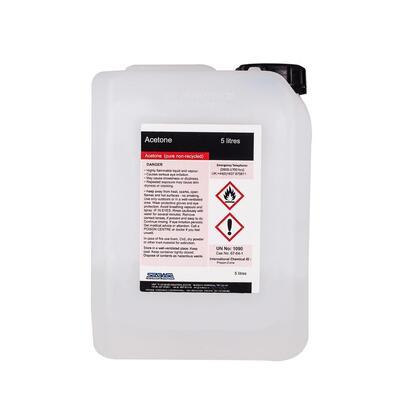

No. 25 in my photo collection of signs of unique Spanish-language business names ending in –ería: BIZCOCHERÍA
The Spanish word "bizcocho" means slightly different things in different Spanish-speaking regions, but essentially it is a type of cake. In Spain, a bizcocho is a sponge cake, but in Latin American countries, it can be a type of cake, pastry, croissant, or cookie with a wide range of flavors and forms. In any case, a "bizcochería" is a shop that makes/sells bizcochos.
June 2023 | Mexico City, Mexico
#spanish #language #signs #streetphotography #urbanexploration #urbanwalking #graphicdesign #etymology
The Spanish word "bizcocho" means slightly different things in different Spanish-speaking regions, but essentially it is a type of cake. In Spain, a bizcocho is a sponge cake, but in Latin American countries, it can be a type of cake, pastry, croissant, or cookie with a wide range of flavors and forms. In any case, a "bizcochería" is a shop that makes/sells bizcochos.
June 2023 | Mexico City, Mexico
#spanish #language #signs #streetphotography #urbanexploration #urbanwalking #graphicdesign #etymology

raccoon / trash panda


The words "ossifrage" and "saxifrage" mean, respectively, "bone breaker" and "stone breaker". Can you guess which is an animal and which is a plant?
The only other word I can find in English that ends in "-frage" is "suffrage" (and variations thereof), and its origin is unclear.

Have discovered that Italians don't know the word “conducive”. I thought this was odd seeing as it resembles the Italian verb condurre (lead, conduct (and more!)) and derives from the #Latin conducere meaning to lead or bring together, contribute, serve. #etymology #italian #English
https://wordorigins-org.ghost.io/domestic-terrorism-terrorist/
A little etymology for today, from Dave Wilton
domestic terrorism/terrorist
https://wordorigins-org.ghost.io/domestic-terrorism-terrorist/


📖 New Research Entry
"The York Minster Echo: Resonance in the Speaking Tubes"
Trapped between the Department’s sedans and the Professor’s invitation into the lattice, I chose the silver horn—only to find myself spat out into the shifting corridors of the York Minster Library.
https://chronostrange.com/the-york-minster-echo-resonance-in-the-speaking-tu/
#ChronoStrange #Mystery #HistoricalMystery #Etymology #TimeTravel
The surprisingly connected origins of "cable", "heave", and "heavy".
#etymology #wordnerd #linguistics #HistoricalLinguistics #language #words #lingcomm #cable #heave #heavy

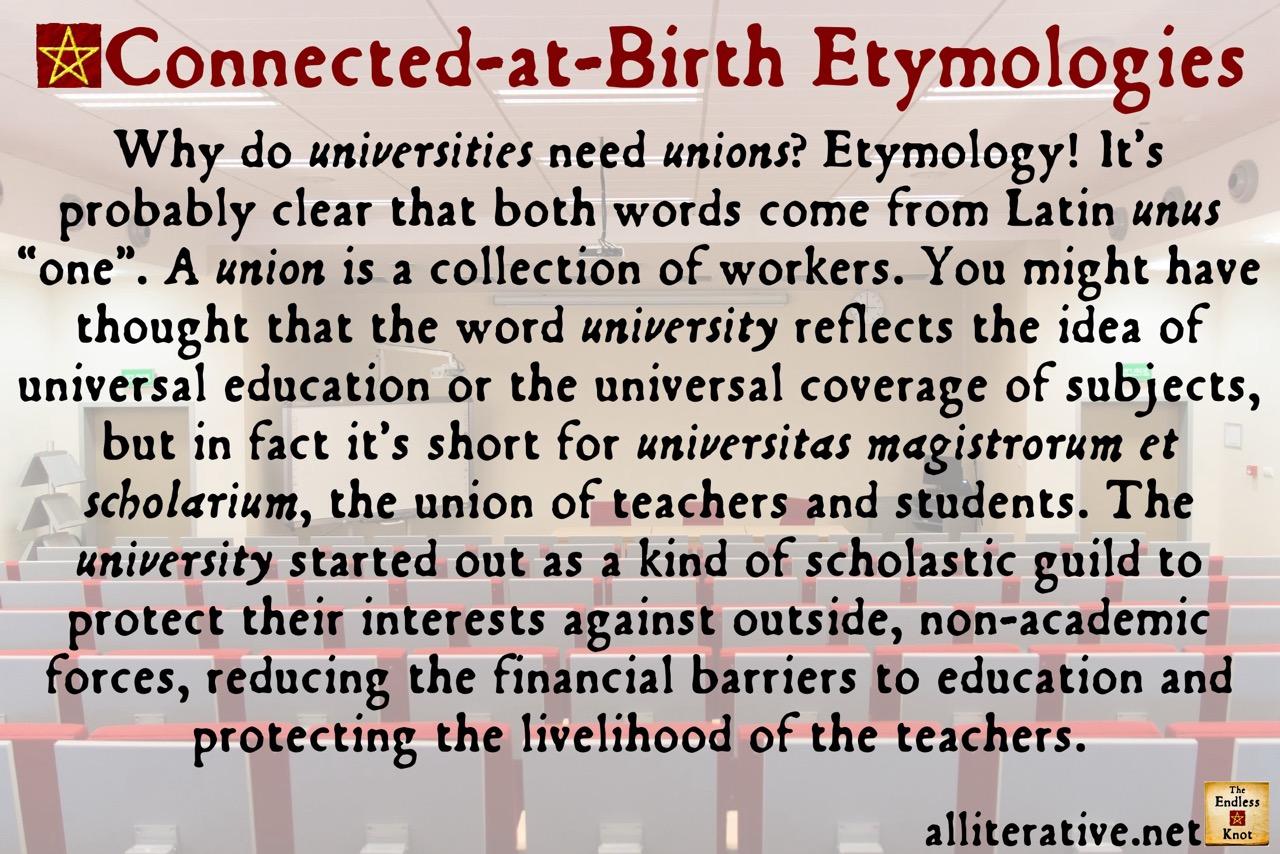
I’m on strike at my university, so the #ConnectedAtBirth #etymology of the week is union/university! (For more info about the strike: linktr.ee/lufappul) #wotd #union #university #strike

C'est du Tiktok mais du TikTok cool. Ici on apprend l'étymologie du mot "average" an anglais (qui est cousin de notre "avarie" français).
Quel est le lien entre ce mot qui veut dire "moyen" et les catastrophes maritimes en Méditerranée?
https://www.tiktok.com/@human.1011/video/7573006258664393998


Not so silent sunday followup for my #curiousity
If there are word nerds that find themselves reading this - in the description of the photo I started to write "flotsam and jetsam" as a phrase for stirred up sediment. I spelled "flotsam" wrong - and in the correction learned that both have a specific maritime meaning.
I don't know whether my use is a Jasonism - or there are others - actual writers - that have used "flotsam and jetsam" as a more loquacious version of sediment. #etymology
Client Info
Server: https://mastodon.social
Version: 2025.07
Repository: https://github.com/cyevgeniy/lmst