In 1913 on #ThisDayInHistory, textile workers in #Rochester, NY, went on #strike for an #EightHourDay, a wage increase, and #union recognition. #IdaBreiman was shot dead by the owner of a tailor shop she was picketing. The strike ended in April with only union recognition gained.
#EightHourDay

Today in Labor History January 22, 1890: The Knights of Labor Trade Assembly No. 135 and the National Progressive Miners Union merged to form the United Mine Workers of America. Their initial goals were improved mine safety, independence from company stores, and collective bargaining. In 1898, they won the 8-hour day. By the 1930s, the UMW had over 800,000 members. However, their history was filled with bloody strikes. On April 3, 1891, deputized members of the National Guard killed at least 10 striking UMW members in the Morewood massacre. The cops killed 19 striking UMW members in the Lattimer Massacre, September 10, 1897. Eight UMW members and five private detectives died in the Battle of Virden, in October 1898.
#workingclass #LaborHistory #KnightsOfLabor #union #UnitedMineWorkers #umw #strike #massacre #mining #eighthourday #workplacesafety #police

The #LimaGeneralStrike began on #ThisDayInHistory in 1919, when thousands of workers walked out demanding the #EightHourDay. They were joined by university students, and persisted despite #torture used against #anarchist #union organizers. The government gave in after three days.
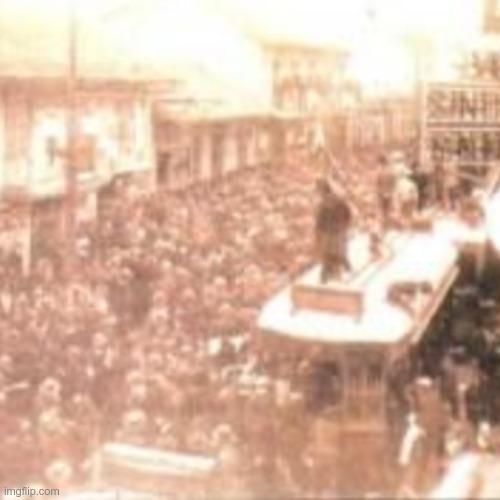
Today in Labor History December 10, 1865: August Spies, anarchist labor organizer and Haymarket martyr was born. As he was led to the gallows (1887), he shouted, "The day will come when our silence will be more powerful than the voices you are throttling today." In 1883, he was a leader in the Revolutionary Congress, in Pittsburgh, that launched the International Working People's Association in America.
On May 1, 1886, 350,000 workers went on strike across the U.S. to demand the eight-hour workday. In Chicago, Albert and Lucy Parsons led a peaceful demonstration of 80,000 people down Michigan Avenue. It was the world’s first May Day/International Workers’ Day demonstration—an event that has been celebrated ever since, by nearly every country in the world, except for the U.S. Two days later, August Spies, addressed striking workers at the McCormick Reaper factory. Chicago Police and Pinkertons attacked the crowd, killing at least one person. On May 4, anarchists organized a demonstration at Haymarket Square to protest that police violence. The police ordered the protesters to disperse. Somebody threw a bomb, which killed at least one cop. The police opened fire, killing another seven workers. Six police also died, likely from “friendly fire” by other cops. The authorities went on a witch hunt, rounding up most of the city’s leading anarchists and radical labor leaders, including Albert Parsons and August Spies. They executed four of them in 1887, including Parsons and Spies.
Read more about the Haymarket affair here: https://michaeldunnauthor.com/2024/03/24/lucy-parsons/
#workingclass #LaborHistory #anarchism #AugustSpies #haymarket #EightHourDay #execution #deathpenalty #prison #Revolution

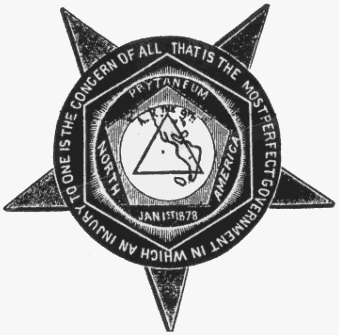
Today in Labor History December 9, 1869: The Knights of Labor was founded in Philadelphia as a secret society open to all members of the working class. They specifically barred bankers, land speculators, lawyers, liquor dealers and gamblers from membership in their union. The Knights were one of the most important labor organizations of the late 1800s, reaching a membership of 700,000 by 1886. One of their first early successes was their strike against J. Gould’s Wabash Railroad. In addition to walking off the job, they occupied company buildings and sabotaged the tracks and equipment. While other unions were fighting for a 10-hour work day, the Knights were demanding an 8-hour day, as well as an end to child and convict labor. They were also one of the earliest labor organizations to accept blacks and women, and one of the first organized by industry, rather than craft. 50 African American sugarcane workers, organized by the Knights, were murdered by white scabs in the 1887 Thibodaux massacre. Their motto was “An Injury to One is the Concern of All.” Yet they also supported the Chinese Exclusion Act and participated in anti-Chinese riots, including one in Tacoma, Washington (1885) in which they expelled all the Chinese from town (at the time, 10% of the city’s population), as well as the Rock Springs massacre, in Wyoming (1885), which killed scores of Chinese. Support for the Knights quickly waned following the repression in the wake of the Haymarket Affair.
The KOL attracted and spawned many radicals, including Daniel DeLeon. He went on to cofound the IWW and the Socialist Labor Party. Two of the Haymarket martyrs were also KOL members. The KOL also denounced strikes. However, like its more radical cousin, the IWW, it called for the abolition of the wage system. And like the IWW, fought to organize all workers into one big union, including women and immigrants. In 1890, they merged with another union to form the United Mine Workers.
#workingclass #LaborHistory #union #strike #knightsoflabor #racism #Riot #AntiAsianHate #haymarket #eighthourday #IWW
Today in Labor History December 6, 1889: The trial of the Chicago Haymarket anarchists began amidst national and international outrage and protest. None of the men on trial had even been at Haymarket Square when the bomb was set off. They were on trial because of their anarchist political affiliations and their labor organizing for the 8-hour work-day. 4 were ultimately executed, including Albert Parsons, husband of future IWW founding member Lucy Parsons. One, Louis Ling, cheated the hangman by committing suicide in his cell. The Haymarket Affairs is considered the origin of International Workers Day, May 1st, celebrated in virtually every country in the world, except for the U.S., where the atrocity occurred. Historically, it was also considered the culmination of the Great Upheaval, a series of strike waves and labor unrest that began in Martinsburg, West Virginia, 1877, and spread throughout the U.S., including the Saint Louis Commune, when communists took over and controlled the city for several days. Over 100 workers were killed across the U.S. in the weeks of strikes and protests. Communists and anarchists also organized strikes in Chicago, where police killed 20 men and boys. Albert and Lucy Parsons participated and were influenced by these events. I write about this historical period in my Great Upheaval Trilogy.
The first book in this series, Anywhere But Schuylkill, is available from Historium Press. Check it out here: https://www.thehistoricalfictioncompany.com/hp-authors/michael-dunn.
Or send $25 via Venmo (@Michael-Dunn-565) and your mailing address, and I will send you a signed copy!
You read my full article about Lucy Parsons and the Haymarket Affair here: https://michaeldunnauthor.com/2024/03/24/lucy-parsons/
And my full article about the Great Upheaval here: https://michaeldunnauthor.com/2024/03/31/the-great-upheaval/
#workingclass #LaborHistory #haymarket #anarchism #IWW #strike #union #solidarity #riot #police #policebrutality #chicago #EightHourDay #greatupheaval #AnywhereButSchuylkill #historicalfiction #hisfic #books #novel #author #writer @bookstadon

Today in Labor History November 10, 1887: Chicago Haymarket martyr Louis Lingg, 22, “cheated” the state the day before his scheduled execution by committing suicide in his prison cell. He exploded a dynamite cap in his mouth. It took him 6 painful hours to die. Using his own blood, he wrote "Hoch die anarchie!" (Hurrah for anarchy!) on the stones of his cell. In 1893, Illinois Governor John Altgeld granted Lingg a posthumous pardon because he, and his 7 codefendants were actually all innocent of the Haymarket bombing. None of them had even been present at Haymarket square when the bomb was thrown. All 8 were, however, anarchists, and were railroaded because of the political beliefs and affiliations.
On May 1, 1886, 350,000 workers went on strike across the U.S. to demand the eight-hour workday. It was the world’s first May Day/International Workers’ Day demonstration—an event that has been celebrated ever since, by nearly every country in the world, except for the U.S. Two days later, another anarchist, August Spies, addressed striking workers at the McCormick Reaper factory. Chicago Police and Pinkertons attacked the crowd, killing at least one person. On May 4, anarchists organized a demonstration at Haymarket Square to protest that police violence. The police ordered the protesters to disperse. Somebody threw a bomb, which killed at least one cop. The police opened fire, killing another seven workers. Six police also died, likely from “friendly fire” by other cops. The authorities, in their outrage, went on a witch hunt, rounding up most of the city’s leading anarchists and radical labor leaders, including Albert Parsons, Louis Lingg and August Spies.
Read my article on Lucy Parsons and the Haymarket affair here: https://michaeldunnauthor.com/2024/03/24/lucy-parsons/
#laborhistory #WorkingClass #haymarket #anarchism #prison #deathpenalty #EightHourDay #chicago #police #policebrutality #lucyparsons #louislingg

Today in Labor History October 6, 1969: Shortly before the Days of Rage, the Weather Underground blew up a statue in Haymarket Square, Chicago commemorating the policemen who died in the Haymarket affair of 1886. It was rebuilt in 1970, only to be blown up again by the Weather Underground. After being rebuilt again, Mayor Daley posted a 24-hour armed police guard, at a cost of over $67,000 per year. But it was eventually moved to an enclosed area of Police Headquarters. The statue was erected in 1889. In 1927, on the 41st anniversary of the Haymarket affair, a streetcar jumped its tracks and crashed into the monument because the driver was "sick of seeing that policeman with his arm raised." In 1968, on the 82nd anniversary of the Haymarket affair, activists vandalized it with black paint in protest of police brutality against the antiwar movement.
On May 1, 1886, 350,000 workers went on strike across the U.S. to demand the eight-hour workday. In Chicago, anarchists Albert and Lucy Parsons led a peaceful demonstration of 80,000 people down Michigan Avenue. It was the world’s first May Day/International Workers’ Day demonstration—an event that has been celebrated ever since, by nearly every country in the world, except for the U.S. Two days later, another anarchist, August Spies, addressed striking workers at the McCormick Reaper factory. Chicago Police and Pinkertons attacked the crowd, killing at least one person. On May 4, anarchists organized a demonstration at Haymarket Square to protest that police violence. The police ordered the protesters to disperse. Somebody threw a bomb, which killed at least one cop. The police opened fire, killing another seven workers. Six police also died, likely from “friendly fire” by other cops.
The authorities went on a witch hunt, rounding up most of the city’s leading anarchists and radical labor leaders, including Albert Parsons and August Spies. The courts ultimately convicted seven anarchists of killing the cops, even though none of them were present at Haymarket Square when the bomb was thrown. They executed four of them in 1887, including Albert Parsons. After her husband’s execution, Lucy continued her radical organizing, writing, and speeches. In 1905, she cofounded the IWW, along with Mother Jones, Big Bill Haywood, Eugene Debs, James Conolly and others.
You can read my more about the Haymarket anarchists, Lucy Parsons, and the fight for the 8-hour day here: https://michaeldunnauthor.com/2024/03/24/lucy-parsons/
Read more about the Pinkertons here: https://michaeldunnauthor.com/2024/04/04/union-busting-by-the-pinkertons/
#workingclass #LaborHistory #haymarket #anarchism #police #policebrutality #chicago #weatherunderground #eighthourday #lucyparsons #IWW #mayday #internationalworkersday
![Workers finish installing Gelert's statue of a Chicago policeman in Haymarket Square, 1889. The statue was destroyed by a bomb in 1969 and a replica now stands at the Chicago Police Headquarters. By A[dolph]. Witteman - Chicago Historical Society (ICHi-14452) http://www.encyclopedia.chicagohistory.org/pages/3774.html, Public Domain, https://commons.wikimedia.org/w/index.php?curid=3424497](https://files.mastodon.social/cache/media_attachments/files/115/327/605/965/123/869/original/f3bf626d0607ff19.jpg)
If you enjoy Labor Day, you could thank a union, like the memes suggest. But it would be historically more accurate to thank radical working-class activists and here is why. President Grover Cleveland initiated the holiday as a bone to calm the labor movement, irate over the 100 workers slaughtered in the Pullman strike of 1894. However, that strike started as a wildcat strike because the workers in Pullman, Illinois, had not yet formed a union. And when they did unionize, they affiliated with the militant American Railroad Union, led by Eugene Debs, socialist and later cofounder of the radical IWW, which struck despite a federal injunction prohibiting them from doing so (a risk that unions today refuse to take—remember the recent railroad strike?). The ARU’s militancy, solidarity and refusal to back down to federal violence led to attacks by the army, dozens of deaths, and the imprisonment of ARU leader Debs. And here is one more thing to consider: Pres. Cleveland’s commitment to the holiday had much less to do with his fear of or respect for labor, and much more to do with his desire to take the wind out of the sails of the then much more popular and radical May 1st, International Workers Day, which is currently celebrated in virtually every country in the world, except the U.S. That holiday commemorates the Haymarket anarchists who were falsely convicted and executed for their efforts fighting for the 8-hour work day and an end to child labor.
You can read more about both the Pullman Strike and the Haymarket Affair in my articles on the Pinkertons and Lucy Parsons:
https://michaeldunnauthor.com/2024/04/04/union-busting-by-the-pinkertons/
https://michaeldunnauthor.com/2024/03/24/lucy-parsons/
#laborday #LaborHistory #workingclass #strike #union #eighthourday #childlabor #haymarket #anarchism #chicago #police #IWW #mayday

Well, sort of....
Labor already had, and still has, May Day, celebrated in every country in the world except the US, commemorating the Haymarket affair and the anarchists who were wrongly convicted and executed in Chicago in the fight for the 8 hour work day.
While the 1st Labor Day parade was in 1882, a few years before the Haymarket Affair, the nationally recognized federal holiday of Labor Day (1894) was largely a bone thrown to workers by President Cleveland and congress in the wake of the bloody Pullman strike, where federal troops and cops slaughtered 70 workers. And as a way to erase the radical anarchist and socialist roots of the labor movement in the US.
#workingclass #LaborHistory #strike #anarchism #socialism #mayday #laborday #union #eighthourday #haymarket

Today in Labor History July 10, 1894: The Pullman Rail Car strike was put down by 14,000 federal and state troops. Over the course of the strike, soldiers killed 70 American Railway Union (ARU) members. Eugene Debs and many others were imprisoned during the strike for violating injunctions. Debs founded the ARU in 1893. The strike began, in May, as a wildcat strike, when George Pullman laid off employees and slashed wages, while maintaining the same high rents for his company housing in the town of Pullman, as well as the excessive rates he charged for gas and water. During the strike, Debs called for a massive boycott against all trains that carried Pullman cars. While many adjacent unions opposed the boycott, including the conservative American Federation of Labor, the boycott nonetheless affected virtually all train transport west of Detroit. Debs also called for a General Strike, which Samuel Gompers and the AFL blocked. At its height, over 200,000 railway workers walked off the job, halting dozens of lines, and workers set fire to buildings, boxcars and coal cars, and derailed locomotives. Clarence Darrow successfully defended Debs in court against conspiracy charges, arguing that it was the railways who met in secret and conspired against their opponents. However, they lost in their Supreme Court trial for violating a federal injunction.
By the 1950s, the town of Pullman had been incorporated into the city of Chicago. Debs became a socialist after the strike, running for president of the U.S. five times on the Socialist Party ticket, twice from prison. In 1905, he cofounded the radical IWW, along with Lucy Parsons, Mother Jones, Big Bill Haywood and Irish revolutionary James Connolly. In 1894, President Cleveland designated Labor Day a federal holiday, in order to detract from the more radical May 1st, which honored the Haymarket martyrs and the struggle for the 8-hour day. Legislation for the holiday was pushed through Congress six days after the Pullman strike ended, with the enthusiastic support of Gompers and the AFL.
#workingclass #LaborHistory #union #strike #eugenedebs #IWW #pullman #chicago #haymarket #EightHourDay #socialism #lucyparsons #motherjones #BigBillHaywood #revolutionary #jamesconnolly #generalstrike #boycott

Today In Labor History June 29, 1898: Michael Schwab, who was convicted for the Haymarket bombing, died from tuberculosis, after having been pardoned and released from prison just a few months prior. Schwab, who was born in Germany, was a bookbinder by trade. He emigrated to the U.S. in 1879 and wrote for the labor newspaper, “Arbeiter-Zeitung.” His brother in-law, Rudolph Schnaubelt, is believed by some to be the person who actually threw the Haymarket bomb. Schnaubelt was never tried or convicted of the crime. 8 other anarchists, none of whom were present at the bombing, were convicted of the crime. 4 were hanged. And one committed suicide in prison.
Learn more about the Haymarket Affair in my biography of Lucy Parsons: https://michaeldunnauthor.com/2024/03/24/lucy-parsons/
#workingclass #LaborHistory #haymarket #anarchism #prison #bomb #WrongfulConviction #EightHourDay
Today in Labor History June 6, 1894: Colorado’s governor sent in the state militia to support the Cripple Creek miners' strike, the only time in history that a state militia was used to help a workers’ struggle, rather than to suppress it. The mine owners were demanding a 10-hour day without an increase in pay. In response, the miners went on strike. There was considerable violence from both sides during the strike, led by the Western Federation of Miners (WFM). On March 16, some miners ambushed, shot and beat some sheriff’s deputies. The judge, a WFM member, let the miners off, but charged the deputies with carrying concealed weapons. Furious, the Sheriff arrested 20 union leaders. Meanwhile, the mine owners conspired to bring in hundreds of scabs and deputized vigilantes. When the new deputies marched on the strikers’ camp, the miners blew up several mine structures, forcing the deputies to flee. The mine owners hired hundreds more vigilantes for their army. When he heard about the size of the miner owners’ force, the governor declared the deputies illegal and sent in state troops to defend the miners.
On June 5, the day before the state troops arrived, the mine owners’ army began cutting telegraph lines and arresting reporters and hundreds of town residents. When the state troops arrived, there were already gun battles going on between the vigilante army and the miners. However, the state troops gained control of the town relatively quickly and the mine owners disbanded their army and sent them home. 300 miners were arrested, but only four were convicted. And the populist governor pardoned them all. The WFM won, keeping the 8-hour day and their $3/day wages. And, they were so popular because of their victory, that they easily organized most of the other industries in the region (e.g., waitresses, laundry workers, bartenders, newsboys) into 54 new locals.
#workingclass #LaborHistory #mining #colorado #union #strike #solidarity #militia #sabotage #police #policebrutality #acab #EightHourDay #wfm #vigilantes #cripplecreek

Today in Labor History May 14, 1771: Utopian-socialist Robert Owen was born on this day in Wales. In the early 1800s, he made a fortune in textiles. However, he tried to run his mills on higher principles than greed. One of his reforms was to offer prices at his company store that were only slightly higher than their wholesale cost. This was in marked contrast to his competitors, who paid their workers only in scrip and charged exorbitant prices at their company stores. In 1810, Owen implemented the eight-hour workday for his employees. And in 1817, he came up with the slogan, “Eight hours labor, eight hours recreation, eight hours rest.” He also provided free schools for the children of factory workers.
In 1824, he travelled to America and invested his fortune in an experimental socialistic commune at New Harmony, Indiana. It only survived for two years. However, it changed many aspects of American culture. Residents created the first public library and public school system open to both boys and girls. The town also became an important center of scientific research in the mid-1800s.
#workingclass #LaborHistory #socialism #utopia #EightHourDay #library #robertowen
Today in Labor History May 5, 1886: The Bay View Massacre occurred in Milwaukee, one day after the Haymarket bombing, in Chicago. Workers in both cities were demonstrating for the 8-hour work-day. There were approximately 1,400 strikes that year for the 8-hour day. In Milwaukee, the governor called out the state militia. They shot and killed seven protesters, including a 14-year-old boy. No militiamen were ever charged. However, the authorities convicted fifty of the strikers and sentenced them to hard labor for "rioting."
#workingclass #LaborHistory #bayview #massacre #riot #EightHourDay #union #strike #haymarket
Today in Labor History May 4, 1886: A day after police killed four striking workers and injured hundreds, protesters gathered at Haymarket Square in Chicago. As the peaceful event drew to a close, someone threw a bomb into the police line. Police responded by shooting into the crowd, killing one and wounding many. Eight anarchists were later framed even though most were not even present at the Haymarket rally and there was no evidence that linked any of them to the bombing. They tried and convicted eight anarchist leaders in a kangaroo court: August Spies, Albert Parsons, Adolph Fisher, George Engel, Louis Lingg, Michael Schwab, Samuel Felden and Oscar Neebe. Parson’s brother testified at the trial that the real bomb thrower was a Pinkerton agent provocateur. This was entirely consistent with the Pinkertons modus operandi. They used the agent provocateur, James McParland, to entrap and convict the Molly Maguires, 20 innocent Irish union activists, just a few years prior. As a result, twenty of them were hanged and the Pennsylvania mining union was crushed. McParland also tried to entrap WFM leader, Big Bill Haywood, for the murder of Idaho Governor Frank Steunenberg. Steunenberg had crushed the WFM strike in 1899, the same one in which the WFM had blown up a colliery. However, Haywood had Clarence Darrow representing him. And Darrow proved his innocence.
On November 11, 1887, they executed Spies, Parson, Fisher and Engel. They sang the Marseillaise, the revolutionary anthem, as they marched to the gallows. The authorities arrested family members who attempted to see them one last time. This included Parson’s wife, Lucy, who was also a significant anarchist organizer and orator. In 1905, she helped cofound the IWW. Moments before he died, Spies shouted, "The time will come when our silence will be more powerful than the voices you strangle today." And Engel and Fischer called out, "Hurrah for anarchism!" Parsons tried to speak, but was cut off by the trap door opening beneath him.
Workers throughout the world protested the trial, conviction and executions. Prominent people spoke out against it, including Clarence Darrow, Oscar Wilde, George Bernard Shaw, and William Morris. The Haymarket Affair inspired thousands to join the anarchist movement, including Emma Goldman. And it is the inspiration for International Workers’ Day, which is celebrated on May 1st in nearly every country in the world except the U.S.
You can read my complete bio of Lucy Parsons here: https://michaeldunnauthor.com/2024/03/24/lucy-parsons/
You can read my article on the Pinkertons here: https://michaeldunnauthor.com/2024/04/04/union-busting-by-the-pinkertons/
And my article on the Molly Maguires Here:
https://michaeldunnauthor.com/2024/04/13/the-myth-of-the-molly-maguires/
#LaborHistory #workingclass #anarchism #haymarket #execution #deathpenalty #chicago #union #solidarity #IWW #maythefourth #eighthourday #lucyparsons #bigbillhaywood #pinkertons #mollymaguires #police #strike
Today In Labor History May 1, 1886: The first nationwide General Strike for the 8-hour day occurred in Milwaukee and other U.S. cities. In Chicago, police killed four demonstrators and wounded over 200. This led to the mass meeting a Haymarket Square, where an unknown assailant threw a bomb, killing several cops. The authorities responded by rounding up all the city’s leading anarchists, and a kangaroo court which wrongfully convicted 8 of them, including Albert Parsons, husband of Lucy Parsons, who would go on to cofound the IWW, along with Mother Jones, Big Bill Haywood, Eugene Debs, and others. Worldwide protests against the convictions and executions followed. To honor the wrongfully executed anarchists, and their struggle for the 8-hour day, May first has ever since been celebrated as International Workers Day in nearly every country in the world, except the U.S.
You can read my complete bio of Lucy Parsons here: https://michaeldunnauthor.com/2024/03/24/lucy-parsons/
#workingclass #LaborHistory #anarchism #haymarket #bombing #policebrutality #police #prison #execution #deathpenalty #GeneralStrike #IWW #lucyparsons #motherjones #EightHourDay #mayday

Today In Labor History May 1, 1884: The Federation of Organized Trades and Labor Unions, forerunner of the AFL, resolved that "8 hours shall constitute a legal day's work starting May 1, 1886." Ironically, this union, created as a conservative foil against the radical Knights of Labor, helped radicalize workers with its resolution. It was this fight, for the 8-hour day, that led a few years later to the Haymarket affair, the execution of innocent anarchists, and the international celebration of May 1 as International Workers Day.
#workingclass #LaborHistory #EightHourDay #union #KnightsOfLabor #mayday #haymarket #anarchism #prison
Today in labor history April 30 1886: 50,000 workers in Chicago were on strike. 30,000 more joined in the next day. The strike halted most of Chicago’s manufacturing. On May 3rd, the Chicago cops killed four unionists. Activists organized a mass public meeting and demonstration in Haymarket Square on May 4. During the meeting, somebody threw a bomb at the cops. The explosion and subsequent gunfire killed seven cops and four civilians. Nobody ever identified the bomber. None of the killer cops was charged. However, the authorities started arresting anarchists throughout Chicago.
Ultimately, they tried and convicted eight anarchist leaders in a kangaroo court. The men were: August Spies, Albert Parsons, Adolph Fisher, George Engel, Louis Lingg, Michael Schwab, Samuel Felden and Oscar Neebe. Only two of the men were even present when the bomb was thrown. The court convicted seven of murder and sentenced them to death. Neebe was give fifteen years. Parson’s brother testified at the trial that the real bomb thrower was a Pinkerton agent provocateur. This was entirely consistent with the Pinkertons modus operandi. They used the agent provocateur, James McParland, to entrap and convict the Molly Maguires. As a result, twenty of them were hanged and the Pennsylvania mining union was crushed. McParland also tried to entrap WFM leader, Big Bill Haywood, for the murder of Idaho Governor Frank Steunenberg. Steunenberg had crushed the WFM strike in 1899, the same one in which the WFM had blown up a colliery. However, Haywood had Clarence Darrow representing him. And Darrow proved his innocence.
On November 11, 1887, they executed Spies, Parson, Fisher and Engel. They sang the Marseillaise, the revolutionary anthem, as they marched to the gallows. The authorities arrested family members who attempted to see them one last time. This included Parson’s wife, Lucy, who was also a significant anarchist organizer and orator. In 1905, she helped cofound the IWW. Moments before he died, Spies shouted, "The time will come when our silence will be more powerful than the voices you strangle today." And Engel and Fischer called out, "Hurrah for anarchism!" Parsons tried to speak, but was cut off by the trap door opening beneath him.
Workers throughout the world protested the trial, conviction and executions. Prominent people spoke out against it, including Clarence Darrow, Oscar Wilde, George Bernard Shaw, and William Morris. The Haymarket Affair inspired thousands to join the anarchist movement, including Emma Goldman. And it is the inspiration for International Workers’ Day, which is celebrated on May 1st in nearly every country in the world except the U.S.
You can read my complete bio of Lucy Parsons here: https://michaeldunnauthor.com/2024/03/24/lucy-parsons/
You can read my article on the Pinkertons here: https://michaeldunnauthor.com/2024/04/04/union-busting-by-the-pinkertons/
And my article on the Molly Maguires Here:
https://michaeldunnauthor.com/2024/04/13/the-myth-of-the-molly-maguires/
#workingclass #LaborHistory #anarchism #haymarket #lucyparsons #IWW #emmagoldman #strike #union #EightHourDay #PoliceBrutality #killercops #prison #deathpenalty #Pinkertons #police
Today in Labor History April 27, 1825: The first strike for the 10-hour workday was started by carpenters in Boston. At the time, employers often forced people to work over fourteen hours a day. Boston workers struck again in 1827. Both strikes were unsuccessful. However, in 1835, they struck again for the 10-hour workday. This time, they organized a travelling committee to expand the movement. Influenced by their comrades in Philadelphia, Irish workers on the Schuylkill River coal wharves, joined the strike. They threatened to kill anyone who crossed their lines and attempted to unload coal. These actions led to the 1835 Philadelphia General Strike, the first General Strike in America. 20,000 workers participated. And it spread quickly to other cities. By the end of 1835, the 10-hour workday had become the norm in most major U.S. cities.
#workingclass #LaborHistory #GeneralStrike #union #strike #boston #philadelphia #tenhourday #eighthourday
Client Info
Server: https://mastodon.social
Version: 2025.07
Repository: https://github.com/cyevgeniy/lmst