
Over the #earlymodern period different practices to manage conflicts and guarantee peace agreements were established that Laufs and Wenzel will introduce to us. Thus, illustrating the ingenuity but also the limits of #emdiplomacy. (6/6)
#Emdiplomacy
But diplomats did not only try to settle conflicts, they tried to prevent them! Peace treaties and truces were provided with treaty sureties that aimed at safeguarding the agreements. Negotiating these sureties could be difficult and conflictual, too. (5/6)
#emdiplomacy #EarlyModernEurope #peacemaking #peace #earlymodern
Together Laufs and Wenzel tackle the important question of conflict management. How did #emdiplomats deal with conflicts? What practices were established?
Key to #earlymodern conflict management were mediation and arbitration as practices with a long tradition going back to the Middle Ages. Here, a third party tried to mediate and help find a compromise between the conflicting parties. (4/6)
#emdiplomacy #history #EarlyModernEurope #mediation #peacemaking
Christian Wenzel works the universities of Marburg and Duisburg-Essen. He works on #peace treaties and breaches of agreements and ideas of security.
His PhD thesis on security in the debates of the French wars of religion was recently published and is also available #openaccess! (3/6)
Today we want to introduce to you one of our #emdiplomacy dream teams: Markus Laufs and Christian Wenzel!
Markus Laufs currently works at the Deutsches Historisches Museum in Berlin, where he’s part of the team that reconceptualise the permanent exhibition and is responsible for the late Middle Ages and the early modern periond. His PhDthesis on practices of mediation at #earlymodern #peacecongresses is available as #openaccess (2/6)
35 Markus Laufs/Christian Wenzel: Conflict Management in the Early Modern Period: Mediating and Safeguarding Treaties
(1/6)
https://doi.org/10.1515/9783110672008-037
@histodons #emdiplomacy #history #earlymodern

@histodons @historikerinnen @earlymodern
Pühringer highlights the need for more and comparative research on #emdiplomacy’s finances which can reveal completely new connections and networks that could help to explain other ambiguities. (8/8)
@histodons @historikerinnen @earlymodern
Often the agreed amounts were only paid out after the mission’s completion, and the travel and subsistence expenses, which were often agreed upon separately, were carefully checked and settled, and in some cases even refused.
For many #emdiplomats, debts were not uncommon at the place of assignment; especially for bourgeois representatives in lower-ranking positions, diplomatic activity could mean financial ruin. (7/8)
@histodons @historikerinnen @earlymodern
A problem, when it comes to researching the financial side of #emdiplomacy, is that the sources often are distorted as well as incomplete, because of separate budgets or because specific services were not paid for at all or in another way. Account books do not necessarily show the total expenses of a mission, but they do provide information about the daily life of the #emdiplomats. Not only the type and amount of expenses for housing, food, travel and mail are evident, but also how they were handled at court. (6/8)
@histodons @historikerinnen @earlymodern
Pühringer stresses that it has not only to be asked from which sources diplomatic missions were financed, but also whether one single mission was financed from different sources.
The finances of non-permanent missions consisted of two sides, that of the diplomat & that of the commissioner of the mission. It should be emphasised that other more elusive types of remuneration must also be considered. They were a natural part of the life of an #emdiplomat. (5/8)
@histodons @historikerinnen @earlymodern
The concept of finance in the early modern period is a very broad & the transition to gifts, bribery & corruption is rather fluid. So, we also recommend the article by Mark Häberlein on gift-giving. (4/8)
https://hcommons.social/@emdiplomacy/115360255960220982
#EarlyModernEurope #economicHistory #emdiplomacy #giftGiving
@histodons @historikerinnen @earlymodern
Surprisingly, the question of the financial side of emdiplomacy has received little attention in research apart from the trope of the poorly paid diplomat or the prince who could not send his own envoy for financial reasons. (3/8)
#emdiplomacy #earlymodern #EarlyModernEurope #history #economicHistory
@histodons @historikerinnen @earlymodern
It’s high time we introduce the next #handbook article and its author! Please welcome Andrea Pühringer who is a freelance historian based in Marburg. In her research, she focuses on social, cultural and economic history. Although she is not an expert on #emdiplomacy, she is a great addition to the @emdiplomacy crew because of her interest in economic history. In her contribution she helps to reveal one of #emdiplomacysSecrets: the connection between diplomacy and finances. (2/8)
"In this sense, the approximately 800-page handbook edited by Dorothée Goetze and Lena Oetzel can be understood as both a testimony to maturity and a synopsis of research and historiographical evaluation
of early modern diplomacy.
However, the editors' introduction makes it very clear that this is more than just a snapshot. [...] Not only are the individual chapters suitable for updating
specialised research statuses
and questions (and their literature), but they also enable, for example, comparisons to be made [...]."
@dbellingradt has written a wonderful review of the early modern diplomacy handbook aka the big pink book in the current issue of Jarhbuch für Kommunikationsgeschichte (in German):
https://biblioscout.net/book/10.25162/9783515140348#
#earlyModern #history #diplomacy #histodons #emdiplomacy #NewDiplomaticHistory #review
We have to admit that a giraffe is not exactly a common pet - but who knows...
Whether you are a diplomat or not, we would love to see pictures of our pet(s)! (4/4)
#HistoryOfDiplomacy #AnimalStudies #emdiplomacy #diplomacy #diplomat #History #histodons #pet
Did you spot the giraffe in the painting?
In fact, Giorgio Riello argues that “it was not Lorenzo’s real animal but its representation in Ghirlandaio’s fresco that kept the visual imagination of giraffes alive in Europe”.
This points us to another topic for another day: the visual representation of early modern diplomacy.
https://mhistories.hypotheses.org/?p=1788. (3/4)
#HistoryOfDiplomacy #diplomacy #emdiplomacy #AnimalStudies #ArtHistory #history #histodons
But the afterlife of the giraffe was much longer. It had been the first giraffe in Europe since the 13th century and it remained so for many centuries coming. Thus, one should not wonder that it was commemorated in literature and paintings, such as the painting by Giorgio Vasari (1556/1558).
But there are many other figurative representations of this giraffe, such as the famous frescos in the Tornabuoni Chapel by Domenico Ghirlandaio (1485-1490). (2/4)
#HistoryOfDiplomacy #AnimalStudies #ArtHistory #Renaissance #RenaissanceStudies #emdiplomacy #diplomacy #history #histodons
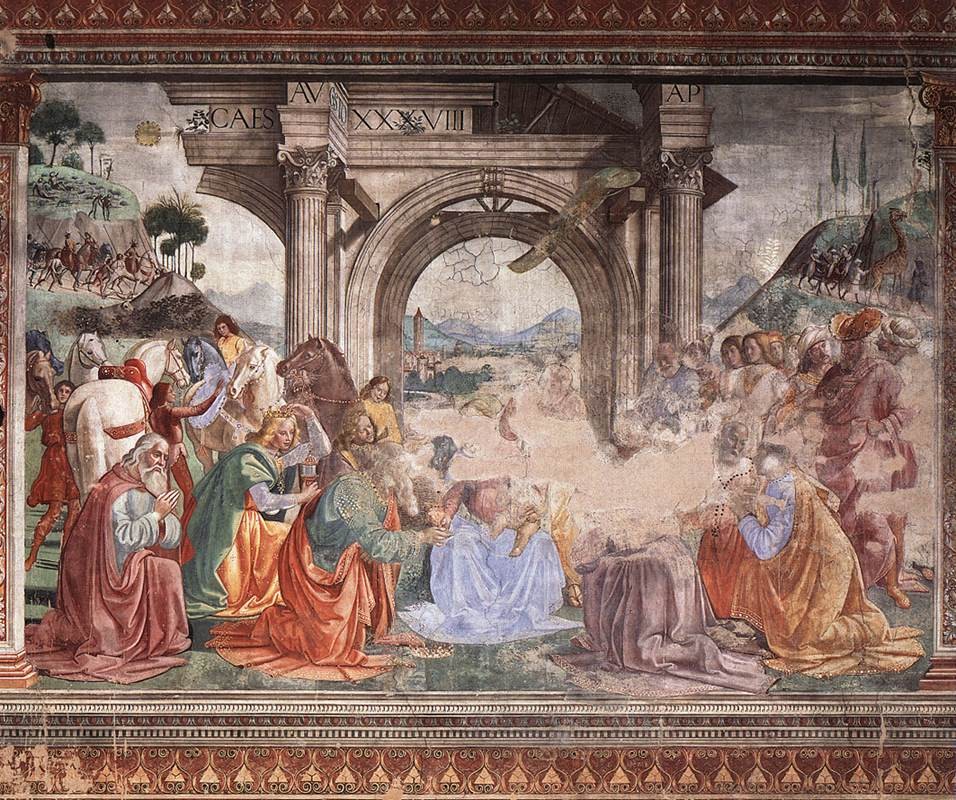
We want to follow up last week’s thread on diplomatic gift-giving with a very impressive example: the fate of a giraffe
In 1487, Lorenzo de Medici received the giraffe as a gift by Sultan Qā’itbāy of Egypt who thereby showed his support in Lorenzo’s fight against the Ottomans.
The animal was presented to the Florentine republic by the Egyptian ambassadors at the market place so that everyone could marvel the giraffe. Unfortunately, it died only a few months after its arrival breaking its neck while being transported in its box. (1/4)
#HistoryOfDiplomacy #AnimalStudies #diplomacy #earlyModern #history #histodons #emdiplomacy #Medici #Florence #Egypt #ambassador
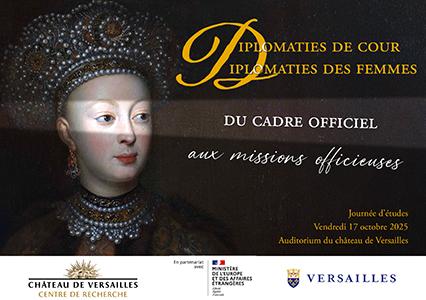
Voici le programme du jour!
Diplomaties de cour, diplomaties des femmes, du cadre officiel aux missions officieuses. Une journée d'études pour compléter l'exposition "Excellences!", dans l'auditorium du château de Versailles.
#Diplomatie #ÉpoqueModerne #Histodons #EarlyModern #EMDiplomacy
But what do you do with all these exquisite gifts, when they are not for personal use?
They are registered and kept in official collection.
The German government and the government of the German federal states occasionally auction them off as part of a raffle.
Perhaps you want to take a look into the latest auction catalogue from North Rhine-Westphalia:
#emdiplomacy #diplomacy #HistoryOfDiplomacy #CulturalHistory #earlyModern #history #histodons #NordRheinWestfalen
Client Info
Server: https://mastodon.social
Version: 2025.07
Repository: https://github.com/cyevgeniy/lmst