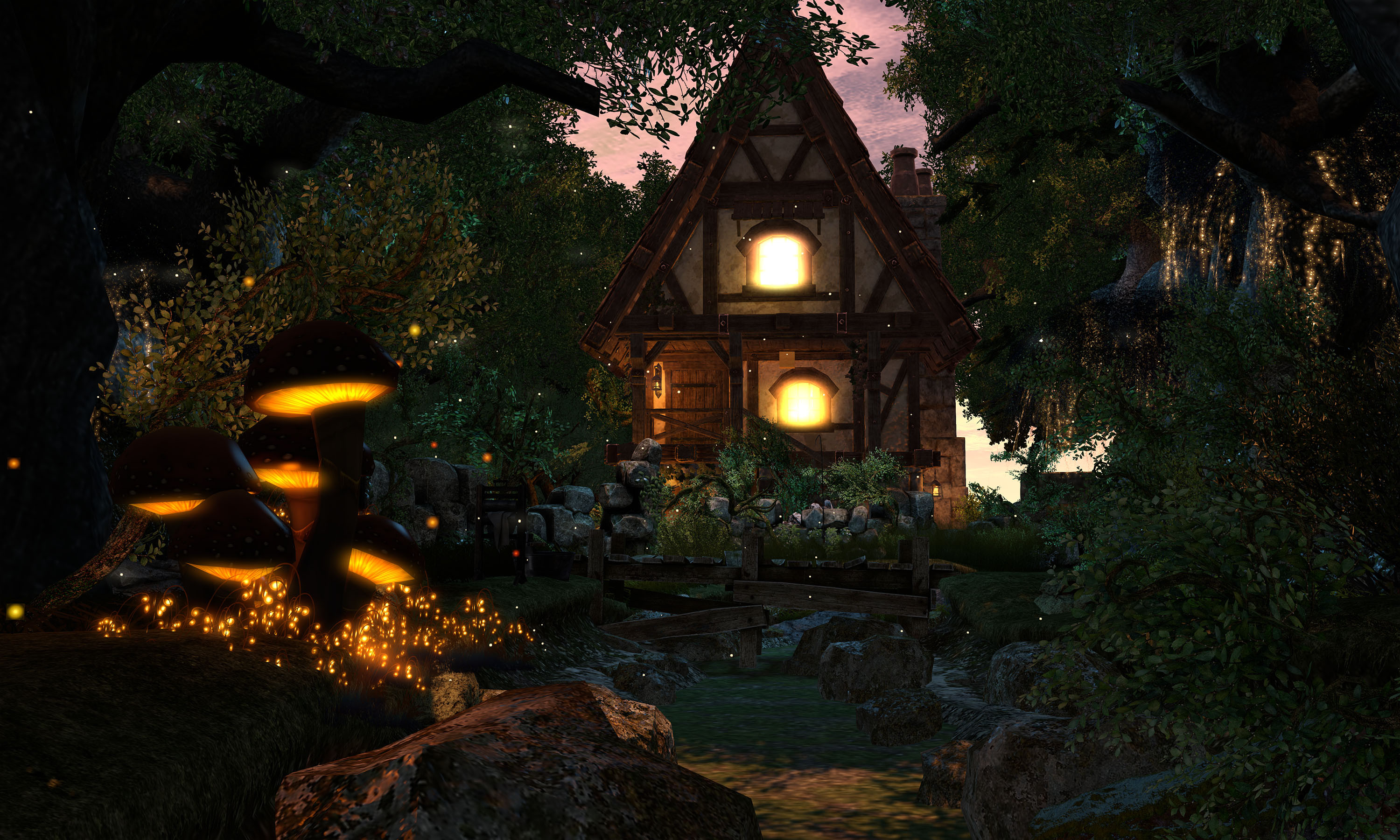
Just yesterday,
the Firestorm team released the Firestorm Viewer 7.1.9.74745. Although they only advertise the new version for Second Life, the OpenSim variants have been upgraded, too.
So @
Juno Rowland, my little in-world sister, helped me test it and travelled around a bit.
Firestorm 7 introduced three major changes. The first one is the introduction of Physically-Based Rendering. The second one, along with it, is that the Advanced Lighting Model is now permanently on. This caused a lot of commotion in the Second Life and OpenSim communities and fearmongering that Second Life and OpenSim will now require high-end gaming machines.
The third change, however, is the introduction of multi-threading. Up until Firestorm 6, the viewer was single-threaded, and only one CPU core was ever used. So if your Firestorm was slow, that probably wasn't because it drove your hardware to its limits but because it actually
didn't. In contrast, Firestorm 7 makes use of
all CPU cores. And the test drive was done on a not-quite-new-anymore AMD CPU with six cores and a dozen threads.
So after Juno had logged in, Firestorm produced a rather stable 60fps. Then again, that wasn't too unusual, given she didn't exactly login with a toaster, and the graphics settings were lowered somewhat. So she turned ambient occlusion on. Still 60fps. She turned shadows on. Still 60fps. Then she went for the new settings. Screen Space Reflections. Still 60fps, although there wasn't that much around her that was reflective. Even with mirrors on and reflection detail set to realtime, the fps didn't drop, only the CPU and GPU fans howled increasingly.
It did show that the new Firestorm and its new rendering engine are still a bit rough around the edges. Ambient occlusion under nothing but sunlight and ambient light seems a lot grainier now. The water surface is somewhat prone to tearing. And with mirrors on, it produces nasty cyan, magenta and yellow artifacts.
Still, Firestorm 7 stayed blazing fast. So we decided to challenge it a bit. Juno put on a Clutterfly Ruffled Bottom Dress, notorious for raising your avatar rendering complexity by a whopping half million, and then she went to Lbsa Plaza.
Lbsa Plaza promised to be a challenge for two reasons. One, it's Blinn-Phong galore now with a floor texture that's both specular-mapped and normal-mapped, and it has a lot of stuff standing around that'll demand its share of graphics power. Since its redesign, it looks like Nexus Storm of Neverworld fame had a part in it because she actually did. Two, you're practically never alone, and if there's something that eats into your graphics performance, it's avatars.
At this time of day, only few avatars were around plus the usual few animesh figures. With three or four avatars on-screen and shadows and ambient occlusion still on, Firestorm still delivered 50fps or more. Even with eight avatars, it didn't go under 40fps. Firestorm 6 would be lucky to reach 20fps without shadow and without ambient occlusion in the same situation on the same hardware.
Also at Lbsa Plaza, there is a sci-fi helmet on display with very detailed glossy surfaces and various bruises on it. It really demonstrates what the new Firestorm can do. I'm not sure, but it may actually already have been built using PBR materials. After all, this should be possible, seeing as OSgrid still is the same experimental grid as which it was launched back in 2007, and Lbsa Plaza runs on a development version of OpenSim from Wednesday evening. But that helmet didn't cut into the performance at all.
Something else we've noticed: When an avatar with a facelight teleports out, the illumination by the facelight disappears immediately.
Juno's next stopover was the Dereos Grid, the PSSMG Freebie Mall, to be more specific. It's a very detail-rich mixture of classic prim construction and custom meshes. This particular sim, being an "official" sim of the grid, runs on a special version of OpenSim. It used to be the ArribaSim fork, but Arriba itself stopped being developed even before OpenSim 0.8.2.1. It was then forked by Freaky Tech and eventually forked again or taken over by grid admin Akira Sonoda. In fact, it doesn't even have all features of OpenSim 0.9.1.0 included; for example, it still doesn't support universal layers, nor does it support BoM scripting. In fact, Bakes-on-Mesh itself was backported from a newer vanilla version because Arriba's development came to a halt before BoM was introduced to vanilla.
And so the newest and most advanced Firestorm met a not really up-to-date OpenSim.
First of all, the FPS dropped to something between 20 and 35 while looking at the town from an elevated location, depending on what was visible. This has to be due to the many details and being out in the open.
I've also noticed a reflective ground that didn't reflect a building immediately adjacent. Otherwise there was no trouble that I might attribute to the new version.
One bug that persists, however, is that Firestorm renders certain surfaces on certain mesh objects persistently and reproducibly as plain white.
All in all, however, I'll stick with the new version, seeing as how performant it has grown.
#
Long #
LongPost #
CWLong #
CWLongPost #
OpenSim #
OpenSimulator #
Metaverse #
VirtualWorlds #
PhysicallyBasedRendering #
PBR #
Firestorm #
FirestormViewer