
algebra final tmrw 😤 watch me cook
#abstractAlgebra

Fundamentals Of Hypercomplex Numbers | UCLA Extension
Dr. Michael Miller, a retired researcher at RAND, has been teaching upper level undergraduate/graduate level math courses for fun at UCLA Extension for over 50 years. This winter, he'll be introducing hypercomplex numbers to those interested in abstract math: Fundamentals Of Hypercomplex Numbers. His courses are thorough and rigorous, but geared toward lifelong learners and beginners in abstract mathematics to allow people better entry points into higher level mathematics. His classes are […]https://boffosocko.com/2025/12/03/fundamentals-of-hypercomplex-numbers-ucla-extension/

Ah yes, nothing screams cutting-edge tech like animating 80-year-old math 🤓. Enjoy watching lambda diagrams do the cha-cha while #JavaScript holds your browser hostage 💻🔐. Because who doesn't love mixing abstract algebra with forced web scripting? 😂
https://cruzgodar.com/applets/lambda-calculus #cuttingEdgeTech #lambdaDiagrams #abstractAlgebra #webScripting #humorousTech #HackerNews #ngated

The determinant of transvections. — New blog post on Freedom Math Dance
A transvection in a K-vector space V is a linear map T(f,v) of the form x↦x+f(x)v, where f is a linear form and v is a vector such that f(v)=0. It is known that such a linear map is invertible, with inverse given by f and −v. More precisely, one has T(f,0)=id and T(f,v+w)=T(f,v)∘T(f,w). In finite dimension, these maps have determinant 1 and it is known that they generate the special linear group SL(V), the group of linear automorphisms of determinant 1.
When I started formalizing in Lean the theory of the special linear group, the question raised itself of the appropriate generality for such results. In particular, what happens when one replaces the field K with a ring R and the K-vector space V with an R-module?
https://freedommathdance.blogspot.com/2025/11/the-determinant-of-transvections.html

Numperphile - “Lord of the Commutative Rings”
This was the sort of stuff I loved in upper-level undergraduate mathematics.


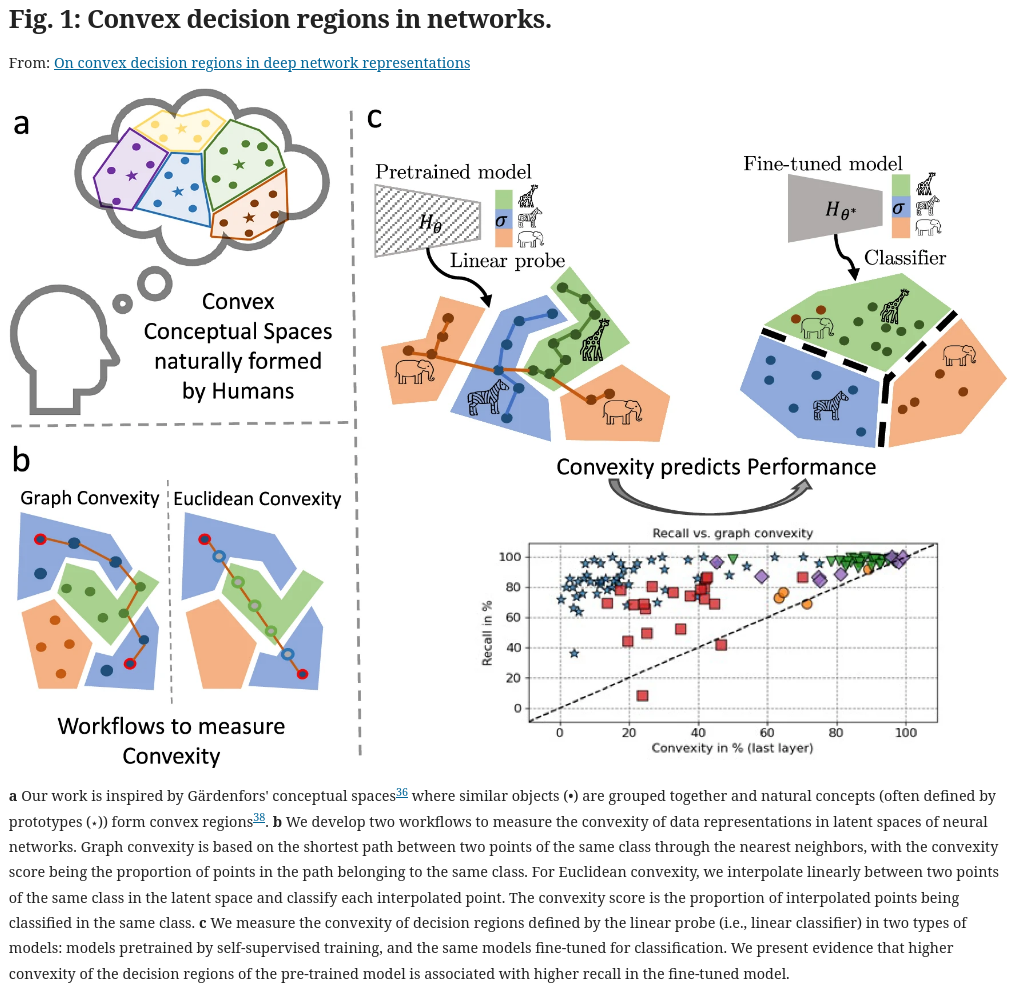
A geometric link: Convexity may bridge human & machine intelligence
https://phys.org/news/2025-07-geometric-link-convexity-bridge-human.html
On convex decision regions in deep network representations
https://www.nature.com/articles/s41467-025-60809-y
Convexity (algebraic geometry)
https://en.wikipedia.org/wiki/Convexity_(algebraic_geometry)
#ML #RepresentationLearning #convexity #AbstractAlgebra #DeepLearning #intelligence #NetworkTheory

A fundamental result in universal algebra is the Subdirect Representation Theorem, which tells us how to decompose an algebra \(A\) into its "basic parts". Formally, we say that \(A\) is a subdirect product of \(A_1\), \(A_2\), ..., \(A_n\) when \(A\) is a subalgebra of the product
\[
A_1\times A_2\times\cdots\times A_n
\]
and for each index \(1\le i\le n\) we have for the projection \(\pi_i\) that \(\pi_i(A)=A_i\). In other words, a subdirect product "uses each component completely", but may be smaller than the full product.
A trivial circumstance is that \(\pi_i:A\to A_i\) is an isomorphism for some \(i\). The remaining components would then be superfluous. If an algebra \(A\) has the property than any way of representing it as a subdirect product is trivial in this sense, we say that \(A\) is "subdirectly irreducible".
Subdirectly irreducible algebras generalize simple algebras. Subdirectly irreducible groups include all simple groups, as well as the cyclic \(p\)-groups \(\mathbb{Z}_{p^n}\) and the Prüfer groups \(\mathbb{Z}_{p^\infty}\).
In the case of lattices, there is no known classification of the finite subdirectly irreducible (or simple) lattices. This page (https://math.chapman.edu/~jipsen/posets/si_lattices92.html) by Peter Jipsen has diagrams showing the 92 different nontrivial subdirectly irreducible lattices of order at most 8. See any patterns?
We know that every finite subdirectly irreducible lattice can be extended to a simple lattice by adding at most two new elements (Lemma 2.3 from Grätzer's "The Congruences of a Finite Lattice", https://arxiv.org/pdf/2104.06539), so there must be oodles of finite simple lattices out there.
#UniversalAlgebra #combinatorics #logic #math #algebra #AbstractAlgebra
I've been on a longer hiatus from livestreaming than I originally intended, but you can see me give a seminar talk this evening at the The New York City Category Theory Seminar:
https://www.sci.brooklyn.cuny.edu/~noson/Seminar/index.html
I'll be talking about the invariant theory part of my thesis (https://arxiv.org/abs/2402.18063) at 7PM, New York time. I'll discuss how I found that every (positive) property of finite structures can be checked by counting small* substructures.
*Terms and conditions may apply. Small is constrained by the logical complexity of a property and may not conform to mundane notions of smallness in bad cases.
#CategoryTheory #combinatorics #logic #Bourbaki #algebra #AbstractAlgebra
Microsoft's Outlook on mobile won't allow me to attach this 618kb jpg to an email, so I'm posting it on Mastodon in order to have a copy of it on my laptop. This is related to the thing about Tarski's High School Algebra Problem I posted a while ago. The long identity is called the Wilkie Identity.
#Microsoft #Outlook #math #algebra #AbstractAlgebra #UniversalAlgebra #logic

I've found a citation of my own work on Wikipedia for the first time!
https://en.wikipedia.org/wiki/Commutative_magma
Naturally, I read this page before I wrote my rock-paper-scissors paper. It's neat to see that my own work is now the citation for something that was unsourced "original research" on Wikipedia.
#math #research #Wikipedia #algebra #games #RockPaperScissors #AbstractAlgebra #UniversalAlgebra #combinatorics #GameTheory
My fourteenth Math Research Livestream is now available on YouTube:
https://www.youtube.com/watch?v=pVoFfZAyXzk
I talked about some topics related to my recent preprint (https://arxiv.org/abs/2409.12923) about topological lattices.
I decided to skip streaming today because I wanted to talk about polyhedral products, but I haven't found the old calculation that I wanted to talk about yet. Shocking I couldn't find something I did like six years ago in the ten minutes before I would start streaming. I'll look for it now, so hopefully I'll be ready next week.
#math #topology #algebra #AbstractAlgebra #UniversalAlgebra #combinatorics #LatticeTheory
I'll be streaming again in 20 minutes at twitch.tv/charlotteaten. I'll be talking about my recent preprint (https://arxiv.org/abs/2409.12923) about topological lattices!
#math #topology #algebra #AbstractAlgebra #UniversalAlgebra #combinatorics #LatticeTheory
I posted a new paper on the arXiv!
https://arxiv.org/abs/2409.12923
In "Higher-dimensional book-spaces" I show that for each \(n\) there exists an \(n\)-dimensional compact simplicial complex which is a topological modular lattice but cannot be endowed with the structure of topological distributive lattice. This extends a result of Walter Taylor, who did the \(2\)-dimensional case.
I think this kind of result is interesting because we can see that whether spaces continuously model certain equations is a true topological invariant. All of the spaces that I discuss here are contractible, but only some can have a distributive lattice structure.
A similar phenomenon happens with H-spaces. The \(7\)-sphere is an H-space, and it is even a topological Moufang loop, but it cannot be made into a topological group, even though our homotopical tools tell us that it "looks like a topological group".
This is (a cleaned up version of) something I did during my second year of graduate school. It only took me about six years to post it.
#math #topology #algebra #AbstractAlgebra #UniversalAlgebra #combinatorics #LatticeTheory
My thirteenth Math Research Livestream is now available on YouTube:
In this one, I mention that 13 is a lucky number in math, and then keep talking about topological lattices as a continuation of my stream from the previous week.
I'm taking this week off from streaming, but I expect to be back next week at the same time!
#math #livestream #Twitch #topology #research #UniversalAlgebra #AbstractAlgebra #algebra
This is a friendly reminder that
((1+𝑥)ʸ+(1+𝑥+𝑥²)ʸ)ˣ⋅((1+𝑥³)ˣ+(1+𝑥²+𝑥⁴)ˣ)ʸ=((1+𝑥)ˣ+(1+𝑥+𝑥²)ˣ)ʸ⋅((1+𝑥³)ʸ+(1+𝑥²+𝑥⁴)ʸ)ˣ for all natural numbers \(x\) and \(y\), but this formula is impossible to obtain by using only those arithmetic laws taught in high school. Credit for this goes to Alex Wilkie, who found this in the 1980s.
I'll be streaming again in 15 minutes at https://www.twitch.tv/charlotteaten. I'm gonna keep talking about topological lattices, since I've realized some new things since last week.
#math #livestream #Twitch #topology #research #UniversalAlgebra #AbstractAlgebra #algebra #LatticeTheory #CategoryTheory
My twelfth Math Research Livestream is now available on YouTube:
This time, I talked about this paper (https://arxiv.org/abs/1602.00034) by George Bergman. I have something related which I've finally decided to post to the arXiv, so hopefully I'll be ready to talk about that preprint next week.
#math #livestream #Twitch #topology #research #UniversalAlgebra #AbstractAlgebra #algebra #LatticeTheory #CategoryTheory
I'll be streaming again in 20 minutes at https://www.twitch.tv/charlotteaten. This week I'm going to switch gears and talk about this paper (https://arxiv.org/abs/1602.00034) of George Bergman. I have something related which I've finally decided to post to the arXiv, so hopefully this will prepare me to talk about that new preprint next week.
#math #livestream #Twitch #topology #research #UniversalAlgebra #AbstractAlgebra #algebra #LatticeTheory #CategoryTheory
The Cayley table below has an infinite amount of structure in the following sense: For any finite list of equations that hold for this operation, there will always be another equation which holds but is not a consequence of the given ones. In other words, the \(3\)-element magma below is not finitely based.
\[
\begin{array}{r|ccc}
& 0 & 1 & 2 \\ \hline
0 & 0 & 0 & 0 \\
1 & 0 & 0 & 1 \\
2 & 0 & 2 & 2
\end{array}
\]
In 1951, Lyndon showed that every \(2\)-element algebra is finitely based, so three is the smallest order of a non-finitely based algebra. This example was found by Murskiĭ in 1965.
Client Info
Server: https://mastodon.social
Version: 2025.07
Repository: https://github.com/cyevgeniy/lmst