
Pals, I wrote about some common things I've seen across many #cybersecurity career mentoring sessions in recent months. https://tisiphone.net/2023/01/03/lessons-learned-from-cybersecurity-mentoring/

h4sh
Security engineer, blue/red/purple team, open source enthusiast, bullshit detector
He/him
📍QLD AU
h4sh boosted:

First day back at work in the new year? Don't forget to update your passwords from ending in 22 to 23
https://ironicsans.substack.com/p/the-strangest-computer-manual-ever
We need more computer manuals like this
h4sh boosted:

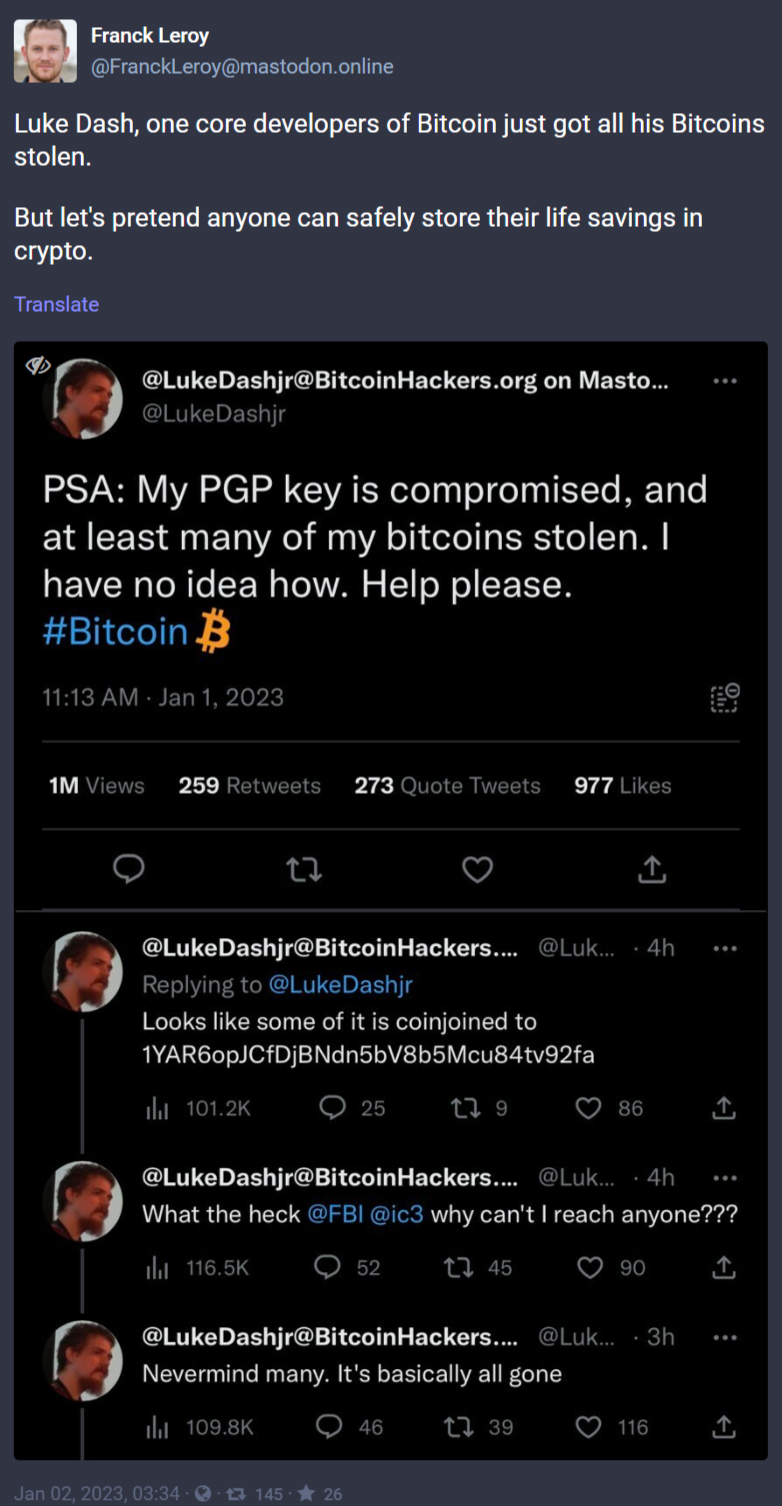
Look, if a core Bitcoin developer can get their whole wallet emptied out unrecoverably on them, and that developer's immediate reflex is to start calling a centralized authority for help, it's time to stop pretending this entire cryptocurrency exercise is ever going to work. We're done here.
h4sh boosted:

Your periodic reminder that just because a URL is saved at archive.org doesn't mean it's going to stay there.
Last year, I wrote a series about proxy services marketed to cybercriminals, and that relied heavily on Archive.org links to document various connections. After my story ran, the person that those links concerned asked Archive to remove those links from their database, which they did. The person in question came back and said hey, what you said in your story is wrong because there's no supporting evidence and you must remove this. Archive.org confirmed they removed all of the pages at the request of the domain holder, and that was that.
If you stumble upon a page that is in archive.org and you want to make sure there is a record that won't be deleted at some point, consider saving the page to archive.today/archive.ph
Alternatively, of course, you could save the page locally, using something like Firefox's built-in full page screenshot (right click on page). Better yet, save the Archive.org pages you want locally.
h4sh boosted:

My favourite review on Google Maps is for an Antarctic research station. Unfortunately, their penguin is not a people pleaser.

My code is full of bugs that create features
Featurebugs!
h4sh boosted:

When building a product - it’s surprisingly tempting to match competitor features even if you think they are bad ideas - because not having them sounds like a deficiency/un-smart.
It’s why so many products end up working equally badly.
controversial opinion: in C userland code, calling free() is completely unnecessary, and detrimental to security.
if there are no dynamically sized memory that needs resizing in your program, don't even use malloc(), just use the stack and int x = strlen(something); char buf[x];
if you use malloc, not calling free() will prevent the exploitation of ANY heap based memory bugs, including use-after-free and double-free (see the common thing about both? they need free()!)
the OS will reclaim all memory when your program exits. If you're making a server, make it multi-processed using fork instead of pthreads; that way when one of your sub-workers run out of memory when you don't free, just kill and spawn another one

h4sh boosted:

There doesn't seem to be anything on the @2600@mastodon.social account I think they moved to @2600@mastodon.online maybe
h4sh boosted:

When your email finds me well

h4sh boosted:

hey, you.
stop checking work emails on vacation.
stop telling people “you can still reach me” when you’ve taken time off.
stop cleaning up emails the night before you go back to work (weekend or PTO.)
stop taking responsibility for the company taking advantage of you. if you truly are the *only* person who can solve a problem, that is on the COMPANY. not you.
being buried with work doesn’t mean you have to finish it all right now. you need the time to rest and recuperate. take it. don’t blur those lines. we are working most of our lives, so take the break when you get one.
h4sh boosted:

I recently wrote a post detailing the recent #LastPass breach from a #password cracker's perspective, and for the most part it was well-received and widely boosted. However, a good number of people questioned why I recommend ditching LastPass and expressed concern with me recommending people jump ship simply because they suffered a breach. Even more are questioning why I recommend #Bitwarden and #1Password, what advantages they hold over LastPass, and why would I dare recommend yet another cloud-based password manager (because obviously the problem is the entire #cloud, not a particular company.)
So, here are my responses to all of these concerns!
Let me start by saying I used to support LastPass. I recommended it for years and defended it publicly in the media. If you search Google for "jeremi gosney" + "lastpass" you'll find hundreds of articles where I've defended and/or pimped LastPass (including in Consumer Reports magazine). I defended it even in the face of vulnerabilities and breaches, because it had superior UX and still seemed like the best option for the masses despite its glaring flaws. And it still has a somewhat special place in my heart, being the password manager that actually turned me on to password managers. It set the bar for what I required from a password manager, and for a while it was unrivaled.
But things change, and in recent years I found myself unable to defend LastPass. I can't recall if there was a particular straw that broke the camel's back, but I do know that I stopped recommending it in 2017 and fully migrated away from it in 2019. Below is an unordered list of the reasons why I lost all faith in LastPass:
- LastPass's claim of "zero knowledge" is a bald-faced lie. They have about as much knowledge as a password manager can possibly get away with. Every time you login to a site, an event is generated and sent to LastPass for the sole purpose of tracking what sites you are logging into. You can disable telemetry, except disabling it doesn't do anything - it still phones home to LastPass every time you authenticate somewhere. Moreover, nearly everything in your LastPass vault is unencrypted. I think most people envision their vault as a sort of encrypted database where the entire file is protected, but no -- with LastPass, your vault is a plaintext file and only a few select fields are encrypted. The only thing that would be worse is if...
- LastPass uses shit #encryption (or "encraption", as @sc00bz calls it). Padding oracle vulnerabilities, use of ECB mode (leaks information about password length and which passwords in the vault are similar/the same. recently switched to unauthenticated CBC, which isn't much better, plus old entries will still be encrypted with ECB mode), vault key uses AES256 but key is derived from only 128 bits of entropy, encryption key leaked through webui, silent KDF downgrade, KDF hash leaked in log files, they even roll their own version of AES - they essentially commit every "crypto 101" sin. All of these are trivial to identify (and fix!) by anyone with even basic familiarity with cryptography, and it's frankly appalling that an alleged security company whose product hinges on cryptography would have such glaring errors. The only thing that would be worse is if...
- LastPass has terrible secrets management. Your vault encryption key always resident in memory and never wiped, and not only that, but the entire vault is decrypted once and stored entirely in memory. If that wasn't enough, the vault recovery key and dOTP are stored on each device in plain text and can be read without root/admin access, rendering the master password rather useless. The only thing that would be worse is if...
- LastPass's browser extensions are garbage. Just pure, unadulterated garbage. Tavis Ormandy went on a hunting spree a few years back and found just about every possible bug -- including credential theft and RCE -- present in LastPass's browser extensions. They also render your browser's sandbox mostly ineffective. Again, for an alleged security company, the sheer amount of high and critical severity bugs was beyond unconscionable. All easy to identify, all easy to fix. Their presence can only be explained by apathy and negligence. The only thing that would be worse is if...
- LastPass's API is also garbage. Server-can-attack-client vulns (server can request encryption key from the client, server can instruct client to inject any javascript it wants on every web page, including code to steal plaintext credentials), JWT issues, HTTP verb confusion, account recovery links can be easily forged, the list goes on. Most of these are possibly low-risk, except in the event that LastPass loses control of its servers. The only thing that would be worse is if...
- LastPass has suffered 7 major #security breaches (malicious actors active on the internal network) in the last 10 years. I don't know what the threshold of "number of major breaches users should tolerate before they lose all faith in the service" is, but surely it's less than 7. So all those "this is only an issue if LastPass loses control of its servers" vulns are actually pretty damn plausible. The only thing that would be worse is if...
- LastPass has a history of ignoring security researchers and vuln reports, and does not participate in the infosec community nor the password cracking community. Vuln reports go unacknowledged and unresolved for months, if not years, if not ever. For a while, they even had an incorrect contact listed for their security team. Bugcrowd fields vulns for them now, and most if not all vuln reports are handled directly by Bugcrowd and not by LastPass. If you try to report a vulnerability to LastPass support, they will pretend they do not understand and will not escalate your ticket to the security team. Now, Tavis Ormandy has praised LastPass for their rapid response to vuln reports, but I have a feeling this is simply because it's Tavis / Project Zero reporting them as this is not the experience that most researchers have had.
You see, I'm not simply recommending that users bail on LastPass because of this latest breach. I'm recommending you run as far way as possible from LastPass due to its long history of incompetence, apathy, and negligence. It's abundantly clear that they do not care about their own security, and much less about your security.
So, why do I recommend Bitwarden and 1Password? It's quite simple:
- I personally know the people who architect 1Password and I can attest that not only are they extremely competent and very talented, but they also actively engage with the password cracking community and have a deep, *deep* desire to do everything in the most correct manner possible. Do they still get some things wrong? Sure. But they strive for continuous improvement and sincerely care about security. Also, their secret key feature ensures that if anyone does obtain a copy of your vault, they simply cannot access it with the master password alone, making it uncrackable.
- Bitwarden is 100% open source. I have not done a thorough code review, but I have taken a fairly long glance at the code and I am mostly pleased with what I've seen. I'm less thrilled about it being written in a garbage collected language and there are some tradeoffs that are made there, but overall Bitwarden is a solid product. I also prefer Bitwarden's UX. I've also considered crowdfunding a formal audit of Bitwarden, much in the way the Open Crypto Audit Project raised the funds to properly audit TrueCrypt. The community would greatly benefit from this.
Is the cloud the problem? No. The vast majority of issues LastPass has had have nothing to do with the fact that it is a cloud-based solution. Further, consider the fact that the threat model for a cloud-based password management solution should *start* with the vault being compromised. In fact, if password management is done correctly, I should be able to host my vault anywhere, even openly downloadable (open S3 bucket, unauthenticated HTTPS, etc.) without concern. I wouldn't do that, of course, but the point is the vault should be just that -- a vault, not a lockbox.
I hope this clarifies things! As always, if you found this useful, please boost for reach and give me a follow for more password insights!
h4sh boosted:

It’s a complete failure of infosec-meets-user-psychology that “this TLS certificate is issued for your bank and the server is sneaky hackerman dot com” and “this otherwise valid certificate expired a day ago” have the EXACT SAME USER EXPERIENCE.
h4sh boosted:

Memo to the media:
Stop letting politicians get away with calling asylum seekers "illegal immigrants" or saying they're not coming to this country "the right way." Seeking asylum is legal. Presenting themselves at the border & requesting asylum is "the right way" to seek asylum.
When I say "data-driven security", what comes to your mind?
@vt52 yea that kind of ISP restrictions and plan is disgusting..
Client Info
Server: https://mastodon.social
Version: 2025.07
Repository: https://github.com/cyevgeniy/lmst