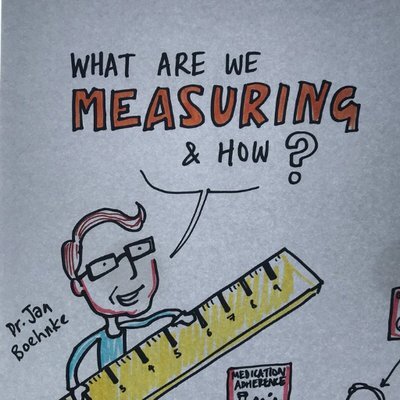
Quick reminder:
"Content validity is defined as the degree to which the content of a measurement instrument adequately reflects the outcome being measured. [...] It is considered to be the most important measurement property".
https://www.sciencedirect.com/science/article/pii/S0895435625002124
#COSMIN
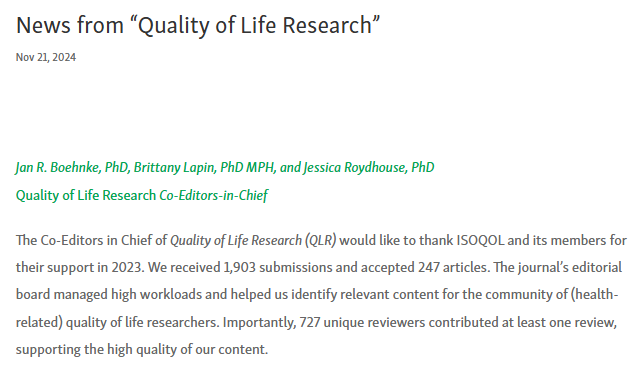
Read about the editors' choice papers, most downloaded, and interacted paper in "Quality of Life Research":
https://www.isoqol.org/news-from-quality-of-life-research-112024/
The last annual update I will be involved in... 😅👋
#ISOQOL #HRQL #HealthEconomics #Psychometrics
#EQ5D #COSMIN #PROMIS
Last week "Quality of Life Research" published 7 papers:
https://link.springer.com/journal/11136/online-first #ISOQOL
For example,
effectiveness of verbal instruction vs video-based education for caregivers of head & neck #cancer patients
https://rdcu.be/diEFn
#India #PalliativeCare
#SysReview of psychometric quality of instruments reporting #HRQL in survivors of critical illness
https://link.springer.com/article/10.1007/s11136-023-03487-x #COSMIN
Estimating the disutility of relapse in #MultipleSclerosis
https://link.springer.com/article/10.1007/s11136-023-03486-y #EQ5D #AQoL #SF6D
I argue that there is some understanding in the #psychometrics and professional communities that use #TestScores that evidence of quality is tentative as any statistical result.
And in my personal view, the different methodologies #COSMIN has developed (e.g., https://link.springer.com/article/10.1007/s11136-018-1798-3) or is currently pushing forward (https://doi.org/10.1186/s13643-022-01994-5) are tools to aggregate available evidence exactly for this reason: each individual study and estimate offers an incomplete picture.
Another #PeerReview finished.
Paper ~ 5000 words
Review ~ 1800 words
Duration ~ 2.5 hours
Translations of questionnaires are difficult. Consider using the guidelines by the International Testing Commission to plan your study:
https://pubmed.ncbi.nlm.nih.gov/32711675/
Use participatory methods to (i) identify which instrument is relevant to translate; and (ii) to develop a population-appropriate translation.
And #COSMIN helps to identify which type of evidence is needed:
https://www.cosmin.nl/
Quality of Life Research, July issue published:
https://link.springer.com/journal/11136/volumes-and-issues/32-7
#ISOQOL #HRQL
Opened by a #SysReview of instruments measuring the quality of dying and death in Asian countries:
https://rdcu.be/ddRIE
#COSMIN #EndOfLifeCare
the issue features several pieces on properties of various instruments in different contexts and versions, e.g.,
#EQ5D
https://link.springer.com/article/10.1007/s11136-023-03372-7
#EORTC https://link.springer.com/article/10.1007/s11136-023-03373-6
#PROCTCAE
https://link.springer.com/article/10.1007/s11136-023-03374-5
@flourn0
I have been myself inconsistent in this and cannot offer anything directly in the remit of your question, but eg. the 2nd supplement of this could be made a usual addition to any paper, testing invariance of measures in a given application:
https://royalsocietypublishing.org/doi/suppl/10.1098/rsos.211114
That would allow researchers planning for their projects or #SysReviews interested in psychometric properties at least to collate relevant information on such aspects.
#Psychometrics #HRQL
edited to add #COSMIN
Client Info
Server: https://mastodon.social
Version: 2025.07
Repository: https://github.com/cyevgeniy/lmst