#ClimateFeedback

rexirexi
2025-11-14

phys.org/news/2025-11-higher-m

(more on the theme)

rising temperatures speed up microbiological degradation, causing methane emissions to increase exponentially. Researchers' calculations show that if the IPCC's warmest climate scenario becomes a reality, current emissions of methane from lakes and reservoirs will almost double by the end of the century.

2025-06-06

The smoke from #Canada’s #wildfires may be even more #toxic than usual

A legacy of #mining means that #ToxicMetals could be carried along plumes of smoke.

by Matt Simon, June 5, 2025

"More than 200 wildfires are blazing across central and western Canada, half of which are out of control because they’re so hard for crews to access, forcing 27,000 people to evacuate. Even those nowhere near the wildfires are suffering as smoke swirls around Canada and wafts south, creating hazardous air quality all over the midwestern and eastern parts of the United States. The smoke is even reaching Europe.

"As the climate changes, the far north is drying and warming, which means wildfires are getting bigger and more intense. The area burned in Canada is now the second largest on record for this time of year, trailing behind the brutal wildfire season of 2023. That year, the amount of #carbon blazed into the atmosphere was about three times the country’s #FossilFuel emissions. And the more carbon that’s emitted from wildfires — in Canada and elsewhere — the faster the #PlanetaryWarming, and the worse the fires.

" 'There’s obviously the #ClimateFeedback concern,' said Mike Waddington, an environmental scientist at McMaster University in Ontario who studies Canada’s forests. 'But increasingly we’re also concerned about the smoke.'

"That’s because there’s much more to wildfire smoke than charred sticks and leaves, especially where these blazes are burning in Canada. The country’s #forests have long been #mined, operations that loaded #soils and #waterways with #ToxicMetals like #lead and #mercury, especially before clean-air standards kicked in 50 years ago. Now everyone downwind of these wildfires may have to contend with that legacy and those pollutants, in addition to all the other nasties inherent in #WildfireSmoke, which are known to exacerbate respiratory and cardiac problems.

" 'You have there the burning of these organic soils resulting in a lot of carbon and a lot of #ParticulateMatter,' said Waddington. 'Now you have this triple whammy, where you have the metals #remobilized in addition to that.'

"What exactly is lurking in the smoke from Canadian wildfires will require further testing by scientists. But an area of particular concern is around the mining city of #FlinFlon, in #ManitobaCanada, which is known to have elevated levels of toxic metals in the landscape, said Colin McCarter, an environmental scientist who studies pollutants at Ontario’s #NipissingUniversity. Flin Flon’s 5,000 residents have been evacuated as a wildfire approaches, though so far no structures have been destroyed.

"But a fire doesn’t need to directly burn mining operations to mobilize toxicants. For example, in #Yellowknife, in Canada’s #NorthwestTerritories, #GoldMining operations between 1934 and 2004 spread #arsenic as far as 18 miles away, adding to a landscape with an already high concentration of naturally occurring arsenic. In a paper published last year, Waddington and McCarter estimated that between 1972 and 2023, wildfires around Yellowknife fired up to 840,000 pounds of arsenic into the atmosphere. Arsenic is a known carcinogen associated with cardiovascular disease, diabetes, and developmental problems, according to the World Health Organization. (After the 2023 #LahainaFire in Maui, officials reported elevated levels of arsenic, lead, and other toxic substances in ash samples. California officials also found lots of lead in smoke from 2018’s #CampFire.)"

Source:
grist.org/climate/canada-wildf

#WaterIsLife #SoilIsLife #AirIsLife #Mining #ToxicLegacy #FirstNations #Canada #Pollution #Worldwide #AQI #ClimateChange #ClimateCrisis #ClimateCatastrophe #AirQualityIndex

2025-04-20

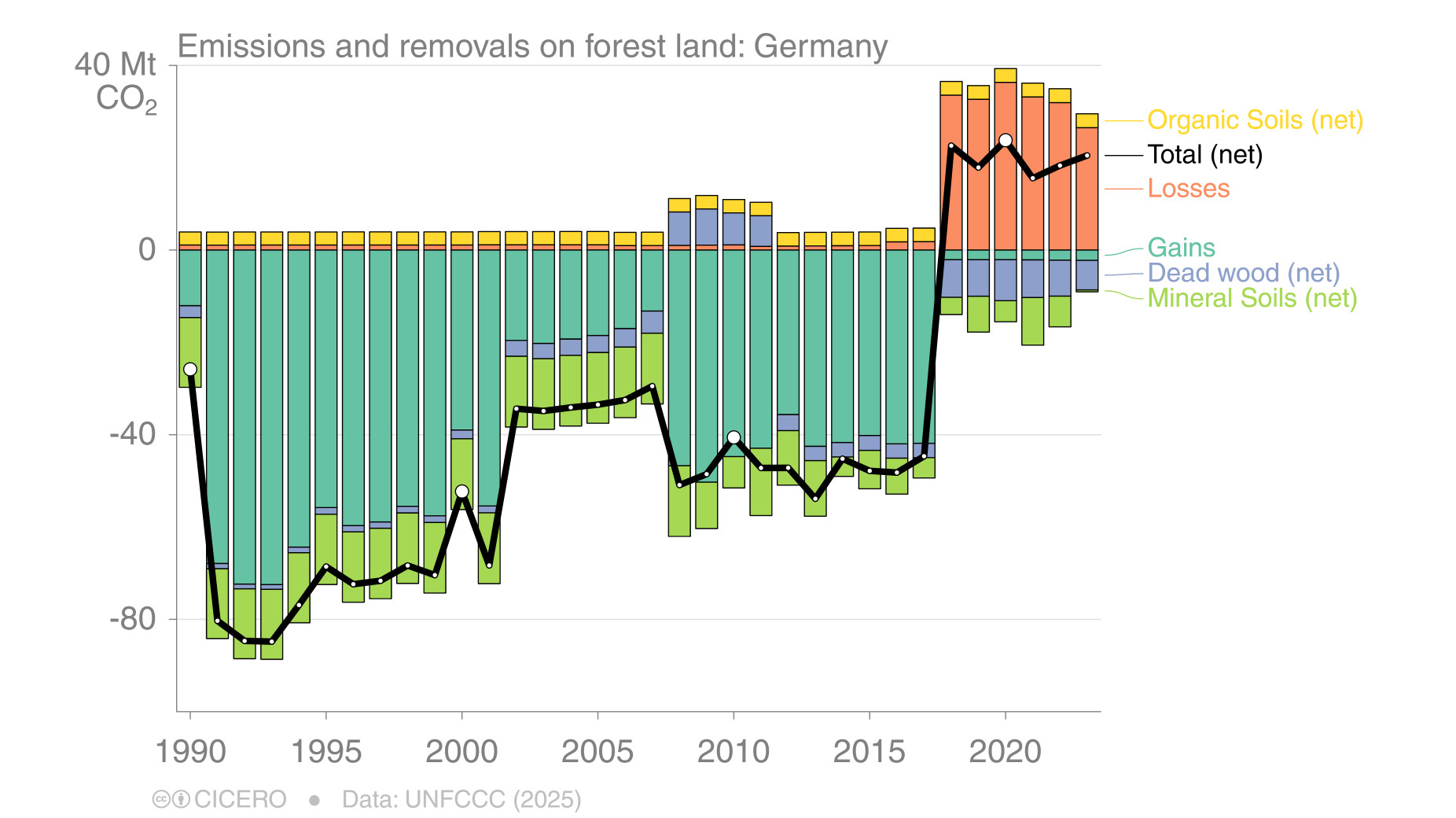
Dangerous development: how German forests flipped from taking up CO₂ from the atmosphere to becoming a major net source of CO₂, around 2018.
Main cause: the spruce bark beetle, propelled by storms, drought, and hot summers (see Robbie Andrews' thread on Bluesky: bsky.app/profile/robbieandrew.).
#ClimateChange #climatefeedback #forest

Bar graph showing net CO2 absorption by German forests, 1990-2017, of 40-80 Mt/year and net emissions of 30-40 Mt for the years 2018-2023
2023-02-20

Nearly 30 dangerous feedback loops could permanently shift the Earth's climate, scientists say

Such cyclical chain reactions occur when one change triggers further changes in a process that keeps repeating itself. Some drive down warming while others amplify it, scientists say.

By Laura Paddison, Feb 17, 2023

"'We, already at 1.5 [degrees Celsius], are likely to cross multiple tipping points, causing feedback loops that would make our options for a safe climate future even fewer,' Johan Rockström, Director of the Potsdam institute and a co-author of the study, told CNN.

"The authors called for 'immediate and massive' reductions in planet-warming pollution, as well as increased research into climate feedback loops."
#ClimateFeedback #ClimateChange #ClimateCatastrophe #ClimateCrisis

Read more:
accuweather.com/en/climate/dan

Dr. Brad Rosenheim has moved!Brad_Rosenheim@climatejustice.rocks
2022-11-26

This is a large amount of dampening from a depositional system that is not physically dominant on Earth's surface! Luckily, the systematic are such that this fjord carbon 'battery' cannot release its energy while sea level is high, hence it will not result in positive feedback with anthropogenic warming (runaway warming). #climatefeedback #climatechange

2022-06-10

Warming of Earth’s surface and oceans continues apace, contrary to claims in blog climatefeedback.org/claimrevie

The Fediverse is such a serene rational island that I hate to bring the madness of Twitter into it, but as part of the fact-checking group #ClimateFeedback we just reviewed an exceptionally misleading blog post.

It is really nice to do such reviews with knowledgeable colleagues rather than on your own. ClimateFeedback even contacted the author of the article which was abused as "evidence".

2021-02-08

NOAA shows clear global warming trends over the past 58 years based on radiosonde data climatefeedback.org/claimrevie

Fact checker #ClimateFeedback asked me & 2 colleagues to review a conspiracy Facebook meme. Verdict: "inaccurate".

Even if weather balloons had not shown a trend that would be no biggy. #GlobalWarming is about surface warming, not upper air warming. The sparse radiosonde network using one-use instruments is a much less accurate way to estimate warming than the station record.

2020-10-11

#ClimateFeedback is a group of climate scientist reviewing press articles on climate change, but there is only so much a few scientists can do & by the time the reviews are in & summarized the article is mostly old news.

With a larger group we could review more articles & have results while people are still reading it.

We could test how well such a larger group does (& how to statistically combine their grades) by comparing their assessments with the ones later published by Climate Feedback.

Julien BenⓋenuto_Jujulb@mastodon.zaclys.com
2017-08-29

Faut-il rappeler que le #permafrost contient, entre autre, d'immenses quantités de #méthane, bien plus dangereux que le #CO2 pour l'effet de serre, dans des quantitées telles qu'on ne peut prédire ce qu'il se passera en cas de dégel complet ? Que le dégel d'une partie entraine un effet boule de neige, déjà commencé, entrainant le dégel de plus en plus de permafrost ? #Climat #Pollution #EffetDeSerre #ClimateFeedback climatefeedback.org/evaluation

Julien BenⓋenuto_Jujulb@mastodon.zaclys.com
2017-05-11

Doublé pour #ClimateFeedback, qui montre que #TheTelegraph et #TheDailyWire se plantent. Les températures plus froides en ce début d'année sur la banquise arctique sont toujours 5 à 10°C au dessus des normales saisonnières, et ne suffisent pas à rattraper le redoux de l'épisode El Niño. Et -20°C en Arctique, c'est chaud. #Climat #Environnement #Réchauffement
frama.link/ek3UMooW
frama.link/0yqEuC48

Client Info

Server: https://mastodon.social
Version: 2025.07
Repository: https://github.com/cyevgeniy/lmst