#LimitsToGrowth

2025-12-21

as i said: can we please leave non-equilibrium thermodynamics out of the discussion.

1. it is hell of a stretch

2. it is just confusing and honestly the people who bring this up don't understand the 3rd law and completely misinterpret what is called the 4th law, but it actually is just an interpretation by biologists.

3. is all your need to understand to make your effing point

it is just lowkey cultsy and esoteric

2025-12-01
«El amanecer del "día del fin del mundo".»

https://futurocienciaficcionymatrix.blogspot.com/2025/11/el-amanecer-del-dia-del-fin-del-mundo.html

Buenos días, lunes de final de mundo capitalista-productivista-que-se-comporta-como-un-cáncer

> Lo último que han decidido nuestros dirigentes es conducirnos a la guerra, mientras se realiza un esfuerzo supremo por traer a los mercados todos los recursos necesarios para mantener la maquinaria en marcha un poco más, mientras se preparan para la guerra.

> Discrepo también de aquellos bienintencionados que presentan un escenario de decrecimiento controlado, para evitar un abrupto descenso. El sistema está diseñado para crecer, no admitiría comenzar una contracción leve sin que saltarán por los aires todas las burbujas y excesos acumulados. Y además, las retroalimentaciones impedirían ese control de la caída, por la complejidad alcanzada por el sistema, que necesita que todo funcione como un reloj. Un fallo en la cadena y la ley del mínimo de Liebig rompe todo el sistema (y no solo habría un error, sería una serie de ausencia de suministros).
> Hemos cometido tal cantidad de excesos que sorprende que alguien pueda pensar que "nunca pasa nada". Parecemos como el borracho que está a punto de desmayarse, mientras conduce un coche y sigue diciendo, "tranquilo, que yo controlo" ... He comenzado con las estimaciones de la futura producción industrial y he acabado con la previsión de un colapso sistémico completo. Todo tiene sentido, porque para evitar el crash en los últimos veinte años, hemos ido más allá de lo razonable en un intento absurdo de ganar tiempo. Una locura por otra parte, consustancial a la naturaleza humana, que siempre quiere más y no acepta un "no" por respuesta. El sistema ha hecho lo que se esperaba de él, agotar todos los recursos en un desesperado intento por alargar la bonanza, mientras sacaba conejos de la chistera (en forma de creación de deuda infinita). Poco importa que el final sea 2026-2030, porque lo único importante es que el ciclo civilizatorio ha alcanzado su cenit y toca descender. Y por supuesto, no estamos preparados ...
¿Podemos escapar del precipicio?
La respuesta es no, lo único que podemos hacer y seguramente hagamos, es ganar un poco más de tiempo.

#Colapso #Capitalismo #LimitsToGrowth #EverythingBubble #Silver #Plata


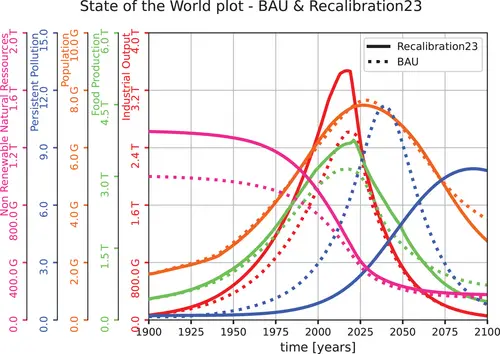
Gráfico que compara la producción industrial global real con la predicción de la recalibración de "Limits to Growth" de Nebel et al. Hasta el presente se ve que la sigue muy bien, incluyendo dos pequeños valles. Ambos crecen hasta hacerse planosnlos últimos años. El modelo predice justo una caída a partir del presente, muy abrupta
2025-11-25

is there left anyone in the movement who

a) acknowledges there are

b) acknowledges that a despots oligarchy is inadequate to fight climate change

c) has some basic understanding of the systems- and thermodynamics of living organisms?

THAT IS NOT A EFFIN ?

i feel so alone

0×4a6f4672jofr@ruby.social
2025-11-16

@dpiponi a foretaste of things to come? Our whole economy still depends on oil which is running out soon, as predicted in the #LimitsToGrowth report 50 years ago. Life without water and electricity is indeed challenging
politybooks.com/bookdetail?boo

CUSP :verified:cusp_uk@mstdn.social
2025-11-12

The Quest for Prosperity | Tim Jackson’s Foreword for Richard McNeill Douglas’ new book The Meaning of Growth: Anti-Environmentalist Rhetoric and the Defence of Modernity. → cusp.ac.uk/themes/aetw/tj-ques

"What can prosperity possibly mean when you’re living on a lonely rock hurtling blindly through space at half a million miles an hour? Some questions are as old as the hills—and yet remain fresher than the darling buds of May."

cc #Postgrowth #LimitsToGrowth #ProsperityWithoutGrowth

2025-11-05

I finished reading Energy and Human Ambitions on a Finite Planet by Thomas Murphy. It's powerful. He argues decisively that growth (including economic growth) will stop soon compared to the length of time since the beginning of agriculture. All it takes is one critical resource to limit growth. Even in the wildly optimistic scenarios where energy is limitless, eventually temperature from our own energy use will limit growth. Space exploration will only delay the end of growth, and will cause its own problems. I found the arguments to be convincing.

escholarship.org/uc/item/9js52

#sustainability
#limitsToGrowth
#finitePlanet

1/N

CUSP :verified:cusp_uk@mstdn.social
2025-10-21

Climate denial and the defence of modernity—What we are lacking is an inspiring vision of our lives, collective futures, and spiritual reality in a world in which we cannot keep growing forever. As much as we need policy wonks, scientists, and campaigners, CUSP researcher Dr Richard Douglas argues in this blog, now is the time for philosophers, religious thinkers and writers to apply themselves to social change.→ cusp.ac.uk/themes/m/blog-rd-gr

cc #LimitsToGrowth #PostGrowth #TheCareEconomy #Modernity

2025-10-20

I have been on a kick reading/listening about how human civilization will stop growing. It is crazy the disconnect between these physical limits and "common sense". People talk about how in the long term stocks go up in value. So much of our society is predicated on perpetual growth. But nothing grows for ever even if it has grown for the past few centuries.

Tom Murphy has a very solid argument about how economics is tied to the physical world, and physical limits will lead to the economy to stop growing. I recently came across his Comment in the journal Nature Physics
tmurphy.physics.ucsd.edu/paper

#limitsToGrowth

2025-10-16

but that is basically all that is said about it in the actual report.

it is one of sort of the shortcomings of it, because wealth inequality was much less when it was done & so it did not account for it.

we are talking about having to live with a lot less, fast, soon. and we did so far not talk about wealth inequality. we can just say: global average income will decline.

i'll just leave that as food for thought about what the next step might be.

2025-10-16

according to the report, the first peak that we will face, and it might actually happen pretty soon, is the peak in industrial output. a combination of resource depletion, environmental pollution & infrastructure depreciation resulting in diminishing returns and untimatly decline of investment in many aspects of human life. income, employment, goods & services will get less. this is a seneca-type of .

2025-10-16

please don't get me wrong. i am not denying the findings of or the reports. yes, things look really dire. but the lack of true understanding of , which is not hard to obtain bc at the end of the day it is just basic observation of nature, will lead this whole -thing to become a self fulfilling prophecy, bc you are closing your eyes to the options we STILL have by practicing this lack of understanding.

and yes, that should be good news.

2025-10-16

the next issue i have with all of this talk is that people cannot differentiate between running a SD model and crystal ball gazing the future. a SD model does not predict the future. it explores system behavior. the scientific question behind was not: "when will happen?". it was: "are there limits to growth of the economy?" and the answer was: "yes".

what humans make of it is not in the authors control.


2025-10-16

so basically:

- & as a concept are final & different from oscillation. it is not a thing you want to look forward to.

- although the are the same, collapse can happen slow and gradually. it depends on which variable you look at. when you say "collapse" also say 'collapse of what', exactly, bc otherwise it is just vibes-based BS. i am sorry.

2025-10-16

when you look at the world3 model you can see the graphs tracking the stocks & flows taking different shapes. the time frame of decline is not always the same for all variables.

when the decline happens faster than the growth resulting in an asymmetric curve it is called "the seneca cliff". it’s the shape takes when decline is accelerated by self-reinforcing feedbacks & lost resilience, making decline faster than growth ever was.

2025-10-16

is not a correction, it is not our chance to reboot civilization, it is a phase shift where our life support systems capacities & feedback structures are fundamentally altered. it is sustained, nonlinear decline to a MUCH LOWER, new equilibrium.

and i am very sorry, but i can't help the feeling that many who celebrate it have no clue what they are talking about.

2025-10-16

so as the population grows, its consumption begins to exceed the regenerative capacity of its environment.

so now this is where collapse is different from temporary decline:

when the balancing feedbacks, which would naturally constrain the growth, and normally let the system fluctuate around its equilibrium, kick in too late - the population keeps growing despite its supporting ecosystem eroding. that is what is meant by the system overshooting.

2025-10-16

in , which is what we are talking about looking at like societies, typically describes a rapid, nonlinear, sustained decline in stocks & flows such as population & industrial output after a period of growth or plateauing, caused by a change in feedback dominance in the systems causal structure.

2025-10-16

anyway people want to , maybe it is time to do that (given , mostly)?

the issue i have that most people who talk about it, really don't know what it means or can mean, nor have any agreed upon definition, apart from just vibes and vague feelings. and that in itself is a dangerous thing because they will take away from people, merely based on .

Client Info

Server: https://mastodon.social
Version: 2025.07
Repository: https://github.com/cyevgeniy/lmst