John Wycliffe
His last name is also spelled: Wyclif, Wickliffe, & Wicklyf.
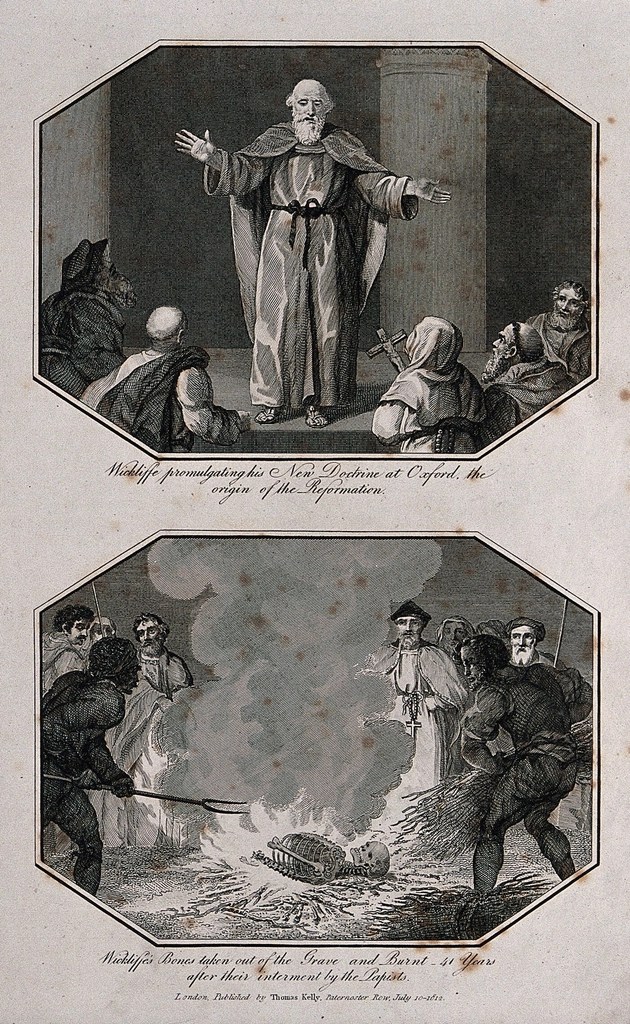
He’s an English scholastic philosopher, Christian reformer, Catholic priest, & a theology professor at the University of Oxford. He’s often called the “Morning Star of the Reformation.”
He made radical challenges to the Roman Catholic Church like advocating for or made a vernacular translation of the Vulgate Bible into Middle English. He paved the way for the Protestant Reformation nearly 200 years before Martin Luther.
Before he was a reformer, Wycliffe was a titan of Scholasticism at Oxford. At the time, the intellectual world was divided between Realist & Norminalists. The Norminalists, like William of Ockham, argued that “universals” (like the concept of “justice” or “humanity”) were just names (nomina) we give to groups of individual things.
John was a fierce Realist. He believed that universals were real entities that existed in the mind of God. For Wycliffe, everything in the physical world was a direct reflection of a divine archetype.
Wycliffe’s most radical political theory was the Dominion of Grace. He argued that all authority (dominium) is a gift from God. Which meant that the church wasn’t allowed to own property or have ecclesiastic courts, & men in mortal sin weren’t entitled to exercise authority in the church or state, nor to own property. He added a dangerous caveat: only those in a state of grace have a right to exercise authority.
Wycliffe’s later followers (derogatorily called Lollards by their orthodox contemporaries in the 15th & 16th centuries. Lollards meaning “mumblers” or “idlers.”) adopted a number of the beliefs attributed to Wycliff such as theological virtues, predestination, iconoclasm, & the notion of caesaropapism, with some questioning the veneration of saints, the sacraments, requiem masses, transubstantiation, monasticism, & the legitimacy/role of the Papacy.
Wycliffe was born in the village of Hipswell, near Richmond in the North Riding of Yorkshire, England. In 1356, Wycliffe completed his bachelor of arts degree at Merton College as a junior fellow. That same year, he produced a small treatise, The Last Age of the Church.
In 1361, he was Master of Balliol College in Oxford. That year, he was presented by the college to the parish of Fillingham in Lincolnshire. For this, he had to give up the headship of Balliol College, though he could continue to live at Oxford.
Wycliffe’s greatest legacy is his role in the 1st complete translation of the Bible into Middle English (circa 1382). At the time, the Bible was only available in the Latin Vulgate. This was accessible solely to the educated clergy.
Wycliffe believed that the Bible was the ultimate authority. Then every person (from the King to the “plowman”), needed to be able to read it.
Wycliffe didn’t just translate words. He helped create the English language. He’s credited with introducing, or popularizing, over 1,000 words into English, including: female, justice, communication, treasure, & glory.
His “potent” ideas were blamed for the Peasants’ Revolt of 1381. Wycliffe didn’t endorse the violence, however the rebels used his discourse of “equality before God” & Wycliffe’s critiques of Church wealth to justify their demands.
In the U.S. culture, Wycliffe’s legacy is preserved in 2 distinct ways:
- The Democratic Spirit of the Bible: The American religious tradition of individual Bible interpretation & the rejection of centralized ecclesiastical authority can be traced directly back to Wycliffe’s “priesthood of all believers.”
- Wycliffe Bible Translators: Founded in 1942 in California by William Cameron Townsend. This organization (now 1 of the largest of its kind in the world) was named in honor of John Wycliffe. It carries on his mission by translating the Bible into thousands of indigenous languages worldwide.
Wycliffe passed away from a stroke, during a Mass, in 1834. In 1415, the Council of Constance declared him a heretic. In 1428, by order of Pope Martin V, his remains were exhumed from his grave in Lutterworth, burned to ashes, & cast into the River Swift.
Make a one-time donation
Your contribution is appreciated.
Donate
Make a monthly donation
Your contribution is appreciated.
Donate monthly
Make a yearly donation
Your contribution is appreciated.
Donate yearly
#1356 #1361 #1382 #1415 #1428 #15thCentury #16thCentury #1834 #1842 #BalliolCollege #bible #Caesaropapism #California #Catholic #DominionOfGrace #Dominium #England #Fillingham #Hipswell #Iconoclasm #IndigenousLanguages #JohnWycliffe #LatinVulgate #Lincolnshire #Lollards #MartinLuther #Mass #MertonCollege #MiddleEnglish #Monasticism #MorningStarOfTheReformation #Nomina #Norminalists #NorthRiding #Oxford #Papacy #PeasantsRevoltOf1381 #Pope #PopeMartinV #Predestination #ProtestantReformation #Realists #RequiemMasses #Richmond #RiverSwift #RomanCatholicChurch #Sacraments #Scholasticism #TheLastAgeOfTheChurch #Translate #Transubstantiation #Universals #UniversityOfOxford #VulgateBible #WilliamCameronTownsend #WilliamOfOckham #WycliffeBibleTranslators #WycliffeSBible #Yorkshire