#PlugData

2026-01-26

Just made a recording I’m really proud of. I’m really enjoying being able to explore the analog inputs that the #ObliquePalette gives me in #plugdata .

I haven’t hooked them up to external modular gear yet. That’s next.

Still gotta optimize for sample rate, but it’s already fun to play with!

Shown: me playing it with #westernmasselectronics last week! Recording is coming, but the track I just did is basically the same as my set that night, but 3x the length and with a few refinements.

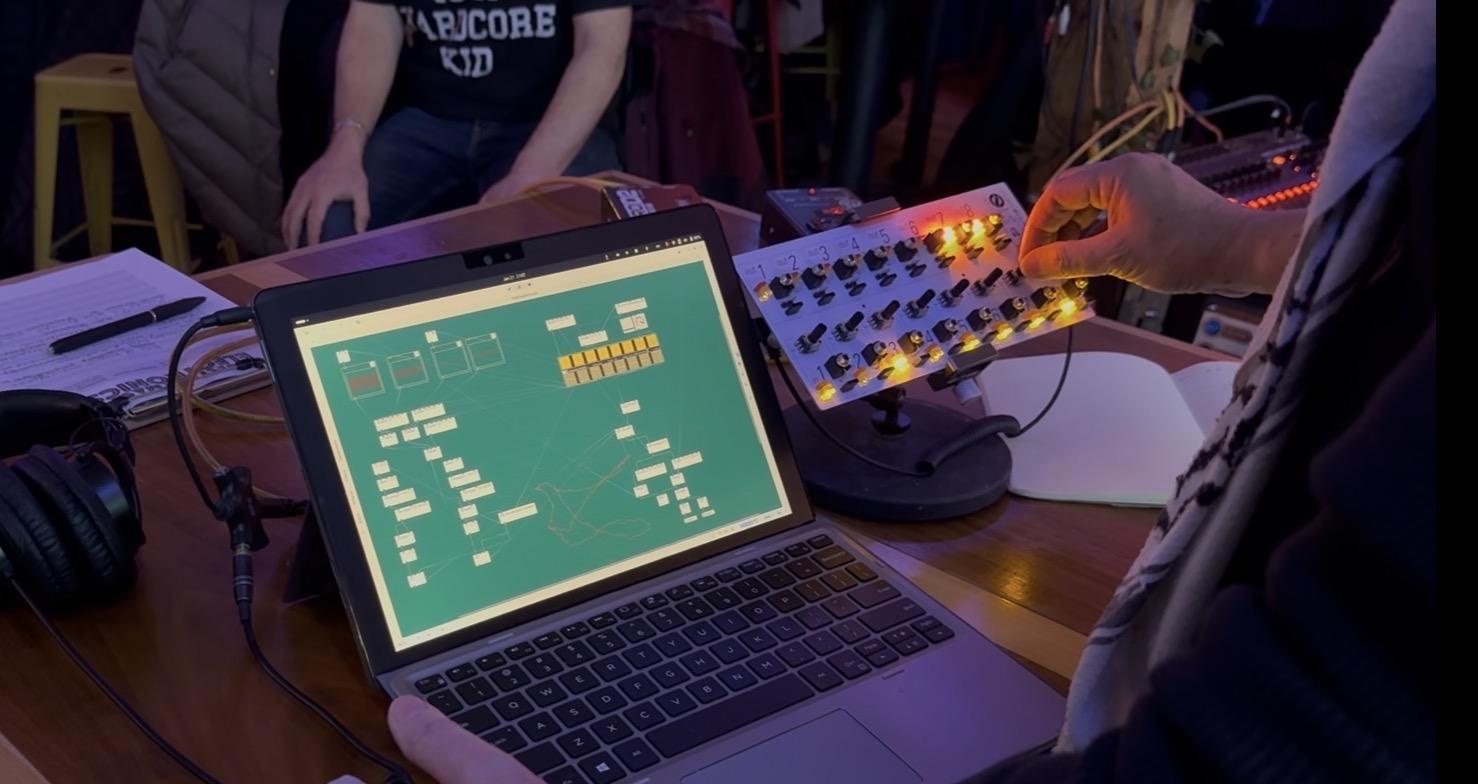
I’m on the left there, with @hissquiet taking video of me.The plugdata patch and the Palette in action.
2026-01-19

Working on this again. A diy wireless, small sensor for dance/movement. To trigger interactive compositions with movements. So much fun (even though for now it's only triggering one chord 😂) #plugdata #puredata #arduino

2026-01-10

10 days of using #asahi daily.

It's been a really smooth experience so far.

Been playing mostly with #supercollider and doing some recreational programming.

I want to get more into #plugdata as my #maxmsp alternative for when I am on Linux, but the current version has some visual issues.

Using #puredata vanialla with the touchpad is just awful though.

Feels like the "hot zone" around node connections spans just a couple pixels and makes the entire patching experience kinda unpleasant.

2026-01-04

Today, I got past the mysterious technical problem I’ve been having with the #ObliquePalette and I’m back to building a creative technology out of and for the propagation of hope.

The Oblique Palette asserts that computers are for you to explore new regions of human creativity.

Livepatch in #plugdata. Control with weird controllers or
#eurorack modules.

Send out sound or CV from your patch to other modules and your mad science electronics.

Make it dance with the servo outputs.

2025-12-06

I can have PlugData running *inside* of Bespoke Synth.

#BespokeSynth #PlugData

2025-12-05

Takumi Ogata just published this #daisysynth patch for #plugdata and its Heavy compiler to build a hardware granular
synthesizer.

I’ve been wanting to build a live looping instrument that does this.

But I’ve also been thinking of granularizing a wavetable in case that project was going to be simple enough that I’d just finish it.

Gonna try to do the easy, simple thing first, like I tell my students.

youtube.com/watch?v=0vWgR7alH7Y

Jef VerbeeckJefverbeeck
2025-11-15

@lislegaard Puredata / Plugdata (newbie) user here. It feels pretty active in development: both softwares had updates pretty recently and have active communities on Discord.

2025-11-15

I don't want to write midi input handling in patch cables, it would be an absolute unmanageable mess, but I do want a sane development loop so puredata and lua is what it is.

#Lua #PureData #PlugData

2025-11-15

Couple more hours with pdlua. lrex-pcre2 (rex_pcre2) is giving `undefined symbol: lua_checkstack`

I *think* this is something to do with the pdlua lua interpreter being statically linked so it looks like I'll have to build the whole toolchain.

#PureData #Plugdata #Lua

2025-11-08

A few hours messing about with #PlugData and #Lua. Can't get my head around luapath right now and there's a couple dependencies that Haxe pulls in that I'd rather not mess with.

#PureData #Haxe

2025-11-05

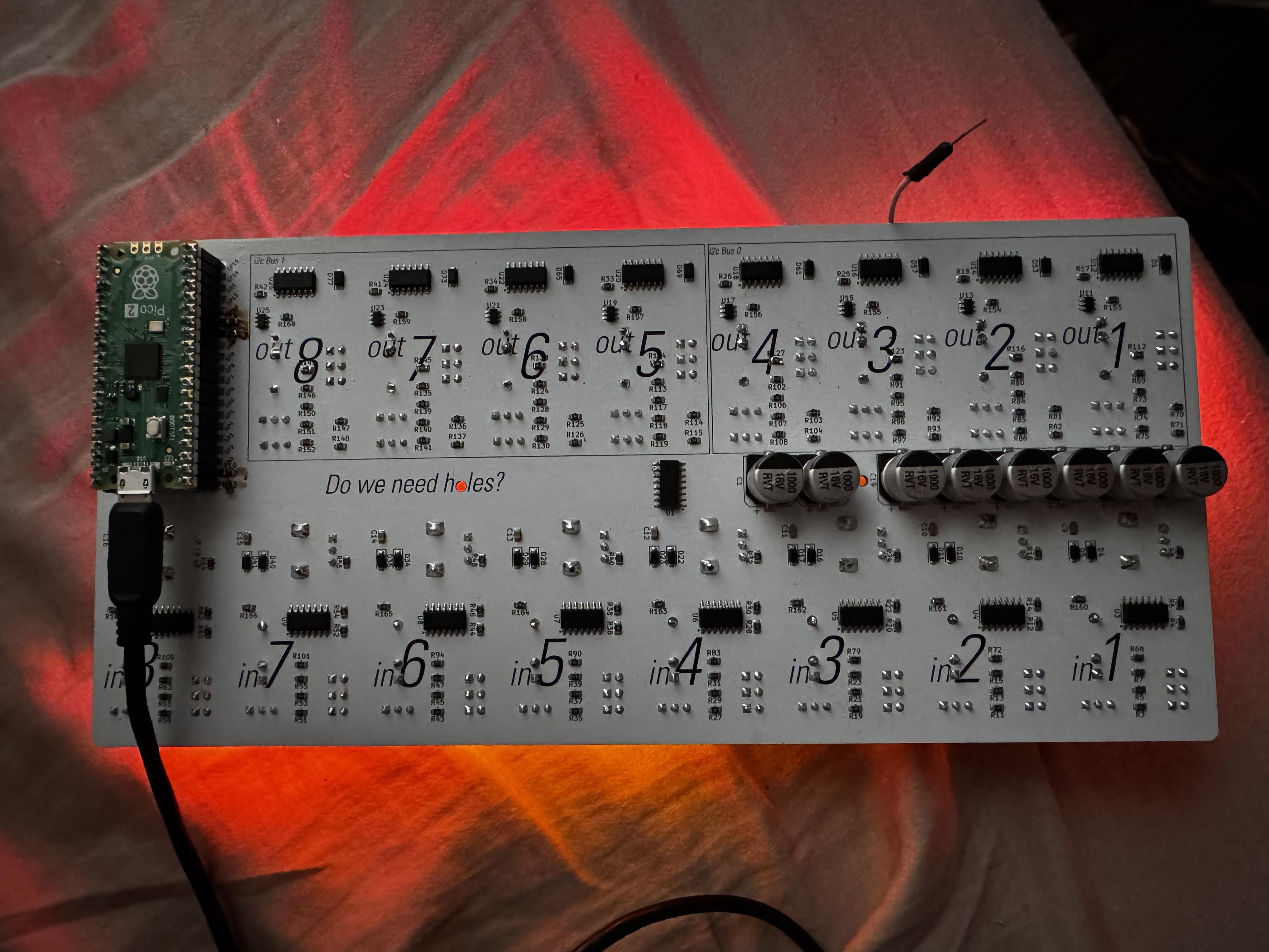
I went to take a picture of the back of the #ObliquePalette prototype 0.5.5 and it came out like this. So I gotta share.

The front, in the second image shows the inputs & outputs. Analog knobs, 3.5mm jacks for Eurorack, pin headers for Arduino (or other electronics) & servos.

(It's for turning computers into machines for making art, fucking around, and falling in love. You talk with it using the extremely powerful graphical language, #plugdata.)
#modularsynt #synthdiy #eurorack #computerart #

The back of a white circuitboard, with labels on each section. In channels 1-8. Out channels 1-8. They're divided into sections 12C bus 0 and 12C bus 1.
On the left is a Raspberry Pi Pico2 that communicates between the board and the host computer. On the right are a line of large capacitors to supply servos with power and keep them from corrupting data with their current draw.
2025-10-31

Do you wish computers were for you to make art with, and not just to make money for your boss's boss?

Then you probably want in on the Oblique Palette project. Make a computer that's part of a #modularsynth that has #robot parts and is programmed with #plugdata

Let's make the future we wanted.

patreon.com/posts/oblique-pale

The Oblique Palette is a control panel with eight analog knob inputs and eight analog (and servo!) outputs. It has little blinky lights to tell you the voltage level you're communicating on each channel.
Not shown: the plugdata patch that controls these inputs and outputs, allowing you full programming control of voltage levels, sampling both the real world (either through twisting knobs or by designing controllers) and the outputs of electronic instruments, and returning programmed responses in the form of control voltage and servo rotation.
It's for making computers that are for making art, fucking around, and falling in love.
2025-10-30

PlugData is a concatenation of several related projects, and allows a user to include objects from any of these projects.

It can also compile to a plugin by means of an included project called Heavy.

But Heavy doesn't support all of the included objects. It doesn't even support all of vanilla PD. So if you want to use delay~, well, you can't.

So what's the advantage of writing your Heavy patch in an IDE that will allow you to build, prototype and test a bunch of stuff that will never compile? There's a way to build a patch in "Compile Mode" which will tell you if your objects won't work, but turning on that mode after you've built a patch is too late. It does not appear to generate a report.

tl;dr If you want flexibility in terms of compiled output type, use Faust

#PureData #PlugData #Faust

2025-10-29

Hoolleee shitballs. The #ObliquePalette might be feature complete.

8 analog in.

8 analog out.

A hardware #plugdata object you program graphically.

(thanks to @ArchiteuthisFlux& the Jumperless krewe for finding the hardware bug!)

I can now control #plugdata software patches with #modularsynth CV or by twisting a knob — and the patch can control hardware with control voltages or by twisting a servo!

Computers are for making art, fucking around, and falling in love.

HTTPS://Patreon.com/joshua

Charles ☭ :trans: is a Greencelesteh@hachyderm.io
2025-10-29

Ok, so I have a panning algorithm I could port to #plugData. It was one audio inlets and one data inlet (the pan knob) and two audio outlets.

I want to use this with #ardour, so ideally, it would replace the built-in panning on the tracks that used it.

Is this complicated?

(Is there a more modular DAW I could use? I just want to scoot audio regions back and forth in a multi track system and automate faders and plugins and be able to bounce to disk.)

#linux

stutterbughedron@ieji.de
2025-10-20

here's how the patch has been shaping up since yesterday

#puredata #plugdata #synth #audio #music

stutterbughedron@ieji.de
2025-10-19

finally started properly trying out #puredata / #plugdata

#synth #audio #music

2025-10-17

Prototype 0.5.5 of the #ObliquePalette is in! I’m 75% sure it’ll work, though I’m hunting a comms bug in the firmware.

The honorary bit portrait on this one is Susan Kare, the original graphic designer of the Macintosh, creator of the I-beam and finger cursors, little house for representing “home” in HyperCard — the direct ancestor of the Web —and so many icons we take for granted now.

It’s just barely possible that I will have voltage control of and by #plugdata this weekend!

A hand is holding a rectangular electronic board with numerous components attached. The board is primarily white with black accents and features eight rows of input and output jacks, arranged in two columns. The top column is labeled "out 1" through "out 8", and the bottom column is labeled "in 1" through "in 8". Each jack has a variety of colored wires connected to it. A logo and text are present on the top right corner of the board, reading "oblique" and the version number, “palette prototype 0.5.5”A person is holding a white rectangular circuit board with numerous electronic components on it. The board has eight vertical columns of components, each labeled with "in" and a number from 1 to 8 at the bottom, and "out" and the corresponding number at the top. Each column features a series of small, dark-colored electronic parts, possibly resistors or diodes, arranged in a grid pattern. A row of eight cylindrical capacitors is centered on the board between the columns of components. A Raspberry Pi Pico2 microcontroller board is attached to the left side of the white board. The text "Do we need holes?" is written on the white board, with the “o” replaced by a mounting hole.
xoroxxorgrox
2025-10-14

is good. It have a lot of good ui ideas implemented nicely but when it comes to performance vinilla wins. I using Linux with realtime kernel and when it comes to processing resources I become really greedy. The downside of vanilla is that you have to dig into tcl plugins to make UX better but there is really nothing even close to how pure data performing (MAX map, etc all bloated).

Client Info

Server: https://mastodon.social
Version: 2025.07
Repository: https://github.com/cyevgeniy/lmst