#SNN

Fabrizio MusacchioFabMusacchio
2026-02-19

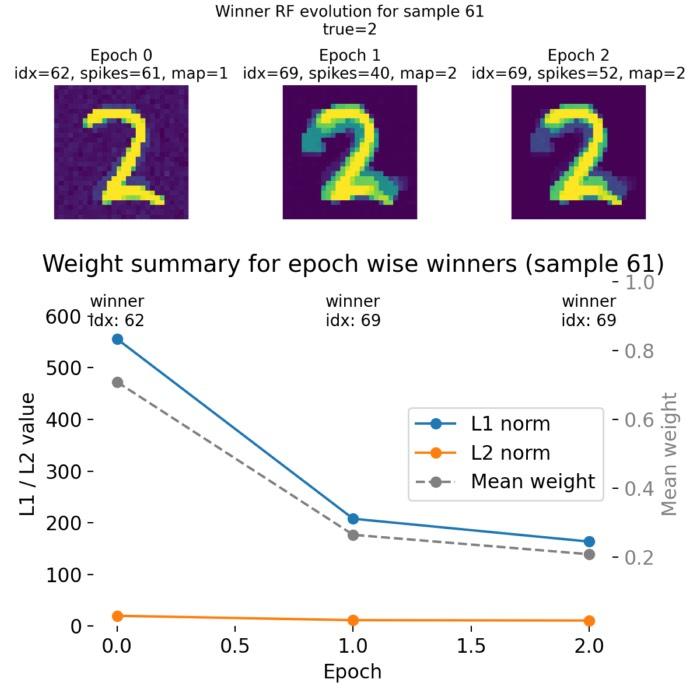
Just came across an elegant new framework called by Maskeen and Lashkare, which implements a two layer SNN w/ local to classify, e.g., digits. Here is an example, where I apply it to a 6-class subset of MNIST. The model reaches around 85% accuracy & the learned synapses show digit-like patterns. Quite impressive in my view, given the simplicity of the architecture & the local learning rule:

🌍fabriziomusacchio.com/blog/202

Top: Evolution of the receptive field of the winner neuron across epochs for sample 61, visualized as tiles. Each tile shows the RF of the winner neuron at a specific epoch, allowing us to see how it evolves during training. The title of each tile indicates the epoch number, the index of the winner neuron, its spike count, its mapped label according to the final neuron label map, and the true label of the sample. Bottom: Summary plot of weight metrics (L1 norm, L2 norm, and mean weight) for the winner neurons across epochs for sample 61.Learned synapses, visualized by summing over output neurons of the same predicted class. We trained the model on the classes 0 to 5, and we can see that the learned synaptic patterns for each class show distinct features that resemble the corresponding digit shapes, indicating that the network has successfully learned to differentiate between the classes based on the input spike patterns.Confusion matrix, row-normalized.
Fabrizio MusacchioFabMusacchio
2026-02-17

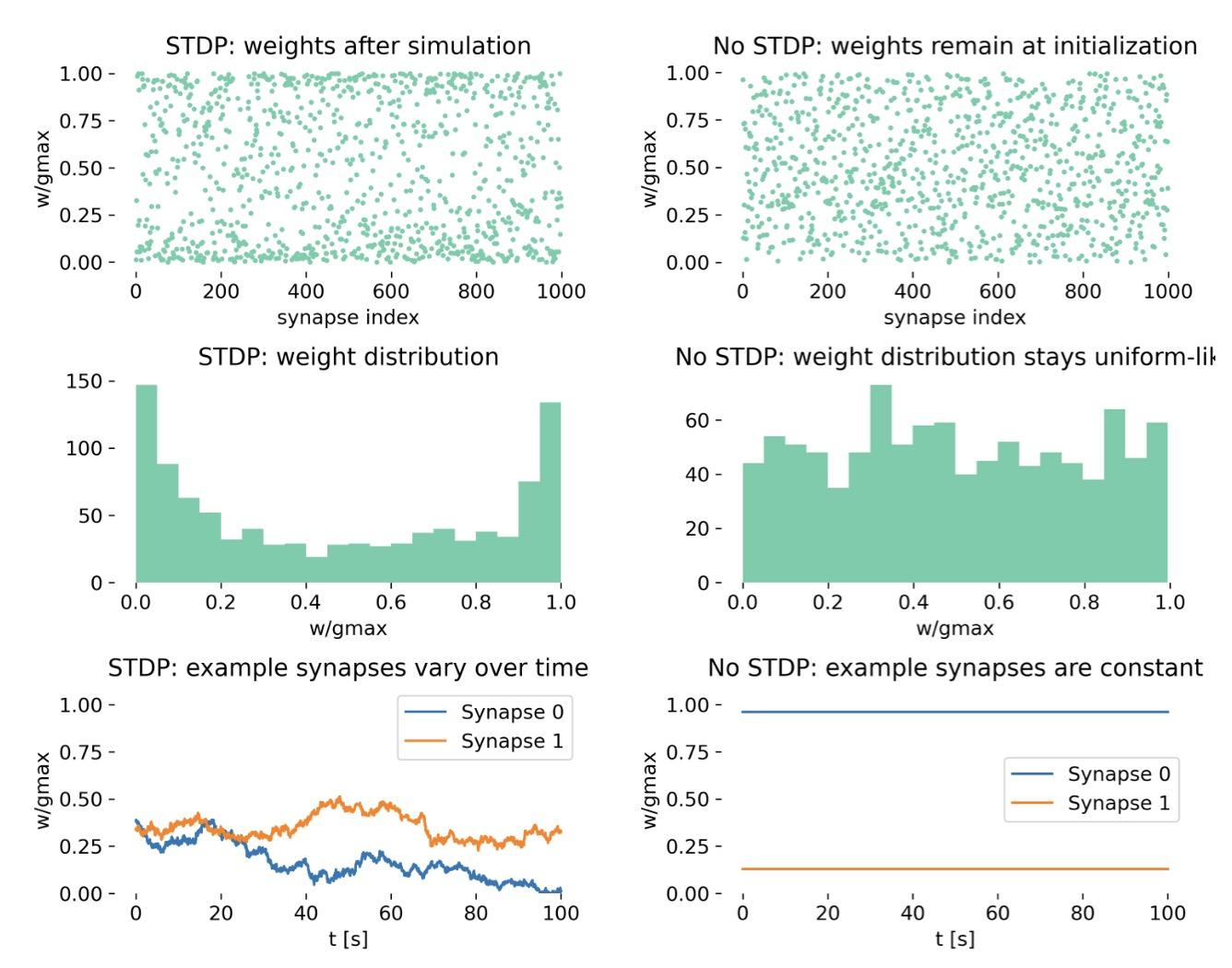
Spike-timing-dependent (#STDP) is a core rule in that adjusts strength based on precise pre- vs. postsynaptic timing, enabling and in . In this post, I summarize its mathematical formulation, functional consequences for learning and along with a simple example:

🌍 fabriziomusacchio.com/blog/202

STDP learning window W(Ξ”t) as a function of the relative spike timing Ξ”tSynaptic weight dynamics with and without spike-timing-dependent plasticity. Left: STDP-enabled network. Synaptic weights differentiate over time and converge toward a bimodal distribution. Right: Control simulation without STDP. Synaptic weights remain at their initial random values and show no dynamical reorganization. Top panels show the final synaptic weights, middle panels show the distribution of synaptic weights, and bottom panels show the time course of two example synapses.
Fabrizio MusacchioFabMusacchio
2026-02-05

Incorporating structural in (#SNN) enables dynamic connectivity, reflecting the 's adaptability. By modeling synaptic growth and pruning based on concentration, we can simulate processes such as and . In this post, I reproduce the tutorial on structural plasticity, demonstrating its impact on network stability and :

🌍 fabriziomusacchio.com/blog/202

Sketch illustrating structural plasticity during learning and memory formation. The sketch illustrates the dynamic remodeling of synaptic connectivity through dendritic spine turnover. Left: Under baseline conditions, synaptic networks exhibit continuous formation and elimination of dendritic spines, reflecting ongoing structural plasticity. Middle: During learning or learning related activity, this baseline turnover is transiently increased, leading to enhanced formation and pruning of synaptic contacts. Newly formed spines preferentially emerge near previously activated synapses, promoting the local clustering of synaptic inputs and enabling adaptive rewiring of circuits. Right: A subset of newly formed and activated synapses becomes selectively stabilized, providing a structural substrate for the long term retention of behaviorally relevant connections and memory traces. Source: Bernardinelli, Y., Nikonenko, I., Muller, D., Structural plasticity: mechanisms and contribution to developmental psychiatric disorders, Frontiers in Neuroanatomy, 2014, 8:123, DOI 10.3389/fnana.2014.00123κœ› (license: CC BY 4.0).Simulation results of the structural plasticity model. The plot shows the temporal evolution of the mean calcium concentration of excitatory and inhibitory neurons (blue and red lines, respectively) and the total number of connections of excitatory and inhibitory neurons (magenta and black dashed lines, respectively). The horizontal lines represent the growth curves for excitatory (blue) and inhibitory (red) neurons. The model demonstrates how the network’s connectivity changes over time based on the calcium concentration in the neurons. The growth curves determine the threshold at which synapses are created or pruned.
πŸ…±πŸ…ΈπŸ…ΆπŸ…ΎπŸ†πŸ†πŸ…΄.πŸ…ΎπŸ†πŸ…Άbigorre_org
2026-01-25

How many runways can you see for Shannon airport (Ireland) ? : The answer is on bigorre.org/aero/meteo/einn/en vl

aboveFRLaboveFRL
2026-01-19

ICAO: 4CAE61
Flt: RYR2WJ -
First seen: 2026-01-19 14:00:13 CET
Min Alt: 10960 m AGL
Min Dist: 0.2 km

globe.adsbexchange.com/?icao=4

aboveFRLaboveFRL
2026-01-17

ICAO: 4CADE7
Flt: RYR2WJ -
First seen: 2026-01-17 22:44:26 CET
Min Alt: 10960 m AGL
Min Dist: 3.36 km

globe.adsbexchange.com/?icao=4

πŸ…±πŸ…ΈπŸ…ΆπŸ…ΎπŸ†πŸ†πŸ…΄.πŸ…ΎπŸ†πŸ…Άbigorre_org
2026-01-16

How many runways can you see for Shannon airport (Ireland) ? : The answer is on bigorre.org/aero/meteo/einn/en vl

aboveFRLaboveFRL
2026-01-15

ICAO: 4CADE6
Flt: RYR9DD -
First seen: 2026-01-15 12:54:34 CET
Min Alt: 10960 m AGL
Min Dist: 3.18 km

globe.adsbexchange.com/?icao=4

aboveFRLaboveFRL
2026-01-14

ICAO: 4008B3
Flt: BAW9274 -
First seen: 2026-01-14 19:59:44 CET
Min Alt: 3040 m AGL
Min Dist: 20.97 km

globe.adsbexchange.com/?icao=4

aboveFRLaboveFRL
2026-01-11

ICAO: 4D2501
Flt: RYR2WJ -
First seen: 2026-01-11 01:12:32 CET
Min Alt: 11569 m AGL
Min Dist: 2.93 km

globe.adsbexchange.com/?icao=4

2026-01-09

Boeren in de provincie Groningen kunnen vanaf 16 januari subsidie aanvragen voor investeringen in duurzame landbouw. Het gaat om steun voor machines en installaties die (jonge) bedrijven toekomstbestendig maken.

#Landbouwtransitie #verduurzaming #SNN
rtvzulthe.nl/westerkwartier/pr

aboveFRLaboveFRL
2026-01-04

ICAO: 4CA9CC
Flt: RYR9DD -
First seen: 2026-01-04 23:08:30 CET
Min Alt: 10952 m AGL
Min Dist: 22.58 km

globe.adsbexchange.com/?icao=4

aboveFRLaboveFRL
2026-01-03

ICAO: 4D2300
Flt: RYR2WJ -
First seen: 2026-01-04 00:18:15 CET
Min Alt: 11561 m AGL
Min Dist: 0.08 km

globe.adsbexchange.com/?icao=4

aboveFRLaboveFRL
2026-01-03

ICAO: 4CA704
Flt: RYR9DD -
First seen: 2026-01-03 12:27:51 CET
Min Alt: 10960 m AGL
Min Dist: 19.32 km

globe.adsbexchange.com/?icao=4

πŸ…±πŸ…ΈπŸ…ΆπŸ…ΎπŸ†πŸ†πŸ…΄.πŸ…ΎπŸ†πŸ…Άbigorre_org
2026-01-01

Aviation weather for Shannon airport (Ireland) is β€œEINN 011200Z 31005KT 9999 FEW015 SCT050 BKN200 07/05 Q1017 NOSIG” : See what it means on bigorre.org/aero/meteo/einn/en vl

πŸ…±πŸ…ΈπŸ…ΆπŸ…ΎπŸ†πŸ†πŸ…΄.πŸ…ΎπŸ†πŸ…Άbigorre_org
2025-12-31

How many runways can you see for Shannon airport (Ireland) ? : The answer is on bigorre.org/aero/meteo/einn/en vl

aboveFRLaboveFRL
2025-12-31

ICAO: 4CA9EC
Flt: RYR2WJ -
First seen: 2025-12-31 13:27:55 CET
Min Alt: 10960 m AGL
Min Dist: 2.85 km

globe.adsbexchange.com/?icao=4

aboveFRLaboveFRL
2025-12-30

ICAO: 4D23FB
Flt: RYR2WJ -
First seen: 2025-12-30 07:35:21 CET
Min Alt: 11569 m AGL
Min Dist: 2.26 km

globe.adsbexchange.com/?icao=4

aboveFRLaboveFRL
2025-12-24

ICAO: 4CA9EC
Flt: RYR2WJ -
First seen: 2025-12-24 13:20:00 CET
Min Alt: 10960 m AGL
Min Dist: 2.07 km

globe.adsbexchange.com/?icao=4

πŸ…±πŸ…ΈπŸ…ΆπŸ…ΎπŸ†πŸ†πŸ…΄.πŸ…ΎπŸ†πŸ…Άbigorre_org
2025-12-21

Aviation weather for Shannon airport (Ireland) is β€œEINN 211300Z 03006KT 9999 FEW006 BKN070 BKN140 06/05 Q1005 NOSIG” : See what it means on bigorre.org/aero/meteo/einn/en vl

Client Info

Server: https://mastodon.social
Version: 2025.07
Repository: https://github.com/cyevgeniy/lmst