#TheGrackleProject

Corina Logan (she/sie/ella)CorinaLogan@nerdculture.de
2025-11-04

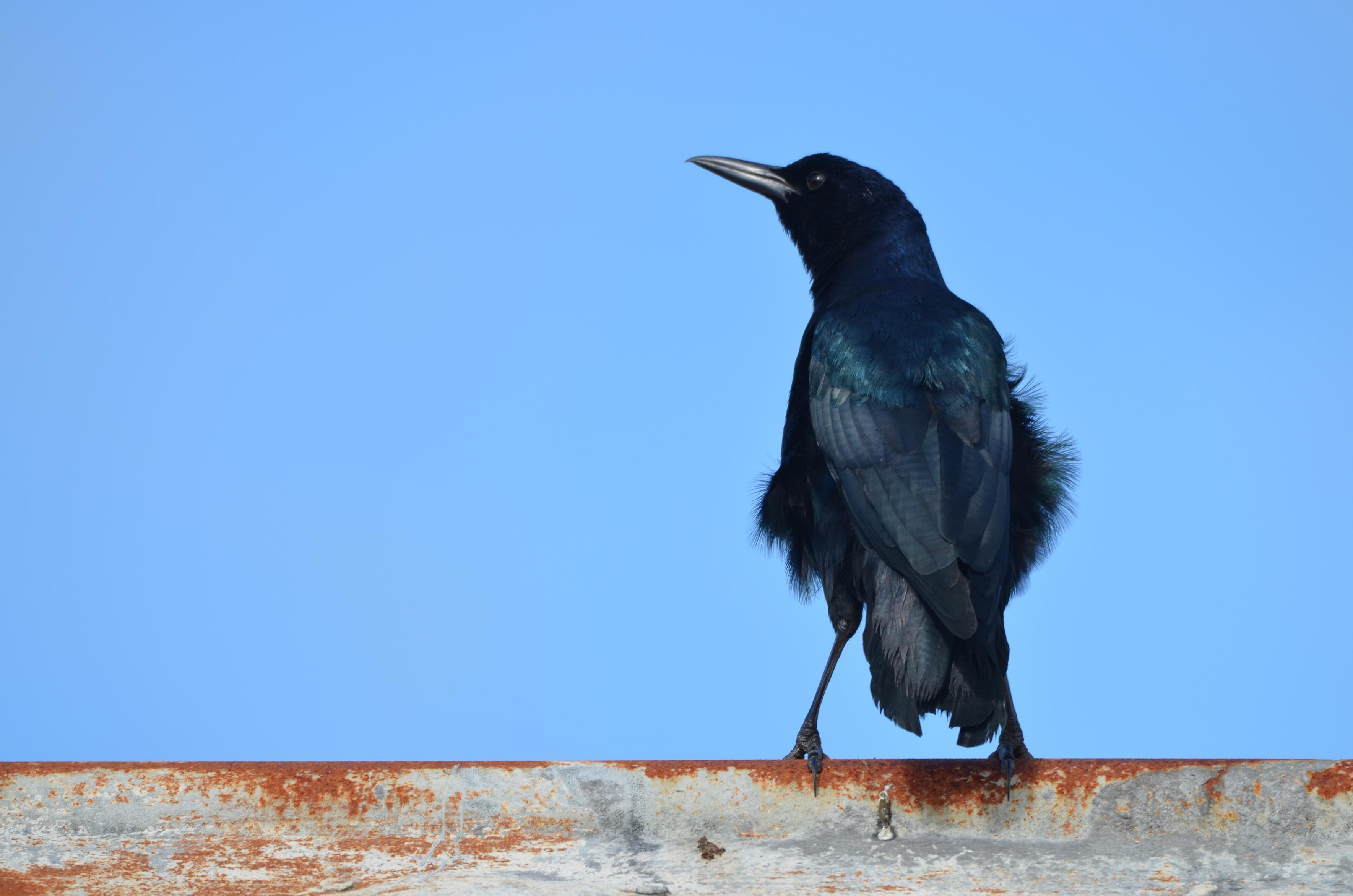
Grackles are amazing. This is aqua purple standing on top of a tower waiting for me to set up the test so he can do a bunch of trials in his reversal learning task

I trained them to come to the towers and wait for me when they are ready to be tested. Sometimes it takes me 5 minutes to set up the test and they just stand there waiting

What I love is that they tell me when they want to do tests and we both understand what the other wants. These are wild birds who willingly (and eagerly!) participate in behavioral choice tests, even when they get frustrated when the rules change (that is part of the test)

#TheGrackleProject #ManyIndividuals

Grackle, aqua purple, standing on top of a tower waiting for me to set up the test
2025-10-19

Fieldwork simplifies bird identification: the bird on the left is "not a grackle", the bird in the middle is "not a grackle", as is the bird on the right #TheGrackleProject

For actual ID's see alt text.

Photo of a small bird, a yellow-rumped warbler. Credit Dieter LukasPhoto of a bird, a acorn woodpecker. Credit Dieter LukasPhoto of a bird, a California scrub-jay. Credit Dieter Lukas
Corina Logan (she/sie/ella)CorinaLogan@nerdculture.de
2025-10-09

I started Aqua Purple’s behavioral observations a few weeks ago and it has been difficult to follow him for long periods of time.

Why? He is a magician! One second, I see him under a car in the parking lot. The next second, he has vanished 🪄 into thin air. I search 🔍 for several minutes, but usually can’t refind him. Where did he go? 👀

When I am able to keep him in sight, he is quite the buffet bird - he goes back and forth through the parking lots finding food along the way.

When he finds a piece of food, he likes to eat lots of it before moving on.

And he is big on napping 💤 - loves his naps under cars 🚗 or in a palm 🌴
#TheGrackleProject #ManyIndividuals

Great-tailed grackle, Aqua Purple, foraging in Santa Barbara, California
Corina Logan (she/sie/ella)CorinaLogan@nerdculture.de
2025-09-26

Aqua Aqua also remembers the feeders we use for testing - I started habituating the new grackles to the test feeder this week and Aqua Aqua came running over to get some free food. He was a bit hesitant to take a piece of food from the feeder tray at first, but he warmed up quickly and kept coming back for more.

It had been 10 months since he last saw one of these feeders!
#TheGrackleProject #ManyIndividuals

Male great-tailed grackle, Aqua Aqua, walking in a park
Corina Logan (she/sie/ella)CorinaLogan@nerdculture.de
2025-09-26

Further evidence in support of grackles remembering specific humans (or maybe the trap in this case), is Red who also hadn’t seen us for 9 months. Last week, he approached us where we were trapping. He stood on the picnic table next to us, 👀 staring at us and the trap, then flew off.

This is not how a grackle who has never seen us before or grackle that is indifferent to us approaches us or the trap. This indicates that Red recognized us and/or the trap
#TheGrackleProject #ManyIndividuals

Male great-tailed grackle, Red, standing on the arm of a chair at a cafe on the beach
Corina Logan (she/sie/ella)CorinaLogan@nerdculture.de
2025-09-26

9 months after I last saw him, great-tailed grackle, Aqua Aqua remembered me! When I returned a couple of weeks ago and he first saw me, he came close, stared at me, and was probably waiting for something interesting to happen (like a test or something).

❓ Grackle #memory is something we have wondered about on #TheGrackleProject. Do the individuals we work with remember us? If so, for how long?

We know that grackles can recognize individual humans because when we used to do tests in aviaries with them, sometimes a grackle would only work with one of us (or sometimes only one gender, which can be tricky on a team with mostly women!).

But after we released them to the wild, they didn’t treat us differently from other humans. It wasn’t clear whether they just didn’t care, or didn’t recognize us. I think Aqua Aqua has answered this question! ✅

#ManyIndividuals

Corina Logan (she/sie/ella)CorinaLogan@nerdculture.de
2025-08-18

🙏 A huge thank to the many people involved in making this research happen! The acknowledgements sections of both articles are huge!

❤️ Of course, we couldn’t have done this without the amazing support from Richard McElreath and the Dept. of Human Behavior, Ecology and Culture at the Max Planck Institute for Evolutionary Anthropology

💕 The University of California Santa Barbara has been the steady supporter over all of the years of #TheGrackleProject - providing a home and a place to base the (many!) permits out of, and support through cooperation agreements - thank you!

📰 Press release: mpg.de/25179774/0811-evan-expl
📎 Articles: doi.org/10.24072/pcjournal.593 and doi.org/10.24072/pcjournal.591

Female grackle on a fence in Sacramento, California
Corina Logan (she/sie/ella)CorinaLogan@nerdculture.de
2025-08-18

Great-tailed grackles in a #population toward the northern edge of their #range (Sacramento/Woodland, California) were less #related to each other, which means that they #dispersed farther from where they hatched 🐣 than grackles in a population nearer the center of their range (Tempe, Arizona).

In particular, females in Arizona stay closer to home 🏡 than males, while females in California disperse farther away from home ✈️ like the males do. To keep pushing the edge of the geographic range further, both males and females must be present so they can breed in the new areas.

Now we know that there are 2 things that are different about the grackles on the edge: they are more #persistent and they disperse farther from where they hatched (especially the females)

Thanks to @DieterLukas for leading this article on grackle genetics and dispersal! #TheGrackleProject

📰 Press release: mpg.de/25179774/0811-evan-expl
📎 Article: doi.org/10.24072/pcjournal.591

A flock of grackles flying in the mist in Sacramento, California

#Vogelarten: Erkundungsfreude & geringere Sesshaftigkeit treiben schnelle Ausbreitung in neue Gebiete voran. 🐦‍⬛ Zwei neue Studien @peercomjournal.bsky.social von einem intl. Team um Corina Logan, @dieterlukas.fediscience.org.ap.brid.gy & Kelsey McCune. #TheGrackleProject www.mpg.de/25181118/081...

Erkundung neuer Gebiete und ge...

Corina Logan (she/sie/ella)CorinaLogan@nerdculture.de
2025-08-18

Even though we measured 4 behaviors: #exploration of new environments and novel objects, #boldness, persistence, and motor diversity, only 2 were consistent across individuals (exploration of a new environment 🔎 & persistence :loading: ). Consistency indicates it’s a stable trait that can be compared with other stable traits (like flexibility)

After the reliability analyses, we then knew that we could conduct the analyses to see if exploration and persistence correlated with behavioral flexibility. We found that the flexibility-trained grackles were more exploratory, but there was not a strong relationship with persistence. Perhaps exploration helps them figure out what is functional/useful in their environment so they can use their flexibility to make good choices

Thanks to Kelsey McCune for leading this article and rocking the individual differences angle! #TheGrackleProject

📰 Press release mpg.de/25179774/0811-evan-expl
📎 Article doi.org/10.24072/pcjournal.593

Three female grackles foraging in a shopping mall parking lot in Sacramento, California
Corina Logan (she/sie/ella)CorinaLogan@nerdculture.de
2025-08-18

🪧 2 new articles from #TheGrackleProject!

🔍 Grackles who were #trained to be more #flexible were more #exploratory after the training than untrained grackles. This indicates that the more an individual investigates a novel object, the more it can learn and adapt its #behavior accordingly

✈️ Grackles in an edge #population disperse farther than those in a more central population. This suggests that the rapid geographic range expansion of great-tailed grackles is associated with individuals differentially expressing #dispersal behaviors

🗺️ These results suggest that flexibility, exploration, and dispersal are key traits involved in this species’ rapid expansion into new areas

💪 They started as #RegisteredReports @ #PCIEcology @PeerCommunityIn years ago! After lots of hard work from many collaborators (including @DieterLukas) they are now at the #diamondOA @PeerCommunityJournal 🎉

📰 Press release: mpg.de/25179774/0811-evan-expl
📎 Articles: doi.org/10.24072/pcjournal.593 and doi.org/10.24072/pcjournal.591

Male great-tailed grackle on a shopping mall sign in Sacramento, California
2025-08-06

„behavioral flexibility, while helpful in allowing birds to adapt to new environments, is not the primary facilitator for range expansion“

news.ucsb.edu/2025/021980/both

#TheGrackleProject

A great tailed grackle, a black slender bird with a long tail, is eating fast food cheese sauce in a parking lot. Photo credit C. Logan

Urban #bird species' key to success: flexibility & persistence. New studies on #grackles by Corina Logan, @dieterlukas.fediscience.org.ap.brid.gy‬, Kelsey McCune & colleagues in @peercomjournal.bsky.social. #TheGrackleProject tinyurl.com/yh5ruyr8 & doi.org/10.24072/pcj... & doi.org/10.24072/pcj...

When the city comes to you, ge...

Erfolgsrezept urbaner #Vogelarten: Flexibilität und Beharrlichkeit. Neue spannende Studien zu #Grackeln von einem intl. Forschungsteam um Corina Logan, @dieterlukas.fediscience.org.ap.brid.gy & Kelsey McCune in @peercomjournal.bsky.social. #TheGrackleProject www.mpg.de/25003256/070...

Erfolgsrezept: Flexibilität un...

Corina Logan (she/sie/ella)CorinaLogan@nerdculture.de
2025-07-22

There are so many people to thank who were involved in making this research happen! The acknowledgements sections of both articles are massive - it took a village to do this research!

None of it would have been possible without the immense amount of support from Richard McElreath and the Dept. of Human Behavior, Ecology and Culture at the Max Planck Institute for Evolutionary Anthropology 💕

The University of California Santa Barbara has been the steady supporter over all of the years of #TheGrackleProject - providing a home base for the project, a place to base the (many!) permits out of, and support through cooperation agreements - thank you! 💓

Corina Logan (she/sie/ella)CorinaLogan@nerdculture.de
2025-07-22

The growing body of research we have been conducting on #TheGrackleProject is showing that #behavioral #flexibility enables birds to #adapt to #human #modified #habitats 🌆 , but plays a smaller role in expanding into new #geographic areas 🗺️

Moving to new towns likely involves more #persistence because we previously found that grackles on the edge of their range in northern California had similar levels of average flexibility (though higher variance), but were more persistent than grackles nearer the center of their range in Arizona peercommunityjournal.org/artic

This is also supported by the fact that the preliminary data we were able to collect on persistence in boat-tailed grackles (who are not rapidly expanding their geographic range) showed that they are less persistent than great-tailed grackles, while having similar levels of flexibility
Articles: doi.org/10.24072/pcjournal.573 and doi.org/10.24072/pcjournal.582
Press release: mpg.de/25000634/0701-evan-when

Male boat-tailed grackle on top of a roof at a cattle farm in Florida
Corina Logan (she/sie/ella)CorinaLogan@nerdculture.de
2025-07-22

#Behavioral #flexibility is not the primary facilitator of a rapid #range expansion. Although we found high levels of flexibility in 2 successful urban bird species (great-tailed & boat-tailed grackles), only one (great) is rapidly expanding its range. This suggests flexibility alone doesn't drive rapid range expansions

#TheGrackleProject went to Florida to study boat-tailed grackle flexibility and compare it with the great-tailed grackles. These species look and behave so similarly, if they were right next to each other, I couldn’t tell them apart (except greats have yellow irises and these boats had brown irises). They are parking lot birds through & through! 🅿️

But in the aviaries, it becomes obvious really quickly that the great-tailed grackles are much more persistent - they will try and try to solve something, whereas a boat-tailed grackle often just sits on their perch 🐥, looks at the apparatus & decides not to even try

doi.org/10.24072/pcjournal.582
mpg.de/25000634/0701-evan-when

Female boat-tailed grackle in a gas station parking lot, walking under a truck-trailer hitch
Corina Logan (she/sie/ella)CorinaLogan@nerdculture.de
2025-07-22

In the process of studying #behavioral #flexibility in great-tailed grackles on #TheGrackleProject, we discovered 🎉 a new measure of flexibility! The grackles that were more flexible in the reversal learning test also switched between eating different food types more often in the wild 🌮 🍿 🍪 🍒

This is such an exciting discovery because it is really difficult to bring birds into aviaries to measure their flexibility. Now we have the ability to measure their flexibility just by watching them in the wild!

This will make studying flexibility much more accessible to a wide range of researchers because, apart from needing to be able to tell the individuals apart, all that is needed is a pair of binoculars
Article: doi.org/10.24072/pcjournal.573
Press release: mpg.de/25000634/0701-evan-when

Three female grackles foraging on a sidewalk in a shopping mall parking lot
Corina Logan (she/sie/ella)CorinaLogan@nerdculture.de
2025-07-22

⁉️ How do you train a grackle to be more flexible? Serial reversal learning! #TheGrackleProject has them form a color 🎨 preference, and then reverse the preference over and over again until they get fast at reversing (it only takes 6-8 reversals to get fast)
nerdculture.de/@CorinaLogan/11
doi.org/10.24072/pcjournal.284

The wide ranging effects of the flexibility training led us to start the #ManyIndividuals project to see whether we can train threatened and endangered species to be more flexible, and if this helps them survive in human-modified environments (where the grackles shine)
github.com/ManyIndividuals/Man

Client Info

Server: https://mastodon.social
Version: 2025.07
Repository: https://github.com/cyevgeniy/lmst