
This 1981 paper described an online help browser and authoring environment for TI or MIT Lisp Machines. The paper is interesting as it also briefly reviewed the state of online help systems at the time.
#lispmachine
Tim Bradshaw discusses the myths around Lisp Machines and why they were probably never competitive.
https://www.tfeb.org/fragments/2025/11/18/the-lost-cause-of-the-lisp-machines

@amoroso @interlisp left scrollbars were a thing on #lispmachine systems. Genera image attached. Probably something where the MIT Lisp Machine was inspired by Interlisp-D or Smalltalk?

In the 1980s some Xerox Lisp Machines came with an IBM PC/XT expansion card that allowed running MS-DOS software from the Interlisp-D environment, like the black window of a spreadsheet program at the bottom left. This screenshot is from a flyer of the Xerox 1186 AI workstation.
https://groups.google.com/g/lispcore/c/aCC34TmRSmc/m/KQwufgfABQAJ

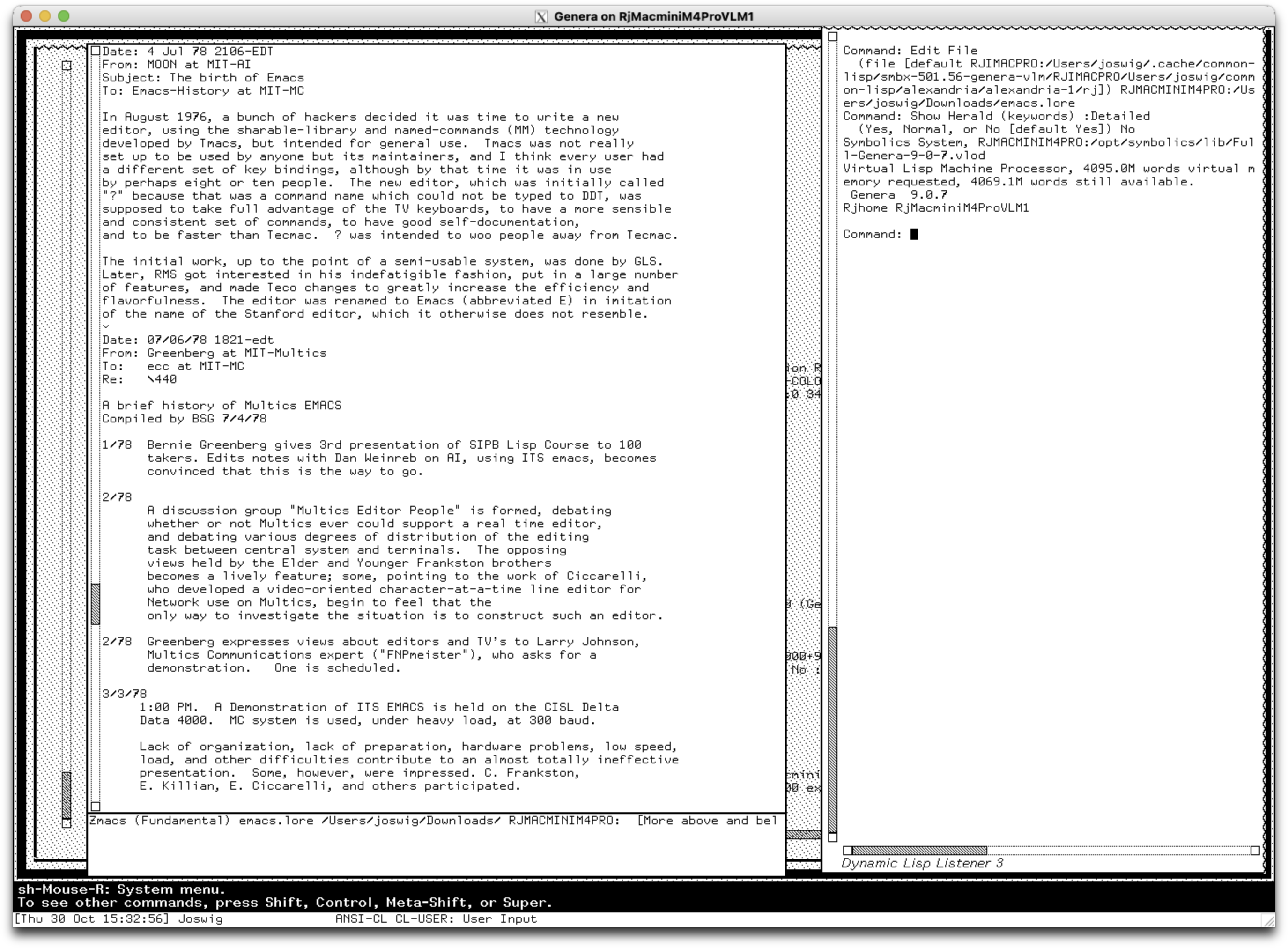
@demiguru @restorante @crandel @alerque @Zenie @weavejester #eine #zwei #zmacs #emacs #lisp #lispmachine Dan Weinreb's thesis describes EINE and ZWEI, the software for Zmacs, the Emacs editor on the MIT Lisp Machine: https://github.com/MITDDC/eine-1975-1981/blob/main/eine/7007637/arc.thesis/th.64

As far as I know, in Lisp Machine, the entire software, from the operating system into user applications are all available as gigantic Lisp functions.
We can use the functions in our code. We can also edit the code, even the code of the program we are currently running, save the code, then reload it.
Yes, the operating system itself can be edited, saved and reloaded.
But it is different with Emacs. It is basically an elisp interpreter with some functionalities to aid text editing. These two are all C code.
They cannot be edited, saved and reload.
Emacs in Unix possibly is different with Emacs (EINE, ZWEINE) on Lisp Machine.
GNU Emacs as a Lisp Machine surely is very nice. But Daniel Weinreb himself disagree with that.
Is it possible that Emacs is only Lisp Machine in spirit only?
Here is the link: https://web.archive.org/web/20250427073638/http://xahlee.info/emacs/misc/Daniel_Weinreb_rebuttal_to_rms.html
Note: on the debate about the original creator of Emacs, whether it is David Moon & Guy Steele or Richard Stallman, I am completely neutral.
Edit: I have ever heard somewhere that Maxima is quite similar with GNU Emacs. At the core of Maxima is an implementation of Common Lisp. Maxima is just sitting on top of the Common Lisp.
#GNUEmacs #Emacs #LispMachine #Symbolic #LMI #RMS #DavidMoon #Maxima #CommonLisp

I updated my post "Do I need a Lisp Machine comeback?". I have added the new information I've found with chatting with folks on lisp IRC channels.
https://far.chickenkiller.com/computing/do-i-need-a-lisp-machine-comeback/
Seems like I was looking for was "residential style development" or something. Dunno yet what does it mean. But for sure I am digging something out of grave!
#lisp #lispmachine #interlisp #residentialdevelopment #development #softwaredevelopment #programming #commonlisp #clisp #cl #computing #computers #retrocomputing #wakegp #research
For #WakeGP researches, do I need a #LispMachine comeback?
https://far.chickenkiller.com/computing/do-i-need-a-lisp-machine-comeback/
If you are too lazy to read it all, just jump to the list in the end.

Current work in #LispMachine world is to implement the bus interface for the CADR 4 project (https://github.com/ams/cadr4).
It's 1986 and you want to use Interlisp-D on your Xerox workstation. This primer will get you up to speed with booting a Lisp image, handling floppy disks, using the mouse, transferring files to a VAX, and interacting with the environment. Some of the material is obsolete but gives an idea of what it was like to use a Lisp Machine in the 1980s.
@vv I wish I could find those programs and restore them. 😞
There are plenty of fun ones, like the 3D airplane model.
CADR4 #MIT #CADR #LispM #LispMachine current status is we are optimizing the simulation runtime (it takes about 10 minutes to run through almost all the boot PROM to the point we are accessing memory -- which isn't fun when you want to work on accessing memory).
Someone should write some #MIT #CADR microcode and supporting code to make it possible to run #Interlisp / #Medley on the #MIT #LispMachine #LispM
CADR4 #MIT #CADR #LispMachine #LispM is now running almost through the whole boot PROM!
Now work to add disk, and memory .. and a bus.
Agentic one promoting the #MIT #CADR #LispMachine #LispM.
CADR4 project is steaming a head. Things have started going through the boot PROM... #LispMachine #LispM #CADR
@lfa https://tumbleweed.nu/lm-3 #LispMachine revolution is nigh! #CADR #LispM.
@lfa I've been restoring / working on the #MIT #CADR #LispMachine #LispM for .. 20+ years now. I've never had the real thing, there are maybe four machines left in the world. N/A?
Two hackers going at it ... https://github.com/ams/cadr4/commits/master/ #LispM #LispMachine #MIT #CADR #FPGA #VHDL
Client Info
Server: https://mastodon.social
Version: 2025.07
Repository: https://github.com/cyevgeniy/lmst