“Curation is a form of pattern recognition – pieces of information or insight which over time amount to an implicit point of view”*…
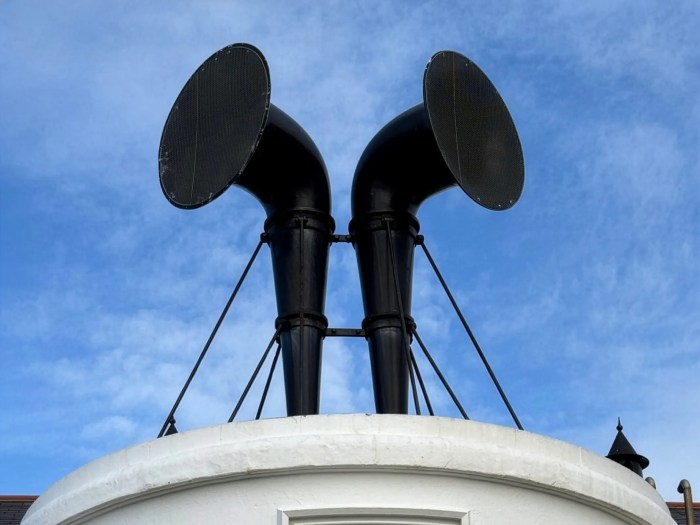
Foghorns from 1908 at the Lizard Lighthouse, CornwallIt’s that time of year again… we’re being inundated by “best-of” lists. Many of them are interesting, if only for the reactions they evoke (“how could you include/omit that???”). A few are gems. Here, two that your correspondent found especially interesting…
First, our (now annual) visit with Tom Whitwell and his “52 things I learned in 2025.” For example…
…
… 11. The Radioactive Shrimp Scare of 2025 was likely caused when a recycling plant in Cikande, Indonesia accidentally melted scrap metal from a piece of medical or industrial equipment containing Caesium-137. A plume of smoke was released across Java, entering the BMS Foods plant which processes 1/3rd of the shrimp imported into the US. [Paris Martineau]…
… 31. In 2023, Nigeria had a million more births than the whole of Europe. [Our World in Data, via Charles Onyango-Obbo]…
… 52. Gall’s law says: “A complex system that works is invariably found to have evolved from a simple system that worked. A complex system designed from scratch never works and cannot be patched up to make it work. You have to start over with a working simple system.” [John Gall p.52]
Next, “The 26 Most Important Ideas For 2026,” from Derek Thompson…
…
… 2. The triumph of streaming video
In my essay “Everything Is Television,” [highy recommended] I wrote that all media are converging toward the same flow of video. Social media is becoming less about keeping up with friends and more about watching short-form videos made by strangers—i.e., television. Podcasts are becoming less about listening to Internet radio and more about watching YouTube talk shows—i.e., television…
[in this entry– as in all of his points– Thompson elobaorates (e.g., here, the end of reading, the victory of streaming, the threat to movie theaters, and the warning that TikTok might be mealting your brain) and substantiates his points with data.]…
… 5. The whole US economy right now is one big bet on artificial intelligence
Housing is in a rut. Farmers are hurting. Manufacturing has been shrinking for months. Hiring is hell. And yet, the US economy continues to grow, powered by an AI infrastructure project unlike anything in modern history…
… 13. Americans aren’t drunk. They’re high.
In 2010, daily or near-daily drinkers outnumbered daily marijuana users by a two-to-one margin. But since then, a wave of decriminalization has allowed marijuana use to soar into the 2020s, so that today daily marijuana users exceed drinkers for the first time ever…
… 26. [in it’s glorious entirety] Great art can save lives.
We’ll close with one of the finer letters to the editor you’ll read, from the Times of London, on the occasion of the death of playwright Tom Stoppard.
“Saved by Stoppard”: Sir, In 1993 my wife and I went to see the first production of Arcadia by Tom Stoppard (obituary, Dec 1), and in the interval I experienced a Damascene conversion. As a clinical scientist I was trying to understand the enigma of the behaviour of breast cancer, the assumption being that it grew in a linear trajectory spitting off metastases on its way. In the first act of Arcadia, Thomasina asks her tutor, Septimus: “If there is an equation for a curve like a bell, there must be an equation for one like a bluebell, and if a bluebell, why not a rose?” With that Stoppard explains chaos theory, which better explains the behaviour of breast cancer. At the point of diagnosis, the cancer must have already scattered cancer cells into the circulation that nest latent in distant organs. The consequence of that hypothesis was the birth of “adjuvant systemic chemotherapy”, and rapidly we saw a striking fall of the curve that illustrated patients’ survival. Stoppard never learnt how many lives he saved by writing Arcadia. – Michael Baum, Professor emeritus of surgery; visiting professor of medical humanities, UCL
###
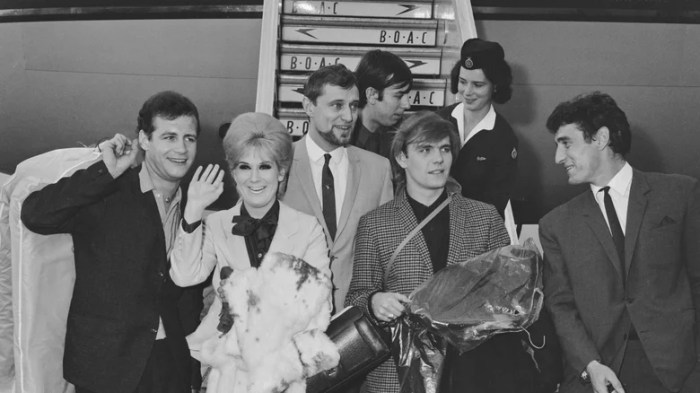
As we read ’em and reap, we might recall that it was on this date in 1964 that Dusty Springfield was deported from South Africa after performing before a desegregated audience at a show near Capetown. Springfield was the first British artist to stipulate the inclusion of a specific “No Apartheid” clause into her contract, and her disgust with the country’s policy of racial segregation and discrimination helped inspire a cultural boycott of South Africa.
Springfield and her band, The Echoes, before the storm (source)#Apartheid #art #bestOfLists #culture #DustySpringfield #history #lists #literature #music #philosophy #politics #society #SouthAfrica #Technology