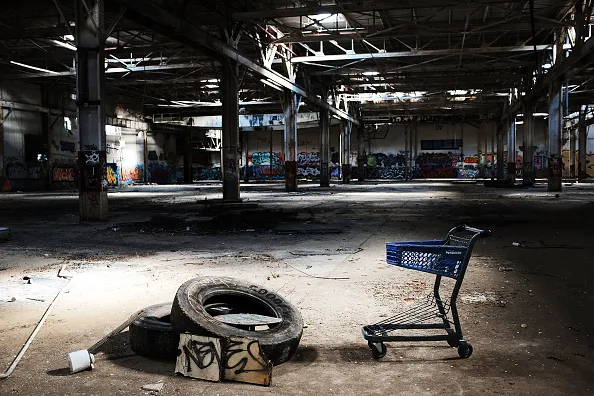
“Jobs in factories will come roaring back into our country”*…
When President Trump announced sweeping tariffs on “Liberation Day” last spring, the promise was that manufacturing– and the jobs it provides– would return to the U.S. Scott Lincicome (from the conservative Cato Institute) assesses the “progress” to date…
US manufacturing ended 2025 with a thud, capping a rough year for the sector. To recap, manufacturers shed 63,000 jobs, according to the latest data from the Bureau of Labor Statistics. It wasn’t just labor that was hurting. The Institute for Supply Management’s manufacturing index clocked in at 47.9 for December, marking the 10th consecutive month of contraction as new orders were especially weak and costs at historically elevated levels.
Then there’s the Federal Reserve’s Beige Book of regional economic conditions and surveys from the regional Fed banks, which have repeatedly documented cases of manufacturers delaying hiring and investment amid weak market conditions, rising costs, shrinking profit margins and persistent uncertainty. As for the “hard” data, manufacturing capacity and output, while incomplete, sagged through the Fall.
Overall, the evidence reveals a sector that’s stagnant at best, and a long way from the manufacturing renaissance President Donald Trump promised when he took office for a second time a year ago. No wonder administration officials have pivoted from predicting a factory boom in 2025 to now saying it will happen in 2026 and beyond.
Better tax, regulatory, and monetary policy should indeed provide a tailwind for manufacturing, but the sector will probably continue to struggle. If so, Trump’s tariffs will be a big reason why…
[Lincicome unpacks the several ways that Trump’s tariffs have confounded domestic manufacturing: increased costs (especially on materials/compnents not available in the U.S.) and tariff and policy/regulations that might be politely called “inconsistent” (or less politely, “flighty”); last year, the US tariff code was amended 50 times)– which has added management/coordination costs (Federal Reserve economists estimate that domestic manufacturers will pay $39 billion to $71 billion annually to comply with the new regime, representing time and money they can’t spend on their businesses); but perhaps even more damagingly, has created uncertainty that has slowed corporate action/investment. Lincicome concludes…]
… The harms to manufacturers are consistent with research on past tariff episodes and help to explain why the sector struggled in 2025 — and why things might not get much better this year. Recent forecasts also suggest caution, with manufacturers and supply chain professionals predicting continued headwinds due to the costs, uncertainty and complexity of tariffs. And the Supreme Court won’t save them. If it invalidates Trump’s “emergency” tariffs in the coming days, administration officials have promised to invoke alternate authorities to recreate them.
Global supply chains took years to develop. They’ll take even longer to reorganize and will do so at great cost if, that is, they don’t break altogether in the meantime…
“America’s Manufacturing Renaissance Is Missing in Action,” (gift article) by @scottlincicome.bsky.social in @opinion.bloomberg.com.
Relatedly, Trump’s immigration policy was (like the “manufacturing boom”) supposed to have reduced the federal deficit. The Administration is deporting immigrants at a brisk clip– but at an extraordinary cost, both economically and constitutionally. That’s not to mention the costs to the targeted immigrants themselves, to their familires and to the companies and economies of which they have been preponderantly positive and productive parts. Indeed, a different group at Cato recently published a thorough study demonstrating that– far from being a drag on the economy– immigrants have reduced federal (and state and local) deficits by $14.5 Trillion since 1994… though, of course that contribution is now, thanks to the ICE storm, slowing down.
The immigration crackdown was also supposed to turbo-charge job growth (for the U.S.-born); it has not. Indeed, the climate of fear and the difficulty in securing visas has led to a hiring boom abroad: “Silicon Valley can’t import talent like before. So it’s exporting jobs.”
It’s easy to see Trump’s election and the imposition of his economic and immigration policies as America’s Brexit. That abrupt rupture of social, cultural, and economic conventions is now about a decade old… and the results aren’t pretty…
Brexit, the United Kingdom’s decision to withdraw from the European Union, is a rare contemporary example of a major developed economy raising trade barriers and more generally pulling back from international economic integration. When the Brexit referendum took place in 2016, academic and professional economists generally forecast that the policy about-face would result in a negative hit to the United Kingdom’s economy of about 4% of GDP over the long-term. Rather than a sudden, visible economic shock following the vote, the costs of Brexit have been gradual and cumulative. Now, almost a decade later, new research aims to assess Brexit’s actual impact on the United Kingdom’s economy, which involves the challenging task of comparing the country’s economic indicators to what they would have been if the United Kingdom had remained in the European Union. This research finds that, ten years on, the economic cost of Brexit has been larger than analysts predicted and that prolonged policy uncertainty contributed importantly to the magnitude of the impact… We estimate that by 2025, Brexit had reduced UK GDP by 6% to 8%, with the impact accumulating gradually over time… Understanding the ways in which Brexit resulted in a drag on economic growth for the United Kingdom provides potential lessons about the costs of abruptly pulling back from the global economy for other countries… – “The Economic Costs of Brexit on the UK” (where there is much more detail)
* Donald Trump
###
As we interrogate empty promises (and lest we think that history doesn’t rhyme), we might recall that it was on this date in 1856 that the Know Nothing Party (dba, “the American Party” and “Native American Party”) convened in Philadelphia to nominate its first presidential candidate. A nativist (and largely anti-Catholic) group composed of anti-immigrant/Old Stock breakaways from the American Republican and Whig parties, the Know Nothings nominated Millard Fillmore.
The last member of the Whig Party to serve as President, Fillmore had been a Congressional Representative from New York who was elected to the Vice Presidency in 1848 on Zachary Taylor’s ticket. When Taylor died in 1850, Fillmore became the second V.P. to assume the presidency between elections.
Fillmore’s signature accomplishment was the passage of the Compromise of 1850 passed, a bargain that led to a brief truce in the battle over slavery– but was so ill-conceived (it contained the Fugitive Slave Act) and unpopular that Fillmore failed to get his own party’s nomination for President in the election of 1852, which he sat out. Unwilling to follow Lincoln into the new Republican Party, he got the nomination of the Know Nothings– though he was not a member of the party and hadn’t sought it; he was out of the country during the convention. Fillmore finished third in the 1856 election. By the 1860 election, the Know Nothings were no longer a serious national political movement.
Campaign poster for Fillmore and his running mate Andrew Jackson Donelson (source) #Brexit #business #culture #deficits #economics #economy #employment #history #immigration #industry #KnowNothingParty #KnowNothings #manufacturing #MillardFillmore #nativism #politics #tariffs #trade