#romancity

2025-09-12

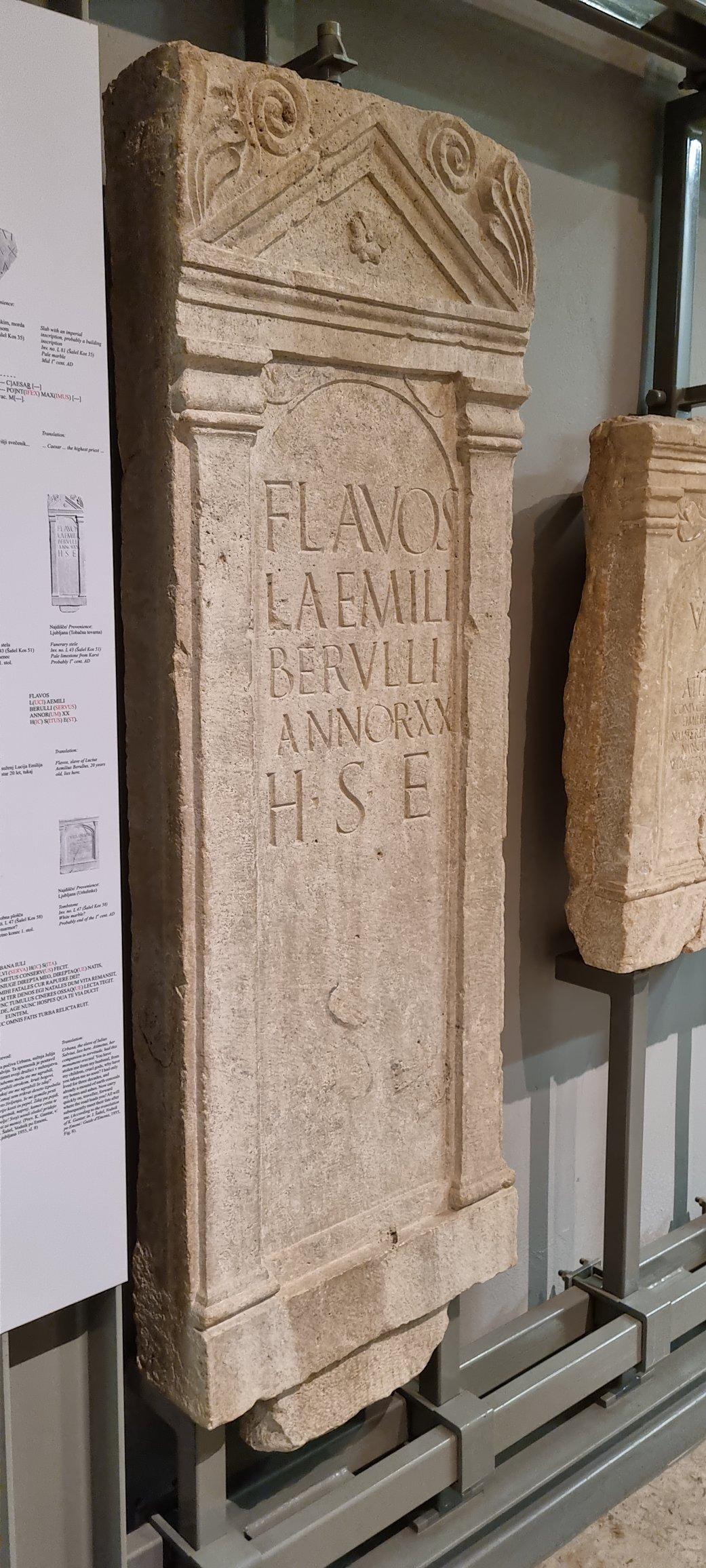
Als Slowenien noch römisch war, stand auf dem Gebiet Ljubljanas die Stadt Emona.

Davon heute noch sichtbar sind Teile der römischen Stadtmauer, zwei ausgegrabene römische Häuser sowie Grabsteine und Statuen.

Besonders: eines der beiden besichtbaren Häuser enthielt neben Thermalbädern – durch Feuer beheizt, nicht durch natürliche Quellen – auch ein christliches Taufbecken. Man kennt sogar den Namen des Ehepaars, das das Land für den Bau des Taufbeckens herschenkte.

(Und ja: der #Eurocity gleichen Namens ist nach der Stadt benannt)

#Unterwegs #Reise #Reisefotos #Ljubljana #Emona #Laibach #RomanCity #TravelSlovenia

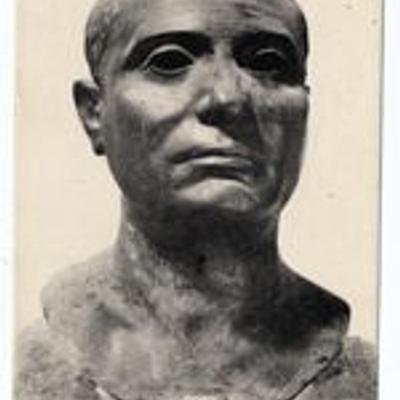
Foto des Taufbeckens. Zu sehen ist ein Mosaikboden, in den in der Mitte ein nicht besonders tiefer Schacht eingelassen ist. In diesem befinden sich mehrere Stufen.Foto eines römischen Grabsteins aus dem 2. Jahrhundert. Auf dem Grabstein steht "FLAVOS LA EMILI BERVLLI ANNORXX H S W"Foto einer vergoldete Bronzestatue hinter Glas im Museum. Die Statue zeigt einen jungen Mann in der typischen Pose eines römischen Redners. Er trägt eine Toga, die nur römische Bürger tragen durften. An den Rändern Italiens und in den Provinzen war die Toga vor allem ein Statussymbol und ein Zeichen der Loyalität gegenüber Rom.
Die Bronzestatue aus Emona zählt zu den seltenen, fast vollständig erhaltenen Bronzestatuen der Antike. In der Römerzeit waren Bronzestatuen häufiger als Marmorstatuen, wurden jedoch größtenteils eingeschmolzen, um wiederverwendet zu werden, da Bronze teuer war.
Die Statue war Teil eines Grabdenkmals und stellen das einzige bekannte Denkmal dieser Art dar, das für eine Person außerhalb der kaiserlichen Familie errichtet wurde.Foto der renovierten und rekonstruierten römischen Stadtmauer von Emona in Ljubljana. Die gezielte Stadtmauer ist zu sehen, links davon ein Gehsteig entlang einer Straße.
Archaeology News :verified:archaeology@mstdn.social
2025-05-18

Roman road, infant burials, and rare artifacts unearthed in ancient Augusta Raurica, Switzerland

In a major archaeological excavation prior to a new construction project in Kaiseraugst, Switzerland, archaeologists uncovered well-preserved Roman structures and rare artifacts in the ancient area formerly known as Augusta Raurica...

More information: archaeologymag.com/2025/05/rom

Follow @archaeology

#archaeology #archeology #archaeologynews #romancity #romanempire #RomanArchitecture #augustaraurica

Roman road, infant burials, and rare artifacts unearthed in ancient Augusta Raurica, Switzerland

In a major archaeological excavation prior to a new construction project in Kaiseraugst, Switzerland, archaeologists uncovered well-preserved Roman structures and rare artifacts in the ancient area formerly known as Augusta Raurica. The rescue excavation, led by the Aargau Cantonal Archaeology Department, was carried out from May 2024 to March 2025 and shed new light on the lower town of one of the most significant Roman settlements north of the Alps...
Archaeology News :verified:archaeology@mstdn.social
2025-04-22

Researchers analyze 4,000 Roman bricks to uncover the building secrets of the ancient metropolis of Trier

A new interdisciplinary research project will investigate the organization of ancient building material production in the Roman city of Trier, an important city in the northern provinces of the empire...

More information: archaeologymag.com/2025/04/res

Follow @archaeology

#archaeology #archeology #archaeologynews #romanempire #romanart #romanarchitecture #trier #augustatreverorum #romancity

Researchers analyze 4,000 Roman bricks to uncover the building secrets of the ancient metropolis of Trier

A new interdisciplinary research project will investigate the organization of ancient building material production in the Roman city of Trier, an important city in the northern provinces of the empire...
2024-10-17

View of the Forum, Rome, Italy between ca. 1890 and ca. 1900. Views of architecture and other sites in Italy Italy Rome

#Italy #Romancity #Corinthian #Greco-Roman #Roman #Romans #photography #historicalPhotos

loc.gov/pictures/item/20017009

This image depicts the ancient Roman city of Rome, specifically focusing on its iconic Forum area. The photograph captures a panoramic view showcasing several well-preserved columns and ruins that were once part of important public buildings or temples in the forum's center.

In the foreground stands an imposing colonnade with Corinthian capitals, which are characteristic of classical Greco-Roman architecture known for their ornate decorative elements including acanthus leaves. The photograph appears to be taken during a time when Rome was undergoing excavation and preservation efforts as evidenced by modern structures like lampposts visible in the scene.

The sky is overcast with clouds suggesting it might have been captured on an early spring or autumn day, not under direct sunlight that could result in harsher shadows. The coloration of this image leans towards sepia tones which are typical for photographs from the late 19th to early 20th century and were used as a form of preservation.

The caption at the bottom right corner indicates "1775 P-Z-Roma Foro Romano", suggesting that it's a postcard or an image taken around that era. The photograph captures both historical ruins alongside traces of modern human activity, indicating how these ancient sites have been integrated into contemporary urban life in Rome.

The Forum was the heart of Roman social and political activities; thus this view encapsulates not just archit [...]
Marcial Tenreiro-Bermudezarchaeoten
2024-07-13
Marcial Tenreiro-Bermudezarchaeoten
2024-07-13
Marcial Tenreiro-Bermudezarchaeoten
2024-07-13
Archaeology News :verified:archaeology@mstdn.social
2024-07-10

Archaeologists uncover trove of burnt bones and ritual artifacts in ancient Roman well near Rome

Ostia Antica, an ancient Roman harbor town at the mouth of the Tiber River, has yielded a significant archaeological discovery. A team of archaeologists has excavated a well near the Temple of Hercules, revealing a collection of artifacts linked to ritual feasting and cult activities...

More information: archaeologymag.com/2024/06/rit

Follow @archaeology

#archaeology #romancity #romanempire #ostiaantica

Archaeologists uncover trove of burnt bones and ritual artifacts in ancient Roman well near Rome

Ostia Antica, an ancient Roman harbor town at the mouth of the Tiber River, has yielded a significant archaeological discovery. A team of archaeologists has excavated a well near the Temple of Hercules, revealing a collection of artifacts linked to ritual feasting and cult activities.

The well, approximately ten feet deep, is located in Regio I – Insula XV, a sacred area within Ostia Antica. This area, once home to several temples and sanctuaries, is dominated by the Temple of Hercules, a monumental structure dating back to the Republican Era.
damian entwistleukdamo@mastodon.org.uk
2023-05-17

Today's photo with the most hits: a detail from the pediment of the Tetrapylon at Aphrodisias, Turkey.

#turkey #archaeology #tetrapylon #aphrodisias #RomanCity #pediment #achitecture

Highly ornamented gateway, at Aphrodisias. A signature architectural monument with Corinthian columns, and elaborate foliate carving on the pediment and arch.

Catching the sunshine in Maastricht, despite around freezing temperatures 2/2
#maastricht #sunshine #winter #netherlands #limburg #citytrip #citywalk #citylife #romancity #oldtown

Catching the sunshine in Maastricht, despite around freezing temperatures 1/2
#maastricht #sunshine #winter #netherlands #limburg #citytrip #citywalk #citylife #romancity #oldtown

damian entwistleukdamo@mastodon.org.uk
2023-02-15

Today's photo: this view of the stadium in the Roman city of Perge, near Antalya, Turkey.

#archaelogy #turkey #perge #stadium #RomanCity

A view of the stadium seating and turn of the stadium in Perge. Tumbledown stones suggest its age but it is largely intact

Client Info

Server: https://mastodon.social
Version: 2025.07
Repository: https://github.com/cyevgeniy/lmst