Don’t talk – listen. Why communities affected by forever chemicals in water must be heard
#Environment #PFAS #ForeverChemicals #WaterSafety #PublicHealth #EnvironmentalJustice #CommunityVoices #Australia #DrinkingWater #Pollution #TrustInScience #The14
https://the-14.com/dont-talk-listen-why-communities-affected-by-forever-chemicals-in-water-must-be-heard/
#trustinscience
"The Big One" scenario: life expectancy drops by 7 years, and a deeper recession than COVID.
That's the price of forgetting.
Available for Broadcast on PRX:
https://exchange.prx.org/pieces/your-piece-id
Support evidence-based conversations:
https://helioxpodcast.substack.com
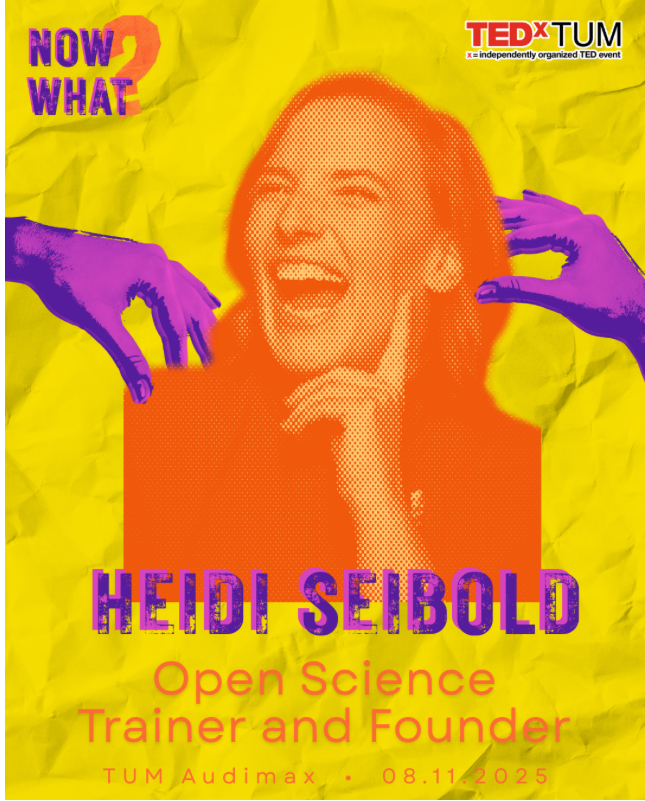
Big goals need powerful voices and ours just hit TEDx! 🎤
Heidi Seibold, co-founder of Digital Research Academy, takes the stage at TEDxTUM 2025 to talk Open & Reproducible Science.
How do we rebuild trust, openness & collaboration in research? Find out Nov 8!
#OpenScience #Reproducibility #TEDx #ResearchCulture #TEDxTUM #OpenScience #Reproducibility #TrustInScience

📉 Trust in science is declining in the U.S., and it’s not just political—it's cultural. This shift threatens public health, climate action, and innovation. Read why it matters and what can be done 👉 https://impakter.com/why-growing-mistrust-of-science-in-america-matters/?utm_source=mastodon&utm_medium=social&utm_campaign=fedica-Autoposting #ScienceMatters #TrustInScience #USA
The Imperative of Science Communication in the Modern Era
In today’s rapidly evolving landscape, science communication—often referred to as “SciComm”—is more critical than ever. Recent history underscores the urgency of effectively communicating scientific knowledge, especially in the face of challenges such as aggressive federal funding cuts to science under the Trump administration, persistent attacks on researchers, and a challenging atmosphere for early-career scientists. As researchers encounter heightened scrutiny and diminished support, many have sought opportunities abroad, resulting in a brain drain that threatens America’s status as a global leader in scientific innovation and literacy.
Understanding this broader context emphasizes why science communication isn’t merely beneficial—it’s essential. SciComm acts as a crucial bridge linking laboratory and field research with public policy, education, and everyday decision-making. Without effective communication, groundbreaking discoveries remain inaccessible and misunderstood, policies become misinformed, and society collectively suffers from stagnation in progress.
The Critical Roles of Science Communication
Science communication serves multiple fundamental functions within society:
1. Informing Policy Making
Policy decisions profoundly shape our society, from climate change initiatives to public health policies. Effective SciComm ensures decision-makers have accurate, accessible, and timely scientific information. Conversely, misinformation can lead to poor policy outcomes, such as inadequate responses to climate crises or ineffective health initiatives.
2. Ensuring Public Health and Safety
The COVID-19 pandemic dramatically highlighted the necessity of clear, effective science communication. Public health messages must distill complex epidemiological concepts into actionable guidelines. Miscommunication and misinformation resulted in vaccine hesitancy, skepticism about public health measures, and preventable illnesses and fatalities.
3. Promoting Democratic Engagement
Informed citizens make better decisions. By understanding science, the public can meaningfully participate in democratic processes, hold leaders accountable, and advocate effectively for science-based policies.
4. Fostering Innovation and Economic Growth
Scientific advancements fuel economic growth. Clear communication enables society to recognize the value of investing in research and development, fostering a culture of innovation essential for economic prosperity.
Navigating Contemporary Challenges
The policies under the Trump administration resulted in significant setbacks for science. Budget cuts, censorship of scientific data, and political undermining severely damaged America’s scientific ecosystem. Early-career scientists were particularly vulnerable, caught between their passion for discovery and an uncertain professional future.
Consequently, many relocated to countries more supportive of scientific endeavors. Nations like Canada, Germany, and China actively attracted American-trained talent, recognizing that investing in science and researchers directly translates to economic and intellectual strength.
Sustaining America’s Leadership in Scientific Literacy
Historically, the U.S. has positioned itself as a leader in science, yet this status is fragile without sustained effort, funding, and societal support. Maintaining leadership requires:
- Consistent and adequate funding for scientific research and education.
- Protection and support for early-career researchers.
- Open, transparent communication about the value and outcomes of scientific research.
Improving the Effectiveness of Science Communication
To effectively communicate science, especially in polarized environments, SciComm practitioners must:
- Use Clear, Accessible Language: Complexity must never overshadow clarity. Simplifying jargon helps broader audiences grasp essential concepts.
- Harness Storytelling Techniques: Humans naturally resonate with stories. Framing science through compelling narratives can engage audiences emotionally and intellectually.
- Leverage Digital Media: Platforms like YouTube, Instagram, and TikTok democratize information access. Short, engaging content or visually appealing graphics greatly enhance reach and retention.
- Encourage Dialogue: Science communication should foster questions, debate, and discussion rather than dictating knowledge from a position of presumed authority.
- Build Trust: Transparency, consistency, and honesty form the foundation of effective communication, creating trust between scientists and the public.
Communicating Human Evolution with Sensitivity to Religious Beliefs
Human evolution remains a sensitive topic in many communities where religious beliefs conflict with evolutionary science. Effective SciComm in paleoanthropology demands nuanced approaches:
- Respectful Engagement: Recognize the personal and cultural significance of religious beliefs without disparagement. Dialogue rather than debate creates respectful learning environments.
- Highlight Shared Values: Emphasizing universal human values such as curiosity, discovery, and knowledge bridges ideological divides.
- Identify Common Ground: Evolutionary science and religious beliefs often intersect positively on ethical considerations, community building, and appreciation of life’s complexity.
- Amplify Diverse Voices: Engaging communicators from varied cultural and religious backgrounds offers relatable perspectives, breaking down misconceptions.
Building Social Cohesion Through Science
Science communication doesn’t merely educate; it unites. By promoting literacy and appreciation of the natural world, SciComm fosters social cohesion rooted in evidence-based thinking. Encouraging scientific literacy at every societal level—schools, community programs, and media—enhances collective decision-making, reduces polarization, and promotes harmony.
Educational initiatives should emphasize critical thinking and scientific reasoning, enabling individuals to assess information critically and challenge misinformation. Literacy programs must directly address scientific misinformation, equipping communities with practical tools to identify and counter false claims.
Looking Ahead: Education, Literacy, and Understanding
A robust commitment to education and literacy is the cornerstone of effective science communication. Educational systems must incorporate rigorous, inclusive, and up-to-date science curricula. Prioritizing STEM education from early childhood through adulthood significantly shapes societal perspectives, fostering respect for evidence-based knowledge.
Moreover, understanding the natural world must extend beyond classrooms. Community engagement via citizen science projects, public lectures, interactive museum exhibits, and collaborative research opportunities profoundly enhances societal appreciation and understanding of science.
Conclusion
As contemporary challenges mount—political, social, environmental—effective science communication remains essential for navigating complexities. SciComm empowers informed policy-making, strengthens public health initiatives, invigorates democratic processes, stimulates economic growth, and fosters societal unity. Amid current setbacks and potential declines in scientific leadership, reinforcing our commitment to clear, engaging, and inclusive science communication is not merely advantageous—it’s imperative.
Our collective future depends on an informed, engaged society. By championing education, promoting scientific literacy, and deepening our understanding of the natural world, we build a resilient framework capable of confronting modern challenges. The path forward demands clarity, respect, inclusivity, and active engagement—hallmarks of impactful science communication. With concerted effort and dedication, science will continue to serve as a guiding force for societal advancement, resilience, and unity.
#AmericanScienceCrisis #BrainDrain #CommunicatingScience #DemocraticEngagement #EarlyCareerScientists #EducationAndLiteracy #EvidenceBasedPolicy #HumanEvolution #InclusiveScience #PublicScienceEducation #PublicUnderstandingOfScience #SciComm #ScienceAdvocacy #ScienceAndDemocracy #ScienceAndReligion #ScienceAndSociety #ScienceCommunication #ScienceFunding #ScienceInTheUS #ScienceLiteracy #ScienceOutreach #SciencePolicy #ScienceStorytelling #ScientificInnovation #ScientificIntegrity #ScientificMisinformation #STEMEducation #TrustInScience #WhyScienceMatters


Join us on 17 Sept at #OSFair2025 for the panel: Open & Trusted: Governing Knowledge in the Digital Age!
13:45 | 📍 Auditorium C, #CERN Science Gateway.
Panel led by Pierre Mounier (OPERAS Research Infrastructure) with speakers from @OpenAIRE AMKE, #OPERAS, #EOSC and OAPEN Foundation , this session tackles trust, disinformation, and the future of our knowledge infrastructure.
🔗 Full programme: https://www.opensciencefair.eu/panels/open-and-trusted-governing-knowledge-in-the-digital-age

19/ The integrity of our public health system is being challenged. When unverified, inaccurate, and fabricated data is allowed to influence policy, it undermines the public’s trust in science—and that’s a crisis we can’t afford.
#PublicHealth #TrustInScience #ScienceCrisis
8/ These issues aren’t small errors—they call into question the integrity of the report as a whole. Why rely on fabricated studies? And how is it that high-ranking officials are pushing this as science? 🤷♂️
#ScienceIntegrity #PoliticalManipulation #TrustInScience #PublicPolicy
Camilla Stoltenberg, CEO of the Norwegian Research Centre (NORCE), recounts her experience of pandemics (incl. SARS and COVID) and the importance of ensuring independence, transparency, and accuracy of public health information. There needs to be room for open disagreement to build trust, especially in uncertain times. Scientific advisors should be allowed to state their opinions.
https://ease.org.uk/ease-events/18th-ease-conference/18th-ease-conference-scientific-programme/18th-ease-conference-session-1/
#EASEevents #EASEoslo #CamillaStoltenberg #PublicHealth #Misinformation #TrustInScience


New study: "[We] tested five theoretically grounded intervention strategies to improve #conservatives’ #trust in scientists. None of the interventions were successful, suggesting that trust in scientists reflects relatively stable attitudes that require more elaborate and time-intensive interventions."
https://www.nature.com/articles/s41562-025-02147-z
Also see this summary. US conservatives "distrust science more broadly than previously thought. Not only do they distrust science that does not correspond to their worldview, but also, compared to liberal Americans, their trust is also lower in fields that contribute to economic growth and productivity."
https://phys.org/news/2025-04-americans-distrust-science-survey.html

This paper makes the case for a science4policy that is responsive to public values and has anticipatory capacity
#science4policy #trustinscience #sciencecommunication

🚀 Recording available! 📺
How does science education shape public trust in science? Experts from our webinar tackled this crucial topic
🎬 Watch now:
🔗 Website ➡️ https://www.interacademies.org/event/iap-webinar-building-trust-science-through-science-education
🔗 YouTube ➡️ https://www.youtube.com/watch?v=o0GWrIyPxJA&t=3s
#ScienceEducation #TrustInScience #STEM #IAPwebinar
💫📚The next IAP Science Education Webinar will feature Bruce Alberts, global leader in science education.
11 March | 12:00 CET
Register now: https://tinyurl.com/5bxamfnj
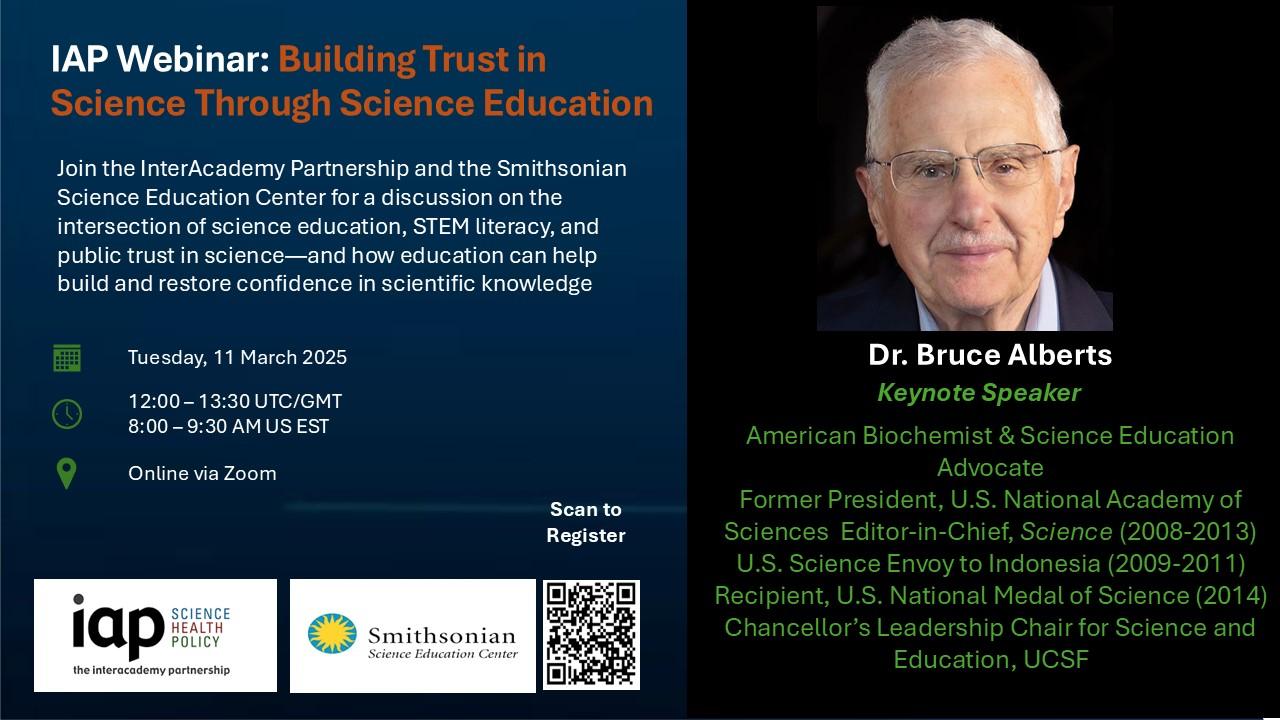
🔬 How can we strengthen public trust in science? Education is key!
Join the IAP Science Education Webinar on March 11, featuring the legendary Bruce Alberts, to explore how science education can build confidence in scientific knowledge.
📅 11 March | ⏰ 13:00 CET
🔗 Register here: https://www.interacademies.org/news/building-trust-science-through-science-education-attend-iap-webinar
#ScienceEducation #STEM #IAPWebinar #TrustInScience #BruceAlberts
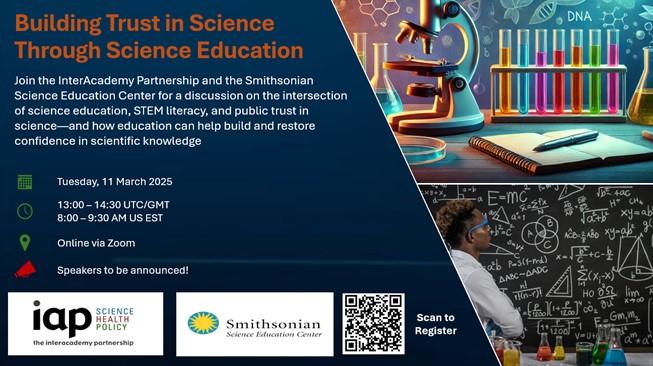
🚀Join us for a global conversation on science education and trust in science!
🌍🔬The InterAcademy Partnership in collaboration with the Smithsonian Science Education Center (SSEC), invites you to a special webinar exploring the intersection of science education, STEM literacy, and public trust in science.
📅 11 March |
⏰ 13:00-14:30 UTC
📍 Virtual – register now!
🔗 https://interacademies.org/news/building-trust-science-through-science-education-attend-iap-webinar
#ScienceEducation #STEMLiteracy #TrustInScience #IAP #SmithsonianScience #STEM #ScienceForAll
10/ Moreover, trust in science among Republican leaders has continued to decline. This is seen in their increasing political interference with scientific institutions, making the environment even more hostile for researchers dedicated to public health and progress. #TrustInScience

New Journal Article: “Trust in #Scientists and Their Role in Society Across 68 Countries” https://www.infodocket.com/2025/01/20/journal-article-trust-in-scientists-and-their-role-in-society-across-68-countries/ #science #trustinscience

Heightened psychopathy, cynicism, and threat perception linked to harassment of scientists https://www.psypost.org/heightened-psychopathy-cynicism-and-threat-perception-linked-to-harassment-of-scientists/?utm_source=dlvr.it&utm_medium=mastodon #ScienceHarassment #Psychopathy #Cynicism #TrustInScience #Narcissism

30 July 2024
Guidelines on lab-grown embryo models are strong enough to meet ethical standards — and will build trust in science
The UK code of practice for researchers working with stem-cell-based embryo models is designed to both reassure the public and provide valuable guidance to researchers.
RT by @EU_ScienceHub: Thanks for the invitation to discuss #trustinscience and science policy, @EU_ScienceHub! Looking forward to the next steps!
[2024-09-17 13:39 UTC]
Client Info
Server: https://mastodon.social
Version: 2025.07
Repository: https://github.com/cyevgeniy/lmst