This new "temperature range squeeze hypothesis" was supported by a huge, global dataset of plant elevation ranges and has big implications for how we expect species ranges to shift with increasing climate variability caused by climate change.
Josh Lynn
I’m a plant ecologist at The University of Manchester. Also a subject editor at Nordic Journal of Botany and Ecological Monographs. (He/him)
University Website
Personal Website
Excited to share a new paper in Nature Communications led by Arnoud Gallou: Diurnal temperature range as a key predictor of plants’ elevation ranges globally (https://doi.org/10.1038/s41467-023-43477-8)
We found evidence for a new hypothesis, contrary to classic theory, that species elevational range sizes decrease in mountain ranges with increasing temperature variability.
Josh Lynn boosted:

🔔 New paper on 🍄 & 🌳🌱❗ Proximity to an old-growth forest edge & ectomycorrhizal tree islands enhance fungal colonization of ectomycorrhizal tree seedlings in secondary forest soils! Kudos to Dr. Andy Cortese from Tom Horton's lab at SUNY ESF; nice collaboration❗
Second PhD opportunity! Please share. We (Richard Bardgett and Giles Johnson) are hoping to recruit a student to work on how novel microbial interactions may confer stress tolerance to range-shifting species and how this affects biogeochemical cycling!
https://www.findaphd.com/phds/project/plant-microbe-interaction-reshuffling-and-its-contributions-to-plant-stress-toleration-and-biogeochemical-cycling/?p161107
#phd #biodiversity #globalchange #ClimateChange #plants #microbes
Josh Lynn boosted:

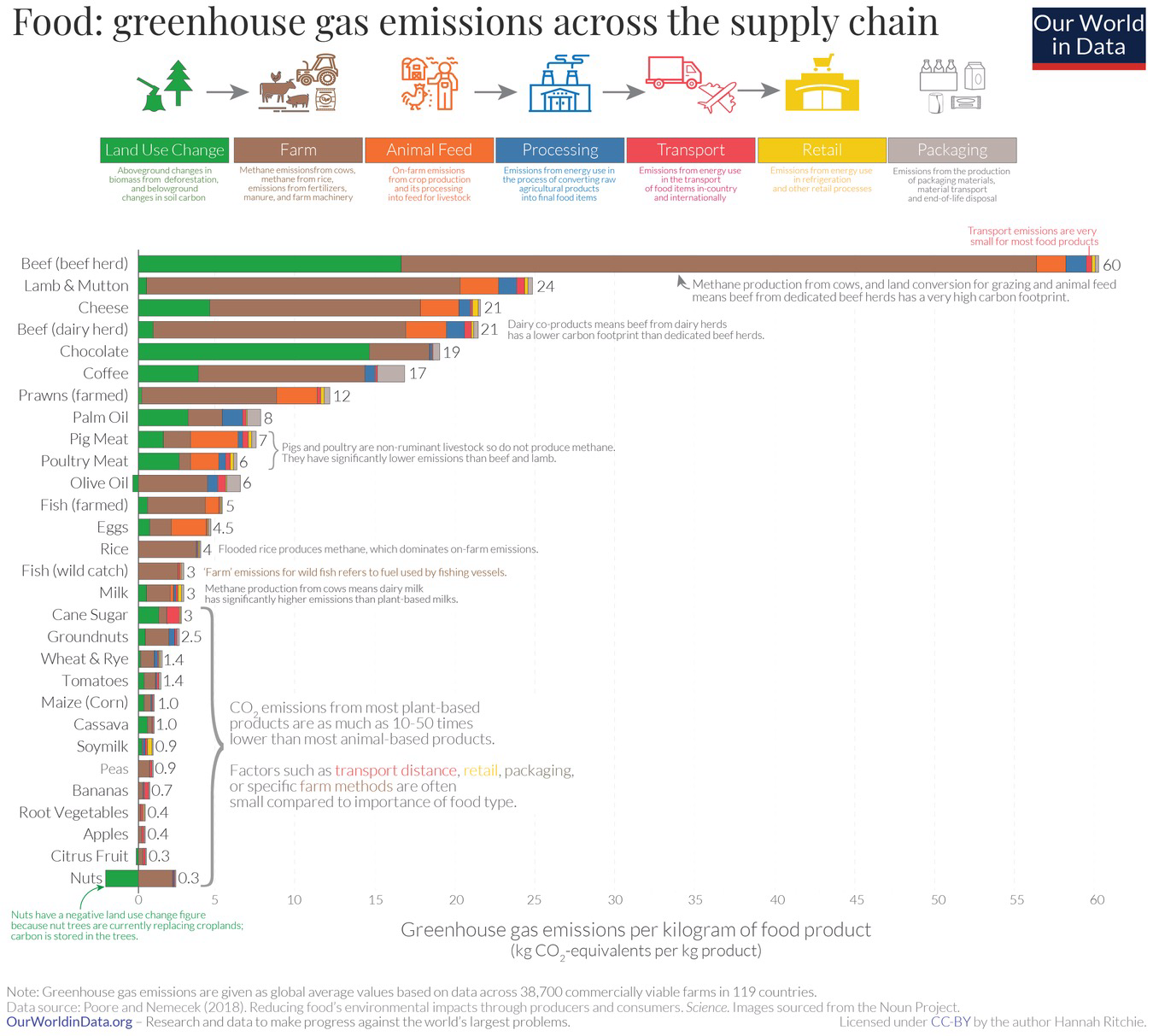
Many believe a significant way to address #climatechange is to 'eat local,’ but that’s not always true. The impact all depends on the kind of #food + how & where it’s produced.
Some foods require fewer resources (water, energy) in some parts of the world. Season can be important. Overall, transportation has a much lower carbon footprint than land use change. And so on.
So instead of ‘eat local,’ let’s go with ‘eat thoughtfully.’ https://ourworldindata.org/food-choice-vs-eating-local
Please share! We (myself and Susanne Shultz) are hoping to recruit a student to investigate how species' geography can be leveraged to predict their responses to global change. #phd #biodiversity #globalchange #plants
https://www.findaphd.com/phds/project/leveraging-species-geography-to-predict-and-mitigate-biodiversity-loss-with-global-change/?p160871
Let's make universities plant-based!!!
https://www.theguardian.com/environment/2023/sep/04/hundreds-academics-call-for-meat-free-meals-british-universities
As the old saying goes, keep your friends close but keep your biomass harvest samples closer.
Josh Lynn boosted:

Josh Lynn boosted:
This is just your periodic reminder that Gary Numan is older than Gary Oldman 👍
Josh Lynn boosted:

🇫🇷 Paris is removing half its street parking to free up space for people.
🚗 Cars in Paris take up 50% of public space.
New paper out! @VVandvik
Here, we assess how variation in plant performance away from their #climate #niche centers (e.g., increased versus decreased abundance change in sites cooler than niche center) is related to #traits. We find that shorter species with more resource acquistive leaf strategies are most likely to increase performance in sites cooler than their niche center.
https://onlinelibrary.wiley.com/doi/epdf/10.1111/ddi.13718
Josh Lynn boosted:

Once again Ted Chiang has it exactly right. The immediate danger from #AI is not that it will become sentient and do whatever it wants. The danger is that it will do what it’s being designed to do: help rich corporations destroy the working class in pursuit of ever-greater profits and thus concentrate wealth in fewer and fewer hands.
https://www.newyorker.com/science/annals-of-artificial-intelligence/will-ai-become-the-new-mckinsey
Josh Lynn boosted:

How Nutrient Dilution is making Nature less edible.
https://t.co/rnXzjKshHh
My group back at the University of Bergen (@VVandvik) were part of the first ever Registered Report (proposing the methods for peer review prior to experimentation with guaranteed acceptance if conducted as proposed) published at Ecology and Evolution. Given this, we were invited to write an editorial on our experience here: https://onlinelibrary.wiley.com/doi/10.1002/ece3.10023
We detail the advantages and disadvantages of RRs and propose them as a useful graduate training tool. Kudos to Raghnild Gya for the great work!
Title is "More than what they eat: uncoupled biophysical constraints underlie geographic patterns of herbivory" with coauthors Jason Fridley and @VVandvik
Also, favorite part of this article was the Cate le Bon quote I got away with including.
#herbivory #plants #interactions #biogeography #macroecology
Additionally, we point out some of the disadvantages of focusing on area based estimates of leaf damage. Finally, we develop a metabolic theory explanation of deviations from the expected "herbivory increases towards the tropics" paradigm. This was a blast to write and hope it inspires some interesting work in the future.
Seems like a good time to repost this (I last posted it elsewhere...). This article was just published as part of the Ecography E4 award special issue. Here, we raise some future directions for the study of plant-herbivore interactions over space, focusing on the biophysical constraints of energy transfer across trophic levels. We raise the idea that uncoupled constraints - resources that benefit one side of the interaction but not the other - with their own geography may be a key player.
Josh Lynn boosted:

Important editorial in @ScienceMagazine by Malcolm & Parikh; it's US-focused but the situation is similar everywhere.
Students and postdocs deserve more https://www.science.org/doi/10.1126/science.adh0336#.Y-XkYgSUemo.twitter
Client Info
Server: https://mastodon.social
Version: 2025.07
Repository: https://github.com/cyevgeniy/lmst