#CardiffCastle

2026-02-06

View from the gate tower into the motte at Cardiff Castle 🏴󠁧󠁢󠁷󠁬󠁳󠁿

May 2012

#CardiffCastle #CastellCaerdydd #Wales #Cymru #Cardiff #Caerdydd #Castle #Motte #Wall #Window #Burg #Motte #Mauer #Fenster #Fensterfreitag
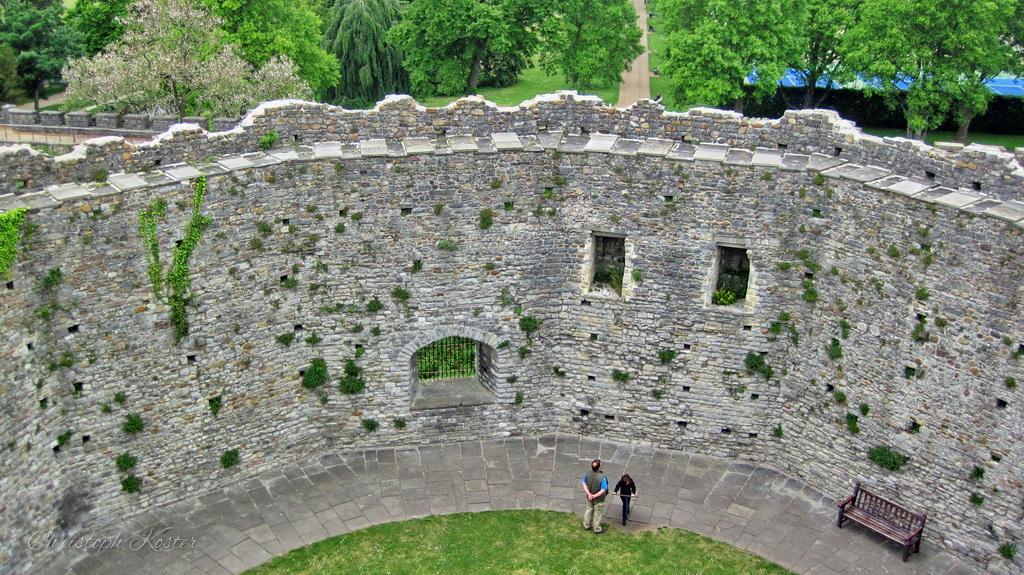
The image shows an aerial view of a circular stone structure, likely part of a historic castle or fortification. The walls are constructed from large, irregularly shaped stones, giving the structure a robust and ancient appearance. Small plants and greenery are growing sporadically from the crevices in the stone walls, adding a touch of nature to the man-made structure.
In the center of the circular area, there is a small, grassy courtyard. Two people are standing in the courtyard, providing a sense of scale to the structure. One of the walls features a small arched doorway with a metal gate, and there are two small, rectangular windows above it.
A wooden bench is placed along the inner curve of the wall, suggesting that this area might be accessible to visitors. The surrounding area outside the walls is lush and green, with trees and well-maintained pathways, indicating that the structure is likely located in a park or a historical site. The overall scene conveys a sense of history and tranquility.
2026-01-24

🏴󠁧󠁢󠁷󠁬󠁳󠁿 Cardiff Castle from Bute Park

May 2012

#Wales #Cardiff #SilentSunday #CardiffCastle #Park #ButePark #Trees #Path #Baeume #Weg

A serene park scene features a wide, paved pathway that curves gently through a lush, green landscape. The path is bordered by well-maintained grass and mature trees with dense foliage, creating a canopy overhead. To the left of the path, there is a tall, historic stone wall with towers, suggesting the presence of an old castle or fortification. The wall is partially obscured by trees and greenery. Benches are placed along the path, inviting visitors to rest and enjoy the peaceful surroundings. The overall atmosphere is calm and inviting, blending natural beauty with historical architecture.
Fiore Di Lunafiore_di_luna_75
2026-01-23

CASTLE - Today, the castle is one of Wales' most famous landmarks, blending Roman, Norman, and Victorian styles all in one. The Clock Tower, designed by architect William Burges, stands out, as does the famous "Animal Wall" with 15 animal sculptures just west of the entrance.

CASTLE - Today, the castle is one of Wales' most famous landmarks, blending Roman, Norman, and Victorian styles all in one. The Clock Tower, designed by architect William Burges, stands out, as does the famous "Animal Wall" with 15 animal sculptures just west of the entrance.CASTLE - Today, the castle is one of Wales' most famous landmarks, blending Roman, Norman, and Victorian styles all in one. The Clock Tower, designed by architect William Burges, stands out, as does the famous "Animal Wall" with 15 animal sculptures just west of the entrance.CASTLE - Today, the castle is one of Wales' most famous landmarks, blending Roman, Norman, and Victorian styles all in one. The Clock Tower, designed by architect William Burges, stands out, as does the famous "Animal Wall" with 15 animal sculptures just west of the entrance.CASTLE - Today, the castle is one of Wales' most famous landmarks, blending Roman, Norman, and Victorian styles all in one. The Clock Tower, designed by architect William Burges, stands out, as does the famous "Animal Wall" with 15 animal sculptures just west of the entrance.
Fiore Di Lunafiore_di_luna_75
2026-01-23

CASTLE - Cardiff Castle is right in the heart of the city and has a history that goes back nearly 2,000 years. Over time, it's been a Roman fort, a Norman stronghold, and even a Victorian fairy-tale castle. The original motte and castle yard were built in the late 11th century by the Normans on top of a Roman fort from the 3rd century. Archaeological digs show that the Romans set up the first fort around 55 AD.

CASTLE - Cardiff Castle is right in the heart of the city and has a history that goes back nearly 2,000 years. Over time, it's been a Roman fort, a Norman stronghold, and even a Victorian fairy-tale castle. The original motte and castle yard were built in the late 11th century by the Normans on top of a Roman fort from the 3rd century. Archaeological digs show that the Romans set up the first fort around 55 AD. CASTLE - Cardiff Castle is right in the heart of the city and has a history that goes back nearly 2,000 years. Over time, it's been a Roman fort, a Norman stronghold, and even a Victorian fairy-tale castle. The original motte and castle yard were built in the late 11th century by the Normans on top of a Roman fort from the 3rd century. Archaeological digs show that the Romans set up the first fort around 55 AD. CASTLE - Cardiff Castle is right in the heart of the city and has a history that goes back nearly 2,000 years. Over time, it's been a Roman fort, a Norman stronghold, and even a Victorian fairy-tale castle. The original motte and castle yard were built in the late 11th century by the Normans on top of a Roman fort from the 3rd century. Archaeological digs show that the Romans set up the first fort around 55 AD. CASTLE - Cardiff Castle is right in the heart of the city and has a history that goes back nearly 2,000 years. Over time, it's been a Roman fort, a Norman stronghold, and even a Victorian fairy-tale castle. The original motte and castle yard were built in the late 11th century by the Normans on top of a Roman fort from the 3rd century. Archaeological digs show that the Romans set up the first fort around 55 AD.
Fiore Di Lunafiore_di_luna_75
2026-01-23

The tower in the picture is the Clock Tower of Cardiff Castle in Wales, an iconic landmark of the city. It was designed by William Burges and built between 1869 and 1873 in a French Gothic style, sitting on the remains of a Roman bastion. At 40 meters tall, it was the tallest building in Cardiff when it was finished and has seven floors. The facade features coats of arms and figures of Roman gods.

The tower in the picture is the Clock Tower of Cardiff Castle in Wales, an iconic landmark of the city. It was designed by William Burges and built between 1869 and 1873 in a French Gothic style, sitting on the remains of a Roman bastion. At 40 meters tall, it was the tallest building in Cardiff when it was finished and has seven floors. The facade features coats of arms and figures of Roman gods, and inside, you'll find fancy rooms like the winter and summer smoking rooms.The tower in the picture is the Clock Tower of Cardiff Castle in Wales, an iconic landmark of the city. It was designed by William Burges and built between 1869 and 1873 in a French Gothic style, sitting on the remains of a Roman bastion. At 40 meters tall, it was the tallest building in Cardiff when it was finished and has seven floors. The facade features coats of arms and figures of Roman gods, and inside, you'll find fancy rooms like the winter and summer smoking rooms.The tower in the picture is the Clock Tower of Cardiff Castle in Wales, an iconic landmark of the city. It was designed by William Burges and built between 1869 and 1873 in a French Gothic style, sitting on the remains of a Roman bastion. At 40 meters tall, it was the tallest building in Cardiff when it was finished and has seven floors. The facade features coats of arms and figures of Roman gods, and inside, you'll find fancy rooms like the winter and summer smoking rooms.The tower in the picture is the Clock Tower of Cardiff Castle in Wales, an iconic landmark of the city. It was designed by William Burges and built between 1869 and 1873 in a French Gothic style, sitting on the remains of a Roman bastion. At 40 meters tall, it was the tallest building in Cardiff when it was finished and has seven floors. The facade features coats of arms and figures of Roman gods, and inside, you'll find fancy rooms like the winter and summer smoking rooms.
Fiore Di Lunafiore_di_luna_75
2026-01-23

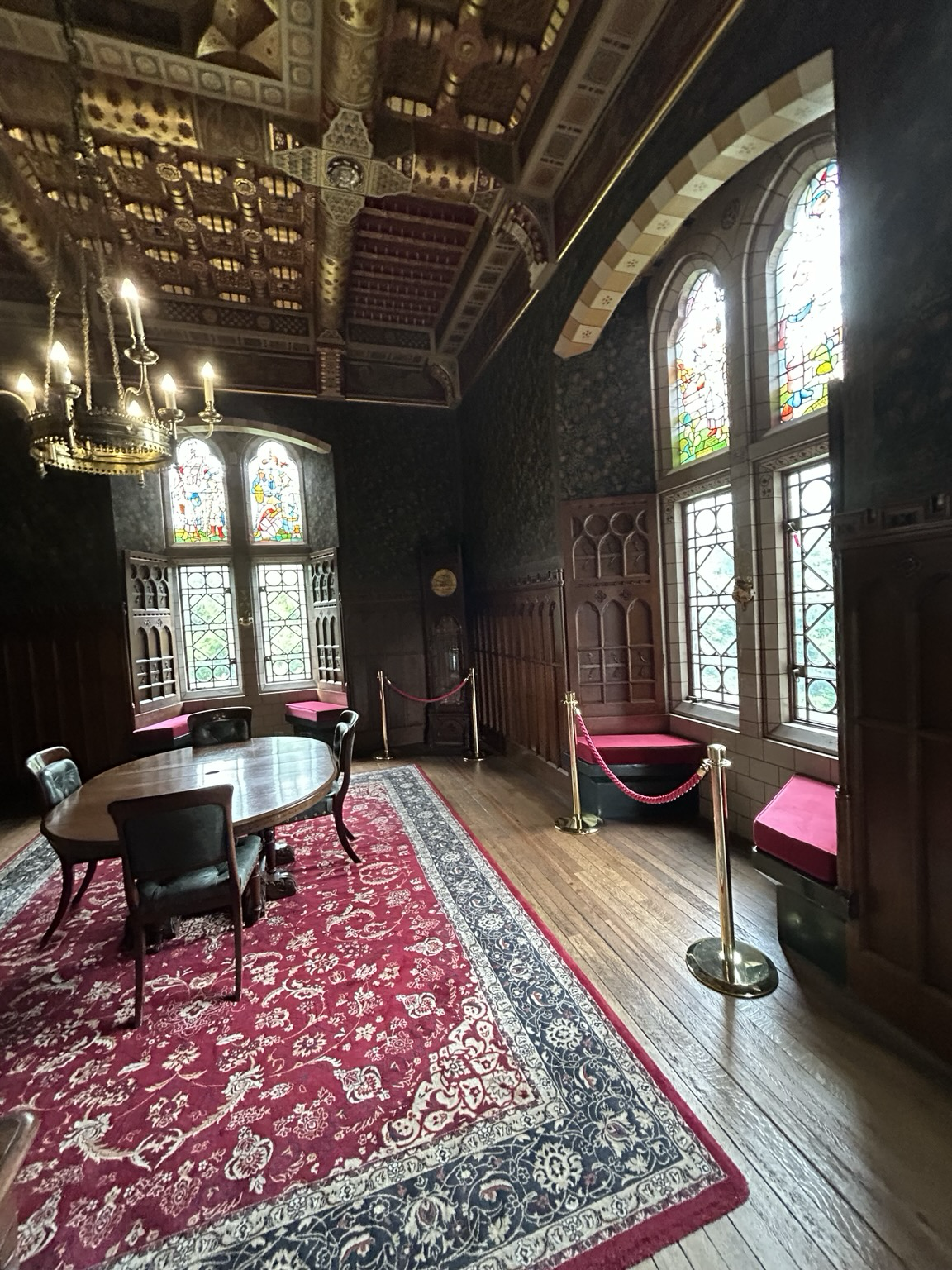
LIBRARY - The library is located in the oldest part of the castle and is the only interior that Burges fully designed and that still exists today, including the original furniture. The room is known for its rich Victorian Gothic style, with elaborate wood carvings and decorative wallpapers, giving it a unique vibe.

LIBRARY - The library is located in the oldest part of the castle and is the only interior that Burges fully designed and that still exists today, including the original furniture. The room is known for its rich Victorian Gothic style, with elaborate wood carvings and decorative wallpapers, giving it a unique vibe.LIBRARY - The library is located in the oldest part of the castle and is the only interior that Burges fully designed and that still exists today, including the original furniture. The room is known for its rich Victorian Gothic style, with elaborate wood carvings and decorative wallpapers, giving it a unique vibe.LIBRARY - The library is located in the oldest part of the castle and is the only interior that Burges fully designed and that still exists today, including the original furniture. The room is known for its rich Victorian Gothic style, with elaborate wood carvings and decorative wallpapers, giving it a unique vibe.LIBRARY - The library is located in the oldest part of the castle and is the only interior that Burges fully designed and that still exists today, including the original furniture. The room is known for its rich Victorian Gothic style, with elaborate wood carvings and decorative wallpapers, giving it a unique vibe.
Fiore Di Lunafiore_di_luna_75
2026-01-23

LIBRARY - The picture shows the library in the castle rooms of Cardiff Castle in Wales, which is a great example of the work of the eccentric architect William Burges. He designed it in the 1870s.

LIBRARY - The picture shows the library in the castle rooms of Cardiff Castle in Wales, which is a great example of the work of the eccentric architect William Burges. He designed it in the 1870s. LIBRARY - The picture shows the library in the castle rooms of Cardiff Castle in Wales, which is a great example of the work of the eccentric architect William Burges. He designed it in the 1870s. LIBRARY - The picture shows the library in the castle rooms of Cardiff Castle in Wales, which is a great example of the work of the eccentric architect William Burges. He designed it in the 1870s. LIBRARY - The picture shows the library in the castle rooms of Cardiff Castle in Wales, which is a great example of the work of the eccentric architect William Burges. He designed it in the 1870s.
Fiore Di Lunafiore_di_luna_75
2026-01-23

The painting depicts John Crichton-Stuart, the 3rd Marquess of Bute (1847–1900), a Scottish nobleman, industrialist, and art patron. Created in 1895 by Sir Hubert von Herkomer, it’s an oil on canvas.

He served as Mayor of Cardiff from 1890 to 1891, the first peer in modern times to hold such a position.

The painting depicts John Crichton-Stuart, the 3rd Marquess of Bute (1847–1900), a Scottish nobleman, industrialist, and art patron. Created in 1895 by Sir Hubert von Herkomer, it’s an oil on canvas.  He served as Mayor of Cardiff from 1890 to 1891, the first peer in modern times to hold such a position.
Fiore Di Lunafiore_di_luna_75
2026-01-23

The painting shows John Crichton-Stuart (1793–1848), the 2nd Marquess of Bute, in a portrait. It's an oil painting on canvas, created by Henry Raeburn.

The painting measures 236 cm in height and 145 cm in width.

The 2nd Marquess of Bute was a Scottish nobleman and landowner.

The painting shows John Crichton-Stuart (1793–1848), the 2nd Marquess of Bute, in a portrait. It's an oil painting on canvas, created by Henry Raeburn.  The painting measures 236 cm in height and 145 cm in width.  The 2nd Marquess of Bute was a Scottish nobleman and landowner.
Fiore Di Lunafiore_di_luna_75
2026-01-23

THE SMALL DINING ROOM - This room was used by the Bute family as a private dining room. It was originally a west-facing sitting room for the 2nd Marchioness of Bute, and her monogram and coat of arms still appear in the decoration.

The room follows a biblical theme from the Book of Genesis, which can be seen in the fireplace and the stained-glass windows.

THE SMALL DINING ROOM - This room was used by the Bute family as a private dining room. It was originally a west-facing sitting room for the 2nd Marchioness of Bute, and her monogram and coat of arms still appear in the decoration.  The room follows a biblical theme from the Book of Genesis, which can be seen in the fireplace and the stained-glass windows.THE SMALL DINING ROOM - This room was used by the Bute family as a private dining room. It was originally a west-facing sitting room for the 2nd Marchioness of Bute, and her monogram and coat of arms still appear in the decoration.  The room follows a biblical theme from the Book of Genesis, which can be seen in the fireplace and the stained-glass windows.THE SMALL DINING ROOM - This room was used by the Bute family as a private dining room. It was originally a west-facing sitting room for the 2nd Marchioness of Bute, and her monogram and coat of arms still appear in the decoration.  The room follows a biblical theme from the Book of Genesis, which can be seen in the fireplace and the stained-glass windows.THE SMALL DINING ROOM - This room was used by the Bute family as a private dining room. It was originally a west-facing sitting room for the 2nd Marchioness of Bute, and her monogram and coat of arms still appear in the decoration.  The room follows a biblical theme from the Book of Genesis, which can be seen in the fireplace and the stained-glass windows.
Fiore Di Lunafiore_di_luna_75
2026-01-20

THE NORMAN KEEP - The most distinctive feature of Cardiff Castle is its twelve-sided Norman Keep, the finest example in Wales. Known as a “shell” keep, its outer walls protected smaller buildings inside.

Built of stone in the early 12th century by Robert Consul, Earl of Gloucester, it replaced earlier wooden defences. The Keep later held Duke Robert of Normandy, son of William the Conqueror, as a prisoner until his death in 1134.

THE NORMAN KEEP The most distinctive feature of Cardiff Castle is its twelve-sided Norman Keep, the finest example in Wales. Known as a “shell” keep, its outer walls protected smaller buildings inside. Built of stone in the early 12th century by Robert Consul, Earl of Gloucester, it replaced earlier wooden defences. The Keep later held Duke Robert of Normandy, son of William the Conqueror, as a prisoner until his death in 1134.
Fiore Di Lunafiore_di_luna_75
2026-01-20

The Banquet Hall - The decor is all about the Middle Ages, and the massive fireplace shows Robert, Earl of Gloucester, an illegitimate son of King Henry I and the guy who ruled Cardiff Castle in the 12th century, in battle.

The Banquet Hall - The decor is all about the Middle Ages, and the massive fireplace shows Robert, Earl of Gloucester, an illegitimate son of King Henry I and the guy who ruled Cardiff Castle in the 12th century, in battle. The Banquet Hall - The decor is all about the Middle Ages, and the massive fireplace shows Robert, Earl of Gloucester, an illegitimate son of King Henry I and the guy who ruled Cardiff Castle in the 12th century, in battle. The Banquet Hall - The decor is all about the Middle Ages, and the massive fireplace shows Robert, Earl of Gloucester, an illegitimate son of King Henry I and the guy who ruled Cardiff Castle in the 12th century, in battle. The Banquet Hall - The decor is all about the Middle Ages, and the massive fireplace shows Robert, Earl of Gloucester, an illegitimate son of King Henry I and the guy who ruled Cardiff Castle in the 12th century, in battle.
Fiore Di Lunafiore_di_luna_75
2026-01-19

The Banquet Hall is the biggest room in the castle and sits in the oldest part of the building, which dates back to the 15th century.

But the ceiling and floors? They’re actually a Victorian twist on a fancy medieval hall, and it took almost 15 years to finish.

The Banquet Hall is the biggest room in the castle and sits in the oldest part of the building, which dates back to the 15th century.  But the ceiling and floors? They’re actually a Victorian twist on a fancy medieval hall, and it took almost 15 years to finish. The Banquet Hall is the biggest room in the castle and sits in the oldest part of the building, which dates back to the 15th century.  But the ceiling and floors? They’re actually a Victorian twist on a fancy medieval hall, and it took almost 15 years to finish. The Banquet Hall is the biggest room in the castle and sits in the oldest part of the building, which dates back to the 15th century.  But the ceiling and floors? They’re actually a Victorian twist on a fancy medieval hall, and it took almost 15 years to finish. The Banquet Hall is the biggest room in the castle and sits in the oldest part of the building, which dates back to the 15th century.  But the ceiling and floors? They’re actually a Victorian twist on a fancy medieval hall, and it took almost 15 years to finish.
Fiore Di Lunafiore_di_luna_75
2026-01-19

The Arab Room in Cardiff Castle really stands out because of its ceiling. It’s designed in a style called muqarnas, which comes from Islamic architecture. The ceiling is made of wood and has been carefully crafted, then covered in gold leaf and decorated in a very detailed, luxurious way.

The Arab Room in Cardiff Castle really stands out because of its ceiling. It’s designed in a style called muqarnas, which comes from Islamic architecture. The ceiling is made of wood and has been carefully crafted, then covered in gold leaf and decorated in a very detailed, luxurious way.The Arab Room in Cardiff Castle really stands out because of its ceiling. It’s designed in a style called muqarnas, which comes from Islamic architecture. The ceiling is made of wood and has been carefully crafted, then covered in gold leaf and decorated in a very detailed, luxurious way.The Arab Room in Cardiff Castle really stands out because of its ceiling. It’s designed in a style called muqarnas, which comes from Islamic architecture. The ceiling is made of wood and has been carefully crafted, then covered in gold leaf and decorated in a very detailed, luxurious way.The Arab Room in Cardiff Castle really stands out because of its ceiling. It’s designed in a style called muqarnas, which comes from Islamic architecture. The ceiling is made of wood and has been carefully crafted, then covered in gold leaf and decorated in a very detailed, luxurious way.
Fiore Di Lunafiore_di_luna_75
2026-01-18

Gothic revival stained glass windows showing Isabel Neville, Duchess of Clarence.

Gothic revival stained glass windows showing Isabel Neville, Duchess of Clarence.
Fiore Di Lunafiore_di_luna_75
2026-01-17

George Plantagenet, duke of Clarence represented in a window at Cardiff Castle.

George Plantagenet, duke of Clarence represented in a window at Cardiff Castle.
Screen OneScreenOne
2025-08-14

🖤 ALTER BRIDGE launch the BLACKBIRD FESTIVAL at Cardiff Castle – June 27, 2026!
With Skindred, Florence Black, Cardinal Black & more.
📖 Full lineup & coverage: screen-one.net/blackbird-festival-2026

2025-07-21

NEW #GIGREPORT

I wanted to share something exciting. This past weekend, I attended one of the best #shows I've ever experienced! It was a massive event celebrating the best of Welsh music inside the stunning #CardiffCastle. As a special highlight, #FuneralforaFriend performed their entire 2005 album, #Hours, in full. It was an incredible day filled with amazing music. Be sure to check out my full report on the #blog now!

Bands featured: #KillTheLights, #DREAMSTATE, #Casey, #PunkRockFactory, #TheBlackout and #FUNERALFORAFRIEND

mickbirchallreview.blogspot.co

Saxafi MediaSaxafi
2025-05-17

hosted a flag-raising ceremony on May 16, celebrating 's . The event, organized by the Wales SL Community, highlighted the community's heritage, contributions to , & ongoing call for international recognition.

saxafimedia.com/somaliland-ind

Saxafi MediaSaxafi
2025-05-17

Historic moment: flag raised at for , a significant event for the large community in . Highlighting their dual identity and contributions.

saxafimedia.com/somaliland-fla

Client Info

Server: https://mastodon.social
Version: 2025.07
Repository: https://github.com/cyevgeniy/lmst