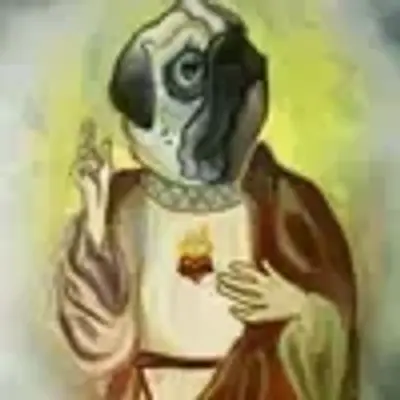
Carthaginian glass pendant, Tunisia, 4th-3rd century BCE
#Carthage

Spirituality & Religious Studiesspiritualityreligiousstudies.wordpress.com@spiritualityreligiousstudies.wordpress.com
2026-03-10Pelagius
He was a Christian theologian known as an ascetic monk & promoting a system of doctrines (termed Pelagianism by the Catholic Church), which emphasized human choice in salvation & denied original sin.
Pelagius was accused of heresy at the Synod of Diospolis in 415. His doctrines were harshly criticized by Augustine of Hippo, especially the Pelagian views about mankind’s good nature & individual responsibility for choosing asceticism. Pelagius especially stressed the freedom of human will.
Pelagius was active between circa 390 & 418. Pelagius was tall & portly in appearance. He was also highly educated, spoke, & wrote Latin & Greek with great fluency. He was well-versed in theology. Pelagius became better known around 380 when he moved to Rome. There, he enjoyed a reputation for austerity. When Alaric sacked Rome in 410, Pelagius & his follower, Caelestius, fled to Carthage, where he continued his work.
The view that mankind can avoid sinning, & that humans can freely choose to obey God’s commandments, is held to have stood at the core of Pelagian teaching. Pelagius stressed human autonomy & freedom of will. For Pelagius, grace consisted of the gift of free will, the Law of Moses, & the teachings of Jesus.
According to Augustine, Pelagius saw baptism of infants as useless because they had no sin. Celestius, who was a disciple of Pelagius, also denied original sin & the necessity of infant baptism for salvation. Seeking to undo his condemnation, Pelagius wrote a letter &statement of belief to Pope Zosimus, Pope Innocent I’s successor, arguing that he was orthodox.
In these, he articulated his beliefs so as not to contradict what the synods condemned. Pope Zosimus was persuaded by Celestius to reopen the case. But opposition from the African bishops & Emperor Honorius forced Pope Zosimus to condemn & excommunicate Celestius & Pelagius in 418. Pelagianism was condemned at the Council of Carthage in 418. Augustine, shocked that Pelagius & Celestius weren’t denounced as heretics, had called the Council of Carthage in 418.
After his condemnation, Pelagius was expelled from Jerusalem. St. Cyril of Alexandria allowed him to settle in Egypt. He’s not heard of afterwards.
His death didn’t end his teachings. Although those who followed him may have modified those teachings. Because little info actually remains concerning Pelagius’ actual teachings, some of his doctrines possibly were subject to revision & suppression by his enemies.
Pelagius & Caelestius were declared heretics by the First Council of Ephesus in 431.
Belief in Pelagianism & Semipelagianism was common for the next few centuries. Especially in Britain, Palestine,& North Africa. St. Germanus went to Britain to fight Pelagianism in or around 429 AD. In Wales, St. David was credited with convening the Synod of Brefi & the Synod of Victory against the followers of Pelagius in the 6th century.
One-Time Monthly YearlyMake a one-time donation
Make a monthly donation
Make a yearly donation
Choose an amount
$5.00 $10.00 $15.00 $1.00 $5.00 $10.00 $5.00 $10.00 $15.00Or enter a custom amount
$Your contribution is appreciated.
Your contribution is appreciated.
Your contribution is appreciated.
DonateDonate monthlyDonate yearly #410 #415 #418 #429AD #431 #6thCentury #Alaric #Asceticism #Britain #Caelestius #Carthage #CatholicChurch #Celestius #Christian #Circa390 #CouncilOfCarthage #Egypt #FirstCouncilOfEphesus #Greek #Heresy #Heretics #InfantBaptism #Jerusalem #Jesus #Latin #LawOfMoses #monk #NorthAfrica #OriginalSin #Palestine #Pelagianism #Pelagius #PopeInnocentI #PopeZosimus #Rome #Salvation #Semipelagianism #StAugustineOfHippo #StCyrilOfAlexandria #StDavid #StGermanus #SynodOfBrefi #SynodOfDiospolis #SynodOfVictory #Wales"Again, with GUSTO!"
https://piefed.social/c/historymemes/p/1860130/again-with-gusto


We gonna keep sailing into storms, though. That's going to happen.

We gonna keep sailing into storms, though. That's going to happen.

Hannibal's arrival
https://piefed.social/c/historymemes/p/1825880/hannibal-s-arrival


"Why won't you fucks just give up"
https://piefed.social/c/historymemes/p/1799675/why-won-t-you-fucks-just-give-up


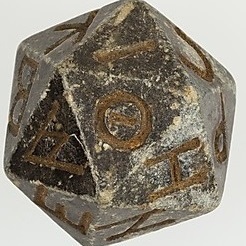
Un petit cippe de Beccut pour finir la journée ?
https://fr.wikipedia.org/wiki/Cippe_de_Beccut
#archeologie #RomeAntique #Carthage #Numides #AfriqueRomaine #histoire #Antiquite #sepulture #Wikipédia
"Actually, let me go back even further..."
https://piefed.social/c/historymemes/p/1791240/actually-let-me-go-back-even-further


Интеграция зависимостей в iOS через Carthage in the wild
На дворе 2026, все пишут на SwiftUI и менеджерят зависимости через SwiftPM, но речь пойдет о Carthage - менеджере зависимостей для приложений под Apple платформу которому уже примерно 10 лет, то есть появился почти сразу после выхода языка Swift. На хабре есть несколько отличных статей, как он устроен, в чем его отличие от CocoaPods и SwiftPM , также там обсуждаются некоторые его проблемы и как их решать. Но как ни странно, ни одна из статей не показывает пошаговую интеграцию зависимостей через Carthage, какие при этом проблемы могут возникать и как их решать. Давайте разбираться с самого начала.
Watch, we'll COPY your boats, and THEN we'll see who's a superpower!

Today in Labor History February 5, 1985: The Third Punic War, officially ended, only 2,131 years after it started in 149 BCE. Ugo Vetere, mayor of Rome, met with Chedli Klibi, mayor of Carthage, to sign the treaty. Fighting only lasted 3 years, but no treaty was signed ending the war until 1985. No one knows how many Romans died in the war, but an estimated 450,000 Carthaginians died.


Histoire sur RFI : "De Carthage à 1830, la Tunisie au fil des influences"
"Direction le nord de l’Afrique pour raconter la Tunisie, de Carthage à 1830. Une histoire fascinante pour avoir abrité dominations romaine, arabe, ottomane ou encore française, faite de bouleversements, de rebondissements, de guerres, de traités de paix. Comment ce petit pays, à la géographie singulière, a-t-il façonné ses identités ? De quelles façons sa morphologie, sa position et ses caractéristiques expliquent-elles son histoire ?"
https://www.rfi.fr/fr/podcasts/afrique-m%C3%A9moires-d-un-continent/20260128-de-carthage-%C3%A0-1830-la-tunisie-au-fil-des-influences
#histoire #Carthage #Tunisie #RFI #archeologie #RomeAntique #Ottomans #MondeArabe #Maghreb
Cunctator wins again
https://piefed.social/c/historymemes/p/1728052/cunctator-wins-again


Client Info
Server: https://mastodon.social
Version: 2025.07
Repository: https://github.com/cyevgeniy/lmst