#Commonism

2024-07-14

Am Samstag den 20.07. gibt es die nächste Ausgabe von unserem Diskussionskreis. Thema ist diesmal #commonism.

Als Diskussionsgrundlage hören wir diese Folge #futurehistories :

futurehistories.today/episoden

#bonn #planwirtschaft

Adrian Riskin 🇵🇸AdrianRiskin@kolektiva.social
2024-01-24

TIL about Kett's Rebellion (1549)!

Led by Robert Ket, himself a landowner, a rebel army of sixteen thousand peasants captured Norwich, England’s second-largest city. They set up their “court” on Mousehold Heath outside the city, where they maintained their cause for six weeks. They demanded that “lords, knights, esquires, and gentlemen” be stopped from commercial stock-raising, and rent-gouging, and from privatizing common lands. We can agree with Bindoff that this was “a radical programme, indeed, which would have clipped the wings of rural capitalism.”

-- Theodore W. Allen, The Invention of the White Race vol. 2

#Capitalism #Commonism #Enclosure #Norwich #KettsRebellion #PeasantUprisings

en.m.wikipedia.org/wiki/Kett%2

Adrian Riskin 🇵🇸AdrianRiskin@kolektiva.social
2023-12-02

“We don’t know and we don’t care who’s supposed to own the land. God put that coal there—not the Philadelphia and Reading Coal Company.”
—Mike McCloskey, miner

Quoted in The Bootleg Coal Rebellion by Mitch Troutman

H/T @anarchismhub

#Anarchism #MutualAid #Labor #Commonism #Pennsylvania #Coal #BootlegCoal #LaborUnions

search.worldcat.org/title/1338

Adrian Riskin 🇵🇸AdrianRiskin@kolektiva.social
2023-11-25

Holy cow, Gerrad Winstanley wrote this in 1652!

Surely then, oppressing lords of manors, exacting landlords, and tithe-takers, may as well say, their brethren shall not breathe in the air, nor enjoy warmth in their bodies, nor have the moist waters to fall upon them in showers, unless they will pay them rent for it: as to say, their brethren shall not work upon earth, nor eat the fruits thereof, unless they will hire that liberty of them. For he that takes upon him to restrain his brother from the liberty of the one, may upon the same ground restrain him from the liberty of all four; viz. fire, water, earth, and air.

A man had better to have had no body, than to have no food for it; therefore this restraining of the earth from brethren by brethren, is oppression and bondage; but the free enjoyment thereof is true freedom.

Gerrard Winstanley, quoted in Ian Angus. The War Against the Commons

#GerrardWinstanley #IanAngus #Commons #Commonism #Diggers #Capitalism #Anarchism

Adrian Riskin 🇵🇸AdrianRiskin@kolektiva.social
2023-11-24

'The privatization of land has been justly described as “perhaps the weirdest of all undertakings of our ancestors.”* The transformation of common resources into private property involved not only new ways of using the land, but also, as both cause and effect, new ways of thinking about it. The idea that individuals could claim exclusive ownership of parts of nature on which all humans depend was very weird indeed. Contrary to the oft-expressed view that greed is inherent in human nature, the shift from commons-based to private profit-based farming was not accepted easily—in fact, it was denounced and resisted as an assault of the laws of God and the needs of humanity.'

--- Ian Angus. The War Against the Commons.

*Karl Polanyi. The Great Transformation p. 178.

search.worldcat.org/title/1348

#Capitalism #Enclosure #Commons #Commonism #Resistance #Anarchism #IanAngus

2023-09-28

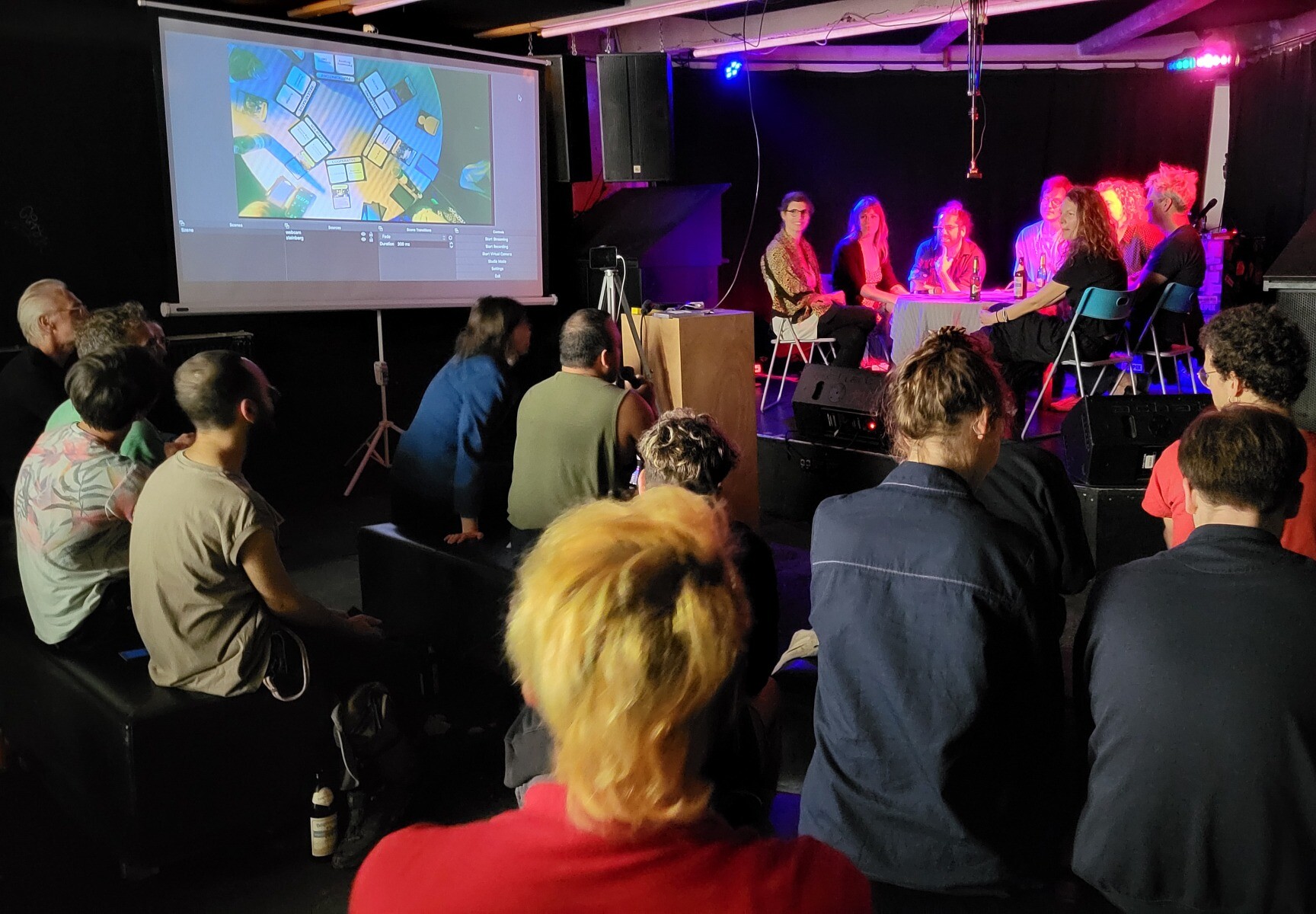
Tonight! ➠ Game-Changers: The Game
panke.gallery/event/game-chang
The stage is set for a clash between Capitalists & Commoners as they battle it out to seize the hottest buzzwords of the new economy.

🎲 @pankegallery, 28 September, 7 pm
Welcome!

@aksioma #supermarkt #PlatformCoopDE #GameChangersEvent #P2P #Commonism #RokKranjc #WeirdEconomies

2023-09-25

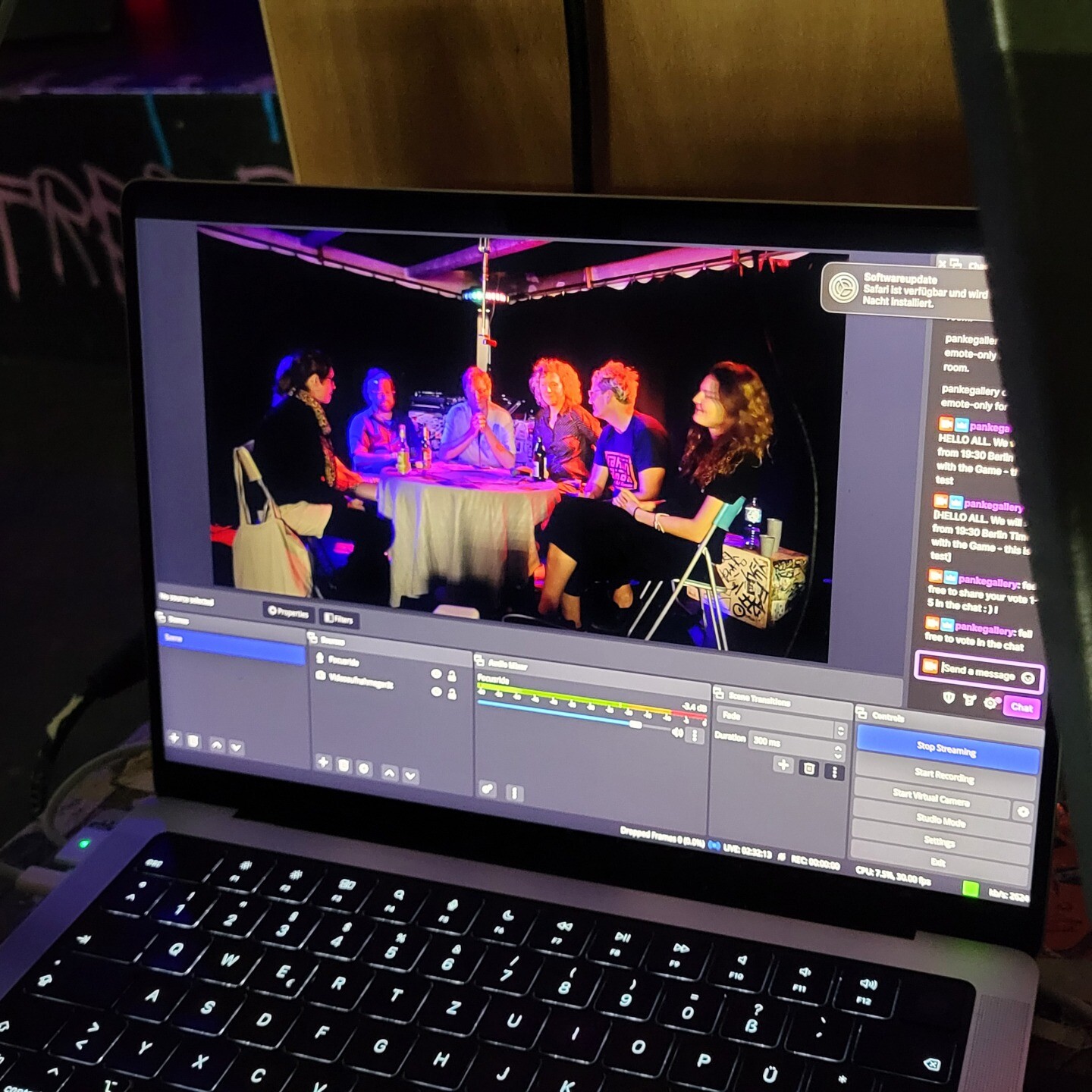
While we encourage you to "peerticipate" throughout the whole event, the game also accommodates those with less time on that particular evening. As an online peerticipant, whenever you tune in, you are free to give your opinion on the current storylines in play using the Twitch poll – or, if you like, just sit back and be entertained:
twitch.tv/pankegallery
panke.gallery/streaming

➠ Game-Changers: The Game
panke.gallery/event/game-chang
🎲 @pankegallery, Thursday, 28 September 2023, 7-10 pm

@aksioma #supermarkt #PlatformCoopDE #GameChangersEvent #P2P #Commonism #RokKranjc #WeirdEconomies

2023-09-23

Next Thursday ➠ Game-Changers: The Game
panke.gallery/event/game-chang
🎉 Get ready for an evening of excitement and engagement!

🎲 @pankegallery, 28 September 2023, 7-10 pm

Introducing Game-Changers: The Game, a public storytelling board game that blurs the lines between reality and simulation. The stage is set for a clash between Capitalists and Commoners as they battle it out to seize the hottest buzzwords of the new economy. And that's not all - enter the interactive audience, known as “peerticipants”, who have the power to shape the game's outcome in real time.

In the game, two teams that embody seemingly opposite discursive poles – for example Capitalism vs. Commonism, Green Growth vs. Degrowth, or Vectoralists vs. the Hacker Class – compete in creating compelling storylines about transformation in order to lay claim to playing fields consisting of real-world “new economy” initiatives and related ideas.

To create these stories, the teams must use the Challenge and Intervention cards available to them at a given time or respond to the cards already linked to particular playing fields. Another, third set of cards, Wildcards, is composed of “external” events which can offer unique windows of opportunity for either team or skew the balance in a number of ways.

Audiences (peerticipants) evaluate the players’ storylines in real time and, in doing so, affect their chance of success. As a peerticipant, you also have the option to contribute prompt cards (prior to or during the event) for the players, making the game a dynamic knowledge commoning and scenario-building tool.

Get ready for an evening of interactive excitement, strategic gameplay, and meaningful reflections! We look forward to having you with us, either as a member of the audience or as an active peerticipant.

@aksioma #supermarkt #PlatformCoopDE #GameChangersEvent #P2P #Commonism #RokKranjc #WeirdEconomies

2023-09-05

Upcoming ➠ Game-Changers: The Game
panke.gallery/event/game-chang
🎉 Get ready for an evening of excitement and engagement!

🎲 @pankegallery, Thursday, 28 September 2023, 7-10 pm

Introducing Game-Changers: The Game, a public storytelling board game that blurs the lines between reality and simulation. The stage is set for a clash between Capitalists and Commoners as they battle it out to seize the hottest buzzwords of the new economy. And that's not all - enter the interactive audience, known as “peerticipants”, who have the power to shape the game's outcome in real time.

In the game, two teams that embody seemingly opposite discursive poles – for example Capitalism vs. Commonism, Green Growth vs. Degrowth, or Vectoralists vs. the Hacker Class – compete in creating compelling storylines about transformation in order to lay claim to playing fields consisting of real-world “new economy” initiatives and related ideas.

To create these stories, the teams must use the Challenge and Intervention cards available to them at a given time or respond to the cards already linked to particular playing fields. Another, third set of cards, Wildcards, is composed of “external” events which can offer unique windows of opportunity for either team or skew the balance in a number of ways.

Audiences (peerticipants) evaluate the players’ storylines in real time and, in doing so, affect their chance of success. As a peerticipant, you also have the option to contribute prompt cards (prior to or during the event) for the players, making the game a dynamic knowledge commoning and scenario-building tool.

Get ready for an evening of interactive excitement, strategic gameplay, and meaningful reflections! We look forward to having you with us, either as a member of the audience or as an active peerticipant.

@aksioma #supermarkt #PlatformCoopDE
#GameChangersEvent #P2P #Commonism #RokKranjc #WeirdEconomies

2023-05-17

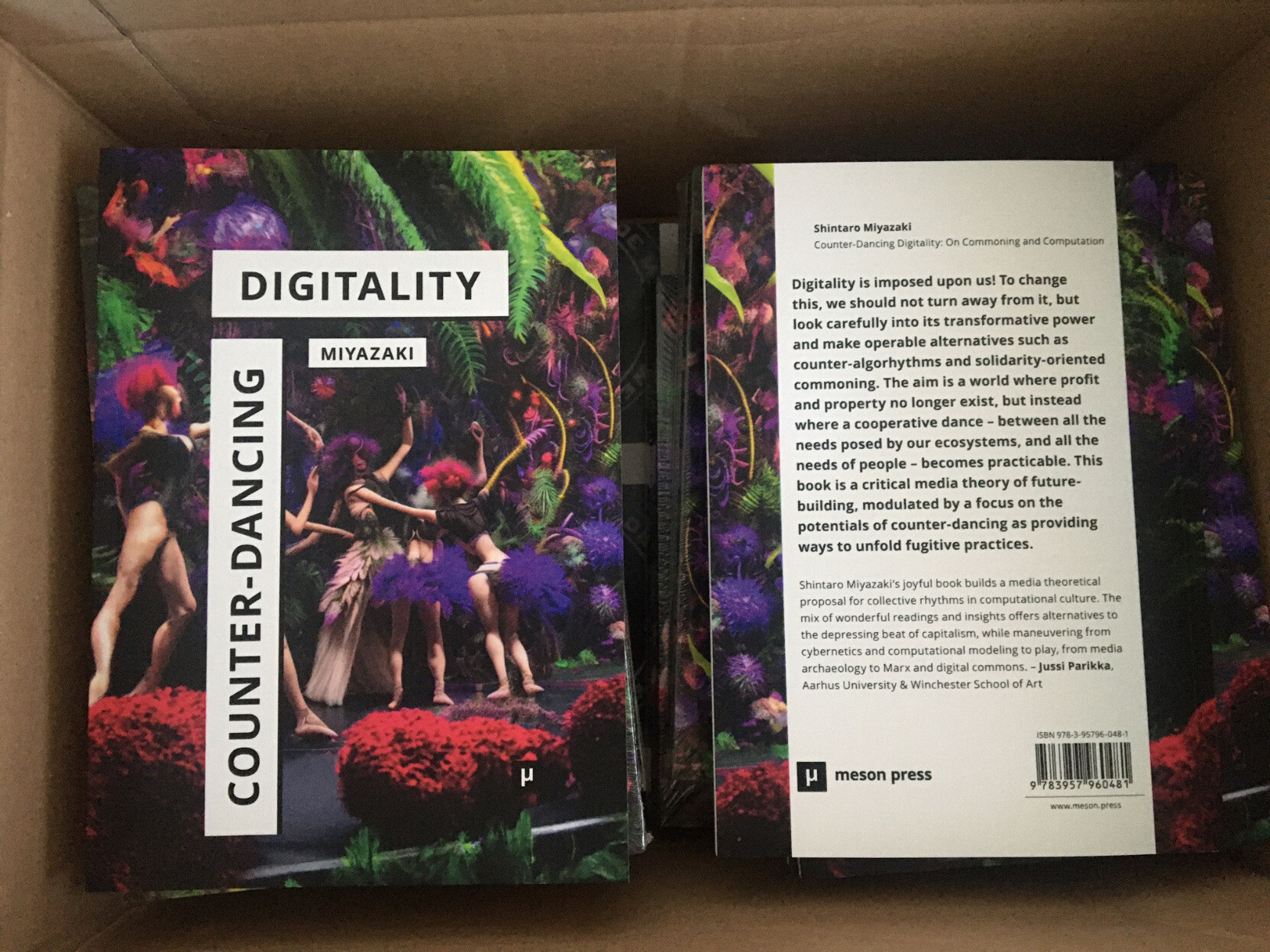
Available now from Meson Press: Shintaro Miyazaki's new book “Counter-Dancing Digitality. On Commoning and Computation”
meson.press/books/counter-danc (free PDF via Open Access)

This has been my most extensive translation effort to date. Going through all these elaborations and finding English words for them, particularly for the idiosyncratic expressions, has been a deep dive into the inspiring network of thoughts presented in this text. I am happy it is finally published: “Digitality is imposed upon us! To change this, we should not turn away from it, but look carefully into its transformative power and make operable alternatives such as counter-algorhythms and solidarity-oriented commoning. The aim is a world where profit and property no longer exist, but instead where a cooperative dance – between all the needs posed by our ecosystems, and all the needs of people – becomes practicable. This book is a critical media theory of future-building, modulated by a focus on the potentials of counter-dancing as providing ways to unfold fugitive practices.”

Prof. Dr. Shintaro Miyazaki teaches and researches in the field of media studies (digitality, computation, critique, and social transformation) at Humboldt-Universität zu Berlin. His collaegue Jussi Parikka, professor in digital aesthetics and culture at Aarhus University & Winchester School of Art, says: “Shintaro Miyazaki’s joyful book builds a media theoretical proposal for collective rhythms in computational culture. The mix of wonderful readings and insights offers alternatives to the depressing beat of capitalism, while maneuvering from cybernetics and computational modeling to play, from media archaeology to Marx and digital commons.”

The German version, published a few months earlier, can be accessed from transcript-open.de/isbn/6626.

#MediaStudies #MediaArchaeology #DigitalMedia #Cybernetics #Commonism #Commons #DigitalCommons #DigitalCulture #Politics #AntiCapitalism #DigitalSolidarity #OpenAccess

A box of copies of “Counter-Dancing Digitality. On Commoning and Computation” by Shintaro Miyazaki.One copy of “Counter-Dancing Digitality. On Commoning and Computation” by Shintaro Miyazaki.Excerpt from page 68 of the “Counter-Dancing Digitality. On Commoning and Computation” by Shintaro Miyazaki: “This leads to unexpected sources of inspiration, such as the fields of learning” and “cognition.”

Learning to Dance.
Moten and Harney refer to the danger of affective-somatic contagion as synaptic work. A mode of work that not only obeys and follows the beats of the profit-driven colonial algorhythm² and the compulsion of “logistic capitalism,” but also enhances and optimizes it (see 2021, 56). While Moten and Harney do not misspell the word algorithm – they seem to leave that to me – they articulate the logic of the factual  constraint of automatic accumulation of capital, M-C-M+, as a 500-year-old rhythm

²Algorhythm as a term originated from the synthesis of the technomathematical term “algorithm,” which is more associated with abstraction and computation, and the musical and sonic term “rhythm,” which has more connotations of flow, the real, and the living. At the same time, the cacography algorhythm is tied to alphanumeric notation. As with Derridean différance, the difference between algorithm and algorhythm is inaudible when it is spoken (see Miyazaki 2013). Rhythm as an epistemic filter for a critique of power gradients was already recognized by the French Marxist and later urban sociologist Henri Lefebvre (1901–91), who argued for rhythm analysis as an approach to temporally capture the operativity of a city (see 2004).”Cover image of “Counter-Dancing Digitality. On Commoning and Computation” by Shintaro Miyazaki.
Adrian Riskin 🇵🇸AdrianRiskin@kolektiva.social
2023-04-27
Adrian Riskin 🇵🇸AdrianRiskin@kolektiva.social
2023-04-24

"Beyond all the ideology of the special mission of the university sector it is worth remembering two things. First, students make the higher education system. Professors are primarily supervisory. Second, students working to become teachers, in any area, are – all of them – being groomed for management. Graduate students feel this contradiction and it hurts because they are moving from the shop floor to management. But the fact is that if you want to teach for money in our system, you’re supposed to supervise. None of this would need saying if we were talking about the automobile sector."

Stefano Harney & Fred Moten
Plantocracy and Communism
@IllWill

illwill.com/plantocracy-and-co

#FredMoten #StefanoHarney #Plantocracy #Communism #Commonism #Undercommons #HigherEducation #Universities #College #Education #IllWill

Diego Gómez-Venegasdigomezvenegas
2023-03-16

You may want to take a look at this; Shintaro Miyazaki’s “Counter-Dancing Digitality.” Open Access thanks to meson press!

meson.press/books/counter-danc

From the book: “my aims can be briefly summarized as using Foucault to energize Marx, and to catalyze the substrate with Kittler to render it ephemeral and fugitive.”

2023-03-16

Freshly out finally: Counter-Dancing Digitality (free PDF) doi.org/10.14619/0481 I am very looking forward to read spicy feedback. Let's practice futuring everyday! #commonism

From the book blurb: Digitality is imposed upon us! To change this, we should not turn away from it, but look carefully into its transformative power and make operable alternatives such as counter-algorhythms and solidarity-oriented commoning.

2023-02-27

Do We Live In Historic Times?

Anamnesis
#Caputalism (1522–2022)
Diagnosis
#DefaultChange (2001–2021)
Prognosis
#LiberalPaternalism (2020–2022)
Therapy
#Commonism

#DWLIHT | dissent.is/DWLIHT

2023-01-30


The diamond/water paradox is a name given to the fact that water has infinitely high use value but only minimal exchange value whereas roughly the opposite is true for diamonds. Apparently economists have been trying to untangle this putative problem for centuries, but my thesis is that it’s actually no problem at all. It seems paradoxical only because these economists have completely ignored the role of state violence in creating value and maintaining capitalism. Without state violence there would be no capitalist economy for them to study and prices of things would be very different than they are now.1

People need water, food, and shelter to survive. For a million years of human history people found countless successful ways to meet these needs directly, for themselves, their families, their communities, without being violently forced by zillionaires to cede a share of the value they created. Fundamentally, capitalism is possible only because if you charge money for those needs and kill anyone who tries to meet them without paying you can force masses of people to labor for your benefit.2

Capitalists can’t have everything their own unchallenged way, though, even with the ability to call down unspeakable violence on their victims. People are brave, daring, capable, creative, and willing to do almost anything to keep their communities, their families, and themselves alive not just for one more day, but sustainably, convivially. They won’t quietly let their own children starve physically or even spiritually just because a capitalist has all the food and will kill anyone who doesn’t buy it. At some point the risk of rebellion no longer outweighs the risk of starvation. The history of capitalism can easily be seen as a series of stabilizing responses to new forms of resistance by its victims.

For instance, one of American chattel slavery’s fatal flaws from capital’s point of view, a flaw which certainly contributed greatly to its downfall, is how unbearably, blatantly evil it was. It was so horrific that the horror could not be made invisible even in a time of painfully slow, imperfect communication. The horrors of slavery were obvious to everyone in contact with it, whether they approved of it or not, whether they wanted to cover up the pain to preserve the slave empire or to end it by abolishing slavery. Abolition in England stabilized capitalism by placating everyone horrified by slavery while the physical isolation of enslaved people in the new world kept them invisible at home so the money kept flowing in.

Now imagine a time when people have been accustomed to gathering food for themselves in the woods, or keeping a cow and some chickens in the yard, or growing fruit or nut trees. This was the United States a hundred years ago, by the way.3 In this context outlawing some of those activities or even just introducing legally enforceable permitting requirements and thereby raising the opportunity cost will stochastically increase the size of the cash economy.4 Stochastic voter suppression is well-understood, but stochastic commoning suppression not so much.5

Just by making it more difficult for people to feed themselves directly by their labor discourages some of them and increases participation in the cash economy. It’s not necessary to rely on direct effects since the statistics are reliable enough.6 By using the law to enforce these rules the door to state violence is opened. Violence is the only means of enforcing the law. But capitalists coudn’t just announce one day that from now on they were going to kill anyone who won’t work in exchange for money to buy food, water, and shelter. The risk of rebellion is too high. The victims of capitalism have had to be trained into their roles, and the training continues.

It’s only possible to move survival needs into the cash economy a little bit at a time, allowing the effects of the transitions to accumulate stochastically rather than in a directly causal way all at once. Each little step of cashifying needs allows the victims’ responses to be tested and policies walked back a little if they’re too destabilizing. This kind of tentativity in the process is itself evolutionarily adaptive. So in the 17th century they could enclose the commons and exploit some labor that way. There was resistance and negotiation and finally a tentative resolution, which allowed capitalists to move on to the next stage of enclosure.

They introduced permit requirements and zoning restrictions for chickens and cows and made the forests into parks with fences and rules so people were increasingly likely to have to buy food instead of creating it, and therefore more likely to work for money, allowing zillionaires to skim their share, rather than directly for subsistence, which would allow them to keep all of the value of their work. This problem isn’t completely solved, either. Just for instance, people still insist on giving food to hungry people so experiments in government technology continue. But water is a still-unsolved enclosure problem for capitalists, maybe because it’s the most immediate of the three needs so its denial is most likely to provoke immediate violent resistance.

Water, at least for drinking, is still mostly free, but significant steps towards enclosure have been taken, with bottled water and other commercial soft drinks, propaganda against drinking wild water, and similar tactics. Capital has not yet finished creating a class of water buyers trained into docility sufficient to support a purely capitalist water market, but they have made some progress. As soon as they evolve their control technologies sufficiently we can expect the price of water to rise indefinitely, but not because of its use value. Without the potential for ultraviolence water would remain essentially free. Imagine if their control tech improves to the point where they can charge for air — maybe this is why they’re so interested in colonizing Mars. Exchange values are determined entirely by the state of government technology at a given time.

And there is nothing special about water in this regard.7 State violence can be used to set the exchange value of anything that has value. State violence keeps the price of diamonds high, not just through the legal mechanisms necessary to enforce a world-wide monopoly, but also because without police violence to supply and control a workforce there’d be no diamonds to monopolize. No one becomes a diamond miner other than through coercion.

If police are abolished expect the exchange value of diamonds to correlate more strongly to their actual use value, which is not nothing but is also not high. The resolution of the so-called paradox lies in the fact that water is cheap only because methods to force people to accept expensive water don’t yet exist. It only seems like a paradox to professional economists who also rely on ultraviolence to retain their privilege, a fact which apparently creates a significant blind spot.

  1. All of which is in itself probably enough of an explanation for the fact that they’re not talking about it.
  2. I stated it in an extreme manner for effect, but it’s not wrong. They might not kill everyone who meets their own needs outside of the capitalist framework, but they kill enough of them so that everyone who wants to avoid exploitation has to consider the risk. Stochastic state terrorism is state terrorism.
  3. The World Is More Than Human is a really nice history of this process in Seattle, whose case roughly parallels that of other similar cities.
  4. I use the term stochastic here because these kind of legal interventions don’t guarantee that the activities will stop so that everyone who previously engaged in them has to move to the cash economy. Instead a few people find it sufficiently more difficult to make them stop, not everyone. These interventions rely on statistics to function rather than deterministic effects. This is one reason it’s so hard for us, the victims, to see what’s going on.
  5. For myself, I think at least part of the difficulty of understanding stochastic suppression of commoning is due to two factors. First, the fact that change is very slow and hard to see because people take the world they’re born to for granted, as the natural way for things to be. That world seems like the starting point, so that each little tweak, each little obstacle in the way of people directly meeting their own needs, seems like only a minor change, not consequential, just as any given individual step towards speciation doesn’t create a new species. After a tweak the world seems the same. After 20 years of tweaks things look very different, and after a hundred years no one who remembers is left alive. After five centuries of capitalism the world is unrecognizable. The second reason its hard to spot is that the most natural explanation, the one people leap to first, is obviously wrong. There’s no directed conspiracy making the world progressively more exploitable by capitalists. They don’t get together at Davos or a Trilateral Commission meeting and plan out the next decade’s worth of increasing oppression. Instead, like animal breeding, each individual zillionaire, whose capitalist enterprise has called a new need into being and who has the individual power to wield government to meet that need, will do so in a way that allows his work to continue. This creates a tool, a new little element of government technology, which then opens up a new vista, a new land, for capital exploitation. It’s like how dog breeders didn’t have to plan together over decades, centuries, or millenia, and yet we somehow still have useful and wonderful dogs. Zillionaires create the conditions in which capitalism thrives by the same mechanism, which is artificial but not socially directed selection.
  6. I’m not claiming that this is the only benefit capital reaps from making it progressively harder for people to work for subsistence rather than for money. Just for instance such laws also provide victims to the prison industrial complex, fodder for cop violence work, and all kinds of other things. But one of them is that people become more likely to work for money rather than direct subsistence.
  7. Other than the fact that it’s the most immediate human need of all besides air and is therefore a very thorny unsolved problem in government technology.

https://chez-risk.in/2023/01/29/state-violence-the-diamond-water-paradox-and-an-invisible-axiom-of-classical-economics/

#AmericanChattelSlavery #Capitalism #CashEconomy #ClassicalEconomics #Commonism #DiamondWaterParadox #ExchangeValue #HumanNeeds #OpportunityCost #ParadoxOfValue #StateViolence #TheWorldIsMoreThanHuman #UseValue

2022-11-25

What Is #Socialwork?

SOCIAL WORK is WORK ON THE SOCIAL
- not on bodies
- not on psyches
- also not on code

the SOCIAL QUESTION thematizes POWER
- domination (constellation of people)
- stratification (constellation of things)
- legitimation (constellation of values)
e- nforcement (constellation of violence)

#Commonism is the new #Caputalism
dissent.is/rules4radicals #rules4radicals

2022-11-18

Client Info

Server: https://mastodon.social
Version: 2025.07
Repository: https://github.com/cyevgeniy/lmst