#MRCLMB


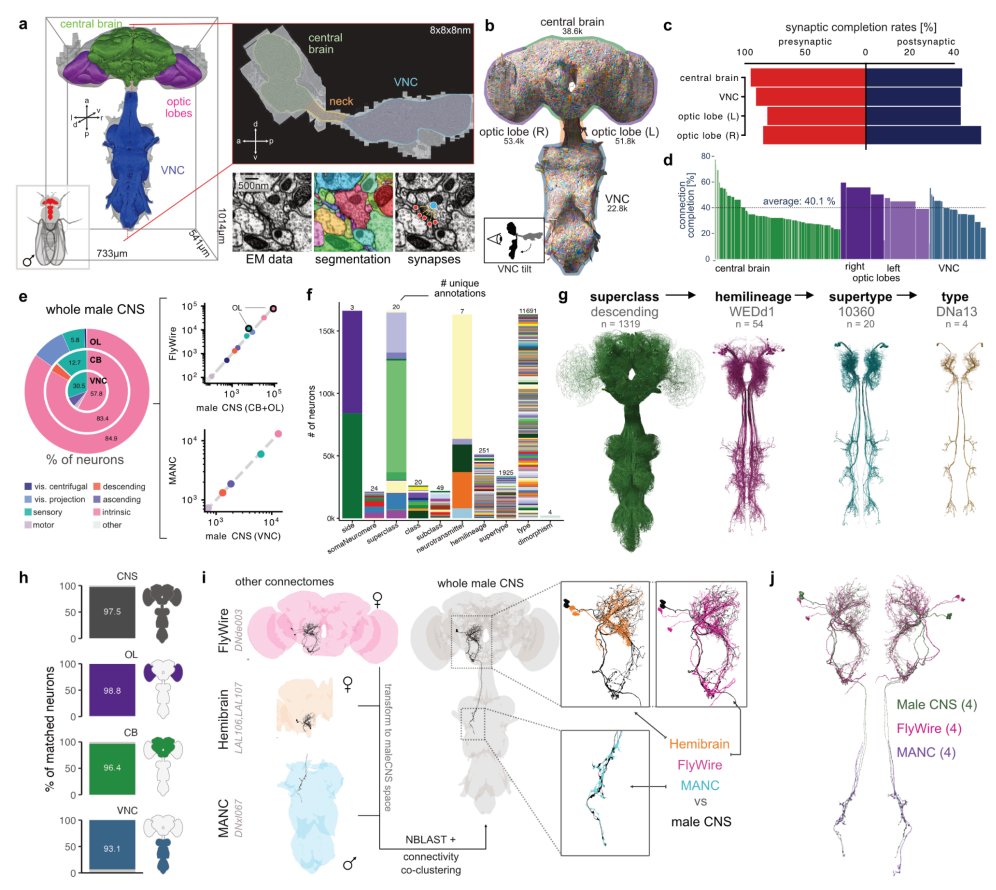
The much awaited connectome of the male central nervous system of the fruit fly, Drosophila melanogaster:
"Sexual dimorphism in the complete connectome of the Drosophila male central nervous system", Berg et al. 2025 https://www.biorxiv.org/content/10.1101/2025.10.09.680999v1
"contains 166,696 neurons spanning the brain and ventral nerve cord, fully proofread and comprehensively annotated including fruitless and doublesex expression and 11,691 cell types."
A collaboration between #HHMIJanelia, #MRCLMB and many others.
Our lab member Samia Mohinta @Mohinta2892 is featured in this outreach video prepared by the Accelerate Program for Scientific Discovery, explaining in lay terms how we map neural circuits in the fruit fly brain using machine learning approaches, AKA computer vision:
https://www.youtube.com/watch?v=68fQ7ZGTxAQ
The eFIB-SEM instrument is featured, setup in the lab, as well as various views of the #MRCLMB.
Rising Talent Fellowship for postdocs of black heritage backgrounds:
"The MRC Laboratory of Molecular Biology (LMB) is proud to launch the next application round of its three-year fully funded fellowship for scientists from Black heritage backgrounds."
https://www2.mrc-lmb.cam.ac.uk/recruitment/rising-talent-fellowship/
Joergen Kornfeld just opened his lab at the #MRCLMB – he is now our colleague!
His lab is recruiting students, postdocs, and staff scientists. Reach out to Joergen directly.
https://www2.mrc-lmb.cam.ac.uk/group-leaders/h-to-m/joergen-kornfeld/
If an #ElectronMicroscopy engineer would like to join us at the #MRCLMB to implement this beam-shifting GridTape TEM approach, send me an email. We have two JEOL TEMs to tinker with.
"The brain: what for?" – my seminar for "everyone else" at the #MRCLMB. Featuring brainless maggots and more.
Talks in Cambridge, UK, are often advertised at https://talks.cam.ac.uk and are open to the public. Quite a few are both in person and over zoom. From my circles:
The MRC LMB seminar series: http://talks.cam.ac.uk/show/index/7725
Adrian seminars in neuroscience:
http://talks.cam.ac.uk/show/index/6140
Foster talks: (neuroscience, development, immunology, cancer, physiology)
http://talks.cam.ac.uk/show/index/6283
Wolfgang Baumeister of #CryoEM fame delivered the John Kendrew Lecture 2023 at the #MRCLMB this past October. The recording of his talk is now online:
"Cryo-electron tomography or the power of seeing the whole picture"
https://www.youtube.com/watch?v=7vrKLnLXebY
With an introduction from @cjrlab
Group Leader position at the #MRCLMB in #connectomics: join us!
https://mrc.tal.net/vx/lang-en-GB/appcentre-1/candidate/postings/2485
Apply by November 16th, 2023.
Areas of particular interest include developing and applying high-density image acquisition methods (electron, X-ray, light) to determine the structure, connectivity and function of intact nervous systems at synaptic resolution; bringing brain-scale connectomics to additional species (including vertebrates); experimental approaches that leverage connectomes to understand brain function; and computational analyses essential for research across these areas.
Postdoc position available in Ingo Greger's lab, my colleague at the #MRCLMB in Cambridge, UK:
"to undertake research into the structural pharmacology of AMPA glutamate receptor complexes using structural biology approaches (cryo-EM)."
Apply by October 30th at the latest.
"A consensus cell type atlas from multiple connectomes reveals principles of circuit stereotypy and variation", by Schlegel et al. 2023 (Greg Jefferis lab at #MRCLMB in collaboration with the Bock, Murthy, and Seung labs, and also Volker Hartenstein)
Interesting to me in particular, and here I see the hand of Volker Hartenstein (my postdoc adviser!), is the annotation of developmental units: the neuronal lineages (Fig 2 below).
"Systematic annotation of a complete adult male Drosophila nerve cord connectome reveals principles of functional organisation", by Marin et al. 2023 (Greg Jefferis lab at #MRCLMB in collaboration with #HHMIJanelia and others).
https://www.biorxiv.org/content/10.1101/2023.06.05.543407v1
On the analysis of the #Drosophila male adult nerve cord (#MANC), reconstructed from #VolumeEM by Takemura et al. 2023 (preprint still pending to come out).
"On being asked what made the LMB such a remarkable place, Max answered: ‘Creativity in science, as in art [referring to the Renaissance in Florence], cannot be organised. It arises spontaneously from individual talent. Well-run laboratories can foster it, but hierarchical organisations, inflexible bureaucratic rules, and mountains of futile paperwork can kill it. Discoveries cannot be planned, they pop up, like Puck, in unexpected corners.’"
From Daniela Rhodes' 2002 piece on #MaxPerutz
https://www.embopress.org/doi/full/10.1093/embo-reports/kvf103
"Generating parallel representations of position and identity in the olfactory system", Taisz et al. 2023 (Greg Jefferis' lab at #MRCLMB) https://www.sciencedirect.com/science/article/pii/S0092867423004725
In a neural circuit of the female brain for processing the scent of the male pheromone (cVA), different features such as that it is a male and where it is in space are read out at different depths of the neural circuit layers.
Faculty position open at the #MRCLMB in Cambridge, UK:
Group Leader at the Neurobiology division: come join us!
https://www.jobs.ac.uk/job/CZP497/research-group-leader-neurobiology-lmb-2136
You are welcome–it's been fun to discover an entirely different slice of science and research here, starting this past October. My presence in the other side is nominal, keeping an account there as a flag and pointer to here. The move gave me the chance to follow more entomology accounts and learn more about insects and small invertebrates I'd like to map some day. Also: one has to follow more accounts here to sample the #neuroscience and #DevBiol fields as broadly as we did on the other side, as the only promotion algorithm is the boost button.
In other news, this week we installed a Bruker SkyScan microCT in the lab, courtesy of the #MRCLMB (I love this place), and we are over the moon. It's essential to quality-control samples that proceed to electron microscopy for #connectomics. But it's also going to prove useful to scan whole small animals densely at 0.5 to 1 µm isotropic resolution.
Harald Hess awarded the 2023 James Prize in Science and Technology Integration by the US National Academy of Sciences: https://www.nasonline.org/programs/awards/2023-awards/Hess.html
At #HHMIJanelia, the lab of Harald Hess revolutionized electron microscopy with enhanced FIBSEM (C. Shan Xu et al. 2017 @eLife https://elifesciences.org/articles/25916 ) –now in use by us at #MRCLMB, and applied to #Drosophila #connectomics; built an automated STEM to image the whole #Drosophila larval body at 5x5x35 nm; and so much more. Hats off! Congratulations!
Fantastic talk today by @DenisDuboule at the #MRCLMB on #Hox genes, highlighting their unique features and introducing the resolution of a long-standing mystery: the Hox timer. As explained in:
"Sequential And Directional Insulation By Conserved CTCF Sites Underlies The Hox Timer In Pseudo-Embryos", Rekaik et al. 2022 https://www.biorxiv.org/content/10.1101/2022.08.29.505673v1
“We had central heating and hot water. They didn’t always work that well but it was way more than what most people had — Americans were told that because of the advantageous English climate you didn’t need heating or refrigeration!”—Joan Steitz, RNA pioneer, discovered the spliceosome https://en.m.wikipedia.org/wiki/Joan_A._Steitz and here commenting on UK housing in the late 1960’s.
From “Ahead of the Curve” by Kathleen Weston, telling the history of the #MRCLMB
#science #academia #history #UK